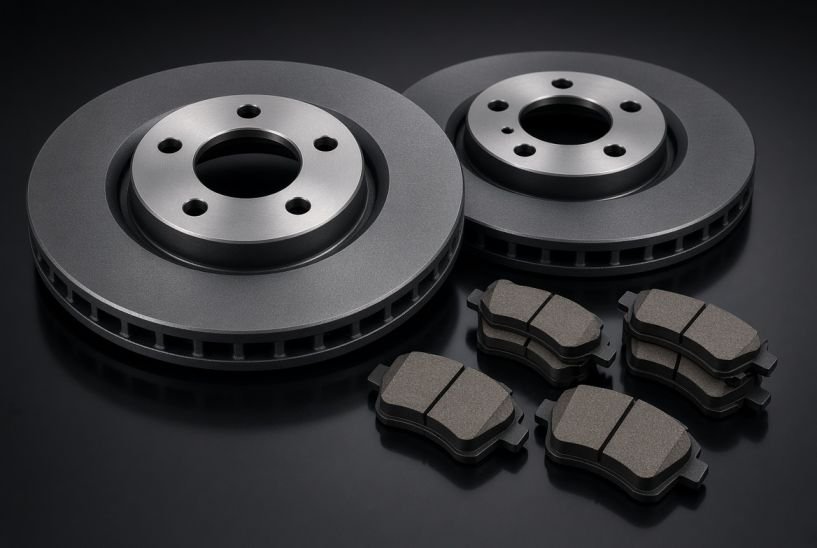
Yes, for the most part. Pagid brake discs come from a genuine OE supplier with decades of history on cars like the VW Golf, Porsche 911, and Mercedes S-Class, and most owners report years of trouble-free braking from them.
The short version: Pagid brake discs are a solid mid-to-upper tier choice, built to OE spec and backed by a 25-month/25,000-mile warranty. The risks are buying a fake, confusing them with Euro Car Parts’ cheaper Eicher line, or landing on an inconsistent batch that judders.
Key takeaways
- Pagid is owned by TMD Friction, the same group behind Textar and Mintex, and has supplied VW, Porsche, and Mercedes as an OE brake partner.
- Genuine Pagid road discs meet ECE R90 and cover about 96% of the European car parc across more than 1,200 references.
- The most common complaint is judder or vibration after fitting, though this is often a caliper or fitting issue, not the disc itself.
- Eicher is a separate, cheaper Euro Car Parts own-brand often mistaken for Pagid. They are not the same product.
- Pagid Racing pads (RS29, RSL29) are used by factory motorsport teams and are genuinely track-credible, not just marketing.
- Expect to pay roughly 40-50% less than Brembo for a comparable disc and pad set.
Who makes Pagid brake discs?
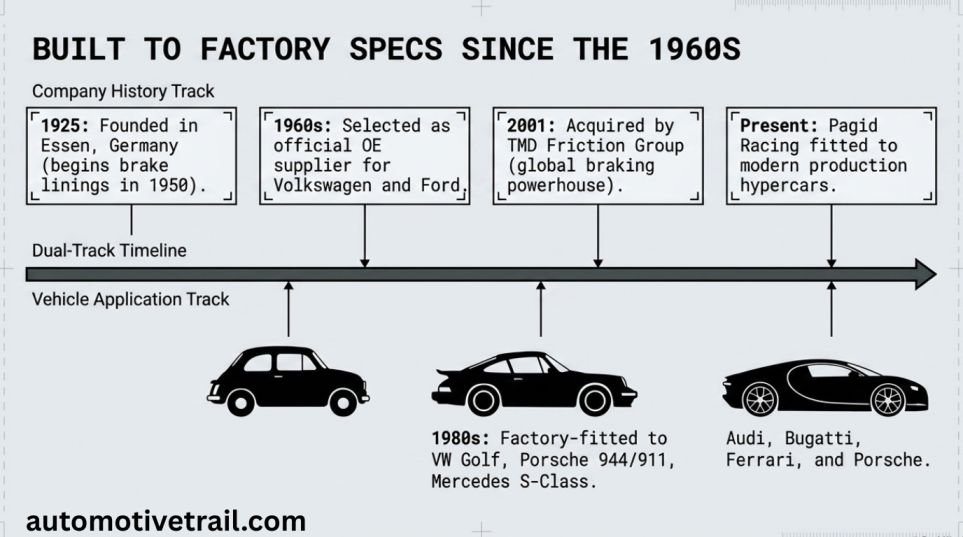
Pagid started in Essen, Germany, in 1925 and took the Pagid name in 1950 when it began producing brake linings for road cars. By the 1960s, both Volkswagen and Ford had picked Pagid as an OE brake supplier. That’s not a minor detail. It means the company was building parts to a car manufacturer’s tolerance specs decades before “aftermarket” was even a category people worried about.
Things scaled up fast after that. By the 1980s, Pagid brakes were factory-fitted to the VW Golf and Scirocco, the Porsche 944 and 911, and the Mercedes S-Class. In 2001, TMD Friction Group took over, and TMD is now one of the largest brake friction manufacturers in the world. TMD also owns Textar and Mintex, so if you’ve run any of those three brands, you’ve used parts from the same manufacturing group.
On the performance side, Pagid Racing pads are fitted as original equipment on some genuinely serious production cars, including certain Audi, Bugatti, Ferrari, and Porsche models.
Pagid brake disc range and specs
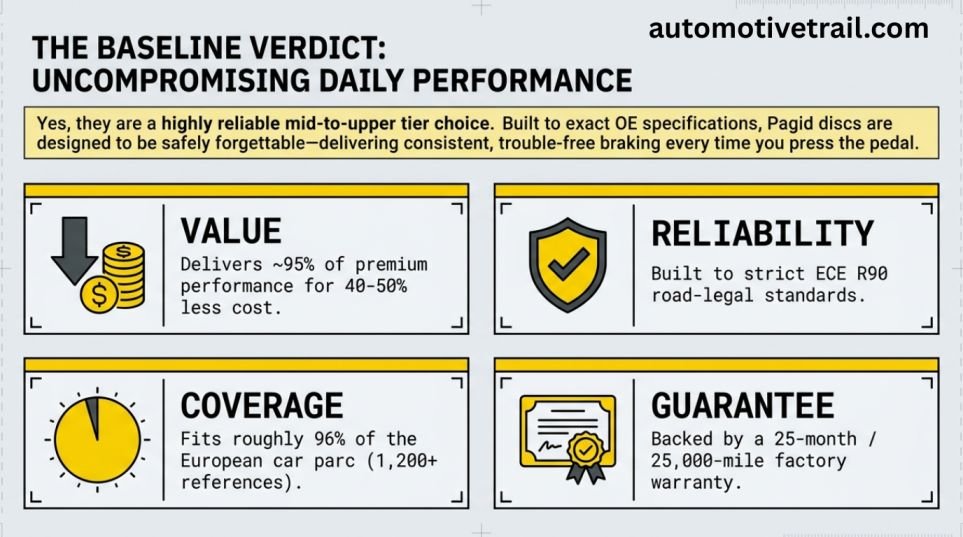
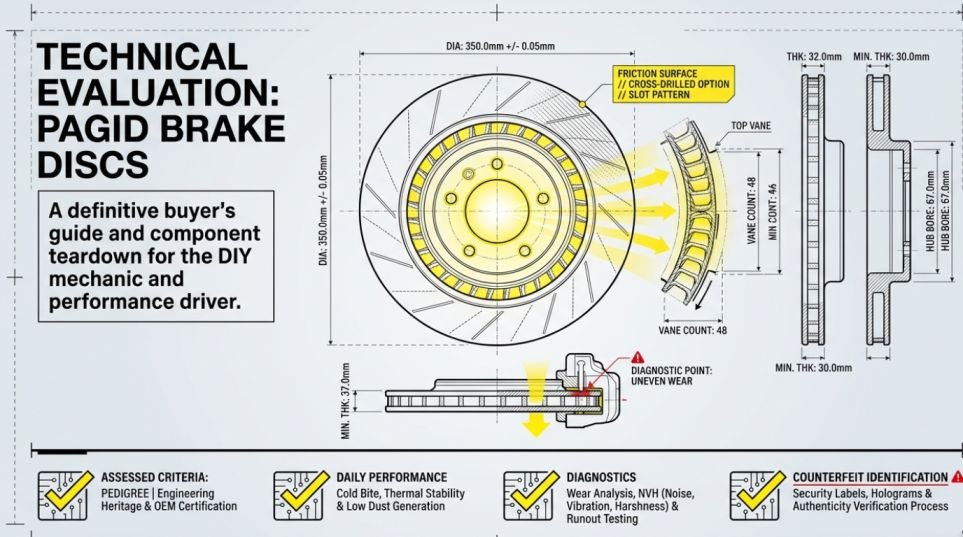
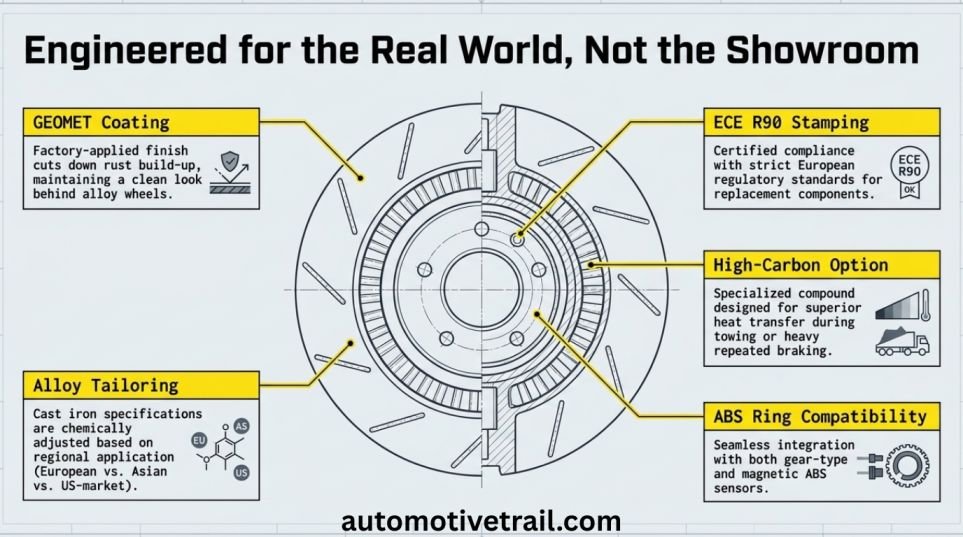
The road-going Pagid disc range is deep. It covers more than 1,200 references and roughly 96% of the European car parc, built to different cast iron specs depending on the application (European, Asian, or US-market cars each get different alloy treatment).
A few specifics worth knowing before you buy:
- Coating: Pagid uses a GEOMET coating on most discs, which cuts down rust build-up and keeps the disc looking clean behind alloy wheels.
- Compliance: All discs are made to meet ECE R90, the regulatory standard for road-legal replacement brake components.
- High-carbon range: A separate line adds carbon content for better heat transfer, aimed at drivers who brake harder or tow.
- Warranty: Pagid backs its discs with a 25-month or 25,000-mile warranty, whichever comes first.
- ABS compatibility: Discs are designed to work cleanly with ABS sensor rings, both gear-type and magnetic.
None of that is exotic. It’s the same spec language you’d see from ATE, Textar, or Bosch. That’s the point. Pagid isn’t trying to be a boutique brand on the street side. It’s trying to be the safe, boring, correct choice.
What real owners say about Pagid brake disc performance
Strip out the marketing copy and look at forum threads, and the pattern holds up. Mechanics who’ve fitted “hundreds of sets” over the years report no issues. One Mercedes SL owner swapped in a full set of Pagid discs and pads and felt zero difference from the factory parts, at less than half the dealer price. A Honda Civic owner who switched from tired OEM pads to Pagid said cold bite improved noticeably and dust dropped.
The praise tends to be consistent rather than gushing: “no complaints,” “does what it says on the tin,” “never had a problem.” That’s actually a good sign for a brake component. You don’t want your discs to be exciting. You want them to be forgettable, in the sense that they just work every time you press the pedal.
Where the story gets more mixed is around specific applications and specific batches, which is the next section.
Common Pagid brake disc problems (judder and warping)
The single most repeated complaint about Pagid discs, especially on VW Group and BMW forums, is judder or vibration through the steering wheel after a new set goes on. One S3 owner measured disc run-out at 0.04 to 0.05mm on a new set, sent it back, and got a replacement with the exact same fault in the exact same spot. Another owner reported discs that started warping at just 8,000 miles.
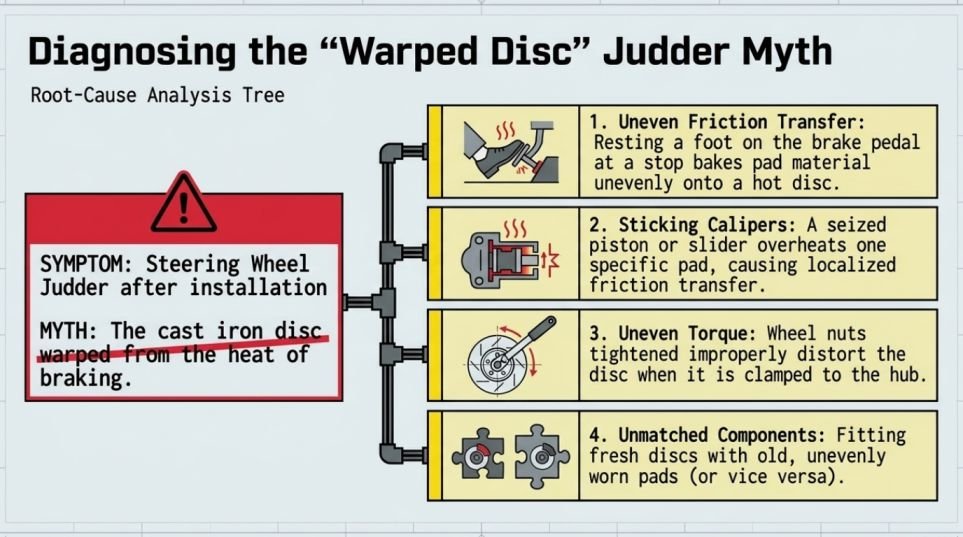
Here’s the part that matters before you write Pagid off, though: brake engineers who work on disc thickness variation testing argue that discs “warping” from heat is largely a myth. Most judder actually comes from uneven friction material transfer onto the disc surface, not the disc bending out of shape. Common real causes include:
- A sticking caliper piston or slider, which overheats one pad unevenly
- Resting a foot on the brake pedal at stops, which can bake pad material unevenly onto the disc
- Wheel nuts torqued unevenly, which distorts the disc when it’s clamped
- Not replacing pads and discs as a matched set
That doesn’t mean every Pagid judder complaint is user error. Some are clearly batch quality control issues. But if you get vibration after fitting, check the simple stuff first before assuming the discs are faulty.
Pagid vs Eicher — don’t buy the wrong one

This trips up more buyers than any actual product flaw. Euro Car Parts sells two different brands that regularly get confused: Pagid and a cheaper own-brand called Eicher. They are not the same product, not the same factory tier, and not the same quality level. Forum regulars consistently warn people to check which one is actually in the box before checkout, since Eicher is grouped with other budget lines like Anschler, RTX, and Circoli that get much rougher reviews.
If a “Pagid” set looks unusually cheap compared to what you’ve seen elsewhere, check the exact product name on the listing. A genuine Pagid disc box will carry the Pagid name directly, not a variant or sub-brand.
How to spot a fake Pagid brake disc
Counterfeit brake parts are a real problem in the UK aftermarket, and Pagid gets faked often enough that TMD Friction puts hologram seals on genuine boxes from its OEM factory. Before you fit a new set, check for these signs:
- Hologram seal on the box. Genuine TMD Friction products (Pagid, Textar, Mintex) carry this. No seal, or a seal that looks printed rather than holographic, is a red flag.
- Seller reputation. Buy from an authorized retailer or a seller with a long, verifiable track record. Marketplace listings from brand-new accounts selling “Pagid” at prices well below RRP deserve extra scrutiny.
- Backing plate finish. One owner reported a counterfeit pad where the friction material physically separated from the backing plate under use. Genuine Pagid backing plates are cleanly finished and stamped, not rough-edged.
- Packaging consistency. Compare box printing, part numbers, and barcodes against Pagid’s official site listing for that reference.
Pagid Racing pads — are they worth it for track use
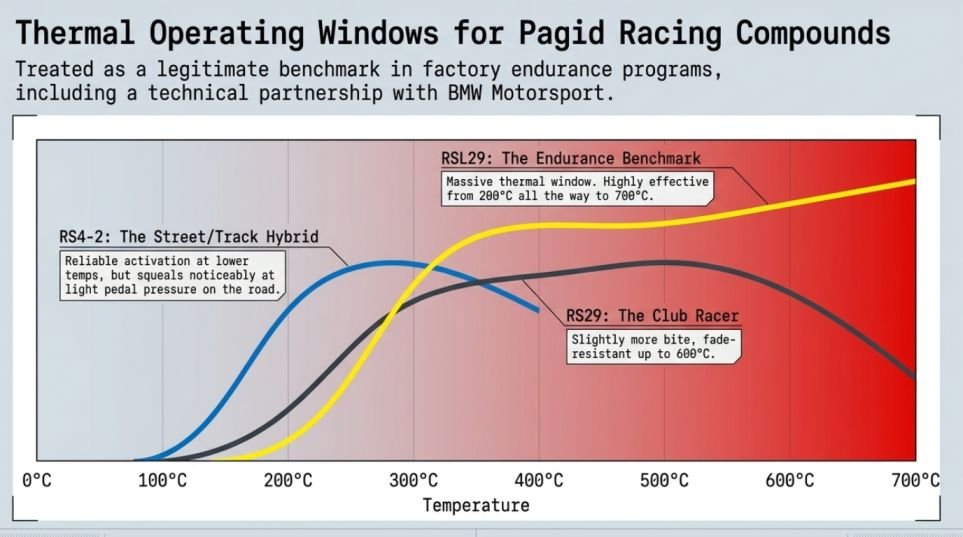
On the motorsport side, Pagid’s reputation gets a lot more specific and a lot more earned. Pagid Racing supplies numerous factory motorsport programs, including a technical partnership with BMW Motorsport, and its RSL29 compound (“Pagid Yellow”) is widely used by winning teams in endurance racing.
A few compounds worth knowing if you’re shopping for track pads:
- RS4-2: A street-and-track blue compound. Works fine on track but squeals noticeably on the road at light pedal pressure, so it’s not a great daily-driver choice if noise bothers you.
- RS29: Combines the wear rate of RS19 with slightly more bite. Fade-resistant to around 600°C. Popular in club racing and endurance events.
- RSL29: The endurance benchmark, effective from 200°C to 700°C, also common on serious track-day cars doing long sessions.
Head-to-head against rivals, opinion splits. Some track drivers who moved from Pagid RS29 to Performance Friction 08 found more initial bite and longer pad life, but also more fade at extended track sessions. Others found Pagid ran cooler and was gentler on rotors than PFC. Neither brand wins every comparison outright. What’s consistent is that Pagid Racing compounds are treated as a legitimate benchmark, not a budget alternative, which is a different conversation entirely from the street-disc judder complaints above.
Pagid vs Brembo brake discs — price and performance compared
For a direct daily-driving comparison, here’s how the two typically stack up based on owner reports and retail pricing for a common application (E46-generation BMW 3 Series front axle):
| Product | Type | Best For | Key Features | Price Level | Warranty / Lifespan | Common Complaints | Brand Relationship |
|---|---|---|---|---|---|---|---|
| Pagid Road Brake Discs | Brake Discs | Standard road cars; VW Golf, Porsche 911, Mercedes S-Class; 96% of European car parc | GEOMET anti-rust coating; ECE R90; OE spec; ABS-compatible with gear-type and magnetic sensors | 40–50% less than Brembo; under half the dealer price | 25 months / 25,000 miles; typically 30,000–60,000 miles | Judder or steering vibration, often fitting/caliper-related; occasional batch QC issues | TMD Friction; same group as Textar/Mintex; distinct from Eicher |
| Pagid Racing Pads (RS29 / RSL29) | Endurance Brake Pads | Motorsport, track days and endurance racing | RS29 fade-resistant to 600°C; RSL29 effective up to 700°C | Benchmark performance; not marketed as budget | Varies by model | Mixed views vs Performance Friction 08 on initial bite and pad life | TMD Friction motorsport division; factory-fitted on Audi, Bugatti and Ferrari |
| Pagid High-Carbon Discs | Premium Brake Discs | Hard braking, towing and heavy loads | Higher carbon content for improved heat transfer | Mid-to-upper tier | 25 months / 25,000 miles | Varies | TMD Friction product |
| Pagid RS4-2 Blue | Street-and-Track Pads | Dual-use road and track driving | Blue compound; good track performance | Varies | Varies by model | Noticeable squeal during light road braking | TMD Friction Racing line |
For ordinary commuting, the two are close enough that price becomes the deciding factor for most buyers. Where Brembo pulls ahead is brand consistency at the very top of its aftermarket range and broader third-party endorsement outside the Pagid/TMD ecosystem.
Pagid brake disc pricing — is the value real
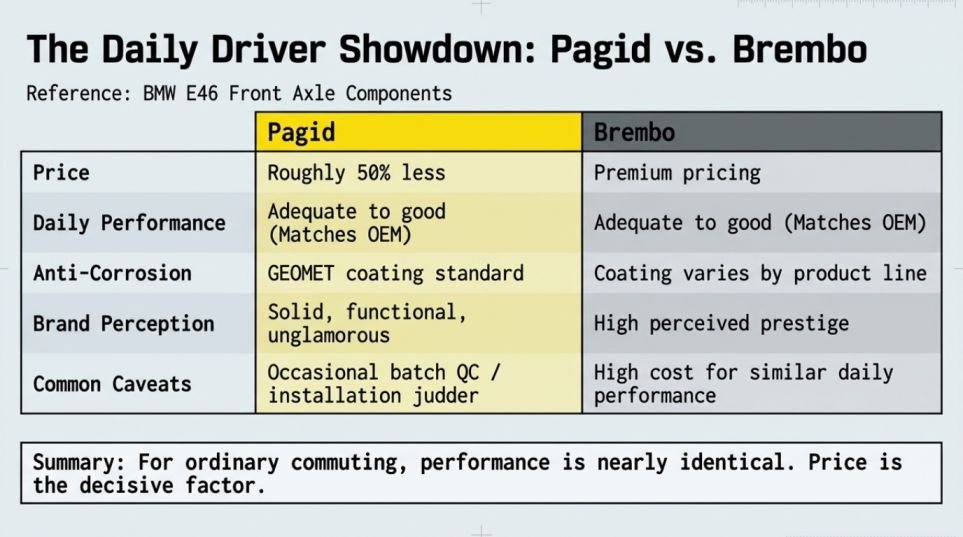
Pricing is where Pagid makes its strongest case. A full front disc and pad set for a mainstream hatchback typically runs meaningfully less than the equivalent Brembo kit, sometimes by close to half. One owner comparing quotes for an E46 328ci found Pagid discs and pads from Euro Car Parts priced at roughly half of a comparable Brembo set from a rival retailer.
That gap holds up across smaller comparisons too. A Honda Civic owner paid around £25 for a set of Pagid pads and rated them a clear step up from tired OEM parts. On a Mazda MX-5, front discs came in at under £30 each during a routine sale, which is well below dealer pricing for the same application.
The trade-off is that “on sale” pricing at retailers like Euro Car Parts is sometimes inflated first and then discounted, so the headline percentage off isn’t always meaningful. Compare the actual final price against other retailers rather than trusting the discount badge alone.
How to buy genuine Pagid brake discs
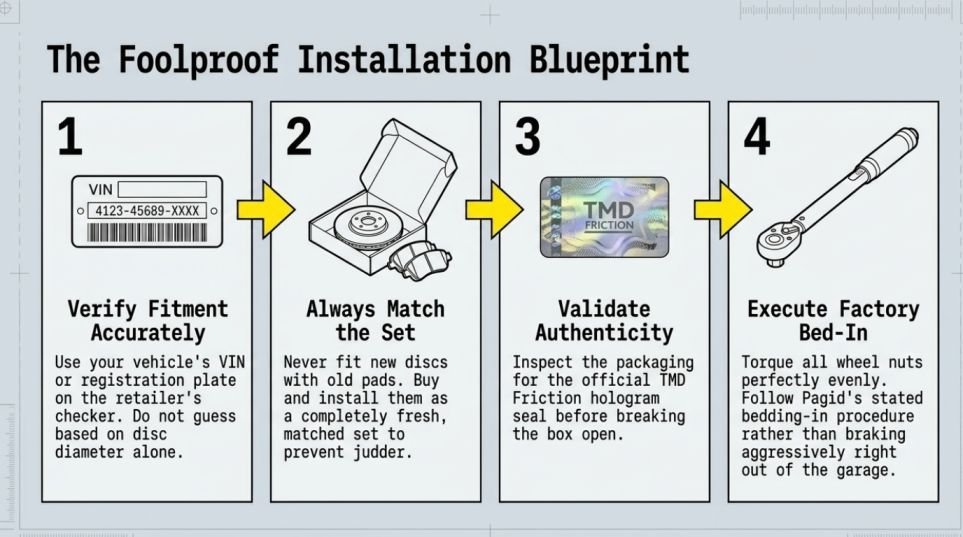
- Confirm your vehicle’s exact disc reference. Use your reg plate or VIN on the retailer’s fitment checker rather than guessing from disc diameter alone.
- Choose the correct product line. Decide between the standard road range and the high-carbon range if you tow, carry heavy loads, or brake hard regularly.
- Buy discs and pads together. Several judder complaints have been traced back to fitting new discs with worn pads, or vice versa. Replace both as a matched set.
- Check the seller and the seal. Confirm the hologram seal and buy from an authorized retailer, not an unverified marketplace listing.
- Get them fitted correctly. Have a mechanic torque the wheel nuts evenly and check for sticking calipers on the old set before assuming any judder issue is the new discs’ fault.
- Bed them in properly. Follow Pagid’s stated bedding-in procedure rather than braking hard immediately after fitting, particularly with the RS-series pads.
Final verdict — are Pagid brake discs worth it
For a daily driver, yes. Pagid has a real OE history, meets the same regulatory standard as premium brands, and costs meaningfully less than Brembo for comparable everyday performance. The complaints that show up most, judder and occasional QC inconsistency, are real but not universal, and a fair share of judder cases trace back to fitting issues rather than the disc itself.
The two things actually worth avoiding are buying counterfeit stock and mistaking Eicher for genuine Pagid. Sort those two out, buy discs and pads together from an authorized seller, and Pagid is a sound, well-priced choice for most cars. For track use, the Pagid Racing compounds carry genuine motorsport credibility and are worth considering alongside Ferodo and Performance Friction rather than as a fallback option.
FAQ
Are Pagid brake discs OEM quality? Pagid supplies several manufacturers directly as an OE partner, including VW Group and Porsche, so its discs are built to genuine OE tolerances. Aftermarket packaging doesn’t always match the exact spec fitted at the factory, but it’s close enough that most owners report no noticeable difference.
Why do Pagid brake discs judder? Judder is usually caused by uneven pad material transfer, a sticking caliper, or uneven wheel torque rather than the disc itself warping. A minority of cases do trace back to genuine manufacturing run-out, particularly if you got a bad batch.
Is Pagid the same as Eicher? No. Eicher is a separate, cheaper own-brand sold mainly through Euro Car Parts. It’s often confused with Pagid because they’re sold by the same retailer, but they are different products from different quality tiers.
How long do Pagid brake discs last? Pagid backs its discs with a 25-month or 25,000-mile warranty, and most owner reports describe normal wear in line with OEM discs, typically 30,000 to 60,000 miles depending on driving style and vehicle weight.
Are Pagid brake pads noisy? The RS4-2 street/track compound does squeal at light braking pressure, which some drivers find unacceptable for daily use. Standard road pads generally run quieter, though a few owners report more brake dust than premium alternatives.
Is Pagid better than Brembo? Neither is clearly better for ordinary road driving. Pagid typically costs around 40-50% less for similar daily performance, while Brembo carries stronger brand prestige and a longer track record outside the TMD Friction group.

- 2 Hole Vs 4 Hole Injectors 5.3 Vortec: Swap Rules + Fitment Check - September 12, 2026
- What Oil Does 2012 Honda Civic Use: What Oil Does Honda Civic Use & Spec - September 12, 2026
- 2014 Ram 2500 5.7 Hemi Sparkplugs: Ram 5.7 Hemi Sparkplugs: Oe Vs Fitment, Swap Steps - September 12, 2026