You’re standing over the coolant reservoir, wondering if your diesel needs a different coolant than a gasoline car. The short answer is that diesel engines do not get a special “diesel-only” coolant, but they do require a specific inhibitor chemistry and approval. Keep reading to learn what spec to match, how to identify what’s already in the system, and what mixing mistakes cost you.
Diesel engines still use the same coolant chemistry families as gas engines, but you must match the OEM coolant spec/standard (not the diesel badge on the jug).
In practice, that means choosing the correct technology (like OAT, HOAT, Si-OAT, or phosphate-silicate), the right premix vs concentrate format, and the correct dilution ratio for freeze protection.
Is There A Specific Kind Of Engine Coolant For Diesel Engines?
Diesel engines do not require a special “diesel” coolant by default. The coolant that matters is the one that meets the vehicle manufacturer’s coolant specification for chemistry type and material protection needs, whether the engine burns gasoline or diesel.
Diesel Versus Gasoline: What Actually Changes
Fuel type does not automatically dictate coolant type. OEM coolant requirements are driven by the engine’s cooling system materials (aluminum heads, steel liners, plastic tanks), the cooling architecture, and the emissions hardware heat load, then backed by a specific corrosion inhibitor chemistry and service interval target.
In practice, diesel vehicles often run hotter at certain operating points and can have additional heat exchangers tied into aftertreatment. That can raise the thermal demands on the same coolant chemistry, so the OEM still specifies the exact standard to protect aluminum, soldered joints, and cavitation-prone areas.
Definitive rule: match the coolant standard and chemistry family on the vehicle, not the engine label (diesel or gasoline). If the cap, expansion tank label, or owner’s manual lists a spec number or standard, use coolant that explicitly meets it.
| What you see on the bottle or label | What to verify before topping up |
|---|---|
| “For diesel engines” marketing | Does it say it meets your vehicle’s coolant specification, exact standard, or OEM part number requirement? |
| Color | Color can be misleading across brands, so confirm the chemistry family and approved standard. |
| Concentrate vs premix | Verify the required mix ratio and whether the OEM permits that water type. |
Mixing coolant types can work for a short time, then corrosion protection can drop off. The safer play is to match the current coolant’s spec before topping up, and avoid “whatever is on sale” when you cannot confirm compatibility.
For heavy-duty diesel applications and some trucks, OEMs may tighten coolant requirements because of higher aftertreatment heat duty and multiple exchangers (radiator, charge air cooler, EGR cooler on some models). That is where a “different” coolant showing up in the manual usually means a stricter inhibitor package and material compatibility, not that diesel inherently demands a unique coolant category.
OEM Coolant Specs Decide Everything
Where To Find The Exact Required Spec
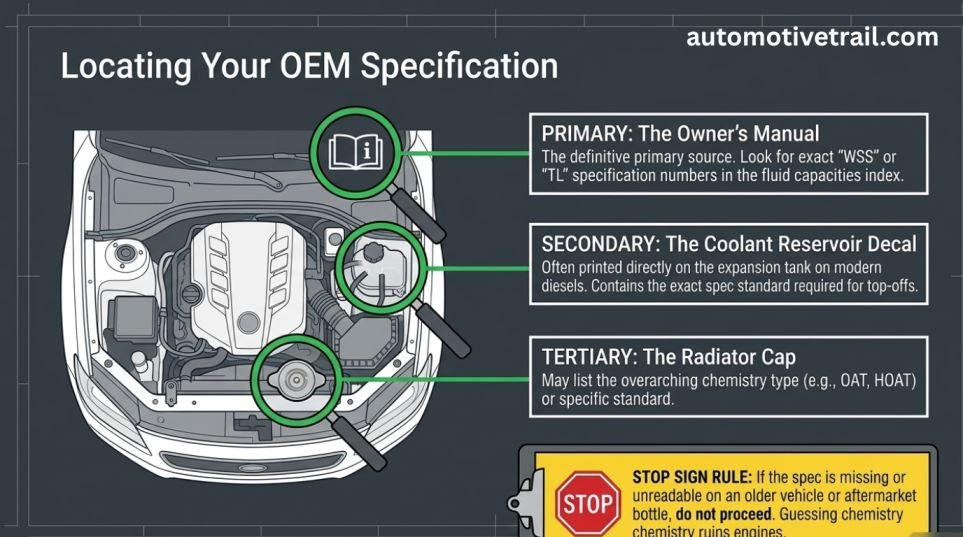
Your vehicle already tells you the required standard if you look in the right places. Start with the owner’s manual, then cross-check the coolant reservoir and radiator cap markings.
How To Read The Coolant Label
Coolant labels usually mix three kinds of claims: a real approval/spec line, broad “compatible with” statements, and marketing chemistry descriptions. Only the approval or spec line guarantees the chemistry and inhibitor package match what the OEM wants.
Search the label for these formats:
| What you see on the bottle | What it usually means for diesel cooling | What to do |
|---|---|---|
| “Meets OEM spec XXXX” | Correct inhibitor chemistry and material compatibility | Buy it, then confirm premix vs concentrate |
| “Compatible with all coolant types” | Too broad, often skips the exact approval | Do not rely on this claim |
| Only a chemistry term (example: “OAT-based”) | May be correct, may still miss the exact OEM approval | Match the OEM standard from the manual or label |
| Only “premix” or “concentrate” | Wrong ratio or wrong chemistry risks damage over time | Confirm both spec and concentrate ratio |
Rule of thumb: An approval line tied to the OEM spec beats a generic chemistry label every time. “Compatible with” is marketing language, “meets” is the target.
If The Spec Is Missing Or Unreadable
Missing or illegible markings are common on older vehicles and aftermarket coolant bottles. Treat that as a stop sign until you verify.
In practice, many diesel platforms in the US and Europe use chemistry choices tied to aftertreatment heat management (coolant-to-aftercooler, EGR cooling, or similar layouts). The OEM coolant spec accounts for those system requirements, so guessing based on “diesel needs special coolant” can still land you on the wrong chemistry.
Coolant Chemistry Families And Inhibitors
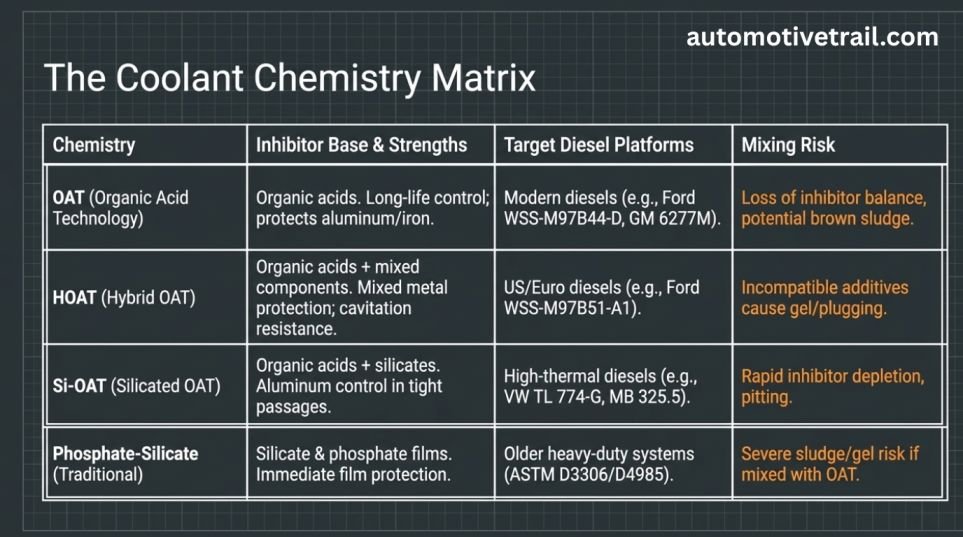
Engine coolant chemistry is more about the corrosion inhibitor package than whether the engine burns diesel or gasoline. Modern diesels are also picky because many use tight cooling passages, aluminum components, and heat exchanger setups where chemistry mismatches show up fast.
Chemistry Families: What Actually Differs
Coolants are commonly sold in four inhibitor-technology families: OAT, HOAT, Si-OAT, and phosphate-silicate (often called traditional). OAT uses organic acids as inhibitors, HOAT blends organic acids with specific additional inhibitors, and Si-OAT uses organic acids plus silicate for aluminum protection. Phosphate-silicate relies more on silicate and phosphate films to control corrosion on mixed metals.
Corrosion protection is driven by the inhibitor chemistry forming or maintaining protective films on internal surfaces. Those inhibitors are also depleted at different rates depending on temperature cycles and system water quality, so a coolant that “chemically kind of looks similar” can still fail the protection goals if the inhibitor package is different.
| Coolant Chemistry | Main Inhibitor Approach | Common Strengths | Compatible OEM Standards (Inferred) | Recommended Application | Replacement Interval | Mixing Risks |
|---|---|---|---|---|---|---|
| OAT | Organic acid inhibitors | Long-life corrosion control; protects aluminum and iron liners | Ford WSS-M97B44-D, GM 6277M (Dex-Cool) | Modern diesels with long-life targets and specific material protection needs | Long-life/Extended | Reduced corrosion protection, inhibitor imbalance, and possible brown sludge |
| HOAT | Organic acids plus mixed inhibitors | Balanced mixed-metal protection; cavitation resistance | Ford WSS-M97B51-A1, Chrysler MS-9769 | Diesel platforms needing organic and inorganic protection | Long-life/Extended | Additive reactions may cause precipitation or gel that plugs small passages |
| Si-OAT | Organic acids plus silicates | Strong aluminum corrosion control; protects tight cooling passages | VW TL 774-G (G12++), Mercedes-Benz 325.5 | Modern diesels with high thermal demands, aluminum components, and aftertreatment heat exchangers | Specification-based (OEM interval) | Inhibitor depletion, deposits, and higher pitting risk in high-heat areas |
| Phosphate-Silicate (Traditional) | Silicate and phosphate film inhibitors | Effective for older mixed-metal systems; immediate film protection | ASTM D3306, ASTM D4985 (Heavy Duty) | Older diesel vehicles and mixed-metal cooling systems | Short/Traditional maintenance interval | Significant sludge or gel risk when mixed with OAT; rapid loss of corrosion protection |
Inhibitor Depletion And Why “Mixing Types” Is Risky
Inhibitors get used up over time, especially with heat cycling, dissolved minerals, and aeration. When the inhibitor package is depleted, corrosion protection drops, pitting can start in localized hot spots, and aluminum surfaces can suffer more quickly. Some inhibitor systems also react badly when you combine chemistries, forming less effective protection and raising sludge or gel risk depending on the exact formulation.
For example, a coolant that is OAT-based may not provide the right silicate or phosphate film behavior expected by a system designed for silicate-containing protection. A vehicle spec that calls for Si-OAT might tolerate a brief top-off with the exact same approved chemistry, but mixing unknown bottles is a gamble because you cannot see the inhibitor balance through the color of the coolant.
Corrosion Protection, Cavitation, And Why Diesels Can Be Sensitive
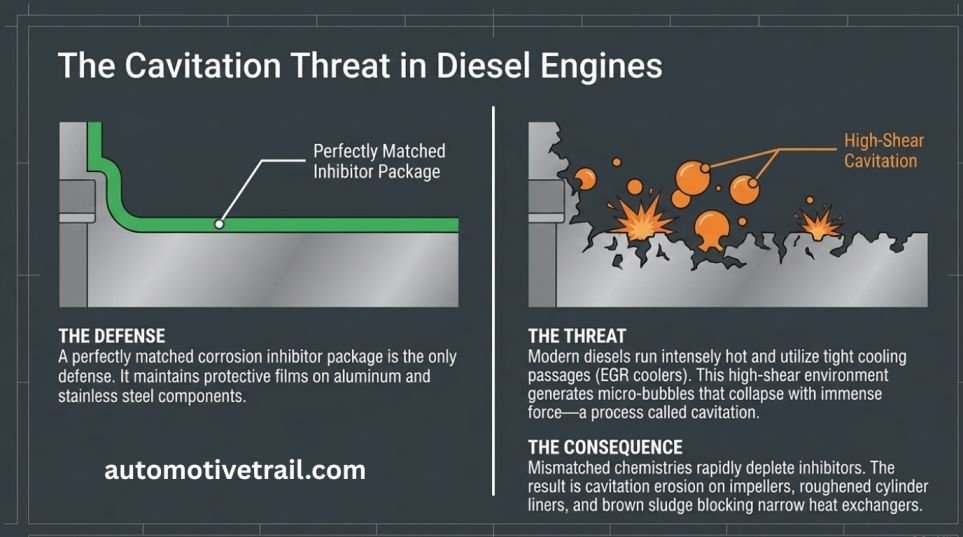
Cavitation erosion is damage from micro-bubbles collapsing near water pump impellers and other high-shear areas. Inhibitor packages and correct water chemistry help control corrosion, reduce surface attack, and support cavitation resistance, especially in pumps and narrow passages.
Modern diesel cooling systems often use aluminum and stainless components, plus aftercoolers and heat exchangers with tight flow channels. Those designs leave less margin for a weak inhibitor package, so a chemistry mismatch can show up as brown sludge, roughened liner surfaces (where applicable), or recurring overheating complaints even when coolant level is “correct.”
Mechanic’s tip: When you find coolant replaced before, confirm the exact chemistry family and vehicle approval standard listed on the container. If the history is unknown, treat the system as mismatched until proven otherwise and plan to align it to the OEM-required coolant spec.
Mixing Coolants: Safe Or Risky?
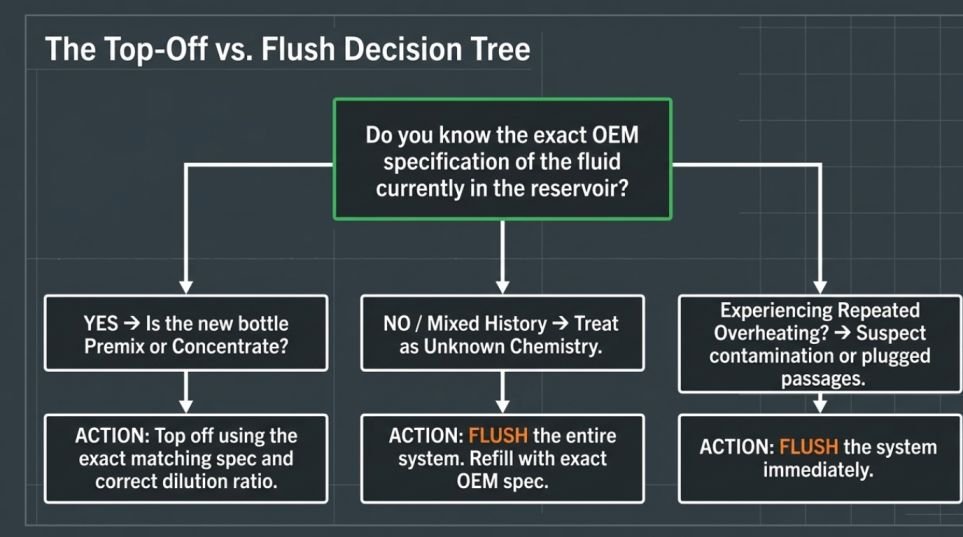
Mixing coolant chemistries is risky because the corrosion inhibitors are designed to work as a matched package, and they can react badly with other inhibitor systems. Using the wrong type can reduce corrosion protection and trigger sludge, gel, or precipitation that plugs small passages.
Best Practice: Match The Exact Coolant Spec, Not The Color
Color can help in rare cases, but it is not a reliable identifier because different brands use similar dyes across different technologies. Treat the label and the spec number as the source of truth.
| Situation | What to do | Why it matters |
|---|---|---|
| Topping off with known compatible coolant | Use the same chemistry and spec as what is already in the system | Maintains inhibitor balance and protects aluminum, iron liners, water pumps, and heat exchangers |
| Topping off, but coolant history is mixed or unclear | Do not add “whatever is on the shelf”; verify the exact spec | Wrong inhibitors can precipitate and increase deposit risk in narrow cooling passages |
| Unknown coolant, or multiple top-offs with different products | Flush and refill with the correct spec coolant | Removes mixed inhibitor chemistry so corrosion protection is restored as a designed package |
What can happen when inhibitors clash is the part that costs money later. Incompatible inhibitor packages can form deposits (precipitation or gel), thin out corrosion protection, and increase the chance of pitting or corrosion in areas that see high heat and cavitation stress (water pump and cylinder liners).
In practice, the first sign is often a coolant change in appearance, higher operating temperatures, or emerging sediment in the recovery bottle. The more mixed and older the coolant is, the more likely you are to find sludge during a drain.
Top-up rule of thumb: only add coolant if you can match the exact spec on the label (or the vehicle owner’s manual) and confirm it is the same chemistry family. If you cannot verify compatibility, treat it as “unknown coolant” and plan a flush.
Flush rule of thumb: choose a flush when the coolant type is unknown, the system has had different colors or brands added over time, or you are unsure what chemistry family is currently in the system. Flushing is also the smart move after repeated overheating events because contaminants increase the chance of inhibitor incompatibility problems.
Mechanic tip: before pouring anything new in, read the coolant label for the specification (the standard number and chemistry type) and match it to what your vehicle requires on the cap, service literature, or owner’s manual. If the spec does not match, do not rely on dye color or “diesel-safe” marketing.
Identify The Coolant In Your System
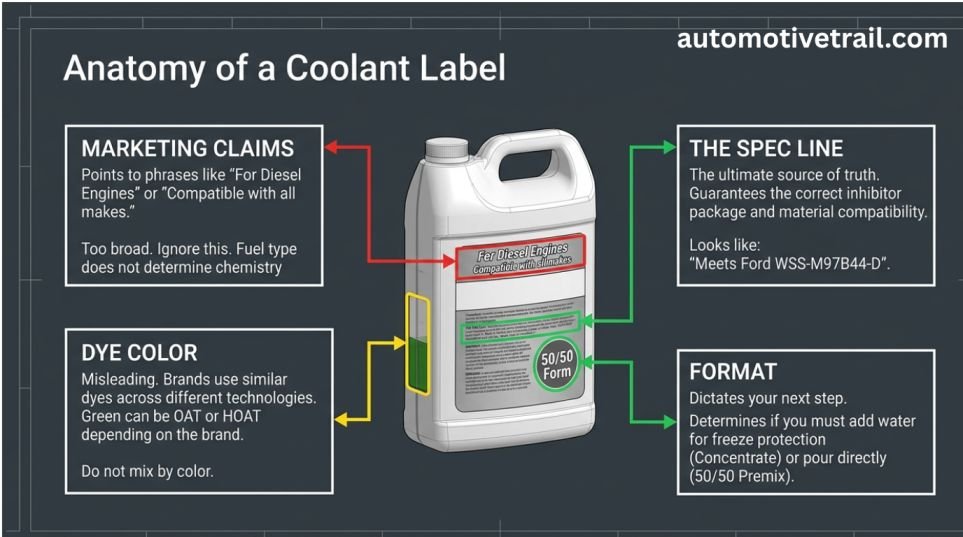
Why Color And “Diesel Coolant” Labels Can Mislead
Manufacturers use different dyes, so the same color can mean different inhibitor packages across brands. One brand’s “green” can be OAT (typically long-life, silicate-free), while another brand’s “green” can be HOAT or a different hybrid chemistry.
Diesel engines still need the correct anti-corrosion and cavitation protection, especially where cylinder liners, water pumps, and turbo aftercoolers are involved. The chemistry type (OAT, HOAT, SOAT, SI-OAT) and whether it is phosphate/silicate based matters more than the word “diesel” on a label.
| What you find | What it can tell you | What it cannot tell you |
|---|---|---|
| Coolant color (green/yellow/red/blue) | May correlate with a brand’s product line | Does not confirm inhibitor chemistry, spec number, or compatibility |
| Spec number on cap/reservoir | Directly ties to what the OEM allows | None if the spec is legible and matches the vehicle |
| “Premix” vs “concentrate” | Determines how you should top up and what dilution you need | Does not confirm the chemistry type by itself |
How To Identify What Is Already In The Vehicle
Check for markings in this order: the radiator cap, the coolant reservoir label, and any sticker in the engine bay. Many diesels (from Ford Power Stroke, GM Duramax, and Ram Cummins lines to European models) specify an OEM coolant standard using a number like “WSS” or “spec” language on the reservoir decal.
Practical rule: Treat the color as “unknown chemistry” until you find a spec number or a stated approval that matches your diesel’s requirements.
Verify premix versus concentrate before topping up. For example, a system that has been filled with a 50/50 premix should not be topped with straight concentrate, and a system filled with a “ready-to-use” product should not be diluted further.
When service history is unclear, assume the coolant could be the wrong chemistry even if the color matches “what looks right.” The safest approach is to use a coolant that explicitly meets your vehicle’s coolant specification, then correct the concentration in the next step described in the coolant dilution guidance.
Dilution Ratio And Freeze Protection
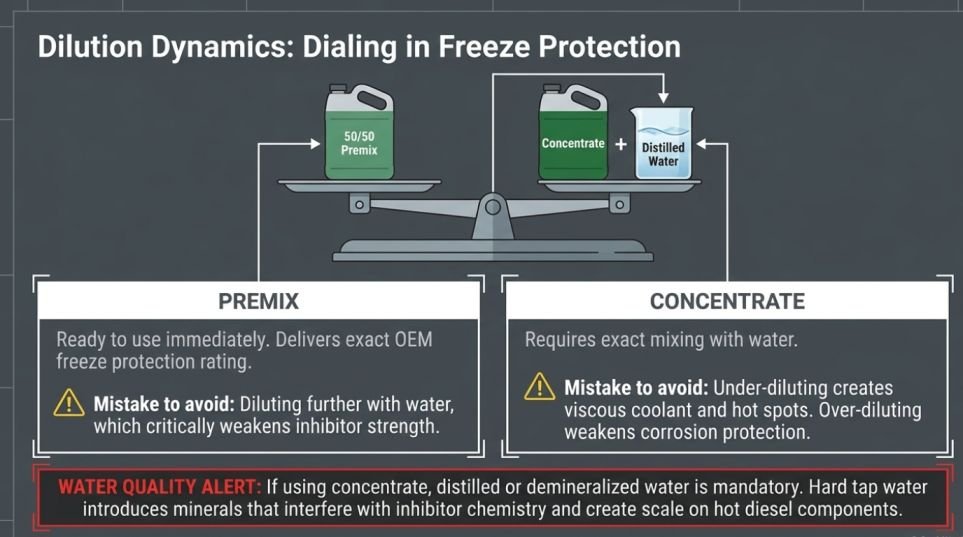
Coolant freeze protection depends on how concentrated the antifreeze package is, and that concentration is determined by the dilution ratio you mix (or the premix you buy). OEMs set a target freeze rating, so follow the vehicle’s specified dilution range or the pre-diluted product label rather than guessing by color.
Premix Vs Concentrate (What You’re Actually Buying)
Premixed coolant is ready-to-use at a specific dilution, typically labeled with the freeze protection temperature for that exact mix. Concentrate coolant requires dilution with water to reach the same freeze protection, and the concentrate alone does not give the rated protection until you mix it correctly.
For concentrate products, distilled or demineralized water is usually required because hard tap water can dilute corrosion inhibitors and raise mineral deposits in the radiator and engine passages. Hard water can also interfere with the inhibitor chemistry that protects metals and cylinder liners, which is where diesel cooling systems can be picky.
| Product form | What the label tells you | What you control | Common mistake |
|---|---|---|---|
| Premix | Freeze protection rating at the as-supplied mix | Whether you top off with the same premix spec | Topping off with a different premix or with straight water |
| Concentrate | Mixing ratio required for a target freeze protection temperature | Water-to-concentrate ratio | Under-diluting (inhibitors too strong) or over-diluting (inhibitors too weak) |
Dial In Dilution For Your Climate (Freeze Targets)
Freeze protection is about the lowest expected ambient temperature, but the safest approach is to match the OEM target freeze rating (often stated as an “engine coolant” spec number plus a dilution requirement). As a practical rule, aim for freeze protection a bit colder than your worst winter temperatures so you get margin for coolant age and uneven system temperatures.
Under-diluting concentrate can create thick, high-viscosity coolant that loses heat transfer efficiency and can leave hot spots in the head and radiator. Over-diluting concentrate is worse for long-term protection because inhibitor concentration drops, which increases risk of corrosion, liner pitting, and deposit formation.
Water Quality And Inhibitor Concentration Matter
Concentrate coolants are built around specific corrosion inhibitor packages, and those inhibitors need the right concentration to do their job. Distilled or demineralized water helps keep inhibitor chemistry at the level the manufacturer engineered, especially important in diesel systems that can see harsher thermal cycling.
Low inhibitor concentration is the classic “works for now” problem. Coolant that is too dilute may still pass a quick visual inspection, but it can accelerate corrosion on aluminum components and cast-iron surfaces, and it can promote scaling that reduces flow and heat transfer.
Shop tip: If you are topping off, match what is already in the system and match the dilution strategy. Mixing premix and concentrate from different lines can quietly shift inhibitor concentration and freeze protection.
When To Replace Diesel Coolant
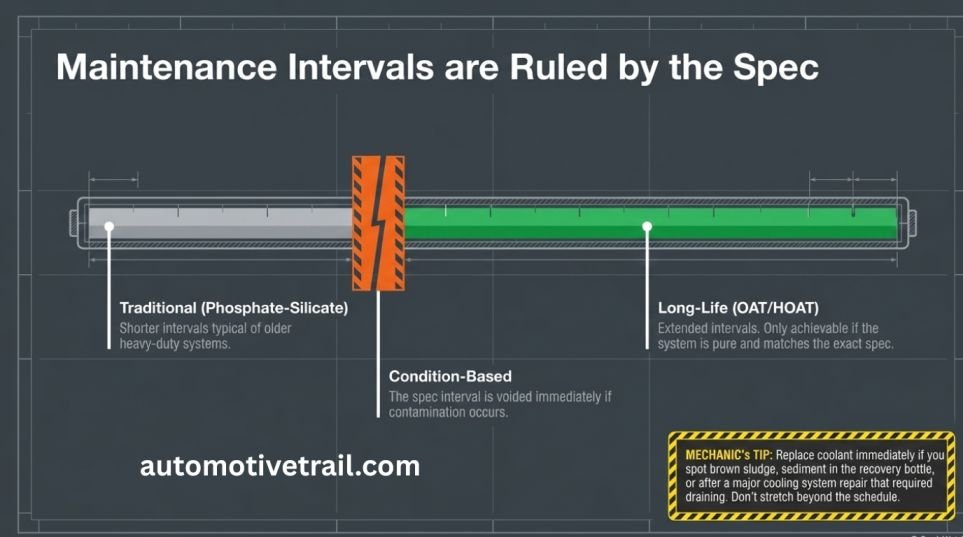
Diesel cooling systems are maintained on an OEM schedule, and the replacement interval depends on the coolant chemistry spec in your engine. Follow the maintenance schedule in your owner’s manual or service info for the exact coolant type. Replace sooner if you see contamination, frequent loss of coolant, or after any cooling system repair that drains the system.
Coolant intervals can vary a lot between diesel applications because different inhibitor technologies wear differently. A long-life OAT or HOAT premix can often go longer than older silicate-based coolants, but you only get that interval if the product meets your engine’s required spec. Always match the coolant chemistry and whether it is a premix or concentrate to the OEM requirements.
OEM Interval Rule (And Why The Spec Controls It)
Use the coolant “spec number” or “meets standard” listed by the manufacturer, then use the interval tied to that spec. If your cap label, coolant bottle, or manual lists an approved coolant type (for example, OAT, HOAT, or SI-OAT), the service interval is based on that inhibitor package, not on whether the vehicle “is a diesel.”
| What to check | What it tells you | Action |
|---|---|---|
| Owner’s manual coolant spec/standard | Correct chemistry and inhibitor package | Use only that spec at service time |
| Coolant type on bottle/cap (OAT/HOAT/etc.) | Whether it is the long-life chemistry | Match top-offs and full service |
| Service interval tied to spec | Expected replacement timing | Don’t stretch beyond the schedule |
Replace Sooner When Contamination Or Coolant Loss Shows Up
Diesel coolant replacement should come early if the system shows signs of inhibitor failure or mixing. Contamination can also accelerate corrosion and scale, which defeats the reason for long-life chemistry.
Shop tip: If you cannot confirm what coolant is currently in the system, treat it as “unknown chemistry” and plan on a spec-matched drain and refill when service is needed.
After any cooling system repair, refilling with the correct spec matters because the wrong inhibitor package can react poorly with existing additives. Even small chemistry mismatches can reduce corrosion protection and shorten the usable life, which is exactly the time you are trying to optimize. For trucks and diesel sedans that see heat soak, this is one of the few maintenance choices where being precise saves future problems.
Quick Summary
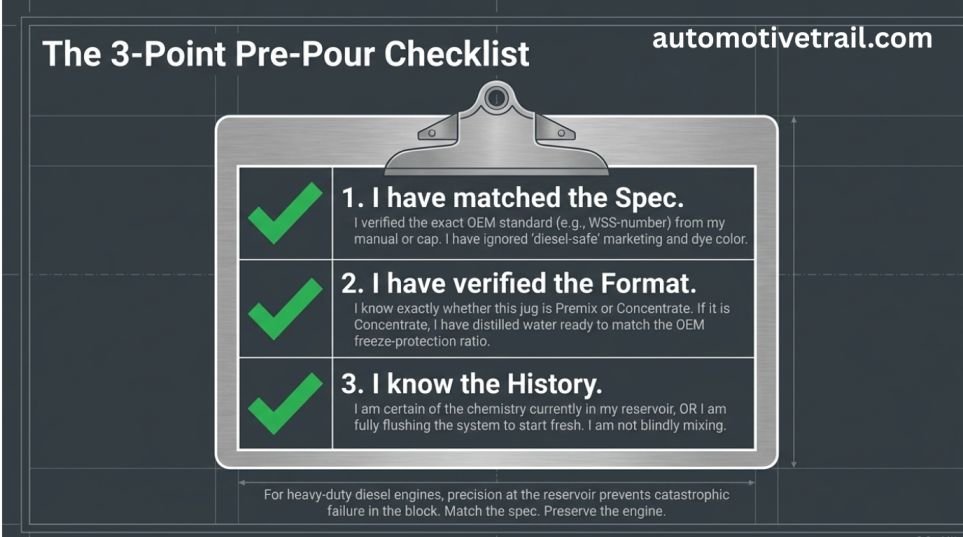
Diesel engines do not automatically require a special “diesel-only” coolant, but they do require the exact OEM coolant specification for inhibitor chemistry and material protection. It highlights common chemistry families like OAT, HOAT, Si-OAT, and phosphate-silicate, and notes that the approval also dictates whether you need premix or concentrate and the correct dilution ratio.
To choose correctly, find the required standard on the cap, expansion tank label, or in the owner’s manual, then buy coolant that explicitly meets that spec number or standard. Mixing coolant types can reduce corrosion protection, so use verified compatible coolant for top-ups, or do a full flush if you cannot confirm the current chemistry. Many climates target a 50/50 mix for freeze protection, but you must follow the label and manual, with replacement planned to the OEM time or mileage interval.
| What to match | What to verify on the bottle/vehicle |
|---|---|
| Chemistry family and inhibitor package | OAT, HOAT, Si-OAT, or phosphate-silicate, plus the required standard or OEM part number |
| Service form | Premix versus concentrate, since the concentrate dilution ratio affects protection |
| Freeze-protection ratio | Often 50/50 water and coolant, but always follow the label and owner’s manual |
Frequently Asked Questions
Do Diesel Engines Need A Different Engine Coolant Than Gasoline Engines?
Usually, it is not about “diesel versus gas”; it is about the coolant type your engine and radiator are designed for (for example, the correct OAT or silicate chemistry). The right choice depends on your vehicle’s specific coolant spec in the owner’s manual.
Is There A Specific Coolant Labeled “Diesel Coolant” That I Should Buy?
Most of the time, “diesel coolant” is just marketing, not a unique chemistry required for diesel engines. What matters is the manufacturer approval and specification printed on the bottle, and matching it to your current coolant type if you are topping off.
Can I Mix Diesel Engine Coolant Types If I Top Off The Reservoir?
You should avoid mixing different coolant chemistries, because the additive packages may not be compatible. If you are unsure what is already in the system, the safest move is to use the exact same coolant type or have the cooling system inspected and flushed per the service schedule.
How Do I Know Which Coolant Spec Is Correct For My Diesel?
Check your owner’s manual or the coolant label for the required specification and approval. If the bottle says it meets a listed spec, that is your best match, and you should also verify the coolant concentration (often sold premixed or as a concentrate).
What Happens If I Use The Wrong Coolant In A Diesel Engine?
Using the wrong chemistry can lead to reduced corrosion protection and cooling-system scaling, especially if the mixture results in incompatible additives. If you suspect the wrong coolant was used, have it tested or flushed rather than running it for long intervals.
Is Long-life Diesel Coolant Different From Regular Coolant?
“Long-life” usually refers to a chemistry and additive package designed for extended service intervals, not diesel-specific design. If your diesel calls for an extended-life coolant spec, stick to that exact type and interval, because changing to a different chemistry can shorten protection.

- Top 10 Ranking Tire Brand for Minivan: Reviewed 2026 - October 5, 2026
- Model Y Tesla Long Range Automatic Wagon Tyre Fitment And Ratings - October 3, 2026
- What Is The Benefit Of Larger Rear Tyres On A Zero-turn Mower - October 3, 2026