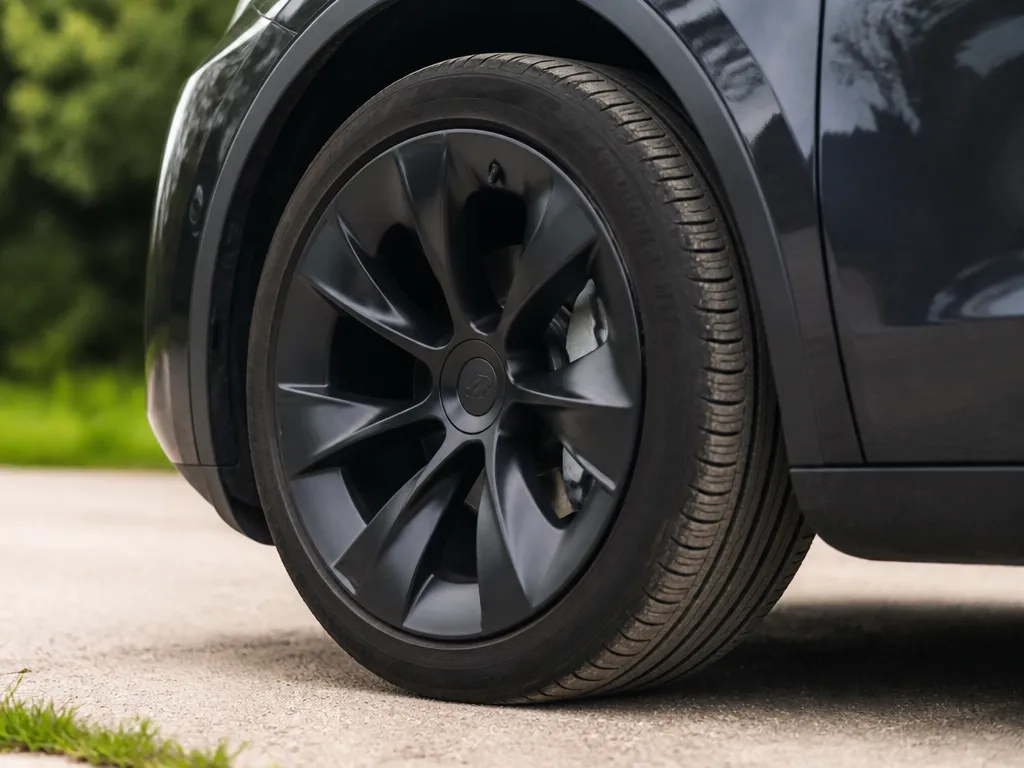
You searched for “Model Y Tesla Long Range Automatic wagon tyre” because you’re trying to pick a tire setup that fits the car and matches Tesla’s efficiency goals. The tricky part is getting the exact size, load index, and speed rating right, while also choosing the right tire type (all-season, all-weather, or winter) for your weather.
Model Y Long Range tire fitment depends on the factory tire size and the load index and speed rating printed on the sidewall or door-jamb sticker. Aim for matching overall diameter and correct rim width, then choose low rolling resistance for range and a quiet ride.
Model Y Tesla Long Range Automatic Wagon Tyre Fitment
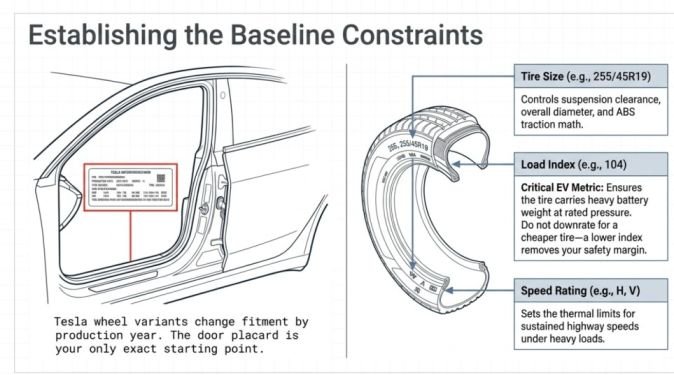
For a Tesla Model Y Long Range, the factory tire size is printed on the tire placard inside the driver door jamb and on the tire sidewall itself. Because Tesla can change fitment by wheel design, production year, and market, the only “exact” starting point you can trust is the placard for your specific car.
Start by recording the factory details exactly as shown on the placard, including the tire size, load index, and speed rating. Also note whether Tesla lists an all-season, all-weather, or summer tire and the recommended wheel size. If the placard lists two different sizes (front to rear differs), record both.
| What to record from your placard/tire | Example format | Why it matters |
|---|---|---|
| Tire size | e.g., 255/xxR19 | Controls clearance, overall diameter, and ABS traction math |
| Load index | e.g., 107 | Ensures the tire can carry the vehicle load at rated pressure |
| Speed rating | e.g., H, V | Sets thermal limits for sustained speed |
| Tire type | All-season, all-weather, winter, summer | Changes tread compound, wet grip, and cold performance |
Common Model Y Long Range Variations You’ll Run Into
Model Y Long Range cars often see multiple wheel sizes across years, and that drives tire size changes. The rim width changes the tire’s measured section width and how the sidewall sits, which affects steering feel, ride comfort, and how close the tire runs to suspension and fender edges.
“If the placard lists a specific load index, do not downrate it for a cheaper tire. A lower load index can mean less safety margin even if the tire “fits.””
Auto/AWD has its own traction and stability strategy, and it relies on consistent rolling behavior. Matching the factory tire size and ratings is the best way to keep the traction control, ABS modulation, and stability calibration working as intended, especially when one corner starts with different tread depth or compound grip.
Compatibility Checklist Before You Buy

Before you pay, verify the sidewall ratings and published dimensions for your Tesla Model Y Long Range. On an EV, even small fitment mistakes can cause rubbing, poor handling, wrong wheel-speed calculations, and traction-system faults.
For example, if two tires share the same size code but one has a different tread width build or overall diameter, the handling can feel “off” because the contact patch and effective rolling radius shift. Before installing, compare the tire’s published specs (overall diameter and section width) against what you already run.
| Check | What to compare | What can go wrong if it’s off |
|---|---|---|
| Size | Placard tire size vs tire sidewall | Rubbing, incorrect clearance, unstable steering feel |
| Load index | Placard vs tire sidewall | Excess deflection, faster wear, overheating |
| Speed rating | Placard vs tire sidewall | Overheating under sustained speed |
| Overall diameter | Published overall diameter vs your current tire | Wrong wheel-speed behavior, ABS/traction oddities |
| Rim width range | Wheel width vs tire approved rim range | Uneven wear, altered tread shape |
If you’re unsure about the numbers, read the sidewall carefully and match the exact placard load and speed requirements. When in doubt, verify with your tire shop using your VIN and current wheel size, because Tesla wheel variants can lead to different recommended setups.
Range-first Tire Choice For Model Y
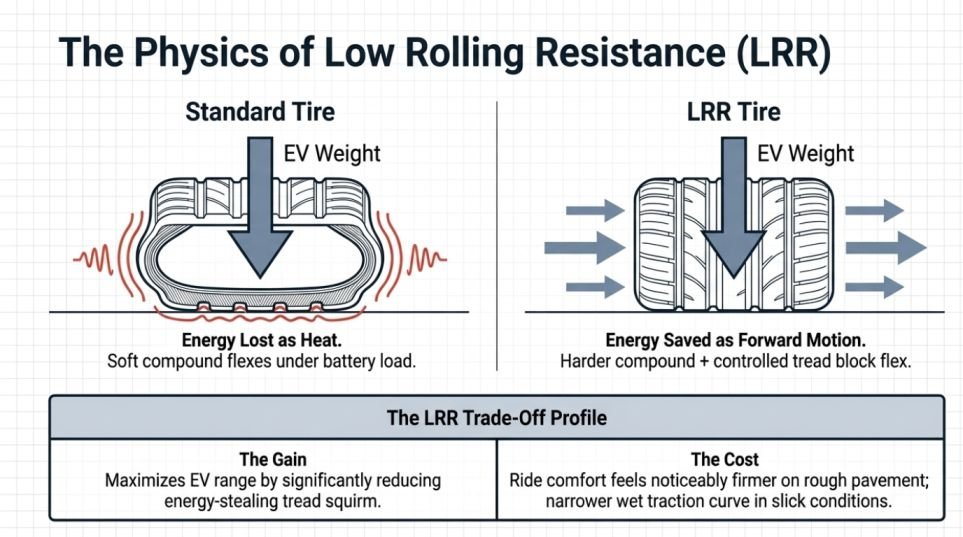
Rolling resistance is the main tire-related draw on an EV like the Model Y Long Range, so a low rolling resistance (LRR) tire helps range by reducing energy lost as the tread flexes. Tire compound and construction control how much heat the tire generates and how much tread flex happens under load.
LRR Explained: What To Look For And What It Costs You
For EV efficiency, shop for tires labeled with LRR or “efficiency” tech, and pay attention to the tread design. LRR tires usually use a harder compound and a more controlled tread block stiffness, which can trade some ride comfort and reduce ultimate wet grip versus a higher-performance all-season.
On a wagon-style daily driver, that trade shows up in two places: the tire can feel a bit more “firm,” and the traction curve can be narrower when pavement is slick or very cold. The practical move is to pick the most efficient tire you can live with, then match treadwear, load rating, and inflation to the conditions you actually drive.
Tread Pattern And Stiffness: Noise And Wet Grip
Tread pattern affects both sound and water evacuation, and stiffness affects how the tread maintains shape. A symmetrical tread with fewer, larger tread blocks often reduces noise, while dense siping helps wet grip by creating biting edges under load.
For highway miles, choose a tire whose tread looks more “road-focused” than “off-road,” and avoid designs that sound great in a spec sheet but behave poorly when the tread blocks flex too much. Over time, worn LRR tires can lose efficiency gains because the contact patch shape changes and the tread wears down unevenly if alignment and pressure are off.
| Design cue | What it tends to do | What to watch on Model Y |
|---|---|---|
| More siping | Better wet biting, more edge movement | Road noise may increase; efficiency can drop if tread blocks flex |
| Stiffer tread blocks | Less flex, lower rolling resistance | Ride comfort can feel firmer; tread pattern may hum |
| Asymmetrical pattern | Grip tuning across inside and outside shoulders | Inner tire wear matters; rotation interval needs attention |
EV Tire Pressure: Range, Contact Patch, And Tread Life
Correct inflation is where range gains can disappear fast. Underinflation increases tread squirm and heat, raises rolling resistance, and accelerates shoulder wear, while overinflation reduces contact patch and can worsen wet traction and center wear.
For a Tesla, start with the pressure guidance on the vehicle label and your specific wheel and tire size. Because LRR tires can be more sensitive to pressure, keep a quality gauge in the garage and check pressure when tires are cold, especially after temperature swings.
Temperature And Load: Practical Efficiency Expectations
Cold weather stiffens rubber, which can increase rolling resistance on LRR compounds, and it often delays full grip until the tire warms up. In hot conditions, the tire heats more quickly, and pressure creeps up, so staying at the labeled spec helps control wear and keeps the contact patch stable.
Load affects efficiency because extra weight increases energy needed to move the vehicle and increases tire deflection. For Model Y, cargo and frequent longer trips at higher speeds make tire temperature rise more, so an LRR tire that works well in calm commuting may show more sensitivity when you add roof loads or carry heavy cargo.
“On an EV, tire efficiency is a system. Compound and tread help, but pressure, alignment, and how hard you run the tires decide whether you actually feel the benefit.”
All-season Vs All-weather Vs Winter
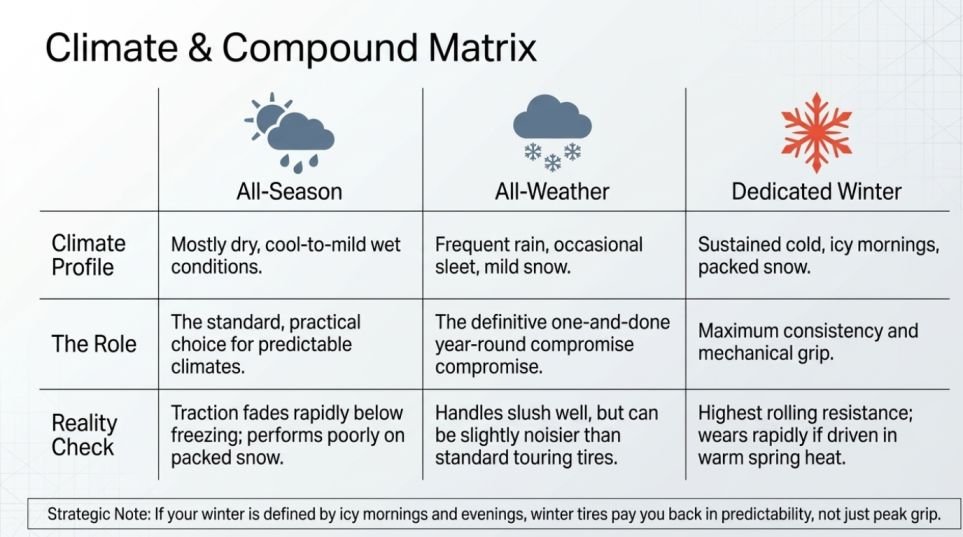
For a Tesla Model Y Long Range, the tire category you pick should follow how much cold and real snow you see, not just what the forecast says for a week. Dry and wet mild climates usually do best with all-season or all-weather tires, while sustained cold and packed snow is where true winter tires earn their keep.
Dry And Wet Climates: What Usually Makes The Most Sense
In regions where winter lows stay mostly above freezing and snow is rare, an all-season or all-weather tire is the practical choice for year-round use. All-weather tires are built for cold-season traction and typically handle wet and light snow better than basic all-seasons, but they still do not match winter tires once roads stay icy and temperatures drop hard.
Road noise and range can tilt your decision. Softer winter compounds often feel grippier in the cold but can increase rolling resistance and wear patterns when the weather is warm, so avoid winter-only tires if you drive long highway miles in consistently mild seasons.
| Typical climate | Best fit for most Model Y Long Range owners | Trade-off to expect |
|---|---|---|
| Mostly dry, cool-to-mild wet | All-season or all-weather | Winter performance is limited if temps stay well below freezing |
| Frequent rain, occasional sleet | All-weather | Can be noisier than a top economy all-season in some setups |
Occasional Snow: The Traction Reality Check
Occasional snow can trick drivers into overconfidence, especially with an all-season tire that looks fine on dry streets. Traction breaks first when the road is icy, transitions from slush to frozen patches, or you hit packed snow where compound grip and sipes do the heavy lifting.
In practice, if you get a few snowy days but temperatures sit below about freezing for extended stretches, an all-weather tire is a better “one-and-done” compromise than a standard all-season. If you regularly drive during the coldest nights or you have to get to work regardless of conditions, plan for the dedicated winter option instead.
Full Winter Conditions: When Dedicated Winter Tires Are Worth It
Dedicated winter tires are worth it when you face sustained cold, slushy-to-icy mornings, or frequent packed snow, because the rubber stays flexible and the tread pattern is built for snow biting and ice control. For a heavy, instant-torque EV like the Model Y Long Range, tire grip is a big part of how smooth and predictable acceleration feels, especially on slick starts.
Winter tires can also reduce the drama of traction control interventions, since the tire has more mechanical grip available. Range can drop a bit in cold weather with any tire choice, but winter tires tend to be the biggest variable when temperatures stay low for long drives.
“If your ‘winter’ is really icy mornings plus evenings, winter tires pay you back in consistency, not just peak grip.”
Seasonal Swap Timing: Tread Depth And Compound Hardening
Swap timing is about tread condition and rubber flexibility. When tread is worn down near the wear bars, you lose snow evacuation, and the sipes can become less effective, so expect a bigger performance fall-off in cold and slush even if the tire still passes a visual inspection.
Compound hardening is the other half of the story. As temperatures drop, some all-season or all-weather tires can stiffen, which hurts both braking and lateral grip on ice. As temperatures rise in spring, winter tires tend to wear faster and can feel less responsive on dry pavement, so don’t “stretch” them far past the last consistent cold nights.
Fitment Safety: Clearance And Handling
Different tire sizes on a Tesla Model Y Long Range change more than ride height; they can affect strut clearance at full lock and full suspension travel. Bigger diameter also shifts wheel speed signals, which can throw off traction control and regen feel. Every fitment choice should start with both turning-lock and bump clearance checks.
For practical fitment sanity checks, measure tire clearance with the car at ride height, then repeat at a compressed position using a safe support method (ramps or approved lift points).
For example, tires that “fit” at rest can still rub on the inner liner during a pothole hit while you’re steering.
| Tire change | Main safety risk | Common symptom |
|---|---|---|
| Wider tread | Inner rub on strut/suspension under lock and compression | Scuff marks on inside shoulder, noise during turns |
| Lower aspect ratio | Less sidewall compliance during steering impacts | More frequent contact over driveway lips |
| Different overall diameter | Wheel-speed mismatch affects speed indication and system calibration | Different regen/traction feel, cruise accuracy drift |
| Unequal circumference across tires | Traction control intervention from wheel-speed differences | Extra stability/traction activity in normal driving |
| Wrong TPMS sensor type | False pressure warnings | TPMS alerts even with correct pressures |
Rule of thumb: prioritize correct rolling circumference and axle matching over “max size.” If you are staying near factory specs, clearance issues usually come down to tire brand and tread width variations, not just the size written on the sidewall.
Best Tyre Picks By Goal
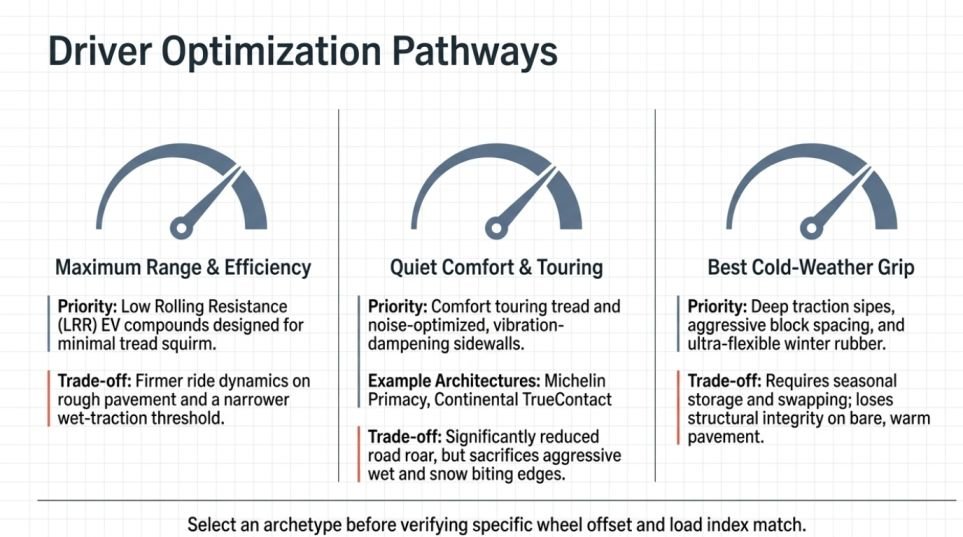
For each goal below, pick an EV-ready tire with the right size, load index, and speed rating, then confirm fitment with your exact rim width and offset.
Best For Range And Efficiency (Low Rolling Resistance EV Tires)
For maximum efficiency, choose an EV-focused low rolling resistance (LRR) all-season. Expect better range than typical touring tires, but you trade a bit of ultimate wet bite compared with the most performance-oriented options.
Trade-off: LRR tires often feel a little firmer on rough pavement because the tread and sidewall construction aims to reduce losses.
Best All-weather Traction (Wet Plus Light Snow, Year-round)
All-weather tires are your “do everything” choice if you see winter roads but do not want a full winter swap. These typically handle rain confidently and manage slush better than standard all-season, with a longevity hit versus pure summer or LRR EV tires.
Best Quiet Comfort (Lower Noise And Gentler Ride Feel)
Quiet comfort comes from tread pattern stiffness, pitch sequencing, and how the tire dampens vibration. Choose touring-focused comfort tires and prioritize models known for reduced road roar rather than aggressive shoulder blocks.
| Goal | What to prioritize on the tire | Model examples to check |
|---|---|---|
| Quiet ride | Comfort touring tread, noise-optimized compound, stable sidewall | Michelin Primacy (touring line), Continental Comfort/TrueContact families (size-dependent) |
Best Cold-weather Grip (Dedicated Winter Or Touring Winter)
Cold-weather grip means a real winter compound and deeper traction sipes for snow and ice. If your winters are harsh, the best move is a dedicated winter tire set, but you must store them and swap seasonally.
Driver reality check: Winter tires improve grip and braking on snow and cold pavement, but they still can lose traction quickly on bare, wet pavement if you drive like it is summer.
What To Verify For Each Candidate On Your Model Y Long Range
Every tire you shortlist must match your wheel’s required setup. Verify these items before you buy, especially if you have non-stock Tesla wheel sizes.
Availability note: Tire model lines change by season and production. If the exact model is not offered in your size, swap to the same category (EV LRR, all-weather, comfort touring, or winter) with the same load index and speed rating.
Tesla Model Y Tyre Care And Rotation
For the Model Y, the easiest way to prevent uneven tread wear is rotating on a schedule tied to your driving mix, then keeping pressures dead-on for the tire size you run. A properly timed rotation helps both noise control and the longevity you care about in an EV.

Rotation Timing That Matches EV Torque And Regen
Model Y wear patterns often come from front-drive bias, pothole hits, and the way regen loads the front axle differently depending on your settings and road grade. Plan for rotations sooner if you drive lots of freeway miles with steady speed, lots of regen-heavy descents, or you live where roads are uneven.
Use a simple interval target and adjust based on tread depth measurements.
| Wear/behavior | What to do | Why it matters |
|---|---|---|
| Front tread wears faster, or cupping appears | Rotate at the shorter interval and schedule an alignment check | EV torque plus regen can amplify front wear and uneven contact |
| One shoulder wears more than the other | Check pressure and alignment, then rotate right away | Sidewall loading usually points to pressure or toe/camber issues |
| Noise increases with time | Measure tread depth and inspect for irregular wear before chasing balance | Noise often follows tread wear patterns, not just wheel weight issues |
Alignment Check Triggers You Should Not Ignore
Alignment problems show up as repeatable tread patterns, steering feel changes, and ride disturbances. The goal is to catch it early, because an alignment correction is cheaper than replacing tires unevenly.
In practice, after a hard impact, book an alignment inspection even if the steering feels “almost fine.” A small shift can wear the tires quickly, and EV weight makes that wear show up faster.
Tread Depth Replacement Cues For Wet And Efficient Driving
Model Y efficiency depends on tire rolling resistance, but grip depends on tread depth and wear shape. On wet roads, shallow tread plus worn shoulders can cause traction fade and longer stopping distances.
Use a tread gauge and replace when tread depth is getting low, or wear is uneven. A safe ownership habit is to measure front and rear at multiple points across the tread, then compare sides.
Insider tip: If you can see or feel a “step” between grooves, the tire is already transitioning into an uneven-wear state. Rotations can slow the damage, but a bad contact patch usually needs alignment work.
TPMS and Inflation Workflow For Range And Tire Health
Keeping pressures accurate protects tread life and helps range by keeping rolling resistance stable. EV tires also heat up faster when pressures are low, which can accelerate wear and make ride quality harsher.
When you rotate or replace tires, keep TPMS sensor positions in mind. Following the shop’s sensor activation and verification steps helps prevent false alerts and keeps your pressure monitoring consistent.
Quick Summary
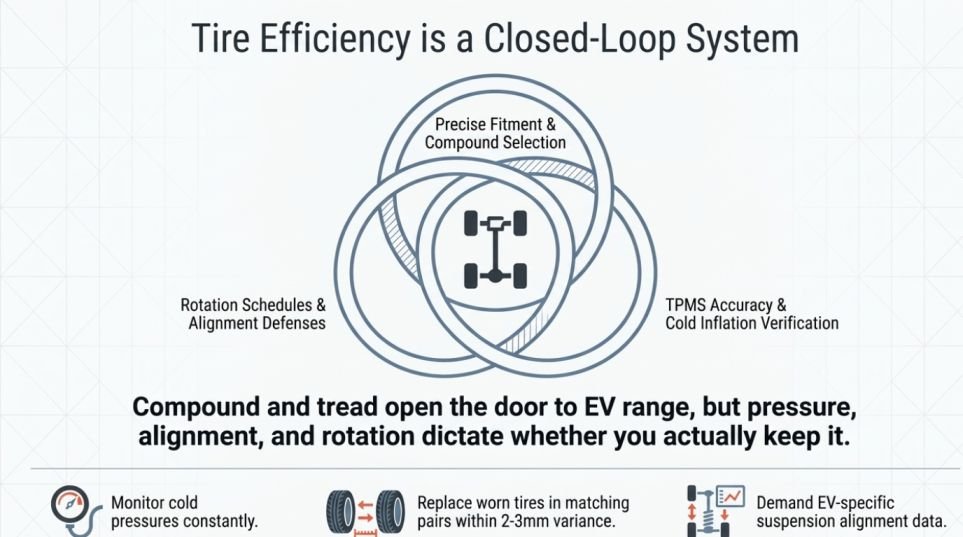
Because the Model Y Long Range can run multiple wheel and tire combinations across years, it’s possible to see front-to-rear differences, plus varying tire types like all-season, all-weather, summer, or winter. The key maintenance actions are rotating on schedule, using the driver door pressure recommendation, and choosing all-weather or winter tires if you see consistent snow or ice.
| What to check on your placard or tire | What the article says to do |
|---|---|
| Tire size (for example, format like 255/xxR19) | Match it closely, including rim diameter, to avoid clearance and overall diameter issues. |
| Load index | Keep it at or above the placard value, since downrating can reduce safety margin. |
| Speed rating | Keep it at or above the placard rating to meet thermal limits. |
| Tire type (all-season, all-weather, summer, winter) | Use all-weather or winter for ice or consistent snow; otherwise prioritize low rolling resistance for range. |
Frequently Asked Questions
What Size Tyre Does A Tesla Model Y Long Range “Automatic Wagon” Use?
The exact tyre size varies by trim, production year, market, and wheel package, so there is no single size for every Model Y Long Range “Automatic Wagon.”
How Often Should I Rotate Tyres On A Tesla Model Y Long Range For Even Wear?
Most drivers find rotating every 5,000 to 8,000 km keeps wear even, especially on Tesla models that can put more torque bias on certain positions. If you notice uneven wear patterns, rotate sooner and get an alignment check, because tyre wear usually follows geometry, not just mileage.
Do I Need To Replace All Four Tyres At Once On A Tesla Model Y Long Range?
Not always, but you generally want tyres with close tread depth on the same axle and avoid mixing drastically different tread depths front to rear. A safe rule of thumb is to replace in pairs and keep remaining tyres within about 2 to 3 mm tread depth difference, then recheck after a short test drive.
What’s The Safest Way To Balance And Align Tyres On A Model Y Long Range?
Go for a proper wheel alignment after tyre work, because alignment is what prevents repeat wear and vibration. Ask the shop to confirm the tyres are seated correctly, balanced to specs, and the alignment uses current Model Y settings, since electric vehicles can feel vibration differently than gas cars.
Can I Use All-season Or All-weather Tyres Instead Of The Factory Setup On A Model Y Long Range?
Usually yes, if the replacement tyre is approved for the wheel and suited to the climate. If you live in snowy regions, pick a true snow-rated all-weather tyre rather than a generic all-season, because traction in cold weather is the whole point.
What’s The Most Common Mistake When Replacing Model Y Long Range Tyres?
The biggest mistake is treating the tire’s size code as the only fitment detail. Wheel package, tire construction, load capacity, speed capability, and overall diameter can all affect ride quality, handling, and safety.

- Top 10 Ranking Tire Brand for Minivan: Reviewed 2026 - October 5, 2026
- Model Y Tesla Long Range Automatic Wagon Tyre Fitment And Ratings - October 3, 2026
- What Is The Benefit Of Larger Rear Tyres On A Zero-turn Mower - October 3, 2026