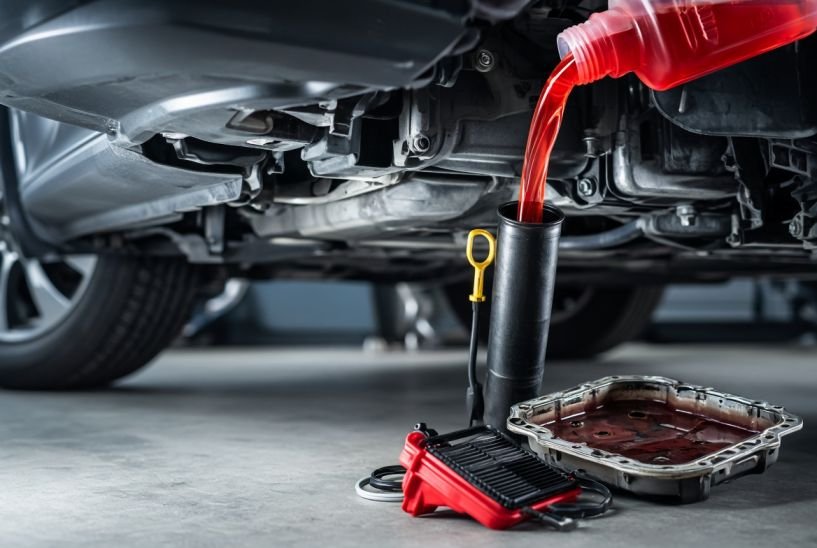
A pan-drop service on this van takes about 4 litres. A full dry fill after a rebuild takes closer to 7.6 litres. Which number applies to you depends on the job you’re doing, not the car itself.
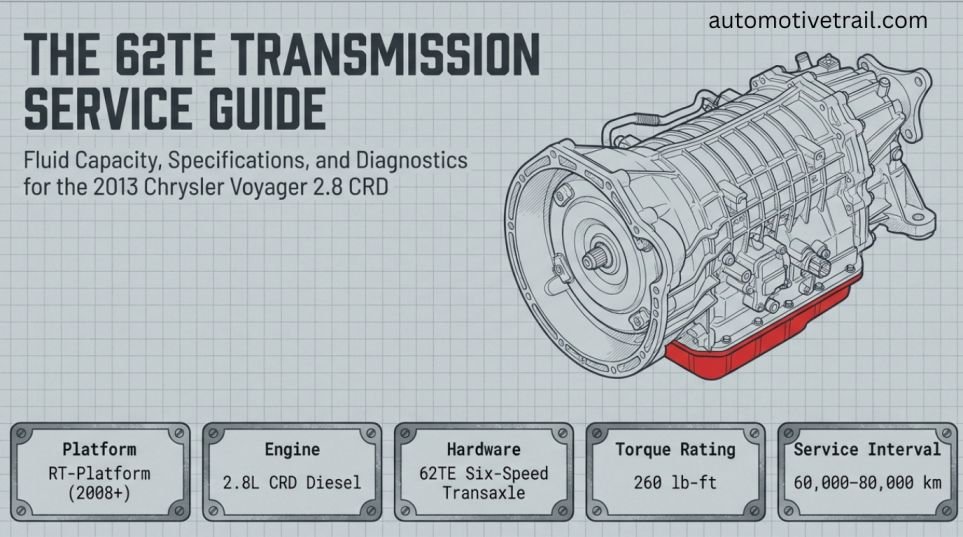
Quick answer: the 2013 Chrysler Voyager 2.8 CRD runs a 62TE six-speed automatic. A routine fluid and filter change needs roughly 4 litres (about 4 US quarts) of Mopar ATF+4. A complete dry refill, the kind you’d do after replacing the transmission or fully flushing the torque converter, needs closer to 7.6 litres (about 8 quarts).
Key takeaways
- Service (pan-drop) fill: ~4 litres of ATF+4
- Total dry fill (empty transmission): ~7.6 litres of ATF+4
- Transmission fitted: 62TE six-speed automatic, not the older 5-speed W5A580 used on pre-2008 Voyagers
- Fluid spec: Mopar ATF+4 only — Dexron, Mercon, or generic ATF will cause shifting faults
- Check the level with the engine running at operating temperature, not with a cold static dipstick check
- Confirm your transmission tag or VIN before buying fluid — export variants exist
How many litres of automatic gearbox oil for Chrysler Voyager 2013 2.8
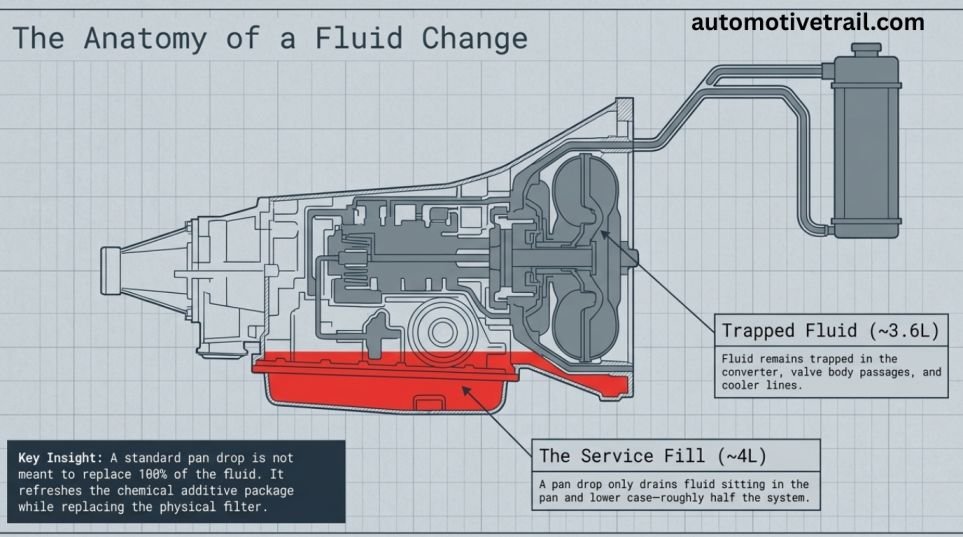
Two figures get thrown around for this van, and both are correct for different jobs. A shop doing a standard fluid and filter change drops the pan, drains what comes out, and refills to level. That’s the 4-litre service fill. The torque converter holds another 3 to 4 litres that stays trapped unless you flush it separately or the transmission comes apart.
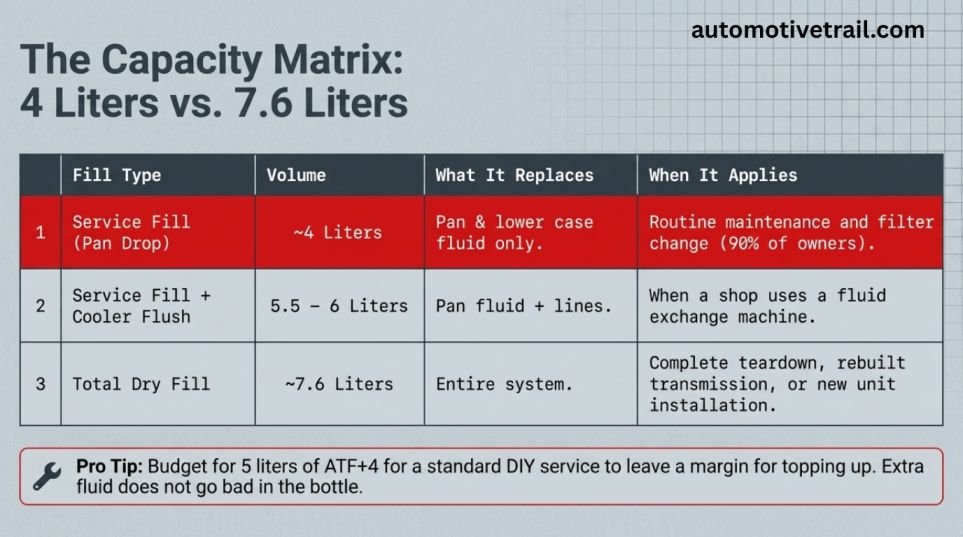
The 7.6-litre figure is the total system capacity: pan, cooler lines, valve body, and converter combined. You’d only need that much if you’re filling a transmission from completely dry, say after a replacement unit goes in.
For 90% of owners doing maintenance, budget for 4 to 4.5 litres and buy a fifth quart as a buffer. ATF+4 doesn’t go bad sitting in the bottle, so extra isn’t wasted money.
Which transmission is in the 2013 Chrysler Voyager 2.8 CRD
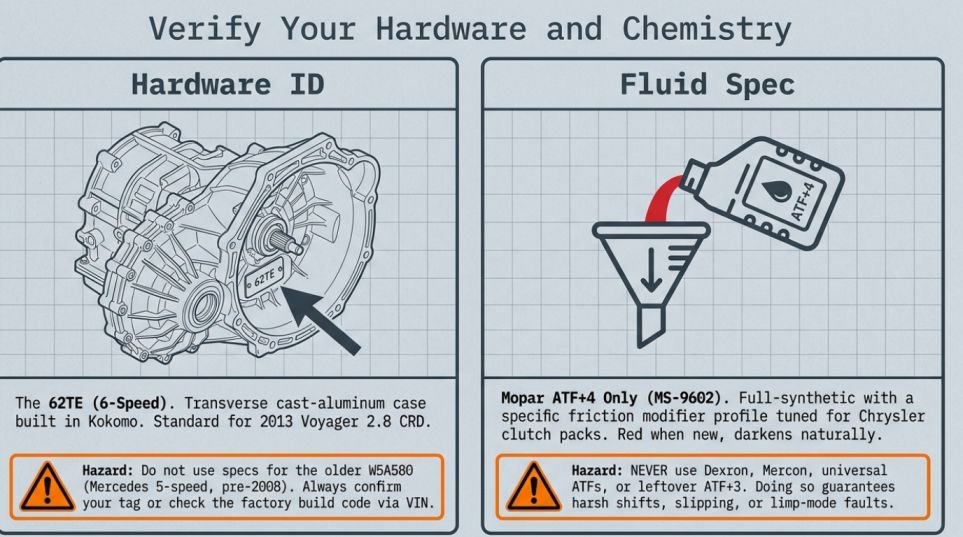
This matters because the wrong assumption here leads to buying the wrong fluid. RT-platform Voyagers and Grand Voyagers (2008 onward, which includes the 2013 model) built with the 2.8 CRD diesel use the 62TE transaxle. Used-parts listings for the Grand Voyager RT 2.8 CRD confirm the 62TE tag stamped on the case.
That’s a different unit from the W5A580, a Mercedes-derived 5-speed automatic fitted to the previous-generation Voyager and Grand Voyager (up to around 2007). Some parts sites and capacity aggregators still list W5A580 specs against “Voyager 2.8 CRD” because the old and new generations share a model name. If you cross-reference a capacity chart, check which generation it’s actually describing.
The 62TE is a transverse six-speed built at Chrysler’s Kokomo plant, shared with the Town & Country, Grand Caravan, and Routan on other engines. It’s rated to 260 lb-ft of torque and uses a cast aluminium case.
Confirm your transmission before you buy fluid
Don’t skip this step, especially if you bought the van used or it’s had transmission work before.
- Look for the ID tag on the transmission case itself, usually stamped or riveted near the bell housing. It reads “62TE” if it’s the standard unit.
- Pull your VIN and run it through a parts lookup (a dealer parts counter or a site like Mopar’s own catalog) to confirm the factory transmission code for your specific build.
- Check your service booklet or owner’s manual — European-spec manuals for this model list the transmission code alongside the engine code.
If the tag doesn’t say 62TE, stop and get the actual part number before ordering fluid or a service kit. A handful of early export units and pre-2008 stock swaps used other transmissions, and filling a non-62TE unit with the wrong quantity or spec causes real damage.
Correct fluid type for the Chrysler Voyager 2013 2.8 gearbox
Use Mopar ATF+4, or a fluid explicitly labelled as meeting the ATF+4 specification. That’s it. There isn’t a “close enough” substitute here.
ATF+4 is a full-synthetic fluid with a friction modifier profile tuned for Chrysler’s clutch packs. Dexron, Mercon, and most generic “universal” ATFs use a different friction modifier chemistry. Put one of those in a 62TE, and you’ll likely get harsh shifts, slipping between gears, or a limp-mode fault within a few thousand kilometres.
A few things worth knowing before you buy:
- ATF+4 is red when new and darkens with age and heat — that’s normal, not a sign of failure on its own.
- Store-brand fluids sold as “ATF+4 equivalent” exist and are generally fine if the bottle states it meets the Chrysler MS-9602 spec, which is the official ATF+4 standard.
- Don’t mix ATF+4 with older ATF+3 stock left over from pre-2001 vehicles. They’re not the same formulation.
Service fill vs total dry fill explained
Here’s why the litre figure changes depending on who you ask.
| Service Type | Litres | US Quarts | Fluid Specification | Transmission | Key Service Steps | Low/Degraded Fluid Symptoms |
|---|---|---|---|---|---|---|
| Service Fill (Pan Drop) | ~4 litres | ~4 US Quarts | Mopar ATF+4 (Chrysler MS-9602) | 62TE six-speed automatic | Warm engine. Drain pan. Replace filter & gasket. Torque pan bolts (~12 Nm). Refill. Check level at 70–80°C with engine idling after shifting through all gears. | Delayed engagement, harsh shifts, burnt odor, dark fluid, slipping under load, warning light or limp mode. |
| Total Dry Fill | ~7.6 litres | ~8 US Quarts | Mopar ATF+4 (Chrysler MS-9602) | 62TE six-speed automatic | Complete refill after rebuild, replacement, or teardown involving the pan, cooler lines, valve body, and torque converter. | Delayed engagement, harsh shifts, burnt odor, dark fluid, slipping under load, warning light or limp mode. |
| Service Fill with Cooler Flush | ~5.5–6 litres | Varies | Mopar ATF+4 (Chrysler MS-9602) | 62TE six-speed automatic | Pan drop plus fluid exchange machine to replace old fluid through the cooler circuit. | Delayed engagement, harsh shifts, burnt odor, dark fluid, slipping under load, warning light or limp mode. |
A pan drop only accesses the fluid sitting in the pan and the lower part of the case, roughly half the system. The rest stays in the torque converter, the cooler lines running to the radiator, and the valve body passages. A fluid exchange machine, which some shops use instead of a pan drop, pushes new fluid through while pumping old fluid out, getting closer to a full exchange without opening the case.
If your shop invoice says “8 quarts of ATF+4,” they either did a full exchange or a torque converter drain along with the pan drop, not a basic pan-and-filter service.
How to check and top up the gearbox oil level
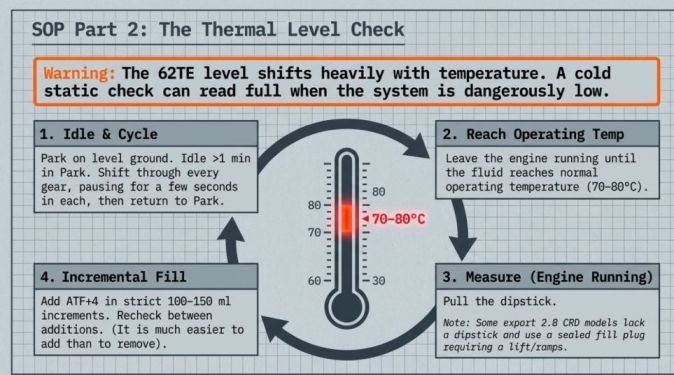
The 62TE doesn’t use a simple cold dipstick check the way older Chrysler transmissions did in some markets. Follow this sequence:
- Park on level ground and let the engine idle in Park for at least a minute.
- Shift through each gear (Park, Reverse, Neutral, Drive, low gears), pausing a couple of seconds in each, then return to Park.
- With the engine still running, pull the dipstick (where fitted) or check the fill plug level once the fluid reaches normal operating temperature, roughly 70–80°C.
- Add fluid in small amounts, about 100–150 ml at a time, rechecking between additions. It’s much easier to add than to remove.
- Wipe the dipstick or plug threads and reseat properly to avoid a slow weep leak.
If your van doesn’t have a conventional dipstick (some export 2.8 CRD models use a sealed fill plug instead), the level check needs to be done through the fill plug hole while the fluid is at temperature, which is easier with a lift or ramps.
Full drain and refill (pan drop) procedure
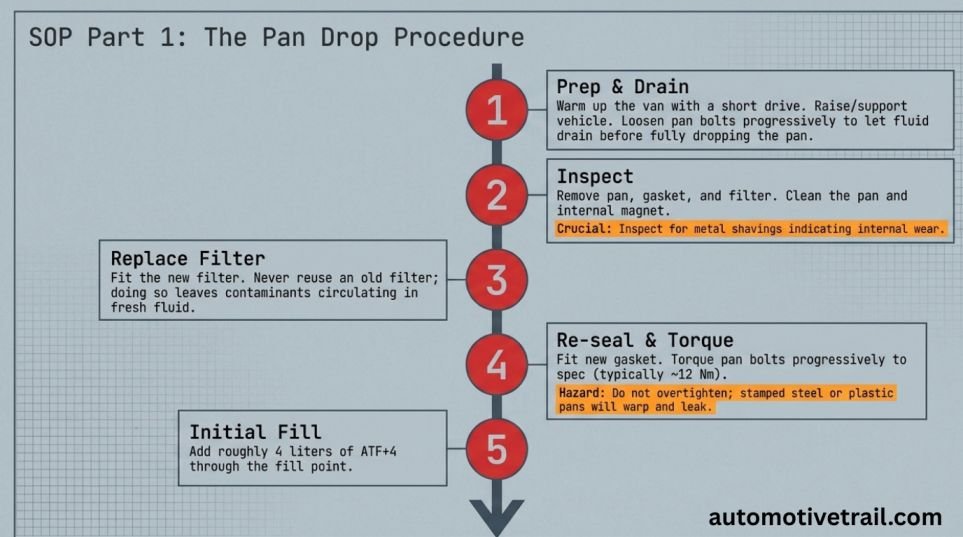
This is the job most owners are actually planning when they search for the litre figure.
- Warm the van up with a short drive so old fluid drains fully rather than clinging to the pan.
- Raise and support the van, then place a drain pan under the transmission oil pan.
- Loosen the pan bolts progressively, working around the perimeter, letting fluid drain as it loosens rather than dropping the pan all at once.
- Remove the pan, gasket, and filter. Clean the pan and magnet of debris, and inspect the fluid and any metal shavings for signs of internal wear.
- Fit the new filter and gasket, torque the pan bolts to spec (check your service data, typically around 12 Nm — don’t overtighten a stamped steel or plastic pan).
- Refill with roughly 4 litres of ATF+4 through the fill point, then run the level-check sequence above.
- Top up in small increments until level, then take a short drive and recheck once warm.
Budget half a day if it’s your first time, less once you’ve done it once. A basic filter and gasket kit plus 5 litres of ATF+4 is the standard shopping list.
Mistakes that damage the 62te transmission
These aren’t hypothetical. They’re the most common ways owners turn a routine service into a repair bill.
- Using the wrong fluid. Dexron/Mercon-based ATF in a 62TE causes shift flare and eventual clutch damage.
- Overfilling. Excess fluid gets aerated by the rotating components, causing foaming, pressure loss, and slipping.
- Checking the level cold and static. The 62TE’s level reading shifts with temperature; a cold check can read full when it’s actually low.
- Skipping the filter. Reusing an old filter after a fluid change leaves contaminants circulating in fresh fluid.
- Overtightening the pan bolts. Warped stamped-steel or cracked plastic pans are a common, avoidable leak source.
- Ignoring a slow leak. A van that’s a quart low for months runs hotter and wears the clutch packs faster, even if it still shifts normally.
What it costs to change the gearbox oil
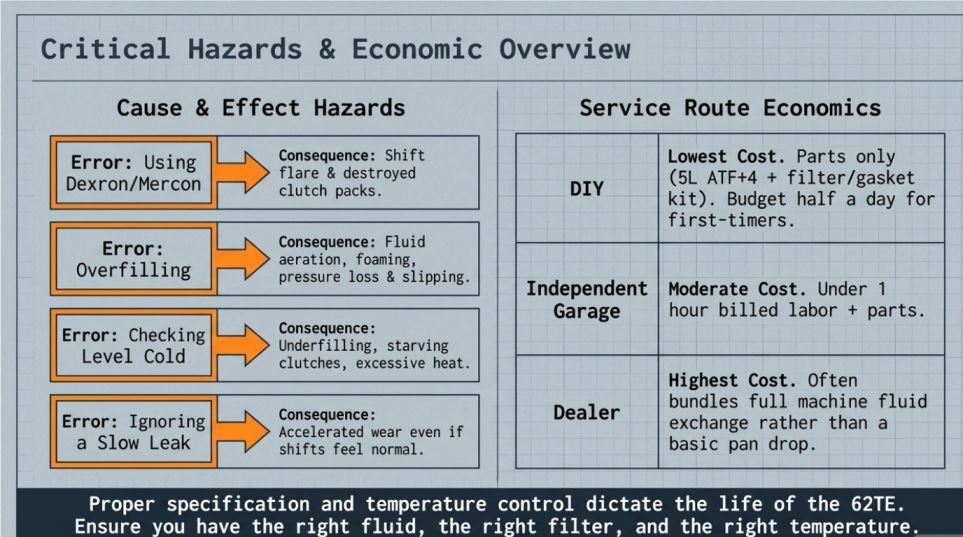
Costs vary by region, but the rough shape holds across most markets.
DIY:
- ATF+4 (5 litres): moderate cost, widely available from parts stores
- Filter and gasket kit: low to moderate cost
- Total: parts only, a few hours of labour
Independent garage:
- Labour plus parts for a standard pan-drop service: a modest one-off cost, usually under an hour of billed labour
- A fluid exchange machine service costs more than a pan drop since it uses more fluid and machine time
Dealer:
- Typically the highest quote of the three, often bundling a full fluid exchange rather than a basic pan drop
If the van has never had the transmission serviced and has covered a high mileage, budget for the filter kit regardless of route, since a filter that’s never been changed is usually due.
Signs the gearbox oil needs changing now
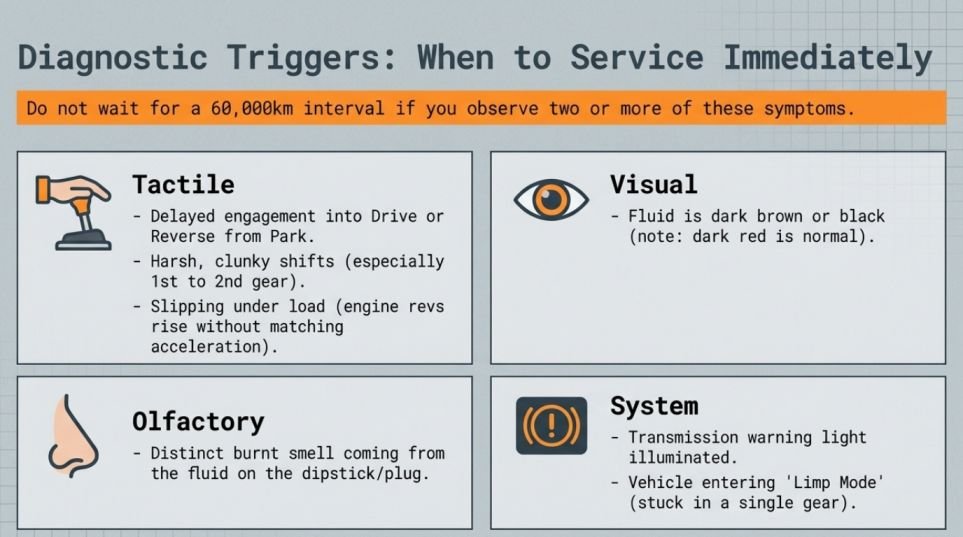
Don’t wait for a fixed mileage number if you’re seeing any of these:
- Delayed engagement into Drive or Reverse after sitting in Park
- Harsh or clunky shifts, especially noticeable from 1st to 2nd gear
- A burnt smell from the fluid, distinct from its normal reddish colour when fresh
- Dark brown or black fluid instead of red or light amber
- Slipping under load, where the engine revs rise without matching acceleration
- A dashboard transmission warning light or the van entering limp mode (stuck in one gear)
Any of these on their own is worth checking. Two or more together usually means the fluid, and possibly the filter, are overdue.
Summary: how much oil to buy and what to do
For a standard maintenance job on a 2013 Chrysler Voyager 2.8 CRD with the 62TE transmission, buy 5 litres of Mopar ATF+4 to cover the roughly 4-litre service fill with a margin for topping up. Only budget for the full 7.6-litre figure if you’re filling a transmission from completely empty.
Confirm the 62TE tag on your unit before buying anything, since the older W5A580 5-speed shows up in some capacity charts under the same model name. Use ATF+4 specifically, check the level while warm and running rather than cold, and don’t skip the filter when you drop the pan. Get those four things right, and this is a straightforward home job, not a trip to the dealer.
FAQ
Does the Chrysler Voyager 2013 2.8 CRD use ATF+4 or a different fluid? It uses Mopar ATF+4 specifically. The 62TE transmission’s clutch packs are calibrated for ATF+4’s friction properties, and other ATF types can cause shift problems or damage over time.
Is the Chrysler Voyager 2013 2.8 automatic transmission the same as older Voyager models? No. The 2013 model uses the 62TE six-speed, while pre-2008 Voyagers used the 5-speed W5A580. They have different fluid capacities and fluid specs, so don’t cross-reference specs between generations.
Can I check the transmission fluid level with a dipstick? Some 2.8 CRD export models have a conventional dipstick, while others use a sealed fill plug that needs checking with the engine running at operating temperature. Check your specific van’s setup before assuming a cold dipstick reading is accurate.
How often should I change the gearbox oil on this van? There’s no single universal interval since it depends on market and usage, but many owners service it every 60,000–80,000 km or if symptoms like harsh shifting or dark fluid appear sooner.
What happens if I put too much or too little ATF+4 in the 62TE? Overfilling causes foaming and pressure loss that shows up as slipping or erratic shifts. Underfilling starves the clutch packs and cooler circuit, which raises operating temperature and accelerates wear.
Do I need to flush the torque converter during a normal service? Not for a basic maintenance change. A pan drop and filter change (about 4 litres) is standard practice. A full converter flush is only needed if the fluid is heavily contaminated or after major transmission work.802 × 447

- Top 10 Ranking Tire Brand for Minivan: Reviewed 2026 - October 5, 2026
- Model Y Tesla Long Range Automatic Wagon Tyre Fitment And Ratings - October 3, 2026
- What Is The Benefit Of Larger Rear Tyres On A Zero-turn Mower - October 3, 2026