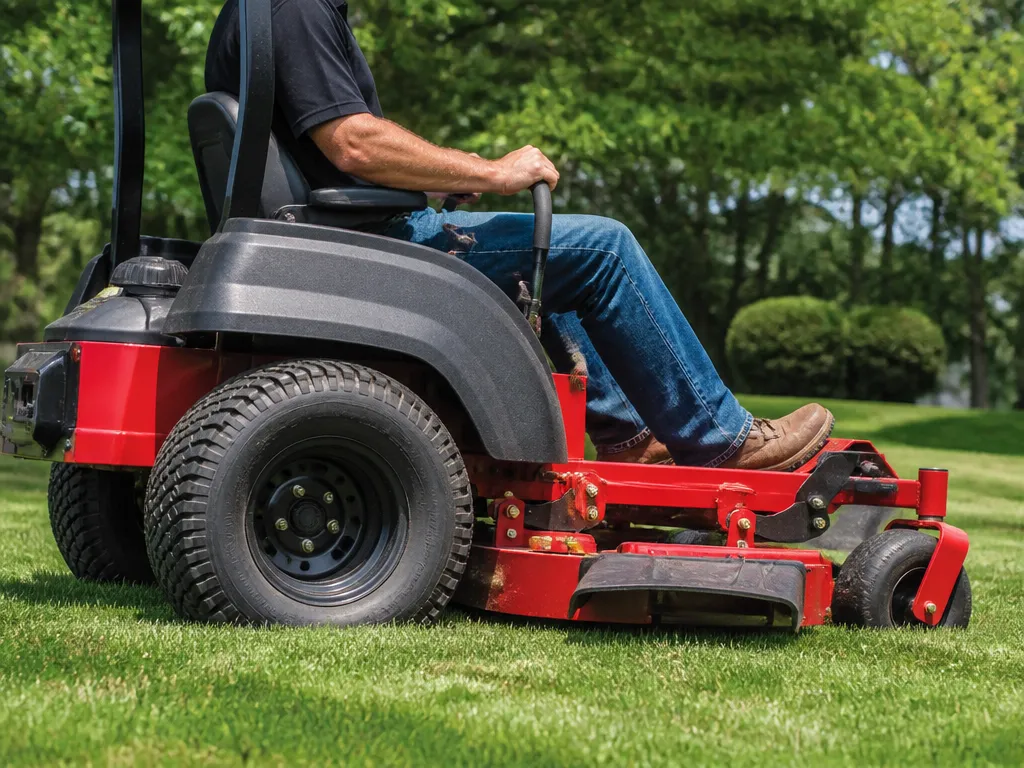
Your zero-turn is spinning the rears when the grass is wet, or it feels twitchy on climbs. Maybe you’re thinking about upsizing the rear tires you see listed for 42- to 54-inch machines, like the common 23×10.50-12 sizes. Bigger rear tires can change traction, stability, and even how fast the mower feels, so the “right” size is about more than ground grip.
Larger rear tires often bring more flotation (less sinking), more usable traction (less wheel slip), and better side-hill stability when their added width or volume spreads the load effectively. The trade-offs are fitment and clearance checks plus a real chance of speed and torque changes since tire circumference affects effective gearing.
Rear tire size can improve traction and flotation on wet or uneven ground by reducing how easily the tire loses grip and sinks into soft spots. A larger diameter also changes effective gearing, so the mower’s theoretical ground speed can increase while available wheel torque decreases; under load, it may therefore feel slower. Expect fitment and belt or drive clearance needs before ordering.

What Is The Benefit Of Larger Rear Tyres On A Zero-turn Mower?
Larger rear tires can give a zero-turn mower a wider or more compliant footprint and more leverage against the ground, which improves traction and stability while you swing the machine around. When the larger tire is also wider or operated at the correct pressure, its tread can “float” over shallow ruts and soft patches instead of digging down and spinning.
Why The Rear Tires Do The Work

Zero-turn mowing puts drive power to the rear wheels, so the rear tires do most of the traction heavy lifting. Front caster wheels mainly guide direction and control balance, while the rears handle pulling the mower and resisting sideways slip during those sharp pivots.
In practice, your rear tires are dealing with three loads at once: the mower‘s weight, side load from turning, and the shear load of grass and debris under torque. When those rear wheels are better suited to the surface, you get fewer “free-wheeling” moments and a steadier deck height because the machine stays planted.
How Bigger Diameter Changes What The Mower Can Do
Increasing rear tire diameter changes how the tire meets the ground and how the mower behaves through the turn. A common ZTR rear size range is around 18×8.50-8 through 24×12.00-12 depending on deck size and class, and the larger sizes are typically found on bigger residential and commercial machines.
| Rear tire size (common range) | Where you commonly see it | What it tends to improve |
|---|---|---|
| 23×10.50-12 | Many 42 to 50 inch residential zero-turns | Ride comfort and steadier grip on typical lawn unevenness |
| 24×12.00-12 | Wider, commercial-class rear setups (50-inch and up decks) | Flotation and stability in softer or bumpier ground |
| 22×11.00-10 | Mid-size commercial and some larger residential | Better resistance to rutting under drive load |
Trade-offs exist. A larger rear diameter can increase theoretical ground speed while reducing mechanical advantage, so top speed, pulling performance, and mowing feel can differ. Clearance matters too (belt, deck, fender, and frame links). Fitment also affects how quickly the mower pivots, because the effective tire radius changes the arc and ground scrub during counter-rotation turns.
Mechanic’s tip: If the mower manual says 23×10.50-12 is the max for your frame and deck class, staying inside the approved rear sizes prevents belt clearance issues and keeps the speed/traction balance where the ZTR was tuned.
On grass and soil, the biggest real-world wins show up when conditions are messy: wet spots, muddy edges, and uneven mowing lanes. Larger rear tires help the mower keep momentum without wheelspin, which improves mowing consistency because the deck stays closer to its intended height and path.
Traction And Wheel-slip Reduction

Larger rear tire size can increase the tire’s contact patch when the tire is wider or correctly inflated, allowing more tread to bite into wet grass or soft soil under load. On a zero-turn, that extra grip means less wheel slip when you climb, cross ruts, or power through thick growth. Reduced slip also keeps the traction you paid for working instead of wasting energy as heat and barked turf.
Contact patch size is the real traction story, not tire diameter alone. A larger, properly inflated rear tire can spread the load across more tread, which improves forward drive and steadier braking from the drive system. Sidewall flex matters too, because a taller tire can deform more without bottoming out, which lets the tread stay closer to the ground over uneven surfaces.
Contact Patch And Sidewall Flex In Real Mowing
On a ZTR, the rear wheels carry drive load while the front casters follow. When you hit uneven ground or cut into thick wet grass, the rear tires see quick changes in load, so tread contact has to stay consistent. More tire volume also helps the tire absorb small impacts, which reduces the “bounce and spin” effect that triggers slipping.
| Condition | What larger rears help with | What you may feel |
|---|---|---|
| Thick or wet grass | Better tread bite and less spin from improved contact patch under load | Cleaner cut through heavy areas with fewer interruptions |
| Ruts and uneven ground | More sidewall compliance keeps more tread on the ground | Smoother tracking, fewer sudden skid events |
| Climbs and banks | Higher effective traction before the tire reaches its slip threshold | Less “stalled feel” when you power uphill |
Sidewall flex is a balancing act. Softer, more compliant tires can grip better on uneven turf, but they can also feel slower to respond if you overinflate or underinflate. Staying within the tire’s recommended pressure range keeps the tread flat enough for bite while still allowing flex over bumps.
Bite On Loaded Tires During Counter-rotation Turns

Zero-turn turns often use counter-rotation, which creates extreme lateral and torque loading on the rear tires. In those moments, each drive wheel is trying to both roll and resist sideways scrub, so the tire reaches slip sooner if the contact patch is small. Larger rear tires give you more “work area” for traction when the deck is loaded, and the machine pivots around its turning axis.
For example, a residential 42 to 50-inch class ZTR commonly runs rear sizes around 23×10.50-12, while wider commercial-class rears may be bigger in diameter and width on larger machines. Moving up in size within the same rim and overall fitment envelope typically reduces how often you feel the mower grab-release-grab during those tight, fast pivots.
Counter-rotation turns are where tire size shows up the fastest, because that’s when wheel slip spikes. If larger rear tires are correctly inflated and fit with proper clearance, you usually feel it first in how confidently the mower pivots without flinging grass or stuttering.
Effective Gearing And Ground Speed Change

Larger rear tires change the mower’s effective “gear ratio” by increasing rolling circumference, so the drive system moves the wheels through more distance per revolution. That can raise theoretical ground speed and reduce wheel torque at a given drive-system speed; under heavy grass or on a climb, the mower may therefore feel slower because it has less mechanical leverage.
Rolling circumference is what matters for real ground speed, not just the tire’s labeled diameter. Two tires with the same width can still have different effective circumference due to tread design and how much they squash under load, so your speed change can be smaller or larger than expected.
Rolling Circumference To Real Ground Speed
A rear tire upgrade increases ground speed per wheel revolution, but the mower’s hydro or belt-driven system still “thinks” in terms of wheel speed. For a hydraulic ZTR, lever travel maps to input shaft speed, and the larger tire radius means the unit covers more feet per revolution, so you feel more distance gained with each increment of control.
In practice, many owners notice that the mower’s travel speed range shifts. The top speed may feel higher on flat ground, while the mid-range can feel different during mowing rows because the mower reaches “forward pace” at a different lever position than before.
Steering And Drive Response You Feel Day-to-day
Larger rear tires also affect how quickly the ZTR responds during differential turning. Zero-turn machines rely on rapid changes in wheel direction speed; with bigger tires, the wheel speed change creates a different ground arc, so steering can feel either smoother or more “heavy” depending on your tire choice and inflation.
For example, a taller, stiffer tire can make throttle and lever inputs feel more delayed on tight turns, because the machine covers more ground per wheel rotation before the deck alignment “catches up” with your steering. A more compliant tire can do the opposite, adding a slight lag from sidewall deflection, which can smear the cut edge if your overlap is too tight.
Owner tip: After a rear tire size change, run a 10 to 20 ft test pattern and adjust your mowing speed before you chase perfect stripes. You are tuning “cutting rhythm,” not just speed.
When Speed Feel Changes Can Affect Cut Quality
Cut quality on ZTRs depends on blade tip speed, airflow through the deck, and consistent forward pace so the grass gets the same “chop and lift” each pass. If larger rears make you naturally travel faster on flat ground, you may notice the deck leaving uncut strips at the ends of turns or during overlap, especially in thicker growth.
In contrast, if the mower slows under load and your RPM drops into a low-load zone, the deck can lose lift, and you can see clumping or uneven discharge. The fix is usually straightforward: hold rated cutting RPM and adjust travel speed until the cut looks repeatable across straight runs and your typical turn path.
| Observed change | Common cause with larger rear tires | What to try |
|---|---|---|
| Stripes look uneven where you overlap | Travel pace changed, steering arc changed | Slow down slightly and keep overlap consistent |
| Clumps or heavier discharge than before | Forward speed drops too much, or RPM falls | Keep cutting RPM up and return to the prior pace zone |
| Steering feels slower or “pushes” wider | Ground arc changes with tire circumference | Relearn lever timing and make wider, cleaner arcs |
Stability During Zero-radius Turns
Larger rear tires can reduce the “wallow and wander” that happens when a zero-turn mower pivots hard, because the drive wheels keep better contact and maintain a steadier stance under load. When you push left or right to near zero-radius, the mower transfers weight to the outside wheel, and a taller or wider rear helps the tire scrub less violently across grass and soil.
Load Transfer And Lateral Scrub During Differential Steering
Zero-turn steering makes each side move at a different effective speed, so the outside rear tends to carry more load while the inside rear unloads. That load shift changes how easily the rear tires slide, and sliding turns into fishtailing when one side regains grip sooner than the other.
More rear tire diameter and section width increase the tire’s ability to “hold on” during that transient moment.
In practice, that means less abrupt lateral scrub at the rear and fewer steering corrections, so the mower tracks straighter while you’re carving tight arcs.
Why Taller And Wider Rears Can Feel More Planted
Real-world “planted” feel comes from the combination of contact area and how the tire deforms under side load. Taller rears also change the rolling behavior, and that can make control inputs feel more linear when you’re near full differential.
For common residential ZTR sizes, the rear tire diameter increase is often the difference between sizes like 20×8 or 20×10-8 versus the very common 23×10.50-12 on many 42 to 50 inch class mowers. That extra height and width typically helps the tire resist sudden grip release when you’re turning across damp grass or slightly rutted turf.
| Rear tire change | Stability effect in hard turns | Trade-off to watch |
|---|---|---|
| Wider rear (more section width) | Less side-to-side twitch from reduced lateral scrub | Clearance limits near deck frame and belt/axle components |
| Taller rear (more diameter) | Smoother grip transitions during load transfer | Small speed change and altered steering feel due to effective gearing |
| Both wider and taller | Most noticeable reduction in fishtailing on uneven turf | Greater chance of rubbing and more tire cost |
Insider tip: If your mower starts to “hunt” during zero-radius turns, check tire pressures first. A larger rear tire won’t behave right if it’s underinflated or uneven across sides.
Flotation on Ruts And Wet Ground

Larger rear tires, particularly wider or larger-volume tires, can spread mower weight over a bigger contact patch, which lowers ground pressure and helps the tires ride over soft spots instead of digging in. On wet grass, that extra footprint reduces sinking during acceleration and during the weight transfer that happens as you load the drive tires. The result is fewer ruts and less churn compared with smaller rear sizes.
Ground pressure is the practical “why” here. A wider rear tire has more area touching the ground, so the same mower mass produces less force per square inch, especially on muddy turf where the surface collapses easily.
Flotation On Uneven Terrain
Uneven terrain compliance is where taller rear tires pay off. As the deck rides over bumps, the rear tire has more sidewall and rolling height to keep the tread engaged instead of popping down into every depression. That steady contact helps traction stay consistent, so the drive wheels spin less when the ground turns from damp to soft.
For example, on driveways with packed soil ridges or on yard paths with shallow ruts, a bigger rear tire is more likely to bridge the low spots. Bridging reduces the “plow effect” that happens when smaller tires drop into a rut and force the tread to re-earn grip with every rotation.
Ruts, bumps, and thick grass also affect how traction “arrives” at the tire. When the tire tread stays in contact longer over changing ground, the mower can hold drive traction through minor obstacles, which means fewer skid moments and less turf scuffing.
| Condition | What smaller rear tires tend to do | What larger rear tires tend to improve |
|---|---|---|
| Soft, wet spots | Sink and deform, increasing wheel slip | Float and roll over, reducing rut depth |
| Shallow ruts | Drop into grooves, creating churn | Bridge low spots, smoother drive engagement |
| Thick, damp grass | Grab clumps, slow down then spin | More consistent contact, steadier traction |
Insider tip: If you routinely mow right after rain or on clay soils, the biggest real-world gain from upsizing rears is fewer deep ruts from drive-tire digging, not higher top speed.
Common rear fitment size ranges vary by deck class, but the takeaway stays the same: moving to the next practical rear diameter (and width the mower is designed to accept) can increase flotation. That is why you’ll often see typical ZTR rear sizes like 22×9.50-12 or 23×10.50-12 on larger machines, while residential units more commonly use smaller rear sizes.
Trade-offs: Fitment, Clearance, Wear
Larger rear tires can improve traction and flotation, but they also create real hardware problems if you do not check clearances. More tire diameter can squeeze the deck skirt, interfere with the wheel motor or hub, and change belt and drivetrain angles. Wrong choices can also accelerate wheel motor stress and make belt wear spike.
Deck And Frame Clearance Problems
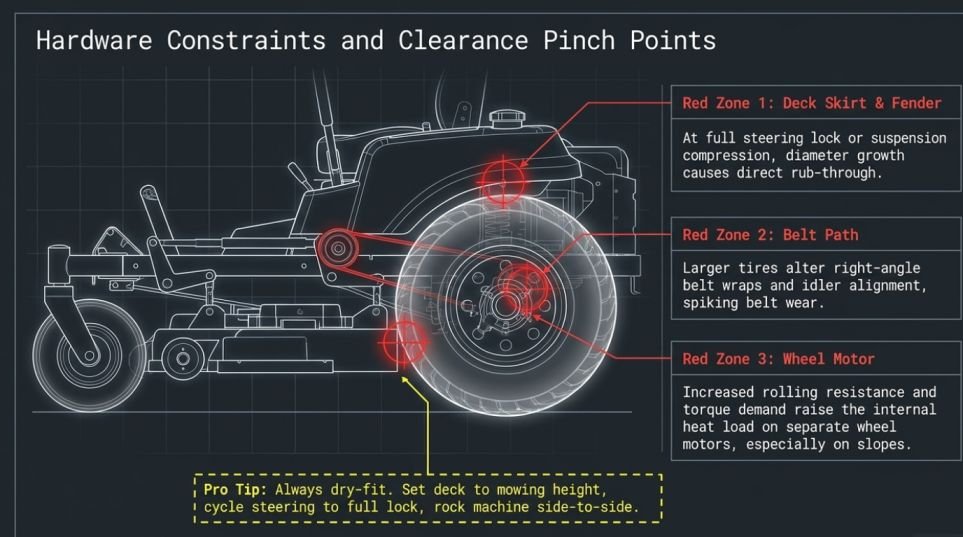
Cutting decks and wheel motors have tight running space, and a bigger tire is simple math plus suspension movement. If the tire growth is mainly diameter, it raises the wheel height and changes how close the tread comes to the deck skirt, discharge area, and frame rails during bumps and full lock turns. Belt wrap and idler alignment can suffer too, especially on decks that route belts near the right-angle turns.
For example, a 42 to 50 inch residential ZTR often uses common rear sizes around 23×10.50-12, while wider commercial rears around 24×12.00-12 show up on larger fabricated decks. Jumping to a wider or taller size without verifying the manual or measuring can cause rub at full compression or while turning across a crowned lawn.
Tip: Dry-fit by setting the deck height to mowing position, then cycle steering to full lock while rocking the machine side to side. If you see even light contact, stop and correct fitment before you mow.
Belt And Motor Clearance, Plus Drive Stress
Zero-turns use belt drives and separate wheel motors, so extra clearance needs to exist at two places: the belt path and the motor-to-tire relationship. Larger rear tires can raise belt tension requirements, alter pulley alignments, and shorten belt life if the belt runs “off line.” Bigger rolling resistance can also increase heat load on wheel motors during repeated climbs or wet mowing.
Wheel motors can be sensitive to how the machine is used, and larger tires raise the torque demand when cutting heavy grass or turning on slippery slopes.
For instance, steering at speed with larger tires can force more corrective control input, increasing internal motor load. Heat and wear will rise if the mower is repeatedly worked at the edge of traction.
Mismatched Circumference And Why Uneven Rear Sizes Are A Problem
Mixing different rear tire circumferences creates a constant “speed mismatch” between left and right drive wheels. A zero-turn depends on matched rolling radii to hold neutral and to travel straight during overlapping cuts. Even small differences in diameter or tread wear can make one side try to outrun the other.
Wear rate differences can also do the damage over time. If you choose a softer compound on one side or run different pressures between sides, the circumference gap grows, and the driveline works harder trying to correct it.
Tread Choice Shifts Mowing, Scuffing, And Traction

Larger tires let you run more flotation, but tread pattern controls how the machine bites versus how it scrapes. Turf-style “super turf” treads often protect grass but can reduce bite in thick, wet clumps, which increases slip and heat. Traction-oriented patterns can grab harder, yet they may also increase drag and scuff marks on delicate lawns.
For practical setup, keep tread style matched to your mowing surface and cut height. Kenda-type rear sizes commonly used on ZTR rears include 22×11.00-10 and 23×10.50-12, and the tread style choices (terra trac versus chevron versus super turf) reflect that “grab versus ride” trade-off. If your ground is sandy or rutted, a traction tread may reduce slipping. If your ground is mostly smooth and you care about cleanup, a turfier tread can reduce visible mowing damage.
| Tread direction | Typical trade-off | When it helps most |
|---|---|---|
| Super turf/turf focused | Less lawn scuffing, easier on grass | Residential lawns, dry or light to moderate grass |
| Chevron/traction focused | More bite, more drag and potential marks | Wet clumps, uneven ground, heavier cutting loads |
Bottom line: Bigger rear tires are only a win when the deck, belt path, and wheel-motor clearance are correct, and both rear tires match in overall size and wear.
When Larger Rear Tyres Are Worth It

Larger rear tires help most when your traction changes a lot from day to day, because more diameter and width can improve grip and stability while keeping the tire from slipping as easily in soft or wet ground. The upgrade usually shows up most on wet grass, slopes, ruts, and frequent side-hill work, where flotation and tread contact matter more than maximum mower speed.
| Cutting condition | What bigger rear tires tend to improve | What can feel worse |
|---|---|---|
| Wet grass | More flotation and a larger, slower “digging” effect so the tire slips less during turns and climbs | Heavier feel in steering if tire width increases, plus extra rolling resistance |
| Slopes and climbs | Better rear contact and reduced wheel spin, which helps maintain drive to the deck | Effective gearing can reduce wheel torque, making the mower feel slower uphill |
| Frequent side-hill mowing | More stable stance and reduced breakaway traction when the weight shifts to one rear tire | More slip sensitivity if the tire pattern is wrong for your grass type |
| Uneven lawns, ruts, heavy compaction | Better ability to bridge small ruts and stay on tread contact instead of hopping or skidding | Ride can feel firmer if the upgrade is a higher-ply tire or narrower tread |
| Smoother, dry residential lawns | Slight improvement in comfort and mowing consistency | Little real traction gain, higher cost, and potential clearance or speed changes |
Wet Grass, Slopes, And Side-hill Mowing
Wet grass is where rear tire diameter and tread contact make the biggest difference because the tire has to keep moving through a thin layer of slick turf instead of “skating” on top of it. For many homeowner ZTRs, common rear sizes include 23×10.50-12 (often on 42- to 50-inch residential zero-turns) and wider 24×12.00-12 setups on larger decks, so upsizing within the same rear-width family can improve how consistently the rear stays planted during tight turns.
For slopes and climbs, bigger rears can reduce spin by increasing the usable traction area at the same throttle setting. For side-hill mowing, a larger tire often helps maintain a more stable contact patch when the machine shifts load toward one side, but only if the tire profile fits your wheel and deck clearance and the tread pattern matches wet grass rather than dry turf.
Uneven Lawns With Ruts Or Heavy Compaction
Uneven ground punishes small rear tires because they lose contact and then re-contact abruptly, which causes traction to drop and steering to feel twitchy. The same flotation idea applies here: bigger rear tires spread load slightly better and are more likely to roll over ruts instead of digging in.
Heavily compacted areas (work paths, frequent wheel tracks, or drive gate routes) benefit from a sturdier tire build; often the 4-ply versus 6-ply decision matters as much as size. A more puncture-resistant tire can keep you from swapping flats every season, but the trade-off can be a harsher ride and more vibration on rough lawns.
Smoother Turf Where Upgrades May Not Deliver Noticeable Gains
Dry, well-kept lawns with minimal dips usually do not need a rear tire size jump because traction is already stable and the mower spends most of its time in the same grip range. If your ZTR mainly cuts straight lines and you do not fight wheel spin on turns, the upgrade may feel more “heavier” than meaningfully better.
Larger tire changes can also alter effective gearing since the drive wheels cover more distance per revolution, so the mower can feel faster on flat ground but lose torque under load. If you are mowing mostly flat, dry ground, your money is usually better spent on the correct tire type for your grass (turf versus more aggressive traction) rather than chasing bigger diameter.
Practical rule: If you routinely see rear wheel spin, shiny slick patches after you turn, or the mower “falls off” traction on wet grass or side-hills, larger rear tires are likely worth it. If you mow mostly dry, level turf and never feel traction limits, the gains are usually subtle.
Rear Tyre Upgrade Checklist

Right-size rear tires improve traction and stability, but only when the upgrade matches fitment, load rating, and tire rolling behavior. A larger rear tire can change effective gearing, turning response, and mowing height consistency if you do not verify clearance and circumference.
| Check | What to confirm | What goes wrong if you skip it |
|---|---|---|
| Size fitment | Exact sidewall size and compatible rim width | Tire rub, bead issues, early sidewall damage |
| Tread selection | Turf-saver vs aggressive bite for your surface | Scalping lawns or losing traction on wet ground |
| Load/plies | Load rating and carcass strength match conditions | Squirm, faster wear, heat buildup during pivots |
| Clearance | Safe clearance at full steering and suspension travel | Rub-through, belt/drive contact risk |
| Circumference balance | Same overall diameter left and right | Pulling, uneven turning response, faster component wear |
Insider tip: if you change tire brand or tread style while keeping the same printed size, measure overall diameter and confirm sidewall markings are truly equivalent. Two “23×10.50-12” tires can behave differently once tread depth and carcass build get involved.
Quick Summary
Larger rear tires on a zero-turn mower are mainly about traction and stability when conditions get rough. Bigger rear tires can bring more flotation, meaning less sinking into soft spots, and more usable traction by reducing wheel slip. They can also improve side-hill stability when their width, pressure, and tread keep the mower planted instead of twitching or spinning when grass is wet, uneven, or rutted.
Beyond grip, upsizing changes how the mower behaves because tire circumference affects effective gearing. The theoretical ground speed can increase, while reduced wheel torque may make the mower feel slower under load. Common rear sizes include 23×10.50-12 for many 42 to 50 inch machines and 24×12.00-12 on wider 50 inch and up decks, with size jumps that can require clearance checks for belt, deck, fender, and frame links. Match rolling circumference close to stock and stay within manual-approved rear sizes to avoid speed and fitment problems.
| Rear tire size (common) | Common where you see it | Main benefit mentioned |
|---|---|---|
| 23×10.50-12 | Many 42 to 50 inch residential ZTRs | Ride comfort and steadier grip on uneven lawn |
| 24×12.00-12 | 50 inch and up, wider commercial-class setups | Flotation and stability in softer or bumpier ground |
| 22×11.00-10 | Mid-size commercial and some larger residential | Better resistance to rutting under drive load |
Frequently Asked Questions
What Benefit Do Larger Rear Tires Give A Zero-turn Mower When Mowing On Rough Ground?
They help with ride comfort and grip by increasing tire contact and rolling stability over uneven turf. On many 42- to 50-inch residential zero-turns, the common rear size is around 23 x 10.50-12, while wider/commercial setups often run larger rear tires like 24 x 12.00-12 to handle heavier loads and traction demands.
Do Bigger Rear Tires On A Zero-turn Mower Improve Traction On Hills Or Wet Grass?
They can, because a larger rear tire usually provides more stable drive traction for the rear wheels that power the mower. The tradeoff is they can also change how the mower’s deck follows the ground, so the tire size still needs to match what the model is designed to run.
Will Larger Rear Tires On A Zero-turn Mower Increase Cutting Quality Or Reduce Scalping?
More stable rear wheel tracking can help reduce harsh bouncing that contributes to scalping, especially when you mow over ruts or uneven lawns. This effect is more noticeable when the larger tire improves sidewall support and keeps the deck attitude steadier over bumps.
Can I Put Larger Rear Tires On My Zero-turn Mower Without Causing Problems With Drive System Performance?
Changing rear tire size can alter ground speed, wheel torque, and effective gearing. Common ZTR rear sizes vary from about 20 x 8.00-8 to 23 x 10.50-12 depending on deck size and class.
Are Larger Rear Tires On A Zero-turn Mower More Expensive To Replace?
Often, yes, because larger and wider rear tires are usually built with more material and come in heavier-duty constructions. Expect cost to vary a lot by brand and ply rating, but the sizes that are common on mid-size and commercial rears, like 22 x 11.00-10 or 23 x 10.50-12, typically cost more than smaller residential rear sizes.
What’s The Most Common Mistake When Upgrading Zero-turn Mower Rear Tires To A Larger Size?
The biggest mistake is mixing tire sizes that aren’t matched to the mower’s intended rim size and pairings, which can cause uneven wear and drive feel. Always confirm your rear tire’s size and rim width match the axle and wheel you have, and don’t mix different rear tire sizes on the same mower.

- Top 10 Ranking Tire Brand for Minivan: Reviewed 2026 - October 5, 2026
- Model Y Tesla Long Range Automatic Wagon Tyre Fitment And Ratings - October 3, 2026
- What Is The Benefit Of Larger Rear Tyres On A Zero-turn Mower - October 3, 2026