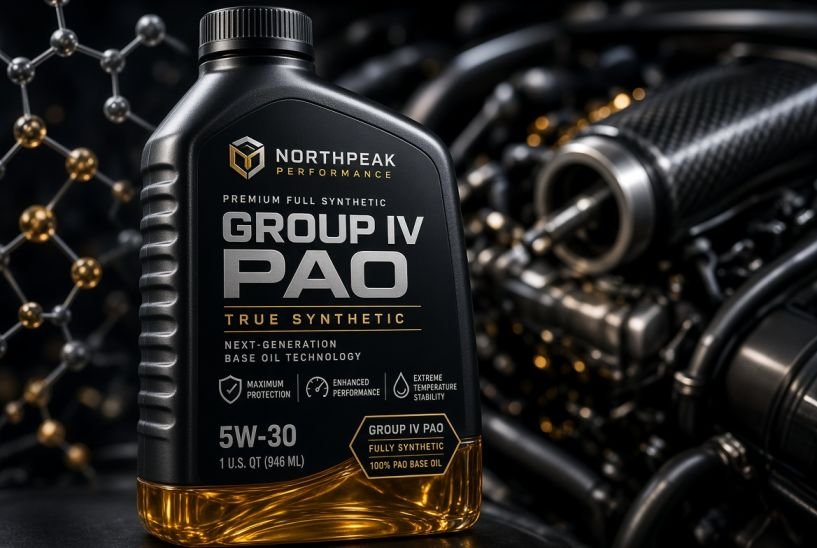
A quart of true Group 4 oil costs about twice what a quart of Group 3 “full synthetic” costs, and most of the oil on the shelf labeled full synthetic isn’t Group 4 at all.
Direct answer: Group 4 (PAO) oil is worth the extra money if you tow, track your car, live somewhere that swings from -20°F to 100°F, or run extended drain intervals past 10,000 miles. For a normal commute in a modern engine changed every 5,000 to 8,000 miles, a good Group 3 synthetic does the same job for less.
Key takeaways
- Group 4 base oil is polyalphaolefin (PAO), built in a reactor rather than refined from crude, with a viscosity index typically above 130.
- Most “full synthetic” oils on U.S. shelves, including standard Mobil 1, are Group 3 hydrocracked mineral oil, not PAO.
- Group 4 oil runs roughly $9 to $13+ per quart versus $6 to $9 for Group 3, based on approximate 2026 U.S. retail pricing.
- The performance gap shows up mainly in cold-start flow, high-temperature oxidation resistance, and extended-drain durability, not in everyday stop-and-go driving.
- Check the safety data sheet (SDS) before paying a premium. “Hydrotreated heavy paraffinic” on the label means Group 3, not Group 4.
What “Group 4” actually means
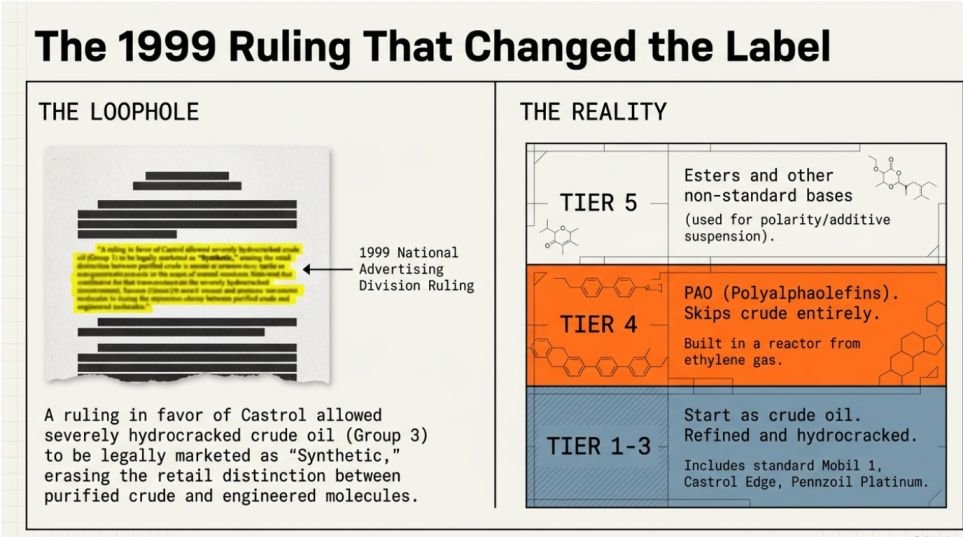
The American Petroleum Institute splits base oils into five groups, and the group number tells you how the oil was made, not how good it “feels.” Groups 1 through 3 start as crude oil and get refined, hydrocracked, or further processed to clean them up. Group 4 skips crude oil entirely. It’s built from polyalphaolefins, synthetic molecules assembled from ethylene gas through a chemical reaction, not pulled out of the ground and purified.
That manufacturing difference matters because it gives PAO a uniform molecular structure. Crude-derived oils, even heavily processed Group 3 ones, contain a mix of molecule shapes and sizes left over from the refining process. PAO molecules are close to identical to each other. A uniform structure resists breaking down under heat and shear more consistently, and it flows better at low temperatures because there aren’t odd molecule shapes clumping together as the oil cools.
Group 5 covers everything else that doesn’t fit the first four groups, mainly esters. Premium and racing oils often blend Group 5 esters with PAO, since esters add polarity that helps additives stick to metal. Motul 300V is one example, and Redline’s high-performance oils lean heavily on esters too.
Group 4 vs Group 3: the difference that matters
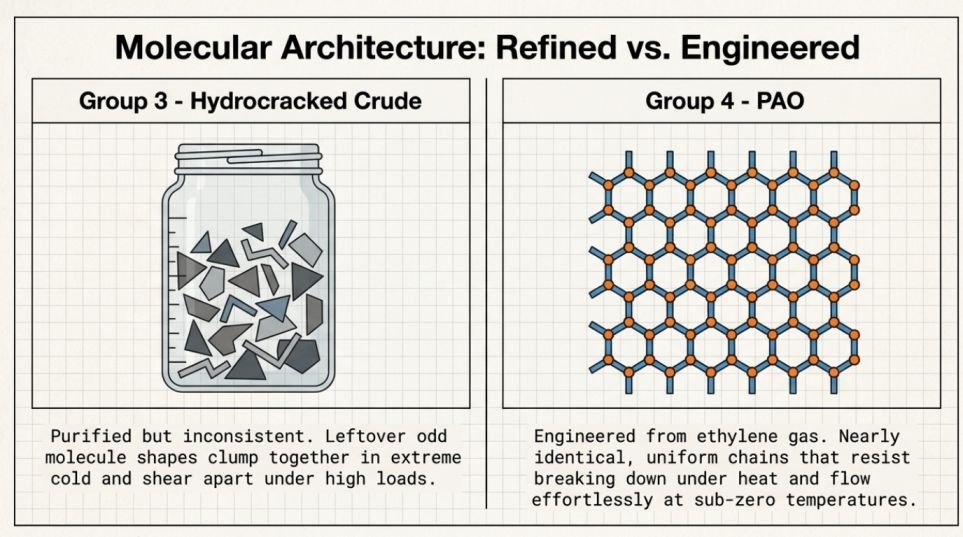
Here’s the part that trips people up: Group 3 oil is legally allowed to be marketed as “full synthetic” in the U.S., even though it starts as crude oil. A 1999 National Advertising Division ruling in favor of Castrol let severely hydrocracked Group 3 oil carry the same “synthetic” label as PAO. That ruling is why most bottles that say full synthetic on the front are Group 3 inside.
Group 3 oil, made through severe hydrocracking and hydroisomerization, has closed a lot of the performance gap with PAO over the last two decades. Modern Group 3 stocks hit viscosity indexes above 120, sometimes close to 130, and handle daily driving conditions fine. That’s why mainstream lines like Mobil 1, Castrol Edge, and Pennzoil Platinum’s standard grades are commonly understood to run on Group 3 and still meet API SP and ILSAC GF-6A specs without trouble.
Where Group 4 still separates from Group 3: oxidation resistance at sustained high temperatures, shear stability under heavy load, and pour point at extreme cold. A PAO base oil typically pours at around -50°F to -70°F before additives; Group 3 pour points land higher, often -30°F to -40°F. For a truck or a diesel pulling a trailer up a grade in July, that oxidation resistance can mean fewer deposits and less viscosity breakdown between changes. For a Camry doing 12,000 miles a year of commuting, the two groups perform close enough that most owners won’t notice a difference at the recommended interval.
What PAO actually gets you on the road
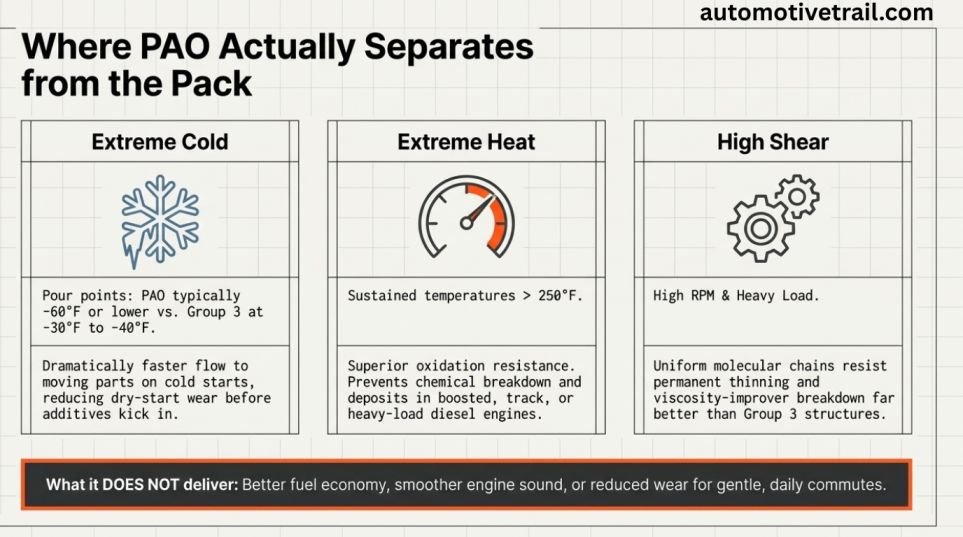
Strip away the marketing copy and three things change with a true Group 4 oil.
Cold-start flow. PAO’s naturally low pour point helps oil move to bearings and the valvetrain faster on a very cold morning. In climates that regularly hit single digits or below, that is the most plausible real-world benefit, though the final result also depends on the viscosity grade and additive package.
Oxidation life. PAO resists breaking down chemically at sustained high temperatures better than Group 3. Engines that run hot for long stretches, like a boosted engine on a track day or a diesel under constant load, keep the oil’s protective properties longer before the base stock itself starts to degrade.
Shear stability. Under high pressure between moving parts, some oils temporarily or permanently thin out as the viscosity-improving polymers break down. PAO’s uniform molecular chain tends to resist this better than the more varied structure in Group 3, which matters most in high-RPM or high-load applications.
What PAO does not reliably deliver: a noticeable difference in fuel economy, a noticeable difference in engine sound or feel, or extra protection against normal wear in a stock engine driven gently and changed on schedule. Those claims show up in marketing copy more than in independent test data.
When Group 4 oil earns its price back
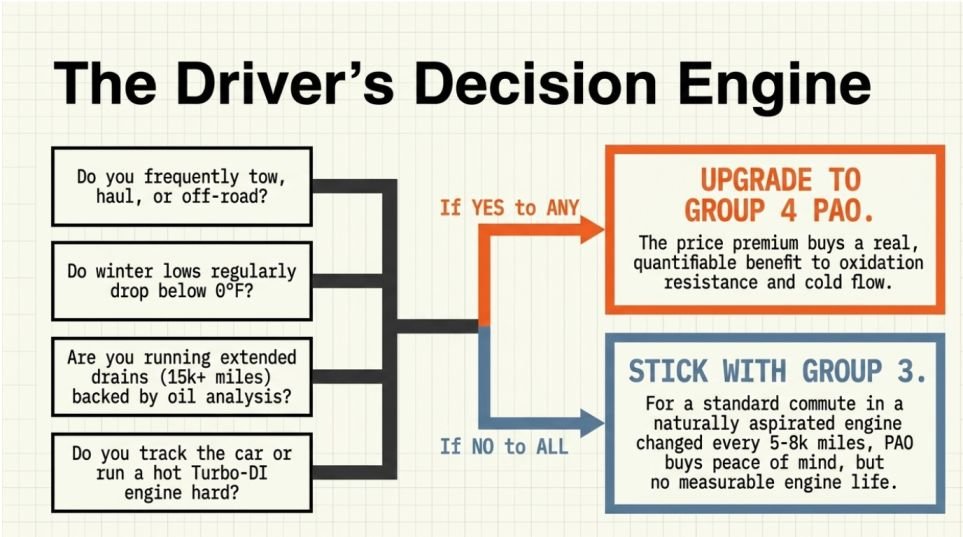
Group 4 pays for itself in specific situations, not as a blanket upgrade.
- Extreme cold climates. If winter lows regularly drop below 0°F, the lower pour point helps oil circulate faster on cold starts.
- Towing and heavy loads. Sustained high oil temperatures from towing, hauling, or off-roading push Group 3 oils toward their oxidation limit faster.
- Track days and high-RPM engines. Sustained high RPM generates heat and shear stress that Group 3 handles less gracefully over a session.
- Extended drain intervals. If you’re running an oil rated for 15,000 to 25,000 miles with oil analysis to back it up, the base stock needs to survive that long without breaking down. That’s a Group 4 job.
- Turbocharged direct-injection engines under hard use. These run hotter and can see more soot and fuel dilution than naturally aspirated engines, and PAO’s oxidation resistance helps keep deposits down. If deposits are your main worry, see our guide to oil additives for direct-injection engines.
If two or more of these apply to how you actually drive, the price premium is buying a real benefit rather than a placebo.
When you’re wasting money on Group 4
Most drivers fall outside every category above, and that’s worth saying plainly. A daily commuter in a moderate climate, changing oil every 5,000 to 8,000 miles in a naturally aspirated engine, gets essentially the same wear protection from a quality Group 3 synthetic. The oil never gets hot enough for long enough, or stressed hard enough, for PAO’s advantages to show up before the scheduled change.
Paying $12 a quart for PAO in that scenario buys peace of mind, not measurable engine life. There’s nothing wrong with buying peace of mind if the budget allows it. Just don’t expect an oil analysis report to show a difference worth the extra $20 to $30 per oil change.
The base oil group also doesn’t fix mechanical problems. If your engine burns oil, leaks, or you routinely skip changes, PAO won’t offset that.
How to check if your “full synthetic” is really Group 4
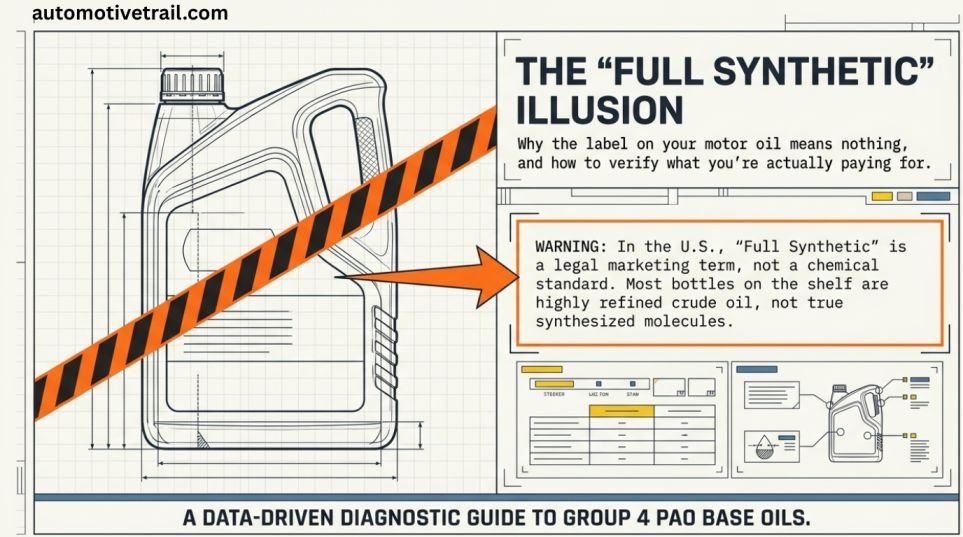
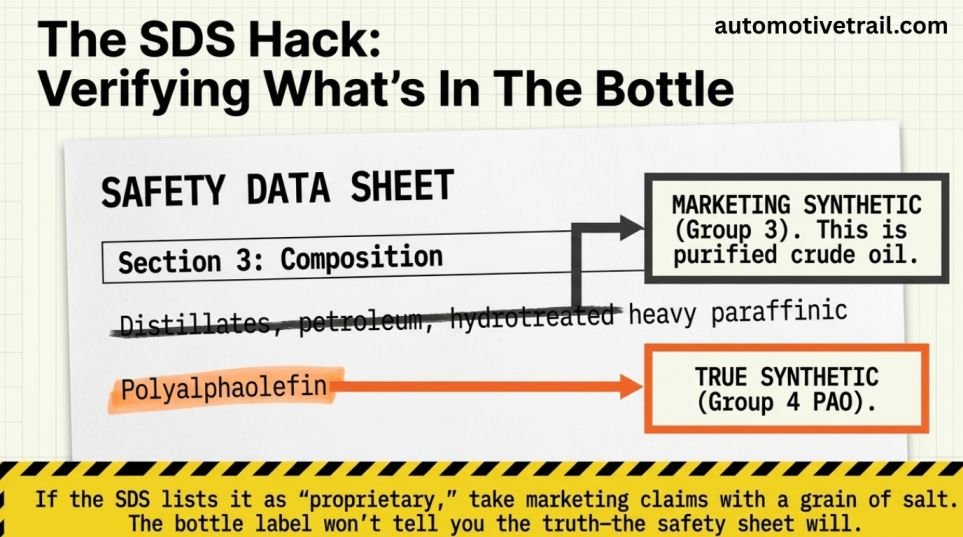
The bottle won’t tell you. Manufacturers aren’t required to disclose base oil group on the label, and “full synthetic” legally covers both Group 3 and Group 4. The safety data sheet (SDS) is the workaround.
- Find the SDS. Search “[product name] SDS” or check the manufacturer’s product page; most post it as a PDF.
- Open Section 3, Composition/Information on Ingredients.
- Read the base oil listing. “Distillates, petroleum, hydrotreated heavy paraffinic” or “hydrotreated light naphthenic distillate” means Group 3, a crude-derived synthetic.
- Look for “polyalphaolefin” or “1-decene, homopolymer, hydrogenated.” That’s Group 4 PAO.
- Check for both listed together. Many premium oils blend Group 4 with Group 3 or Group 5 esters; the SDS will list multiple base oil entries.
Some brands, including AMSOIL, treat their exact base oil composition as proprietary and don’t specify the group on the public SDS. In that case, you’re relying on the brand’s own description, so treat unverified claims with a grain of salt.
Group 4 vs Group 3 vs conventional: price and interval comparison
| Property | Conventional (Group 1/2) | Group 3 Synthetic | Group 4 (PAO) |
|---|---|---|---|
| Source | Refined crude oil | Hydrocracked crude oil | Synthesized from ethylene gas |
| Viscosity Index | 80–120 | 120–130+ | 130–150+ |
| Pour Point | -15°F to -25°F | -30°F to -40°F | -50°F to -70°F |
| Price/Quart (2026) | $3–$5 | $6–$9 | $9–$13+ |
| Drain Interval | 3,000–5,000 mi | 5,000–10,000 mi | 10,000–25,000 mi |
| Best For | Older engines; budget | Most daily drivers | Extreme climate, towing, extended drains |
Figures are typical base oil ranges and approximate 2026 U.S. retail prices; they vary by brand, viscosity grade, and region. Drain intervals are general ranges, not recommendations for your engine.
Group 4 oils worth considering
Not every brand discloses its base oil blend, so treat this list as a starting point and confirm on the SDS or with the manufacturer. For a longer rundown, see our guide to Group 4 synthetic oil brands.
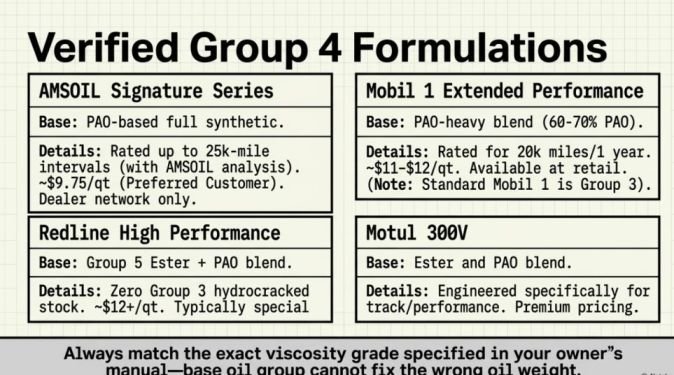
- AMSOIL Signature Series — Marketed by AMSOIL as a PAO-based full synthetic, with extended intervals of up to 25,000 miles when paired with oil analysis. Runs about $9.75 per quart at Preferred Customer pricing and is sold through AMSOIL’s dealer network rather than most retail stores.
- Mobil 1 Extended Performance — Contains a meaningful share of PAO and is rated for up to 20,000 miles or one year. ExxonMobil doesn’t publish the exact blend ratio. Priced around $11–$12 per quart at retail.
Ester-based premium options. Redline High Performance and Motul 300V are often grouped with PAO oils, but both rely heavily on Group 5 esters, with PAO used in some blends depending on the line. They’re popular for track and performance use and typically cost $12+ per quart, with Redline often special-ordered. Check the SDS for the specific product, since esters behave differently from pure PAO.
Buy the specific viscosity grade your owner’s manual calls for from your local auto parts retailer or authorized dealer.
The real cost-per-mile math
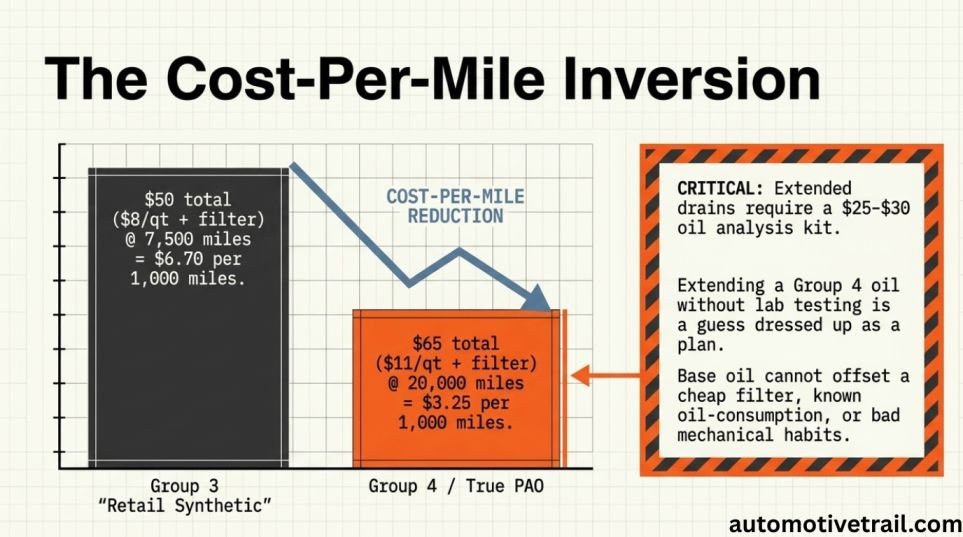
Sticker price per quart is the wrong number to compare. Cost per mile of protection is the number that actually matters, and it flips the math for high-mileage drivers.
Take a 5-quart oil change. A Group 3 synthetic at $8/quart plus a filter runs about $50, changed every 7,500 miles: roughly $6.70 per 1,000 miles. A Group 4 oil at $11/quart plus a filter runs closer to $65, but changed at 20,000 miles instead: roughly $3.25 per 1,000 miles, once the oil and the interval both actually support that mileage.
That math only works if the extended interval is real and backed by oil analysis, not just a bottle claim. Check your owner’s manual and warranty terms first, since many manufacturers specify maximum drain intervals regardless of which oil you use. Extending a Group 3 oil to 20,000 miles without PAO’s oxidation resistance behind it risks running degraded oil for the last several thousand miles. Extending a Group 4 oil without ever testing it is a guess dressed up as a plan. Oil analysis kits run about $25–$30 and remove the guesswork either way.
Mistakes people make buying Group 4 oil
Even when the oil is worth buying, people get the details wrong.
- Buying PAO and still changing it every 5,000 miles. You’re paying the premium and getting none of the extended-interval payoff.
- Trusting the word “synthetic” alone. That word covers Group 3 and Group 4 equally under current labeling rules, so check the SDS.
- Ignoring the manufacturer’s viscosity and approval spec. Running a heavier grade, such as 0W-40 in an engine specified for 0W-20, can raise operating viscosity, hurt fuel economy, and may conflict with warranty requirements, regardless of base oil group.
- Skipping oil analysis on extended intervals. Without a lab report, you’re extending the drain on faith, not data.
- Assuming esters and PAO are the same thing. Group 5 esters (Redline, Motul 300V) behave differently from pure PAO and often cost more.
Bottom line: the actual decision framework
Group 4 oil is a real upgrade in oxidation resistance, cold flow, and shear stability, and it costs roughly double a Group 3 synthetic to get it. The decision comes down to whether your driving conditions actually stress the oil enough for those properties to matter before your next scheduled change.
Buy Group 4 if you tow or haul regularly, track your car, drive in climates with hard winters, or run genuinely extended drain intervals backed by oil analysis. Stick with a quality Group 3 synthetic if you’re a normal commuter on a standard schedule in a stock, naturally aspirated engine. Either way, matching your owner’s manual spec and changing on schedule is what protects the engine; the base oil group only decides how much margin you’re buying.
Before paying the premium, pull the SDS on the specific bottle in your cart. A lot of “full synthetic” price tags are attached to Group 3 oil.
FAQ: Group 4 engine oil questions
Is Group 4 oil better than Group 3? Group 4 has a higher viscosity index, lower pour point, and better oxidation resistance under sustained heat. For normal daily driving, the practical difference is small; for towing, track use, or extreme cold, it’s more noticeable.
Can I mix Group 4 and Group 3 oil? Yes. Base oil groups are compatible with each other, and many commercial oils are already blends. Mixing won’t damage your engine, though it can dilute whichever group’s specific advantage you were paying for.
Is Mobil 1 Group 4 or Group 3? Standard Mobil 1 grades are generally understood to run on Group 3 base stock. Mobil 1 Extended Performance and some European-formula variants contain more PAO, though ExxonMobil doesn’t publish exact ratios, and formulations change over time.
How do I know if my oil is really synthetic PAO? Check the product’s safety data sheet, Section 3. “Polyalphaolefin” or “1-decene homopolymer” indicates Group 4. “Hydrotreated heavy paraffinic distillate” indicates Group 3.
Does Group 4 oil improve gas mileage? Not in any way that shows up reliably in real-world testing. Viscosity grade affects fuel economy far more than base oil group does.
Is AMSOIL actually Group 4? AMSOIL markets its Signature Series as PAO-based, but the company doesn’t publish the base oil group on its public SDS, so you can’t confirm it independently from the paperwork. Some other AMSOIL lines have reportedly been identified as Group 3 through third-party SDS reviews. Check the specific product line rather than assuming the brand name guarantees Group 4.

- Top 10 Ranking Tire Brand for Minivan: Reviewed 2026 - October 5, 2026
- Model Y Tesla Long Range Automatic Wagon Tyre Fitment And Ratings - October 3, 2026
- What Is The Benefit Of Larger Rear Tyres On A Zero-turn Mower - October 3, 2026