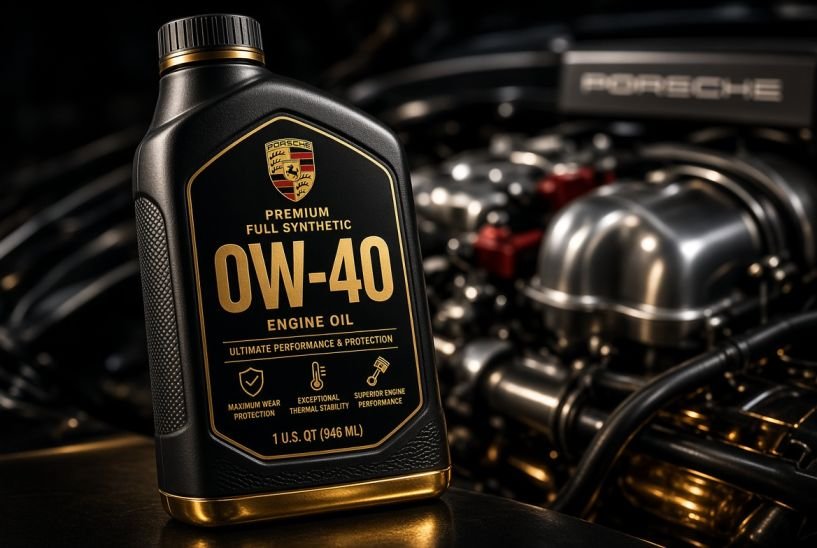
Porsche has factory-filled its engines with 0W-40 since 1996, and the millionth Porsche engine to roll off the line with that fill happened back in 2012. That’s not a marketing number picked at random; it’s a real answer to a real engine design problem.
Direct answer: 0W-40 synthetic oil flows like a 0-weight oil on cold start and holds like a 40-weight oil once the engine is hot, giving high-output and high-RPM engines a thicker protective film under load than a 0W-20 or 0W-30 can provide. It’s the factory or approved fill for Porsche, Corvette Z06/ZR1, many BMW, Audi, and Mercedes-AMG engines, and it’s the wrong choice for an ordinary economy car spec’d for a 20-weight oil.
Key takeaways
- 0W-40 has a high-temperature high-shear (HTHS) viscosity around 3.6 to 3.8 cP, noticeably thicker under load than a 0W-20’s roughly 2.6 cP. That thickness is the entire point for turbocharged and high-RPM engines.
- Not every 0W-40 is Group IV PAO. Mobil 1’s European “New Life” 0W-40 runs on Group III base stock, while the North American Mobil 1 0W-40 has historically leaned toward PAO. Check the specific product, not just the brand name.
- Porsche (A40 spec), Corvette Z06/ZR1/Grand Sport (dexos-rated “Supercar” 0W-40), and many turbocharged Audi and Mercedes-AMG engines call for 0W-40 by name.
- BMW updated its LL-01 spec in a way that excludes nearly all 0W-40 oils today, including both Mobil 1 0W-40 and Castrol Edge 0W-40. Current LL-01-approved oils skew toward 5W-30 and 5W-40 grades instead, so check the live list rather than an old forum thread.
- Running 0W-40 in an engine designed for 0W-20 can restrict oil flow to tight tolerances like VVT solenoids, even though both share the same 0W cold-flow rating.
What the numbers on the bottle mean
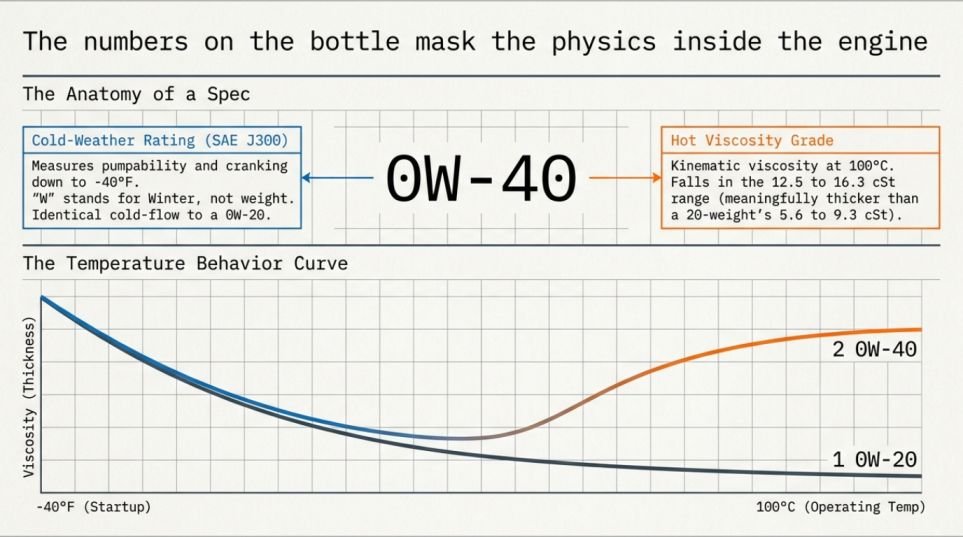
The “0W” half of 0W-40 is a cold-weather rating defined by SAE J300. It measures how the oil pumps and cranks at low temperatures, and a 0W oil is rated to flow at temperatures down to about -40°F, the same cold-flow standard as 0W-20 or 0W-30. The W stands for winter, not weight, and it has nothing to do with how the oil behaves once the engine reaches operating temperature.
The “40” is the hot viscosity grade, measured as kinematic viscosity in centistokes (cSt) at 100°C. A 40-weight oil falls in the 12.5 to 16.3 cSt range at that temperature, meaningfully thicker than a 20-weight oil’s 5.6 to 9.3 cSt or a 30-weight’s 9.3 to 12.5 cSt. That extra thickness at operating temperature is what separates 0W-40 from 0W-20 and 0W-30, even though all three start out flowing identically cold.
The number that actually predicts protection under real load is one most bottles don’t print: high-temperature high-shear (HTHS) viscosity, measured at 150°C under shear stress that mimics a bearing or cam lobe in motion. SAE J300 sets HTHS minimums by grade: 2.6 cP for a 20-weight, 2.9 cP for a 30-weight, and 3.5 cP for a 0W/5W/10W-40. Those are floors, not targets, and real 0W-40 oils on the shelf usually beat the minimum by a meaningful margin: Mobil 1 0W-40 runs around 3.8 cP, Motul 8100 X-Max around 3.7 cP, and Castrol Edge 0W-40 around 3.6 cP. Compare any of those to a 0W-20’s 2.6 cP floor, and the gap is the real reason a turbocharged or high-RPM engine specs 0W-40: a thicker film survives higher loads and temperatures without shearing down to nothing at the exact moment the bearing needs it most.
Which cars actually require 0W-40
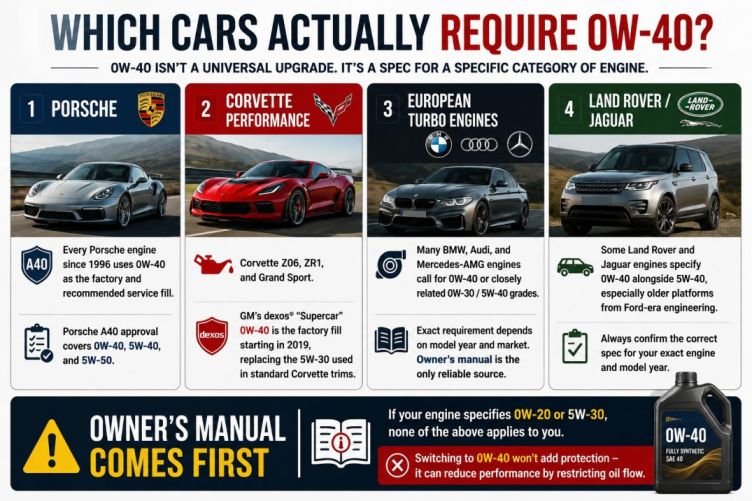
0W-40 isn’t a universal upgrade; it’s a spec for a specific category of engine.
- Porsche. Every Porsche engine since 1996 has used 0W-40 as its factory and recommended service fill, under Porsche’s own A40 approval standard, which also covers 5W-40 and 5W-50.
- Corvette Z06, ZR1, and Grand Sport. GM’s dexos-rated “Supercar” 0W-40 became the factory fill for these models starting in 2019, replacing the 5W-30 used in standard Corvette trims.
- Turbocharged and high-output European engines. Many BMW, Audi, and Mercedes-AMG engines call for 0W-40 or a closely related 0W-30/5W-40 grade, particularly performance and turbocharged variants. The exact requirement depends on model year and market, so the owner’s manual is the only reliable source.
- Land Rover and older diesel-adjacent European models. Some Land Rover and Jaguar engines specify 0W-40 alongside 5W-40, especially older platforms carried over from Ford-era engineering.
If your owner’s manual specifies 0W-20 or 5W-30, none of the above applies to you, and switching to 0W-40 doesn’t add protection. It can do the opposite by restricting oil flow to components tuned for a thinner fluid.
0W-40 vs 0W-20: what changes and why it matters
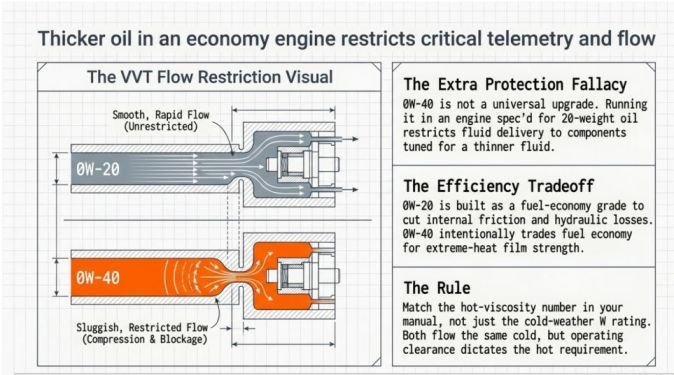
Both grades pour and crank identically cold, since they share the same 0W rating. The difference shows up entirely once the engine is running.
0W-20 is built as a fuel-economy grade, thin enough at operating temperature to cut internal friction and hydraulic losses through the oil pump and bearings. Most modern economy and mainstream engines are designed around that thinner film on purpose, with oil galleries, VVT solenoids, and bearing clearances sized for it.
0W-40 trades some of that fuel-economy benefit for a thicker, more shear-resistant film at high temperature and high load. That’s a real advantage in an engine turning 7,000+ rpm or running sustained boost, where a thinner oil’s film can momentarily fail under bearing load. It’s not an advantage in an engine that never sees those conditions, and running 0W-40 in a 0W-20-spec’d engine can restrict flow through tight VVT and variable-cam passages sized for a thinner fluid, even though cold cranking behaves the same either way.
The rule holds in both directions: match the hot-viscosity number in your manual, not just the cold-weather W rating.
0W-40 vs 5W-40: is the cold-start difference worth it
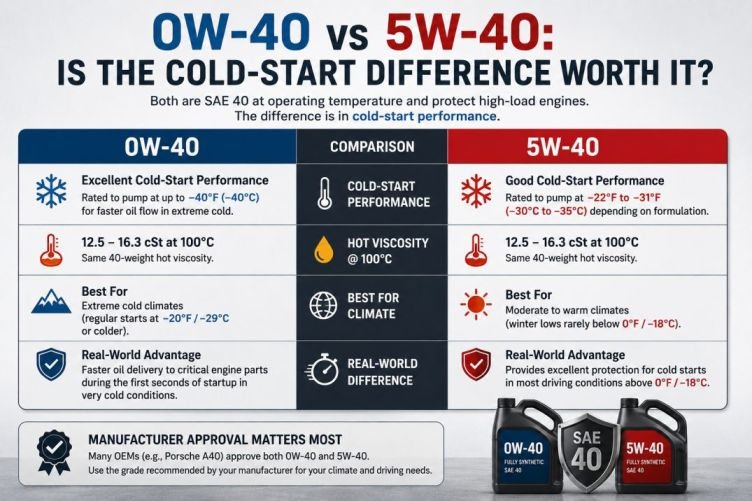
Both share the same 40-weight hot viscosity and the same basic role protecting high-load engines. The difference is entirely in cold-start behavior. A 0W oil is rated to flow at roughly -40°F; a 5W oil’s flow rating is closer to -22°F to -31°F depending on the specific formulation.
For most of the continental United States, that gap matters only during genuine cold snaps. If winter lows in your area rarely drop below 0°F, a well-formulated 5W-40 like Motul 8100 X-cess will protect a cold start just as well as a 0W-40 in practice. If you’re starting a car at -20°F or colder on a regular basis, the 0W’s faster oil delivery to the top end during those first critical seconds of startup is a real, measurable advantage.
Manufacturer approval matters more than the cold-start math in most cases. Porsche’s A40 spec explicitly covers 0W-40, 5W-40, and 5W-50 as interchangeable options, so the choice there often comes down to climate and personal preference rather than one grade being objectively correct.
The spec alphabet: API, ACEA, and OEM approvals decoded
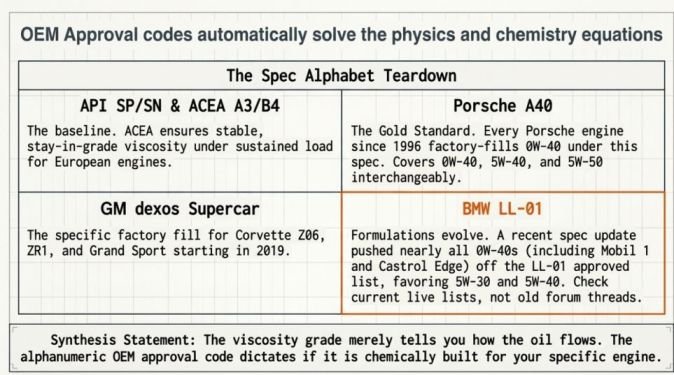
The viscosity grade tells you how the oil flows. The approval codes tell you whether it’s chemically built for your engine, and they matter more.
- API SP/SN is the current American Petroleum Institute service category for gasoline engines, covering wear protection, deposit control, and LSPI (low-speed pre-ignition) resistance in turbocharged direct-injection engines.
- ACEA A3/B4 is the European standard most 0W-40 oils are built to meet, covering both gasoline (A3) and diesel (B4) passenger car engines with a stable, stay-in-grade viscosity requirement under sustained high load.
- Porsche A40 covers 0W-40, 5W-40, and 5W-50 oils approved for Porsche’s full sports car and SUV lineup.
- VW 502.00/505.00 and Mercedes-Benz 229.5/229.3/226.5 are OEM-specific approvals layered on top of ACEA A3/B4, required for warranty-compliant service in those brands.
- BMW LL-01 is BMW’s own long-life approval, and it’s worth a second look if you drive a BMW. A change to the LL-01 requirements pushed nearly every 0W-40 off the current approved list, including both Mobil 1 0W-40 and Castrol Edge 0W-40, which many BMW owners assume still carry it. Today’s LL-01-approved oils skew toward 5W-30 and 5W-40 grades instead, like Castrol Edge 5W-40 and Pennzoil Platinum Euro 5W-30. If LL-01 compliance matters for your warranty or service history, check BMW’s current published list by name and grade rather than assuming a familiar 0W-40 bottle still qualifies.
Not all 0W-40 is Group IV: reading the base oil
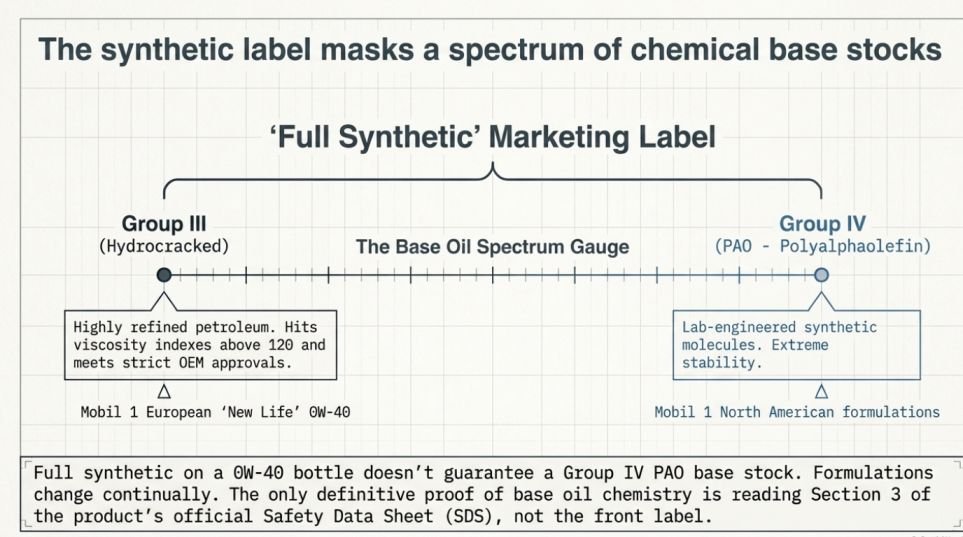
“Full synthetic” on a 0W-40 bottle doesn’t guarantee PAO (Group IV) base stock, the same labeling gap that affects synthetic oils across every viscosity grade. Mobil 1’s European “New Life” 0W-40 has been identified through safety data sheets as a Group III hydrocracked base oil, not PAO, despite carrying the full synthetic label. The North American Mobil 1 0W-40 formulations have historically leaned more heavily on PAO, but formulations change, and the only reliable way to check is the product’s SDS, Section 3.
This isn’t a reason to avoid Group III 0W-40 oils. Modern Group III base stocks hit viscosity indexes well above 120 and meet the same ACEA and OEM approvals as PAO-based oils. It’s a reason not to pay a PAO premium for an oil that isn’t delivering PAO, and a reason to check the SDS if base oil group specifically matters to your build or your oil analysis program.
Best 0W-40 oils to buy
| Oil Brand & Product | OEM Approvals & Specifications | HTHS (cP) | Base Oil Group | Price/Quart (2026) | Key Performance Characteristics |
|---|---|---|---|---|---|
| Mobil 1 0W-40 Advanced Full Synthetic |
API SP, Porsche A40, dexos (Supercar variant) | ~3.8 | PAO-leaning (NA formula) | $6–$8 | High film strength for high RPM/boost; cold flow to -40°F; thicker than 0W-20 for higher loads. |
| Motul 8100 X-Max 0W-40 | ACEA A3/B4, MB 229.5, Porsche A40 | ~3.7 | PAO/ester blend | $9–$12 | European specialty formula; higher cost; 3.5+ cP HTHS for ACEA A3/B4. |
| Castrol Edge 0W-40 | API SN, ACEA A3/B4, Porsche A40, VW 502.00/505.00 | ~3.6 | Group III/IV blend | $6–$8 | Shear-resistant film; favors protection over fuel economy; lacks BMW LL-01 approval. |
| Liqui Moly Leichtlauf High Tech 0W-40 | ACEA A3/B4, VW 502.00/505.00, MB 229.5, Porsche A40 | ~3.6 | Group III/IV blend | $8–$11 | Stable viscosity under high load; favored by European specialty shops. |
Mobil 1 and Castrol Edge sit closest in price and are the two most common choices for Porsche, Corvette, and BMW owners buying off a store shelf. Motul and Liqui Moly run higher per quart and show up more often through European specialty shops and Porsche/Audi dealer parts counters.
Common mistakes with 0W-40
- Buying it because “0W means better cold protection” without checking hot viscosity. The W rating is identical to 0W-20; the 40 is what actually changes your engine’s operating protection.
- Assuming every “full synthetic” 0W-40 is PAO. Some are Group III. Check the SDS if the base oil group matters to you.
- Ignoring a dropped OEM approval. Formulations change year to year. A 0W-40 that was BMW LL-01 approved five years ago may not be today.
- Running 0W-40 in an engine spec’d for a 20-weight oil “for extra protection.” It can restrict oil delivery through tight tolerances designed for a thinner fluid.
- Mixing 0W-40 and 5W-40 without checking that both meet the same OEM approval. They’re compatible to mix, but the resulting blend won’t necessarily carry either oil’s individual approval rating.
Cost breakdown: what 0W-40 actually costs
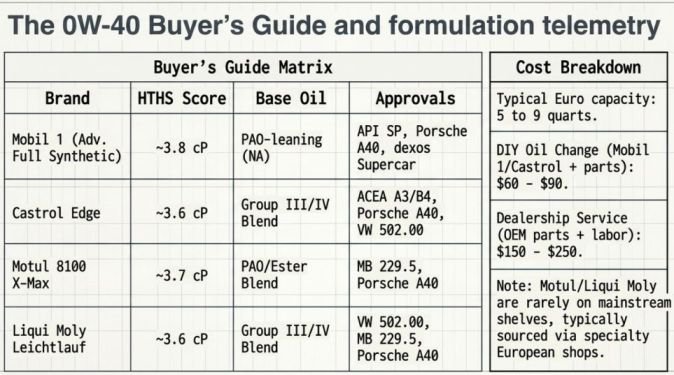
A typical European engine takes 5 to 9 quarts depending on displacement, so the cost swing between brands adds up fast.
- Mobil 1 or Castrol Edge, mainstream retail: $6–$8 per quart, $30–$65 for a full oil change depending on capacity.
- Motul or Liqui Moly, specialty retail: $9–$12 per quart, $50–$110 for a full oil change.
- OEM filter: $10–$25 depending on brand; Porsche and Mercedes-AMG filters run toward the higher end.
- Shop labor, if not DIY: $80–$150 for a standard oil change, more for cars with underbody shields or tight filter access like many Porsche and Audi models.
A DIY oil change on a Porsche or Corvette using Mobil 1 0W-40 typically runs $60 to $90 in parts. The same job at a dealership, with OEM filter and labor, commonly lands between $150 and $250.
Bottom line: the actual decision framework
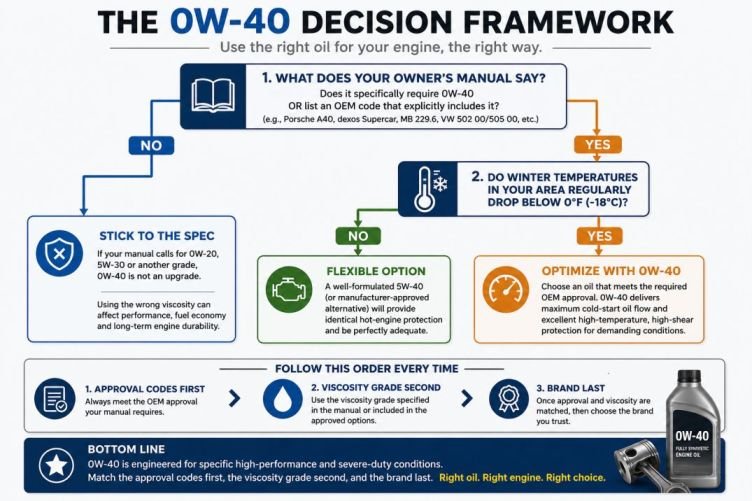
0W-40 exists to solve one specific problem: keeping enough film strength under an engine’s bearings and cam lobes when it’s turning high RPM or running boost, without sacrificing cold-start flow. If your owner’s manual calls for it by name, whether that’s a Porsche A40 approval, a Corvette Z06’s Dexos Supercar spec, or a turbocharged Audi or BMW, use an oil that carries the specific approval your manual lists, not just the right viscosity number on the front of the bottle.
If your manual calls for 0W-20 or 5W-30, 0W-40 isn’t an upgrade sitting on the shelf waiting to be discovered. It’s the wrong oil for that engine’s tolerances, full stop. Match the approval codes first, the viscosity grade second, and the brand name last.
FAQ:
What cars need 0W-40 oil? Porsche has used it as the factory fill since 1996 under its A40 spec. Corvette Z06, ZR1, and Grand Sport use a dexos-rated 0W-40 as factory fill, and many turbocharged BMW, Audi, and Mercedes-AMG engines call for it as well. Check your owner’s manual for the exact requirement.
Can I use 0W-40 instead of 0W-20? Not unless your manual allows it. Both flow the same when cold, but 0W-40 is meaningfully thicker at operating temperature and can restrict oil delivery through tight tolerances like VVT solenoids that are sized for a thinner fluid.
Is 0W-40 better than 5W-30 for a high-performance engine? It depends on what the engine is designed around. 0W-40’s thicker hot viscosity and higher HTHS rating suit engines built for high RPM or sustained boost. A 5W-30-spec’d engine isn’t under-protected by its recommended grade; it’s built around that film thickness.
Is Mobil 1 0W-40 fully synthetic PAO? The North American formula has historically leaned PAO-based, but Mobil 1’s European “New Life” 0W-40 has been identified as Group III base stock through its safety data sheet. Check the specific product’s SDS rather than assuming from the brand name.
Does 0W-40 hurt fuel economy compared to thinner oils? Slightly. The thicker hot viscosity creates more internal friction than a 0W-20 or 0W-30, which is why 0W-40 isn’t marketed as an “energy conserving” API grade. The tradeoff is intentional for engines that need the extra film strength.
Is Castrol Edge 0W-40 or Mobil 1 0W-40 better for BMW? Neither currently carries BMW’s LL-01 approval; a spec update pushed nearly every 0W-40 off that list, including both of these. If LL-01 matters for your car, look at 5W-40 or 5W-30 grades like Castrol Edge 5W-40 or Pennzoil Platinum Euro 5W-30, and confirm against BMW’s current published list rather than what was approved a few years ago.

- Top 10 Ranking Tire Brand for Minivan: Reviewed 2026 - October 5, 2026
- Model Y Tesla Long Range Automatic Wagon Tyre Fitment And Ratings - October 3, 2026
- What Is The Benefit Of Larger Rear Tyres On A Zero-turn Mower - October 3, 2026