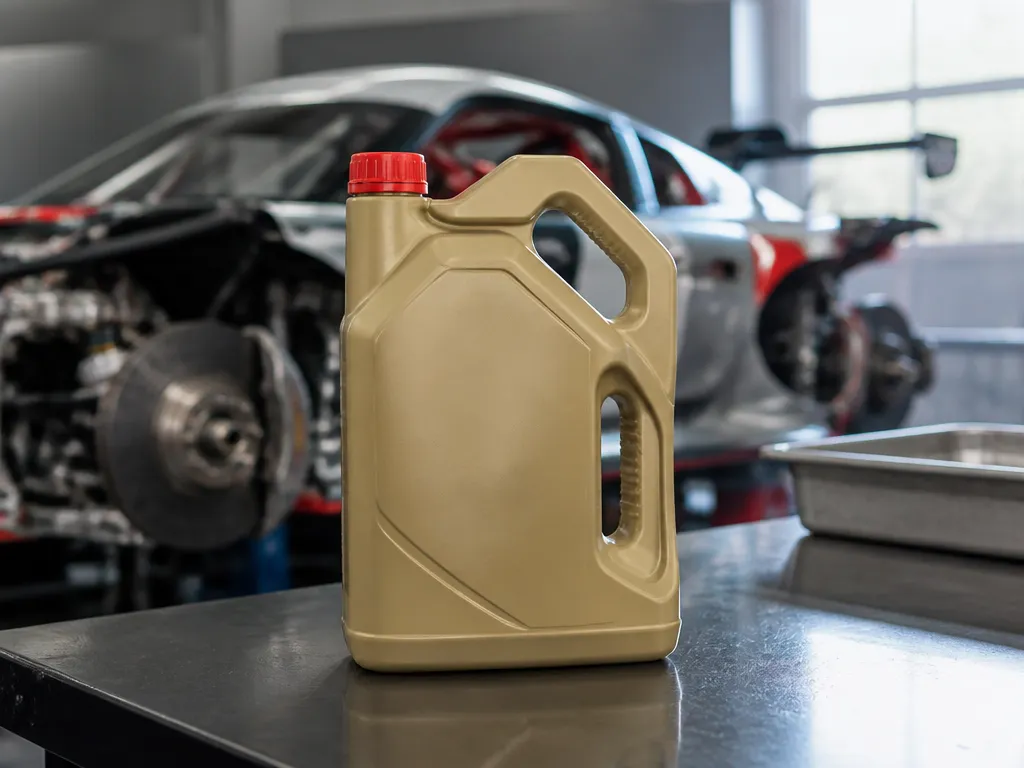
You found “bespoke Castrol Edge” tied to the Audi R26, and now you want the straight answer: why does this oil exist, and what problem is it trying to solve? With an R26 built for hard driving and motorsport-level stress, the goal is lubrication that stays consistent when heat and load spike.
Main purpose: The bespoke Castrol Edge engine oil for the Audi R26 is engineered to keep the oil film strong under severe high-load, high-temperature operation, so wear stays controlled, and lubrication remains stable when the engine is being driven hard, repeatedly, on track or spirited routes.
What Is the Purpose of Bespoke Castrol Edge Oil for Audi?
Bespoke Castrol Edge oil for the Audi R26 is engineered to protect the engine under extreme, high-load driving by keeping an oil film strong and stable when heat, shear, and stress climb. The core intent is consistent lubrication so wear stays controlled even when the engine spends long periods at track-like temperatures and loads.
The R26 application changes the oil’s job because it sees a different stress profile than a normal commuter drive. Track and performance use drive oil temperature higher, thin conventional films faster, and increase the mechanical strain on lubricants due to higher RPM and sustained load.
Engineering Goals Behind The Formulation
For the R26, the oil is tailored to maintain protection across fast temperature swings and heavy throttle use. The formulation approach targets two practical realities: preventing metal-to-metal contact as viscosity drops with heat, and keeping the oil stable as internal shear forces “work” the lubricant.
For performance engines, the “main job” of the oil is simple: it must stay lubricating when viscosity is under stress, not just meet numbers at room temperature.
| R26-style condition | What the oil is trying to prevent | Why it matters |
|---|---|---|
| High oil temperatures | Oil film collapse and faster wear | Protects bearings, cam interfaces, and cylinder wear surfaces |
| Sustained high RPM and load | Viscosity loss from shear | Keeps hydrodynamic and boundary protection steadier session to session |
| Hard acceleration and braking cycles | Lubricant instability and varnish risk | Helps maintain oil flow and reduces wear-promoting surface buildup |
Castrol’s motorsport partnerships with Audi also point to a strategy centered on efficiency and reliability under competition conditions, which matches the kind of stress the R26 demands. In plain terms, the oil is built to give the engine the same protection you’d want after the third hard lap as you had on lap one.
R26 Track Stress Drives Oil Design
Track driving forces the Audi R26’s oil to handle repeated high load and heat spikes. Castrol Edge’s bespoke development targets oil strength and friction behavior under that kind of motorsport use, where the margin for oil breakdown is small.
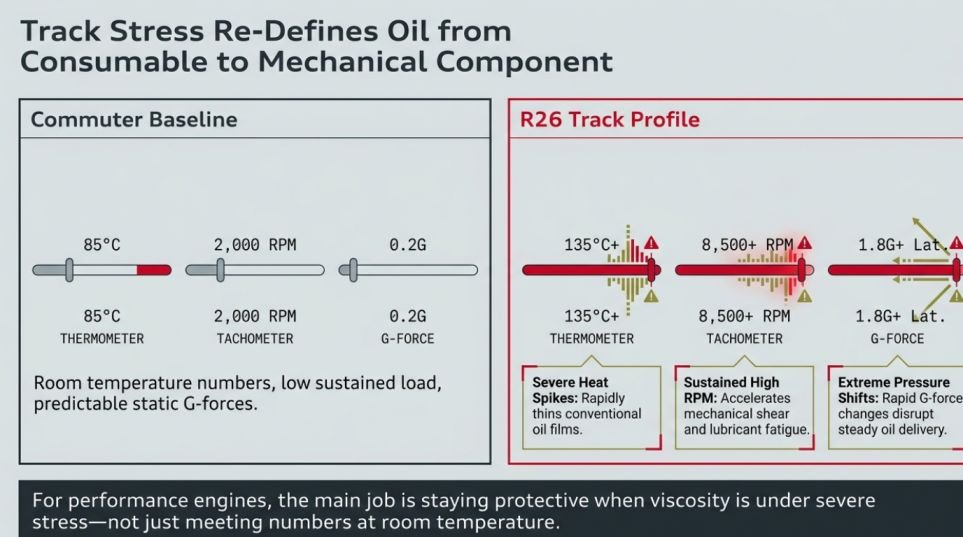
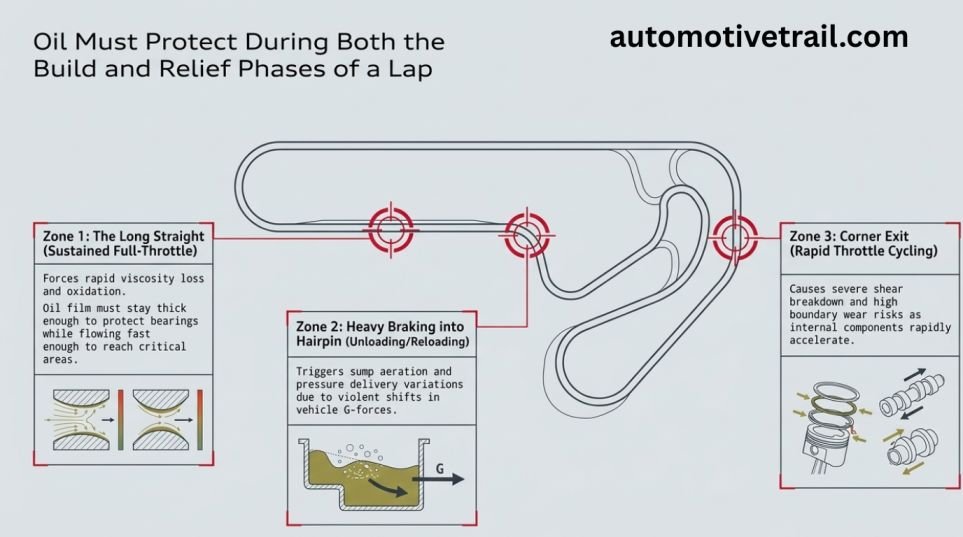
High-load, high-temperature operation is the first governing condition. Under hard acceleration and sustained full-throttle running, oil shear and oxidation accelerate, so the oil film needs to stay thick enough to protect bearings and cam gear surfaces while still flowing fast enough to reach critical areas.
Consistency under repeated accelerations and braking is the second big purpose. The R26 sees rapid changes in oil pressure and sump aeration behavior as load direction and vehicle g forces shift, so aeration control and steady lubrication delivery matter as much as average temperature.
For example, a driver can unload the engine under braking, then reload it hard for corner exit, several times per lap. This cycling demands oil that maintains protective behavior during both the “build” and “relief” phases, instead of only performing well at one steady-state temperature.
Friction control becomes a performance target because the R26’s track pace depends on maximizing available power while keeping temperatures and wear in check. Lower and more consistent internal friction reduces wasted energy, helps reduce thermal stress, and keeps the engine operating in its intended lubrication regime.
Motorsport oil design is a balancing act: maintain film protection at high temperature and load, while keeping friction consistent so power delivery stays repeatable under cycling g forces.
| Track operating condition | Main lubrication risk | Oil design intent |
|---|---|---|
| High load, sustained heat | Viscosity loss, oxidation, deposits | Maintain protective viscosity and film integrity |
| Rapid throttle cycling | Shear breakdown, boundary wear | Resist shear and preserve boundary protection |
| Repeated braking and reload | Aeration and pressure delivery variation | Support steady lubrication delivery across cycles |
| Performance-driven driving style | Internal friction variation and heat build | Friction control for repeatable power and lower stress |
Enhance Power From Fixed Energy
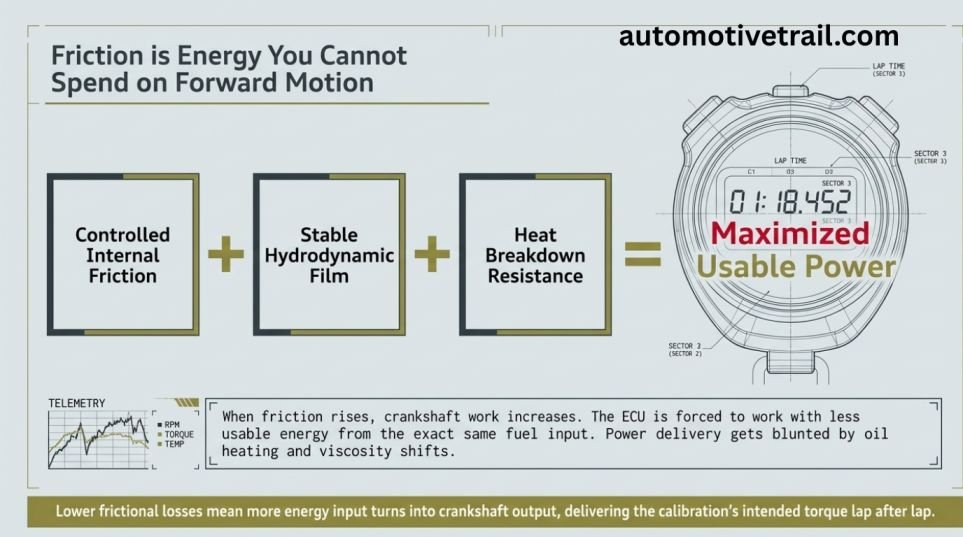
Friction inside the Audi R26 engine is energy you cannot spend on forward motion, so the bespoke Castrol Edge oil is engineered to reduce mechanical losses while keeping the oil film stable under lap-level heat and load. The main purpose is to protect the hardware and keep power output consistent by limiting boundary contact, especially when the engine is forced hard for sustained periods.
When friction rises, crankshaft work increases and the ECU has to work with less usable energy from the same fuel input. On a track, that shows up as slower lap times because power delivery gets blunted by oil heating, viscosity shift, and increased shear at the bearing and ring interfaces.
Frictional Losses Are Lap-time Relevant
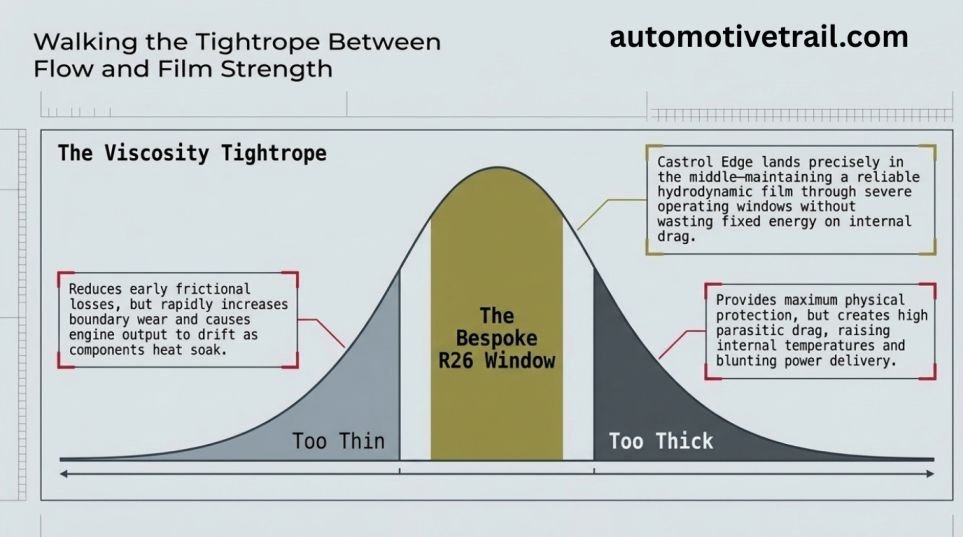
Race driving keeps oil temperatures high, and speeds ramp fast, so the oil is always walking a tightrope between flow and film strength. A thinner film can reduce losses early, but it increases wear and the odds of the engine settling into a less consistent output as components heat soak. A thicker film protects well, but too much drag can raise parasitic loss.
Castrol Edge is built to land in the middle where the oil maintains a reliable film through the R26’s severe operating window, so the engine keeps delivering the calibration’s intended torque and efficiency lap after lap.
“Efficiency and reliability define performance in racing,” which is exactly why lubricants are treated like part of the engine system rather than a generic consumable.
Stable Lubrication Supports Consistent Engine Output Under Strain
Track stress changes oil behavior quickly: shear loads, high temperatures, and repeated load cycles can thin the effective film and increase contact at critical points. The bespoke oil’s job is to keep lubrication consistent across those cycles so bearings, cam components, and piston ring areas do not shift into a higher-friction regime. That consistency helps the R26 maintain predictable response during the sections of a lap where acceleration and sustained load matter most.
| R26 challenge on track | What the oil is designed to control | Payoff in performance |
|---|---|---|
| High load and heat | Oil film strength and temperature stability | Reduced wear risk and less output drift |
| High shear at fast-moving contact points | Shear resistance to keep lubrication behavior steady | Lower frictional losses over a stint |
| Repeated hard acceleration and deceleration | Consistent lubrication across changing conditions | More stable ECU operating feel and repeatable lap behavior |
Performance and reliability always compete in racing calibration. Castrol Edge for the Audi R26 is aimed at the compromise that keeps friction down enough to matter for lap time while still protecting the engine when temperatures and loads stay elevated.
Formulation Goals For Severe Shear
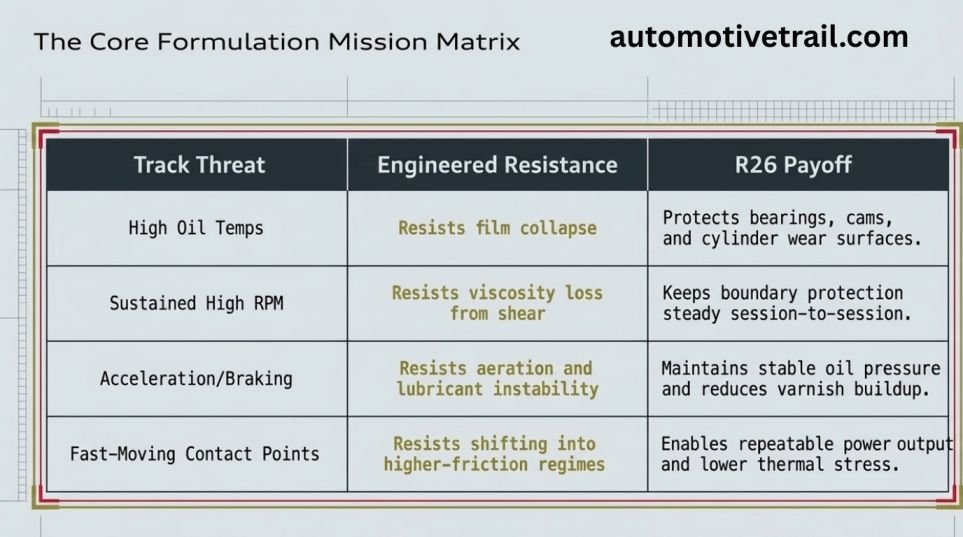
The oil formulation goals are built around preventing wear from load and heat, then holding viscosity long enough to protect the same internal surfaces lap after lap.
In practice, these goals mean the oil is formulated to protect the engine when the lubrication regime shifts. Hard use increases boundary and mixed-film time, so the oil has to hold up even when full hydrodynamic separation is harder to maintain.
| Formulation goal | What the oil must resist | R26 on-track operational benefit |
|---|---|---|
| Oil film strength under shear | Film collapse and rapid loss of protective separation | Reduced wear in hard use |
| Viscosity stability | Over-thinning from temperature swings | Consistent lubrication during hot laps |
| Heat-related breakdown resistance | Thinning and degradation over session time | Sustained protection late in runs |
| Critical surface wear protection | Accelerated wear at bearings and piston/ring interfaces | Durability for repeated high-stress operation |
Track-oriented oil design is less about “best at one temperature” and more about staying protective when conditions change fast and the session length eats into oil performance.
Racing Testing And Oil Analysis Focus
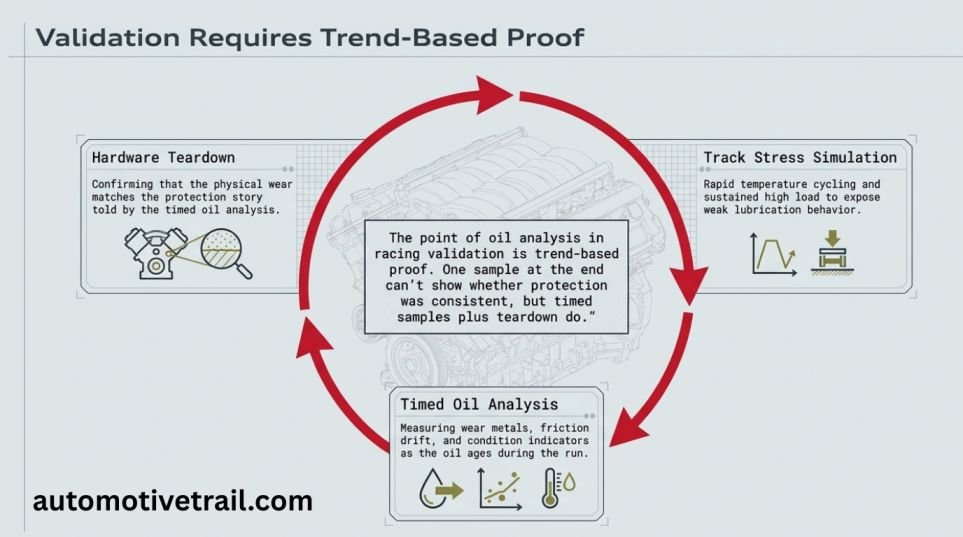
Testing is built around sustained high load, heat soak, and fast temperature cycling, because those are the conditions that expose weak lubrication behavior.
Validation starts with a loop: test the oil against the R26’s known failure risks, measure results, adjust formulation targets, then rerun the same stress pattern. Castrol’s intent for Audi motorsport programs is tied to reliability and efficiency pressures, so the evaluation is designed to catch both wear trends and loss of lubrication performance over time.
For example, if oil analysis shows escalating wear metals after repeated heat cycles, the refinement focus shifts toward improving the oil’s ability to hold up in the exact stress window that produced the spike. If friction or temperature drift shows up without a wear improvement, the team tightens the balance of how the oil maintains lubrication while it ages.
| Measured during R26-style validation | What it confirms | Why it matters to the bespoke purpose |
|---|---|---|
| Wear metal trends from used oil | Actual protection across the test cycle | Confirms the oil film stays effective under repeated severe duty |
| Oil condition indicators over time | How lubrication behavior changes as the oil ages | Validates durability through sustained load and heat soak |
| Friction and temperature behavior in the run | Stability of lubrication performance | Ensures the oil supports consistent operation during high stress bursts |
“The point of oil analysis in racing validation is trend-based proof. One sample at the end can’t show whether protection was consistent, but timed samples plus teardown do.”
Matching the R26 power unit demands means the validation targets are aligned with what that engine asks for in hardware reality: the lubrication points that see the most load, the thermal hotspots, and the wear modes that show up fastest under track heat. The bespoke Castrol Edge intent is considered met only when testing shows stable behavior from run start through the worst part of the cycle, with oil analysis confirming the protection story the teardown should later support.
What You Should Expect In Use
Consistent Lubrication During Hard Driving
Hard driving loads the bearings, cams, and ring pack with high pressures while heat thins conventional oil. The practical outcome you should expect is steadier viscosity and better film strength so critical surfaces keep an effective barrier even during long pulls and fast cooldown cycles.
In use, that shows up as consistent hydraulic and valvetrain behavior because oil delivery stays predictable. When the oil stays where it should and keeps its protective properties, the engine tolerates aggressive driving without the “it’s fine for a session, then it fades” pattern.
Lower Friction Losses For More Usable Power
Racing engines live and die by efficiency. Lower friction in the moving drivetrain reduces parasitic losses, so more of the energy input turns into crankshaft output instead of being wasted as heat in the oil and bearings.
| What the oil is engineered to do | What you feel in use |
|---|---|
| Support boundary and hydrodynamic film stability | Less driveline drag during high RPM and loaded driving |
| Maintain consistent lubrication properties under heat | More repeatable performance across a run, instead of gradual softening |
| Keep wear under control in stressed areas | Reduced risk of performance drift linked to wear and friction growth |
Insider mechanic take: when oil friction stays controlled, the engine usually feels “the same” from the first hard acceleration to the last. When oil breaks down, you often notice the change as increased heat and a subtle fall-off under load.
Durability Orientation For Repeat Events And Runs
Track use is brutal on oil because it repeats the same stress cycle over and over. The durability goal is to keep the oil protective longer in that real-world pattern, so you are not relying on perfect luck between sessions.
Expect the oil to be formulated for repeatability, meaning it aims to hold protective performance as the event progresses. The trade-off is that oils built for severe use often demand strict attention to drain intervals and correct specification matching, because they are designed around track-like stress, not commuting conditions.
Choosing The Right Oil For R26 Demands
Picking “any premium synthetic” is a common mistake because the R26 needs the right viscosity grade and the right performance chemistry to match its lubrication strategy and service intervals. Motorsport and OEM development also tune how the oil behaves with seals, blow-by contamination, and high-shear conditions, which changes how the engine stays within its intended operating envelope.
Match The Spec And Approval, Not The Label
Castrol’s motorsport involvement shows the brand is used in high-performance programs, but that does not mean a retail bottle automatically matches a specific race or OEM calibration. For the R26, your filter for suitability is the approved spec and any stated approval from Audi or the motorsport program, not the color of the bottle or the marketing tier.
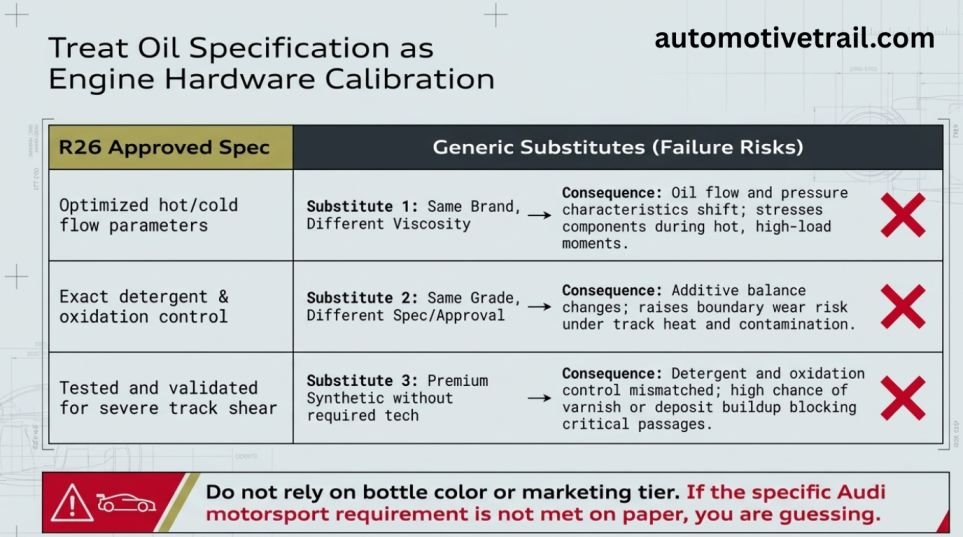
When you substitute an unapproved viscosity or a different additive system, you can upset calibration outcomes because the oil’s flow rate, pressure behavior, and film-forming traits change. Those differences affect how quickly the engine builds pressure on startup, how long the film survives at peak temperatures, and how the oil holds up against fuel dilution and soot loading during hard running.
| Wrong choice | What it can change in the R26 lubrication behavior |
|---|---|
| Same brand, different viscosity | Oil flow and pressure characteristics shift, which can stress components during hot, high-load moments. |
| Same grade, different spec/approval | Additive balance changes film strength and stability, which can raise wear risk under track heat and contamination. |
| “Premium” synthetic without the required tech | Detergent/dispersant and oxidation control can be mismatched, increasing the chance of varnish or deposit buildup. |
Shop-floor rule: treat oil spec/approval as part of the engine’s calibration. If the R26 requirement is not met on paper, you are guessing.
In practice, follow the manufacturer or motorsport guidance for the R26 first, then use retail oils only when they explicitly meet that requirement. Typical consumer “track-ready” oils can be close, but if they do not match the exact spec path, you can end up chasing symptoms that come from lubrication behavior instead of the real mechanical issue.
Quick Summary
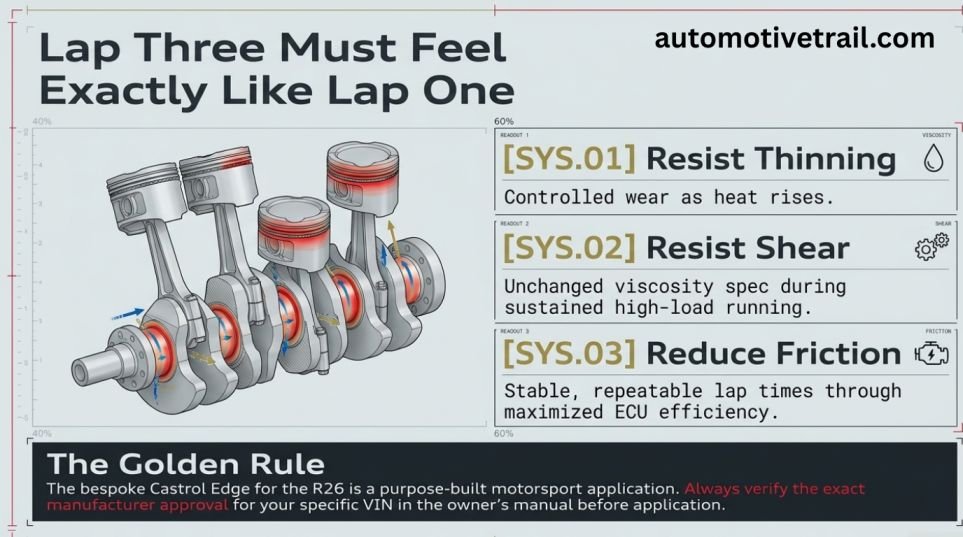
Beyond film strength, the formulation is aimed at preventing metal-to-metal contact as viscosity drops, and at resisting shear breakdown so viscosity stays closer to spec during sustained high-load running. It also targets reduced friction and deposit formation risks that can affect oil flow through critical passages. The oil needs to handle repeated hard sessions, so it supports repeatable performance by reducing lubrication variance from lap one to after the third hard lap, which is the single biggest takeaway for what the R26 oil is trying to achieve.
| Condition the R26 creates | Oil purpose described in the article | Result the article expects |
|---|---|---|
| High-load, high-temperature driving that thins oil | Keep the protective oil film strong, resist thinning | Controlled wear as heat rises |
| Repeated throttle-on stress that shears oil | Resist shear breakdown, keep viscosity closer to spec | More consistent lubrication session to session |
| Boundary lubrication risk when gaps tighten | Hold effective boundary layer strength when hottest and lowest film thickness | Less risk of rapid scuffing |
| Heat, oxidation, and byproducts that can form deposits | Keep deposit formation in check to maintain oil flow | Stable protection of bearings, cam interfaces, and cylinder surfaces |
Frequently Asked Questions
What Is The Main Purpose Of The Bespoke Castrol Edge Engine Oil Developed For The Audi R26?
The oil is associated with the high-stress reliability and performance demands of the Audi R26 in competition, using a Castrol product made for Audi motorsport programs. Castrol has powered Audi racing efforts for more than 40 years, so the development is linked to keeping engine behavior consistent under heavy loads.
Is The Bespoke Castrol Edge For The Audi R26 Meant For Everyday Street Driving?
No, it is developed for a specific motorsport application tied to the Audi program, not for general consumer “one size fits all” use. For a street Audi, follow the vehicle’s manual and the exact oil spec listed there.
Does The Bespoke Castrol Edge For The Audi R26 Improve Engine Protection During Hard Racing Conditions?
Yes, the intent is engine protection under extreme operating conditions such as sustained high RPM and high load, where oil needs to maintain film strength and stability. Exact performance numbers for the R26-specific blend are not clearly confirmed in the available public details, so treat this as purpose-driven, not a guaranteed spec sheet.
How Can I Tell If The Oil Spec For The Audi R26 Applies To My Audi?
Do not assume the R26’s bespoke intent matches your engine’s approved oils. Verify the exact manufacturer approval/spec for your VIN in the owner’s manual, then choose a Castrol product that meets that same approval.
Can Using The Wrong Oil Instead Of The Bespoke Castrol Edge For The Audi R26 Cause Problems?
It can, especially if the substitute does not meet the engine’s required viscosity and performance approval, since racing-focused formulations are not always interchangeable with street specs. For anything beyond routine oil changes, use the correct approval to avoid drivability and long-term wear issues.
Where Does This Bespoke Castrol Edge Development Fit Into Audi’s Motorsport Partnership?
Castrol has been integrated into Audi motorsport programs for decades, including long-running technical support efforts, which is consistent with developing oils for specific race needs. This partnership angle supports the “purpose first” idea, but it does not replace checking your car’s own oil approval requirements.

- 2017 Dodge Grand Caravan Transmission Fluid Capacity: Dodge Grand Caravan Transmission - September 27, 2026
- How Many Gallons Of Transmission Fluid Does A 2017 Gmc Yukon 5.3 Slt Xl Hold: How Many - September 26, 2026
- 17 Gmc Yukon Transmission Fluid Capacity V8 (8l90) Quarts/liters - September 26, 2026