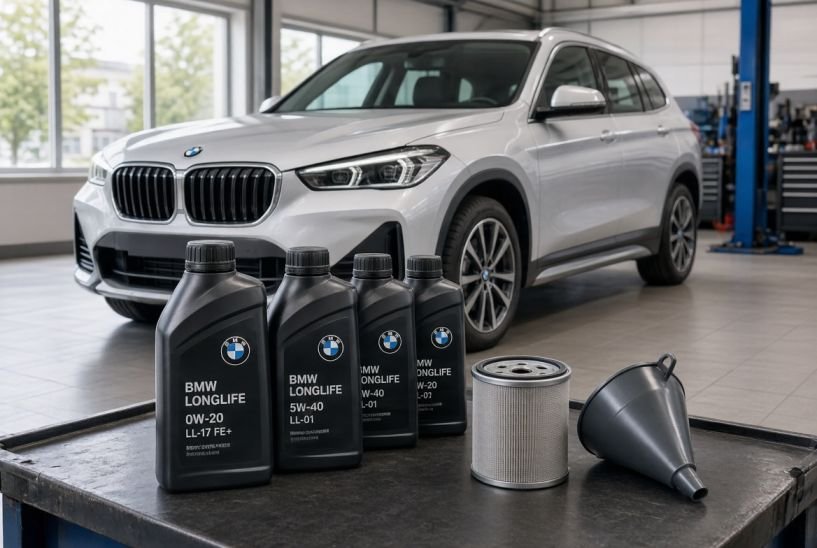
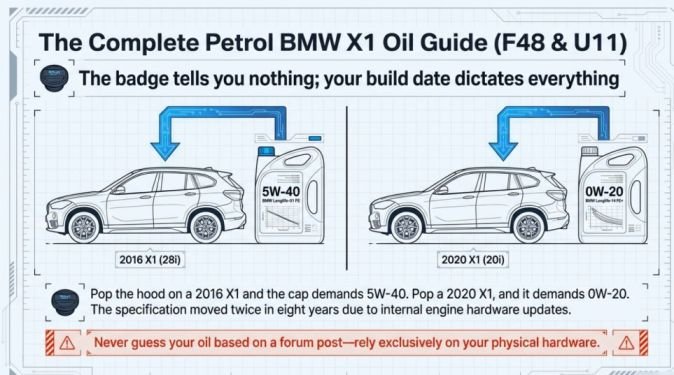
Pop the cap on a 2020 X1, and you’ll find “0W-20” stamped right into the plastic. Pop the cap on a 2016 X1, and it says “5W-40.” Same nameplate, same badge, completely different oil. That’s the whole story of petrol BMW X1 engine oil in one sentence: the spec moved twice in eight years, and your build date decides which one applies.
Quick answer: Petrol X1s run on BMW Longlife oils, either LL-01 (5W-30 or 5W-40, older engines) or LL-17 FE+ (0W-20, 2018-onward engines). Diesel-only LL-04 oil is not a substitute. Check your oil cap or VIN to confirm which one your car needs before you buy anything.
Key takeaways
- Petrol X1s need BMW Longlife-01 (LL-01) or Longlife-17 FE+ (LL-17 FE+), never LL-04.
- Early B48 28i models (2016–2017) spec 5W-40 LL-01.
- Most 2018+ B46/B48 engines moved to 0W-20 LL-17 FE+.
- U11-generation X1s (2022+) mostly run 0W-20, with the M35i possibly needing a heavier grade.
- Oil capacity runs roughly 4.0 to 6.0 liters depending on engine, filter included.
- The oil filler cap almost always tells you the exact spec, no guessing required.
What engine oil does a petrol BMW X1 need
Every petrol X1 built since 2015 uses one of two BMW oil families: Longlife-01 (LL-01) or Longlife-17 FE+ (LL-17 FE+). Both are full synthetic. Neither is interchangeable with the diesel-only LL-04 spec, no matter how close the viscosity numbers look on a shelf.
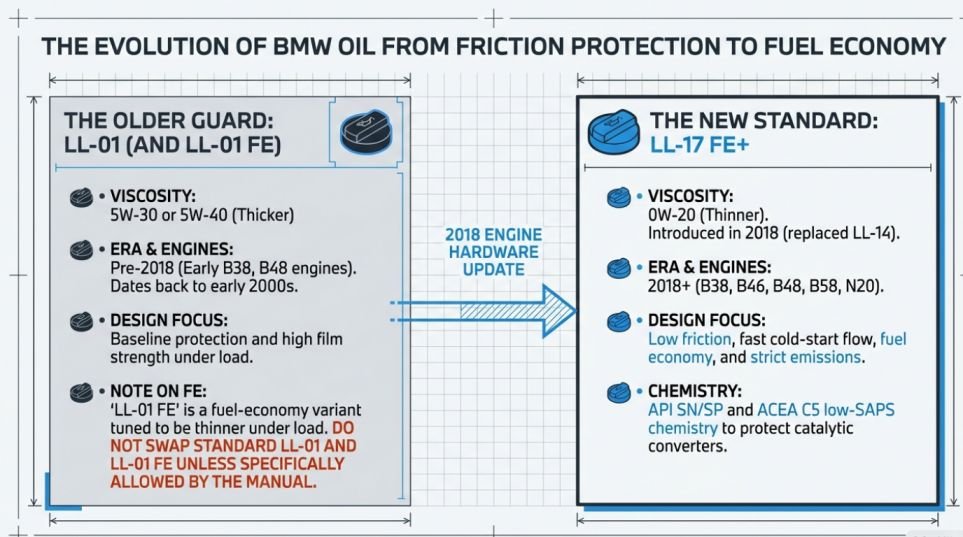
LL-01 is the older, thicker option, usually 5W-30 or 5W-40. It covers the earlier B38 and B48 engines and dates back to the early 2000s in various forms. LL-17 FE+ is newer, always 0W-20, and built around lower friction for better fuel economy. BMW rolled it out in 2018 across the B38, B46, B48, and B58 engine family.
The engine code on your specific car decides which one applies, and the code isn’t always obvious from the trim name alone. A “20i” badge covered different actual engines across 2016 to 2022, so the badge tells you less than the build date does.
Here’s the fast way to check: open the hood, look at the oil filler cap. BMW prints the required spec directly on it in almost every case, something like “0W-20” or “LL-01.” If it’s worn off or you bought the car used and the cap’s been swapped, the owner’s manual and the iDrive service menu both carry the same information tied to your VIN.
One more thing worth saying plainly: using a “close enough” oil isn’t a small risk. BMW’s four-cylinder turbo engines use a bore coating called Nanoslide instead of cast iron liners, and it reacts badly to the wrong additive package over time, not just the wrong viscosity number.
BMW LL-01 vs LL-01 FE: the difference that matters
LL-01 and LL-01 FE look almost identical on paper. Both are full synthetic, both show up on 5W-30 bottles, and both carry BMW’s blessing. The difference is base oil thickness, and it’s not cosmetic.
LL-01 FE is a fuel-economy variant, tuned to be thinner under load than standard LL-01. BMW built it to shave friction and squeeze out slightly better mpg on specific B38 and B48 applications. Standard LL-01, by comparison, runs a bit thicker and was the default across nearly the whole petrol and diesel lineup before particulate filters became standard.
Swap them, and you’re changing how much film strength the oil holds at operating temperature. BMW’s own approval documents say not to substitute LL-01 FE into an engine that calls for standard LL-01 unless the manual specifically allows it, and the same caution runs the other way.
In practice, this matters most if you’re buying oil based on a forum post or a general “5W-30 BMW oil” search instead of your exact spec code. Two bottles can both say “5W-30, BMW approved” and still not be the same product underneath.
If your cap or manual just says “LL-01” without the FE suffix, use standard LL-01. If it specifically says “LL-01 FE,” stick to that. When genuinely unsure, standard LL-01 is the safer default since it’s the broader, older-established spec.
BMW LL-17 FE+ (0W-20): the current mainstream spec
LL-17 FE+ is what most petrol X1 owners are actually buying today, whether they realize it or not. BMW introduced it in 2018 to replace an interim spec called LL-14, and it now covers the N20, B38, B46, B48, and B58 engines, which is most of the current four-cylinder and six-cylinder petrol range.
The number that matters here is the viscosity: 0W-20, noticeably thinner than the 5W-30 or 5W-40 many owners are used to from older BMWs. That’s intentional. Thinner oil flows faster on cold starts and reduces internal friction, which BMW leans on to hit fuel economy and emissions targets across its modern lineup.
LL-17 FE+ oils carry API SN or SP ratings and meet ACEA C5, a European classification tied to low-SAPS chemistry (low sulfated ash, phosphorus, and sulfur) that protects catalytic converters and, on hybrid variants, particulate filters too.
A practical example: a 2020 X1 with the 2.0L turbo engine takes about 5.6 quarts, or 5.3 liters, of 0W-20 LL-17 FE+ including the filter change. That’s the number a shop will actually order for that job.
If your car predates 2018 but has the newer engine internally (some transition-year builds did), check the cap rather than assuming by model year alone. BMW phased this in gradually, not on a single clean cutoff date.
Oil spec by engine: F48 X1 (2015–2022)
The F48 generation covers three distinct oil eras depending on when your specific car was built.
| Gen. | Engine | Model Variants | Years | Viscosity | BMW Spec | Capacity |
|---|---|---|---|---|---|---|
| F48 | B38 1.5L 3-cyl | sDrive18i Select markets |
2015–2022 | 5W-30 | LL-01 / LL-01 FE | ~4.0–4.25 L |
| F48 | B38 + electric motor | xDrive25e PHEV | 2015–2022 | 5W-30 | LL-01 FE | ~4.25 L |
| F48 | B48 2.0L turbo Early |
xDrive28i, sDrive28i | 2016–2017 | 5W-40 | LL-01 | ~6.0 L |
| F48 | B46/B48 2.0L turbo Later |
sDrive20i, xDrive20i, xDrive25i | 2018+ | 0W-20 | LL-17 FE+ | ~5.3–5.6 L |
| U11 | B38 1.5L 3-cyl turbo | sDrive18i, sDrive20i, sDrive16i | 2022–present | 0W-20 or 0W-30 | LL-17 FE+ / LL-01 FE | See manual |
| U11 | B48-derived 2.0L 4-cyl turbo | xDrive23i | 2022–present | 0W-20 | LL-17 FE+ | See manual |
| U11 | B48-derived 2.0L 4-cyl turbo 300 hp |
M35i xDrive | 2022–present | 0W-20 or 5W-30 | LL-17 FE+ | See manual |
The split between the 28i and the 20i/25i rows above isn’t a typo. BMW updated the internal engine hardware and the oil requirement together partway through the F48’s run, so two X1s from the same generation, three years apart, genuinely need different bottles.
If you own a 2016 or 2017 28i, don’t default to 0W-20 just because that’s what a newer BMW forum thread recommends. Stick with 5W-40 LL-01 unless your specific service documents say otherwise.
Oil spec by engine: U11 X1 (2022–present)
The current U11 X1 launched in 2022 and mostly continues BMW’s push toward thinner oils, though the lineup got more complicated with the addition of higher-output variants.
| Engine | Models | Likely oil | Spec |
|---|---|---|---|
| B38 1.5L 3-cyl turbo | sDrive18i, sDrive20i, sDrive16i (select markets) | 0W-20 or 0W-30 | LL-17 FE+ / LL-01 FE |
| B48-derived 2.0L 4-cyl turbo | xDrive23i | 0W-20 | LL-17 FE+ |
| B48-derived 2.0L 4-cyl turbo (300 hp) | M35i xDrive | 0W-20 or 5W-30 | LL-17 FE+ |
The base sDrive18i and sDrive20i share the 1.5L three-cylinder B38 engine, making 136 hp and 170 hp respectively, and both generally run the fuel-economy-focused 0W-20 or 0W-30 blend depending on the market.
The M35i is the wildcard. It pushes around 300 hp out of a heavily tuned version of the familiar B48-family 2.0L four, and higher-output tunes of an engine sometimes carry a different approval than the base version even though the block is related. This is the one X1 in the current lineup where checking your specific oil cap or service menu actually changes the answer, rather than being a formality.
Why LL-04 (diesel oil) will not work in a petrol X1
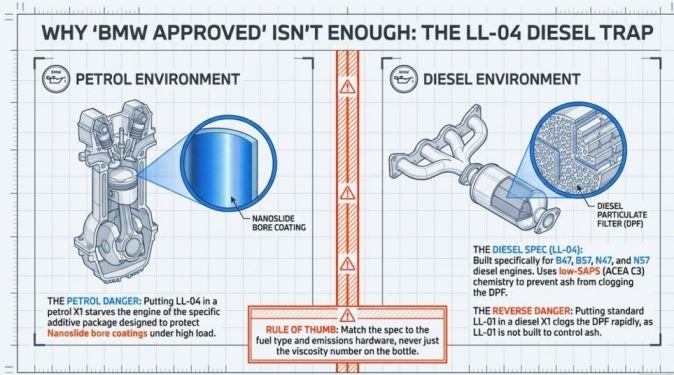
LL-04 shows up constantly in oil aisles and forum threads because it’s a common BMW spec, and that’s exactly why it causes confusion. It is not a petrol oil.
LL-04 is BMW’s low-SAPS specification, built for diesel engines running a particulate filter. Low-SAPS means low sulfated ash, phosphorus, and sulfur, a chemistry designed specifically to keep ash from clogging a DPF over time. It’s based on ACEA C3, and BMW requires it on the B47 and B57 diesel engines, plus older N47 and N57 units.
Put LL-04 in a petrol X1, and you’re not getting a disaster on day one, but you are running an additive package tuned for a completely different combustion environment and emissions system. Petrol engines don’t have the same DPF-protection need, and LL-04’s ash content profile isn’t matched to gasoline direct injection wear patterns the way LL-01 or LL-17 FE+ is.
The reverse mistake happens too: putting standard LL-01 into a diesel X1 risks clogging the DPF faster, since that oil wasn’t built to control ash the same way. The rule runs both directions. Match the spec to the fuel type and the filter hardware, not just the viscosity number on the front of the bottle.
If you’re buying oil online and the listing only says “BMW approved” without naming LL-01, LL-01 FE, LL-17 FE+, or LL-04 specifically, that’s a red flag, not a shortcut.
How to confirm the exact spec for your VIN
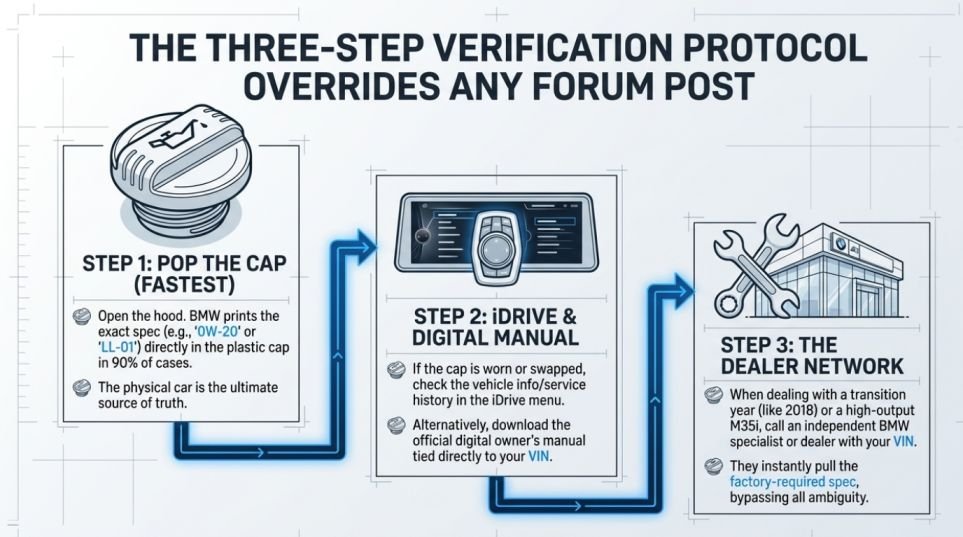
Three ways to nail down your car’s exact requirement, in order of speed.
- Check the oil filler cap. BMW prints the spec directly on it in the vast majority of cases. Pop the hood, look at the cap, done in thirty seconds.
- Check the iDrive service menu. Vehicle info or service history sections often list the last recorded oil type, and the owner’s manual PDF tied to your VIN confirms the factory-required spec.
- Call a dealer or independent BMW specialist with your VIN. They can pull the exact factory spec from BMW’s system instantly, no guessing, no relying on a general year/model chart.
Skip forum threads and general “what oil for BMW X1” articles as your final source, including this one. They’re useful for understanding the categories, but your actual VIN overrides any general table, because BMW made running changes mid-production more than once on this platform.
Oil capacity and change intervals
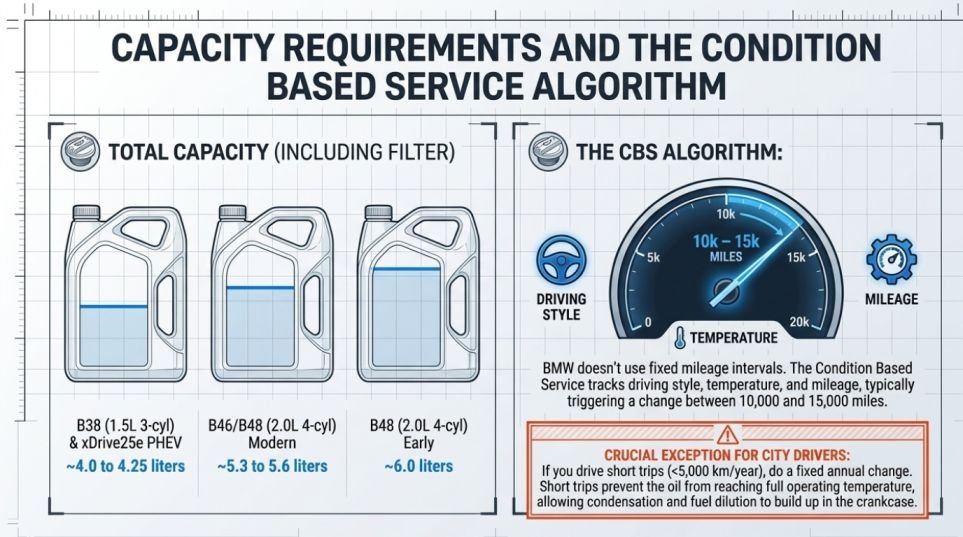
Capacity depends on engine size, and BMW’s own condition-based service system, not a fixed mileage number, decides your interval on most modern X1s.
- B38 1.5L three-cylinder: roughly 4.0 to 4.25 liters including the filter.
- B46/B48 2.0L four-cylinder: roughly 5.3 to 6.0 liters including the filter, with the exact figure depending on build year.
- xDrive25e PHEV: roughly 4.25 liters.
BMW’s Condition Based Service (CBS) system tracks driving style, temperature, and mileage together and flags an oil change when the algorithm calls for it, typically somewhere between 10,000 and 15,000 miles for most owners, sooner for hard driving or frequent short trips.
If you drive mostly short city trips under 5,000 km a year, as some owners report, a fixed annual change regardless of what CBS says is a reasonable extra precaution, since short trips never let the oil reach full operating temperature long enough to burn off condensation and fuel dilution.
Approved oil brands that meet BMW’s spec
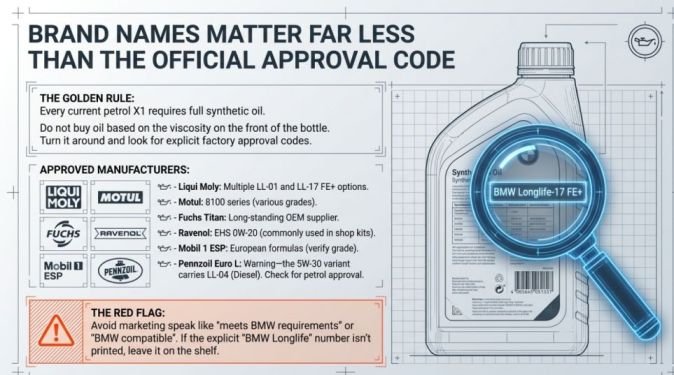
Genuine BMW-branded oil works, but it’s not the only option. Several major manufacturers carry direct BMW approval numbers on specific products, meaning they were tested and certified against the actual spec, not just formulated to a similar viscosity.
- Liqui Moly — multiple products with LL-01 and LL-17 FE+ approval numbers.
- Motul — 8100 series carries BMW Longlife approvals in several grades.
- Fuchs Titan — long-standing OEM supplier relationship with BMW.
- Ravenol — EHS 0W-20 carries LL-17 FE+ approval, commonly used in shop kits.
- Pennzoil Euro L — 5W-30 variant carries LL-04 approval for diesel use; check the specific bottle for petrol-spec approval before buying for an X1.
- Mobil 1 ESP — European-formula variants carry BMW approvals depending on grade.
The brand name matters less than the approval number printed on the bottle or spec sheet. Look for the actual BMW approval code, something like “BMW Longlife-01” spelled out, not just “meets BMW requirements” as a marketing line with no number behind it.
What happens if you use the wrong oil
Nothing catastrophic happens on the first drive. The risk builds over months and years, and it shows up in specific ways depending on which mistake you made.
Too thick an oil in an engine that wants 0W-20 slows oil flow on cold starts, when wear risk is already highest. Too thin an oil in an engine built around 5W-40 reduces the film strength the bearings and Nanoslide bore coating actually need under load, accelerating wear you won’t see until a compression test or an oil analysis flags it.
Using LL-04 diesel oil in a petrol engine, or vice versa, mismatches the additive package to the emissions hardware. In a diesel, running non-LL-04 oil risks clogging the DPF faster and triggering warning lights. In a petrol engine, running low-SAPS diesel oil doesn’t offer the same wear protection the gasoline-specific formula was built to provide.
None of this voids a warranty automatically just from one oil change, but a documented pattern of off-spec oil use is exactly the kind of thing that complicates a warranty claim if an engine problem shows up later. Keep receipts showing the correct spec was used, especially if you’re doing the changes yourself.
DIY oil change vs dealer service: cost comparison
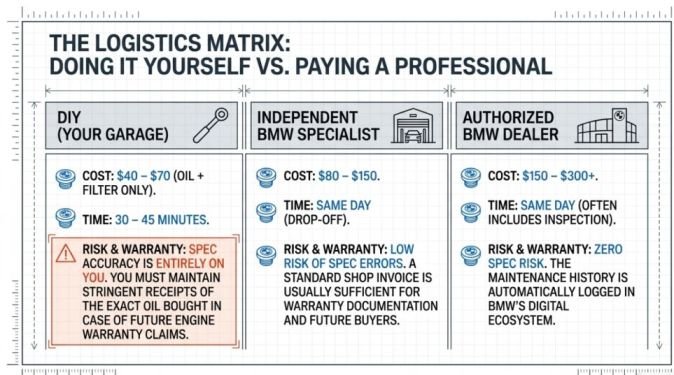
| Factor | DIY | Independent shop | Dealer |
|---|---|---|---|
| Cost (parts + labor) | $40–$70 (oil + filter only) | $80–$150 | $150–$300 |
| Time | 30–45 min | Same day, drop-off | Same day, often with inspection |
| Spec accuracy risk | On you to verify | Usually correct, confirm anyway | Guaranteed correct |
| Warranty documentation | Keep your own receipts | Shop invoice usually sufficient | Automatically logged |
DIY makes sense if you already know your exact spec and have basic tools, since the parts cost alone for a 5.3-liter fill of 0W-20 LL-17 FE+ oil plus a filter typically lands in the $40 to $70 range depending on brand.
An independent BMW specialist splits the difference: correct parts, professional labor, usually cheaper than a dealer, and most keep digital service records a dealer or future buyer can reference.
Dealer service costs more but removes any doubt about spec accuracy and keeps the maintenance history clean and verifiable if the car’s still under BMW’s warranty or you’re planning to sell it with full service history intact.
Summary: choosing the right oil for your petrol X1
Start with the oil filler cap, not a general chart. It tells you the exact spec BMW built your specific engine around, and that beats any model-year table, including the ones in this guide.
From there, the decision collapses to three questions: Is your engine pre- or post-2018 hardware? Does your cap say LL-01, LL-01 FE, or LL-17 FE+? And are you buying a product with the actual approval number printed on it, not just a “BMW compatible” marketing claim?
Early 28i-era F48 models want 5W-40 LL-01. Most 2018-onward F48 and nearly all U11 models want 0W-20 LL-17 FE+. Never substitute LL-04 diesel oil regardless of how close the viscosity looks. And if your car’s an M35i or any high-output variant, confirm the spec directly rather than assuming it matches the base engine it’s derived from.
Get that right and the rest- capacity, brand choice, DIY versus shop- is just logistics.
FAQ
Can I use 5W-30 instead of 0W-20 in my BMW X1? Only if your specific engine’s spec allows it. Some LL-01 applications call for 5W-30, but engines specced for LL-17 FE+ 0W-20 shouldn’t be swapped to a thicker oil without checking BMW’s documentation for your exact engine code first.
Does a BMW X1 oil change void the warranty if I use a non-BMW brand? No, as long as the replacement oil carries the correct BMW approval number for your engine’s spec. Using an unapproved or wrong-spec oil, on the other hand, can complicate a claim if engine damage shows up later.
How often does a petrol BMW X1 need an oil change? BMW’s Condition Based Service system tracks this per car rather than using a fixed interval, typically landing between 10,000 and 15,000 miles for average driving. Short-trip, city-heavy driving usually triggers it sooner.
Is synthetic oil required for a BMW X1? Yes. Every current petrol X1 spec, LL-01, LL-01 FE, and LL-17 FE+, requires full synthetic oil. Conventional oil doesn’t meet the additive or viscosity requirements these engines are built around.
What oil does the BMW X1 M35i take? Most sources point to 0W-20 LL-17 FE+, matching the base B48-derived engine, but the M35i’s higher output tune means it’s worth confirming directly against your VIN rather than assuming it’s identical to the standard xDrive23i.
Can I mix LL-01 and LL-17 FE+ oil in a top-up? Avoid it if possible. They’re both BMW-approved but built around different viscosity and friction targets. A small top-up in an emergency is unlikely to cause immediate harm, but get a full spec-correct change done as soon as you can afterward.

- Top 10 Ranking Tire Brand for Minivan: Reviewed 2026 - October 5, 2026
- Model Y Tesla Long Range Automatic Wagon Tyre Fitment And Ratings - October 3, 2026
- What Is The Benefit Of Larger Rear Tyres On A Zero-turn Mower - October 3, 2026