You’re staring at a bottle that says 5W-30 and wondering if diesel engines need “different” oil, especially if your truck or SUV runs a DPF or you’ve seen warnings about the wrong chemistry. The short version is that 5W-30 mostly tells you the viscosity, but diesel is picky about approvals and additive packages.
5W-30 is a viscosity grade, so gasoline and diesel oils can share the same 5W-30 number, but diesel oil must meet the right diesel/OEM standards (look for applicable ACEA/API categories and manufacturer approvals). In the rest of the article, you’ll learn what to check on the label, how to match your owner’s manual spec, and what risks show up when you grab the wrong bottle.
5W-30 is the same viscosity grade whether the engine is gasoline or diesel, but diesel engines need oil that meets diesel-specific standards. Check the bottle for the applicable ACEA B- or C-series and/or API CK-4 or CJ-4, plus your vehicle maker’s approval, often shown as “meets” or “approved.”
1. Is There Adifferent 5w 30 For Diesel Engines?
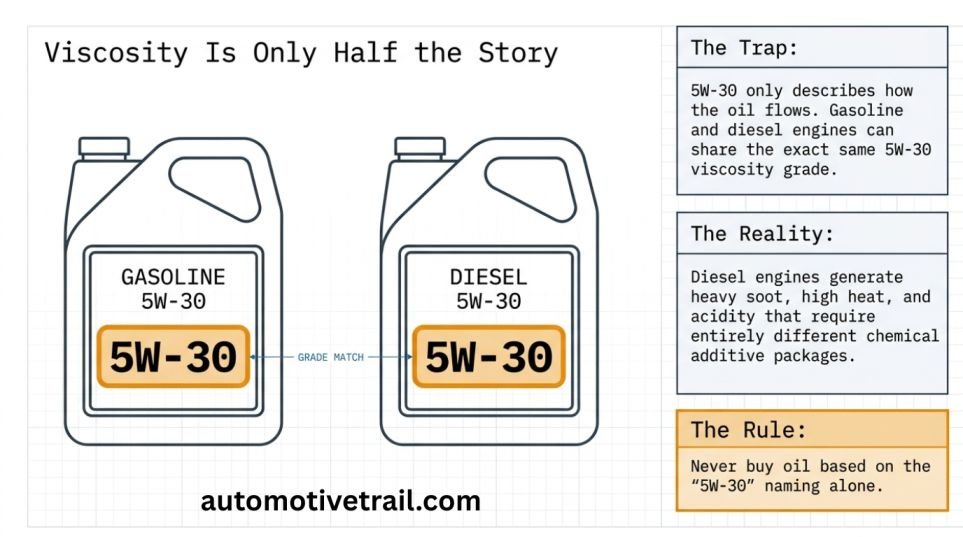
5W-30 is a viscosity grade, so diesel and gasoline engines can share the same weight. The reason this item matters is that diesel engines also care about performance categories and emissions hardware compatibility, which depends on the oil’s spec line, not just the “5W-30” number. Choosing the wrong spec can cause poor wear protection or hardware issues even if the viscosity looks correct.
For example, look for the API service category and any diesel-specific approval marks on the bottle, such as “CJ-4,” “CK-4,” or “FA-4” for modern heavy-duty or emissions-focused diesels (the exact code depends on the application). Many modern light-duty diesels also require a specific manufacturer approval tied to turbo operation and soot control, so the safe move is to match the manual’s listed spec rather than guessing from the viscosity alone. If you have a common pickup diesel, you will often see oils marketed as “diesel engine” because they meet those higher soot and oxidation demands.
What To Check On The Jug
The bottle’s label matters more than the wording “diesel.” Find the API service category (often shown near the center of the label) and any additional certifications or OEM approvals. If your manual specifies an oil that must meet a particular diesel category, stick to that exact category, because additive packages differ between light-duty diesels, heavy-duty diesels, and emissions-ready formulations. If the manual lists a specific ACEA or OEM approval, that typically overrules generic “5W-30 diesel” marketing.
Reader takeaway: Buy 5W-30 only after you confirm it meets the diesel oil spec codes (and OEM approvals) listed in your owner’s manual, not based on viscosity naming alone.
2. What “5W-30” Actually Tells You
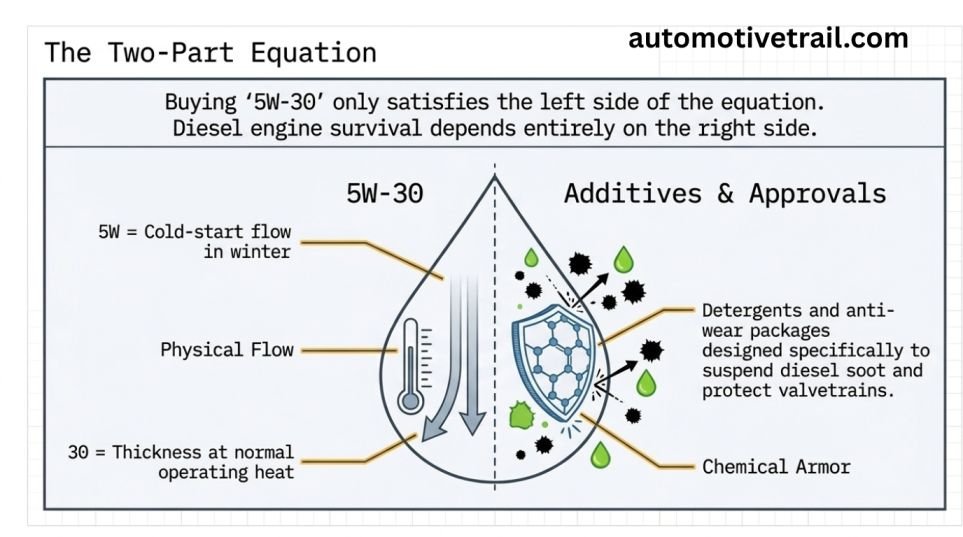
“5w-30” is a viscosity grade, and it tells you how the oil flows when it is cold and how thick it stays at normal operating temperature. The “5w” part indicates cold-start flow at winter temperatures, while “30” refers to the oil’s viscosity in the engine’s normal heat range. Diesel engines do not get a totally different viscosity system, but they often need an oil blend that also meets diesel-specific performance requirements (like soot handling and corrosion protection) beyond the basic 5w-30 number.
In practice, two 5w-30 oils can both say 5w-30, yet one may be intended for gasoline service only, and the other may carry diesel classifications and additive packages. That difference matters because diesel engines generate soot and acidity that the oil must manage over long drain intervals.
Where 5w-30 Is The Same And Where It Changes
The “5w” and “-30” portions of the label describe flow behavior, so they are the same concept whether the engine is diesel or gasoline. The change is in the additive package and approvals, which are what determine whether the oil is meant to control soot, protect turbochargers, and handle exhaust-related contaminants common in many diesels.
For example, many heavy-duty diesels and some turbo diesel pickups have strict requirements listed in the owner’s manual, and using a generic “meets or exceeds” product with the wrong approval can cut oil life and increase wear risk. If the bottle does not clearly show the correct diesel approval category, you are better off picking an oil that explicitly matches it rather than assuming any 5w-30 will work.
3. OEM Oil Approval Comes First
Diesel 5W-30 is a wide category, and the “right” oil depends more on meeting the engine maker’s approval than on the weight rating alone. Many modern diesel engines use emissions systems (like DPFs) that are sensitive to oil formulation, so OEM approval is the shortest path to staying within what the engine was designed to run. When the manufacturer specifies an approval or performance standard, it is usually there to control soot handling, oxidation stability, and emissions compatibility.
Look for an approval claim on the container (such as the exact OEM spec callout) and match it to your owner’s manual.
For example, European diesels often list specific ACEA categories and manufacturer codes, and American heavy-duty applications may reference distinct specs tied to fuel dilution and soot load. A good rule is to buy the same spec the manual lists, even if an “alternate” 5W-30 looks identical on the shelf.
In practice, if the container does not clearly state the required approval, it is safer to switch to a brand that does, even if both oils are 5W-30. This also helps avoid situations where a “diesel 5W-30” exists in name, but it is optimized for older engine designs or different emissions strategies.
How To Find The Approval Fast
Start with the oil spec section in the owner’s manual or the under-hood maintenance label, since that is where the engine maker defines the required approval text. Then cross-check the oil jug for the same approval code wording, often printed near the front label or the back “meets/exceeds” section. If you see only broad claims like “API CJ-4” or “diesel compatible” without an OEM approval statement, treat it as a mismatch until you can confirm it with the vehicle manufacturer or the oil producer. For European makes like VW, BMW, Mercedes-Benz, and Audi diesels, the exact code matters a lot, and for heavy-duty platforms, the manufacturer approval can be even more specific.
4. ACEA B-series For Diesel Soot Control
ACEA B-series diesel oil categories are built around controlling soot and keeping oil performance stable in soot-heavy duty cycles like stop-and-go urban driving and short trips. That is why this item belongs in a list about different 5W-30 options for diesel engines, because ACEA classification often matters as much as the SAE grade when you are trying to match the oil to diesel operating conditions.
For example, many modern passenger-car and light-truck diesels call for an ACEA B-series spec alongside the required viscosity, so a 5W-30 labeled ACEA B4, B3, or B5 type coverage can be a more direct match than a generic “diesel 5W-30.” In practice, look for the ACEA marking on the bottle (it is usually near the API/ILSAC logos) and confirm it also meets your vehicle maker’s listed oil requirements. A typical “diesel soot control” advantage is better retention of viscosity and detergency under higher soot loading, which is common with EGR-equipped engines.
When To Use It
If your diesel sees a lot of short trips, city idling, or frequent regeneration events (common on some newer diesel designs), soot generation and contamination happen faster than on steady highway runs. In those cases, an ACEA B-series oil grade that is specified for diesel soot control can help maintain filtration and oil cleanliness longer, reducing the odds of accelerated thickening or deposits. This matters most when your current oil is due for change on schedule, since topping off with the wrong category can blur the performance balance even if the viscosity is still 5W-30.
5. Api Ck-4 And Cj-4 Meaning
API CK-4 and CJ-4 are oil performance categories, and they matter because diesel engines run higher soot loads and need specific additive packages to protect pistons, bearings, and emissions equipment. CK-4 is the newer standard compared with CJ-4, so matching the correct API category helps the oil meet the protection level your engine was designed to use. This is why many 5W-30 diesel oils list one or both labels on the back of the bottle.
In practice, the “CK” and “CJ” codes refer to heavy-duty diesel service levels, while the number indicates the generation of the specification. CJ-4 oils can still be acceptable for many applications that call for that older level, but CK-4 is often what you choose when the manufacturer allows the newer spec. Look for API markings that include API CK-4 (or API CJ-4) right on the label, and also confirm the oil is intended for diesel service, since some 5W-30 passenger-car oils carry API ratings that do not match heavy-duty diesel needs.
How To Interpret The Labels When Buying 5W-30
When a box or bottle shows both “API CK-4” and “API CJ-4,” it means the oil meets the newer CK-4 requirements and is compatible with applications calling for the older CJ-4 category, assuming the rest of the spec set matches what your vehicle requires.
For example, a 5W-30 heavy-duty diesel oil commonly used in Class 6-8 duty cycles may carry CK-4 to cover modern aftertreatment needs, while still listing CJ-4 for backward compatibility. Always cross-check the manual for viscosity limits and any additional approvals (some engines also care about specific aftertreatment or emission system requirements). If you cannot find the API category called out in the manual, it is usually safer to buy the exact listed category or ask a parts counter to verify the correct grade for your VIN.
6. Low-SAPS and DPF Compatibility
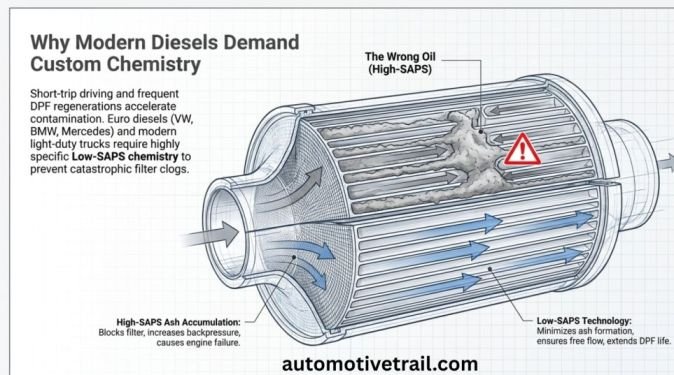
Low-SAPS diesel engine oil is tied to DPF (diesel particulate filter) life because it keeps ash and phosphorus levels lower, which helps reduce DPF loading over time. Many newer 5W-30 oils for modern diesels are built around ACEA low-SAPS specs (often labeled C2 or C3). This is why the “right 5W-30 for diesel engines” can differ, even when the viscosity is the same.
In practice, look for packaging language that explicitly mentions DPF compatibility and low-SAPS or ACEA C-series. If your oil fill cap or owner’s manual calls for an ACEA C2/C3 type, staying in that lane matters more than brand. Many Euro diesels (Volkswagen, Audi, BMW, Mercedes-Benz, and Renault/Nissan platforms) commonly use low-SAPS oils when equipped with diesel particulate filters.
When It Matters Most
If you drive a lot of short trips, the DPF spends more time in regeneration cycles, which makes correct oil chemistry more important. For fleets or commuters running frequent city driving, using the specified low-SAPS 5W-30 (and not a generic diesel oil) helps avoid accelerated soot and ash buildup that can shorten filter service intervals. For older diesels without a DPF, a low-SAPS oil may still be fine, but the “must-have” part is that your manual’s ACEA and OEM requirements get followed.
7. Gasoline Oil Vs Diesel Oil Labels
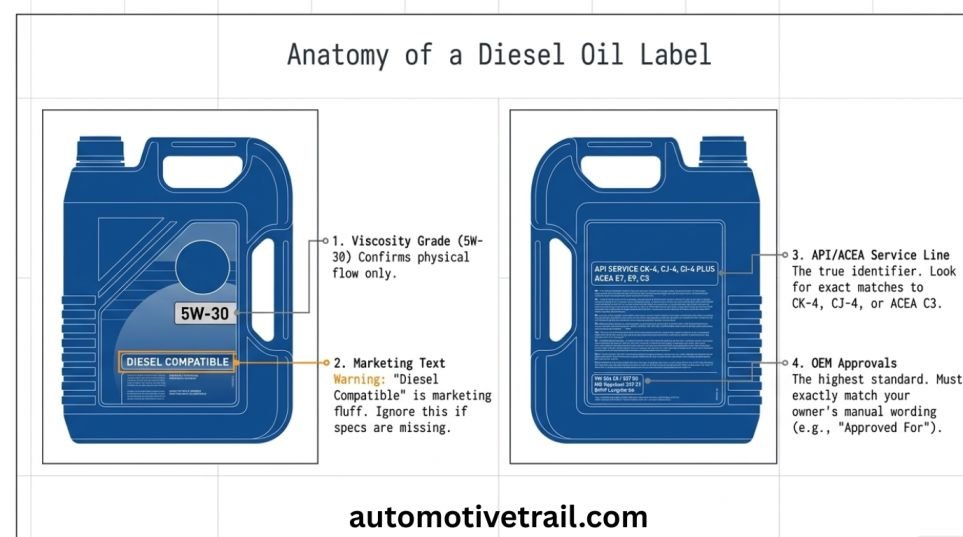
Oil labels matter because diesel engines usually spend more time under high heat and soot load, so modern diesel engine oils are often graded with additive packages aimed at soot control and wear protection. The practical outcome is that “5W-30” tells you the viscosity only, while the label text tells you which performance categories it meets. This is why two bottles can both be 5W-30 and still behave differently in a diesel.
Look for the driving category on the front and back label, typically expressed as API for gasoline (like SN plus energy-conserving language) versus diesel (like CJ-4 or CK-4). The API “Service Category” is the big divider, and you can also see ACEA categories on many European-market oils (such as C-series for diesel passenger cars with particulate filters).
For example, a passenger-car diesel that specifies an oil meeting a low-SAPS spec for a DPF usually needs the right label wording, even when the viscosity is the same.
In practice, gasoline-labeled oils can sometimes meet diesel requirements in older markets, but newer diesel specs are stricter, so the safest approach is matching the manual’s stated API and/or ACEA categories.
How To Read The Fine Print On The Back Label
Most cans include a performance line near the top (API service category and possibly an ACEA code), plus a viscosity chart area that shows where the 5W and 30 numbers apply. If you see an ACEA “B” category, that often relates to light-duty diesel, while “C” categories are commonly tied to emissions system compatibility, such as particulate filters and three-way catalysts in some applications.
For instance, an oil labeled with the wrong diesel category can be missing soot-control chemistry, or it can have higher ash-forming additives that are a problem for DPF-equipped engines.
8. Example Label Check: Acceptable Oil
Oil labeling matters because diesel engines typically need protection against soot and wear, and the label is where you confirm the right performance level. For a 5W-30, “diesel-suitable” is usually shown through an API category (commonly CJ-4, CK-4, or FA-4 for newer HD diesels) and the correct ACEA level when required. Checking these stamps prevents you from buying a 5W-30 that has the right viscosity but the wrong additive package.
In practice, you want the viscosity on the front (5W-30) plus the performance marks on the back or near the label edge.
For example, look for API “Service” designations and any ACEA spec callouts like A3/B4 or C3 (light-duty diesel rules can differ from heavy-duty). Many 5W-30 options that meet both gasoline and diesel needs still require the exact engine spec listed in your owner’s manual, especially for newer emissions systems.
Reading The Label Without Guessing
When you see API marks, match them to the engine’s application, not just “diesel” in general. Heavy-duty diesel oils and light-duty diesel oils can overlap, but the exact category matters, and emissions hardware (like EGR and diesel particulate filtration) can tighten the requirements. If the bottle says it is “backward compatible,” treat that as guidance, then still confirm it meets the same or newer spec your manual requests. When in doubt, use the owner’s manual wording first, because aftermarket labels are broad and not every diesel engine has the same expectations.
9. Example Label Check: Wrong Oil

Mixing oil that only says “5W-30” with the wrong approval can cause poor wear protection, even if the viscosity grade matches. Diesel-focused oils are often built around specific performance levels for soot handling and valve train protection, and the easiest way to catch a wrong choice is by reading the label for the correct engine-oil spec and approval marks.
In practice, the label should show an API service category (for example, CJ-4, CK-4, or similar where applicable) and may also list ACEA ratings, plus OEM approvals if the vehicle requires them.
For example, a passenger-car “5W-30” that lacks the right diesel rating can still look compatible on the shelf, then leave you with an oil that does not meet the engine’s intended protection window. Check the oil cap and the owner’s manual, then confirm the bottle explicitly lists the same or higher spec.
When the bottle is unclear, stick to brands that clearly state both the viscosity and the diesel service category, not just “meets or exceeds” in vague terms. A practical quick check is to compare the bottle’s API/ACEA wording to what your manual calls out, and ignore marketing-only terms like “diesel safe” if the spec line is missing.
What To Do When The Label Is Confusing
For instance, some bottles list multiple certifications, and others only mention “5W-30” plus general claims. If you see “5W-30” but there is no clear diesel service category or rating in the ingredients or performance section, that is a red flag for label mismatch. If the vehicle is under warranty, missing the required specification can become a paperwork problem, even if the oil still flows the same at cold temperatures.
In practice, the safest move is to pick an oil bottle that lists the required spec in plain text and matches or exceeds the manual, then use the same spec for future changes. If you already filled it with the wrong oil, have the situation reviewed by a shop, especially if you are close to an oil-change interval or the manual is strict about approvals. When in doubt, check the manual first, then the label, then confirm with a professional if the spec is not obvious.
10. How To Verify On Owner’s Materials
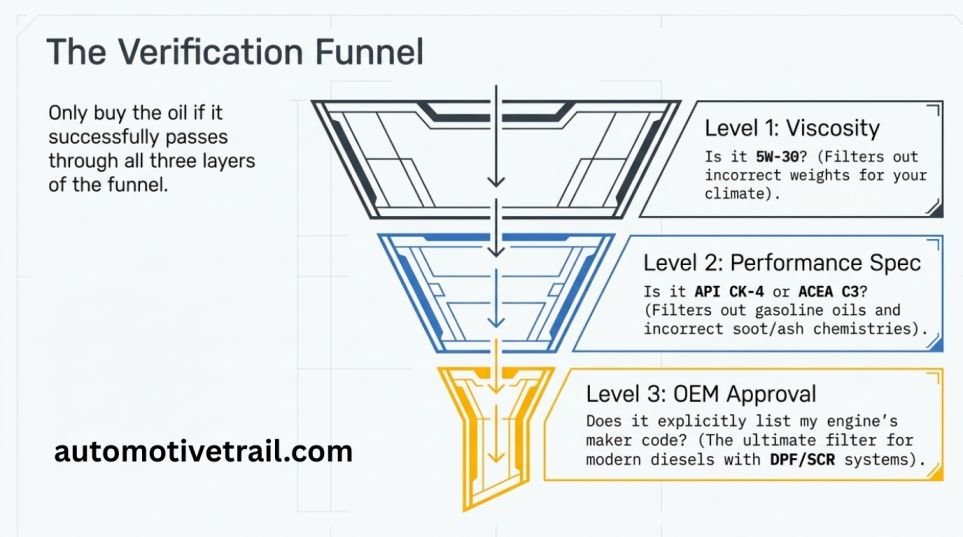
Owner’s materials are the fastest way to confirm whether a 5W-30 is spec’d for diesel duty in your exact engine. Most manufacturers do not ask you to guess by vehicle type alone; they point you to a specific viscosity range plus performance standard (like ACEA or API service categories) to protect bearings and emissions aftertreatment. Using the wrong spec can lead to poor cold flow, faster wear, or incompatible additive chemistry.
Start with the “Engine Oil” section and compare the viscosity (5W-30) and the approval language next to it. Look for wording like meets or approved for a named standard, and check whether your manual references turbodiesel, DPF (diesel particulate filter), or specific drain intervals.
For example, if your owner’s booklet lists multiple grades, it often ties them to temperature ranges, like colder regions using 0W-30 or 5W-30.
In practice, you can verify the oil bottle claims by matching the label’s certification marks to the manual’s listed standard before you buy.
Where To Look And What To Write Down
On most vehicles, the key info is in the “Maintenance” chapter and sometimes in a separate “Fluid Capacities and Specifications” page. Write down the approved standards exactly as printed, plus the oil weight(s) and temperature guidance, because dealers and parts counters can misread abbreviations. If you have a truck or SUV with a diesel, also record whether your manual mentions DPF requirements, since that can affect which 5W-30 variants are acceptable. If the manual is missing or unclear, use the VIN lookup in your manufacturer’s dealer portal or call the parts department with your exact model, year, and engine code so they pull the right specification sheet.
11. Risks Of Using The Wrong 5W-30
Using the wrong 5W-30 is risky because diesel engines often need specific additive packages for soot control, wear protection, and compatibility with emissions systems (especially if your truck uses aftertreatment like DPF). A mismatch in oil specification can increase soot buildup and accelerate wear, even when the viscosity is correct at 5W-30. Many diesel oils are labeled with specific performance levels beyond “5W-30,” so picking by thickness alone is a common mistake.
For example, using an oil that meets a gasoline-focused API level but not the diesel-approved spec can lead to higher piston deposits and faster degradation under stop-and-go heat cycles.
In practice, the safest approach is to match the exact oil specification printed in your owner’s manual or on the engine oil fill area, not just the SAE grade. Watch for “ACEA C-series” or “API CJ-4/CK-4” style markings that align with your engine’s requirements, since these indicate additive targets that protect diesel valvetrains and emissions hardware.
Most Common Symptoms That Show Up Later
When oil selection is off-spec, symptoms often appear after several oil changes, not immediately. Owners may notice increased exhaust smoke at start-up, stronger diesel odor, or oil needing top-offs sooner than expected. Some engines can also run hotter or feel less responsive as friction increases, especially if the oil’s diesel detergent and anti-wear package is not the required one. If you’re seeing rising consumption, darkening oil too fast, or any warning light tied to emissions, have the vehicle checked by a shop before assuming the oil change “fixed it.”
12. When An Oil Change Interval Differs
Oil life and interval recommendations differ because many diesel engines run on different fuel and thermal loads, and modern oil life systems are calibrated around the engine’s duty cycle and the oil’s performance level. That is why your owner’s manual may specify a particular 5W-30 meeting diesel standards and then adjust how many months or miles you can go before the next change. Following that interval matters more than chasing a “diesel-only” label.
In practice, you will see longer intervals when the oil is approved to the right diesel specification and the vehicle uses an oil-life monitor, while severe-duty driving usually shortens the schedule. Check whether your manual calls for fixed intervals (example: every X months or miles) or an oil-life percentage system. Common diesel application guidance often splits between light-duty use (more time between changes) and towing, frequent short trips, or dusty conditions (shorter intervals).
How To Match Interval To Your 5w-30 Choice
When your manual lists a specific diesel approval (usually printed as an industry performance standard number), treat that as the “interval key.” For example, if it specifies an approval tied to emission system durability, you should only use a 5W-30 that clearly meets that same approval so the oil-life monitor stays within its intended assumptions. If the manual uses a fixed schedule, the viscosity and approval still matter, but the interval is less affected by the oil-life math. For owners of popular diesel models like Ram 2500/3500, Ford Super Duty diesels, and many GM Duramax trucks, the biggest interval swing usually comes from how they drive (towing and idling shorten the clock fast).
13. Mixing Viscosities Or Brands Safely
Diesel oil specs are more about meeting the right performance approval than about keeping a perfect “same brand” match. When a 5W-30 product meets the required diesel standard (like API CK-4, CJ-4, or the manufacturer’s spec), short-term mixing usually does less harm than mixing the wrong viscosity or skipping the approval entirely. This is why this item belongs in the list, since it helps owners handle top-offs and incomplete oil changes without creating unnecessary engine risk.
In practice, aim to keep the grade the same (for example, 5W-30 with 5W-30) and verify both oils list the same diesel performance approval.
For example, you can often top off a drained sump with a different 5W-30 that carries the same API category and the same “meets” or “approved for” manufacturer requirement printed on the label. Avoid mixing in heavier grades (like 10W-40) or a different viscosity than the one on the oil fill cap, especially if you drive in cold starts where the “W” rating matters.
What To Check On The Bottle And The Dipstick
Before you pour anything, read the back label for the viscosity grade (for example, 5W-30) and the diesel performance statement, such as API CK-4 or CJ-4, plus any manufacturer approvals (many European and heavy-duty applications name a specific OEM spec). Even if two bottles both say “5W-30,” swapping brands is still a guess unless the performance category matches, since additive packages are tuned for diesel soot, wear protection, and emissions systems. After topping off, recheck the level after a short drive and park on level ground, then plan to complete a full oil change soon to restore consistency across the sump.
14. Checklist Before You Buy Diesel Oil
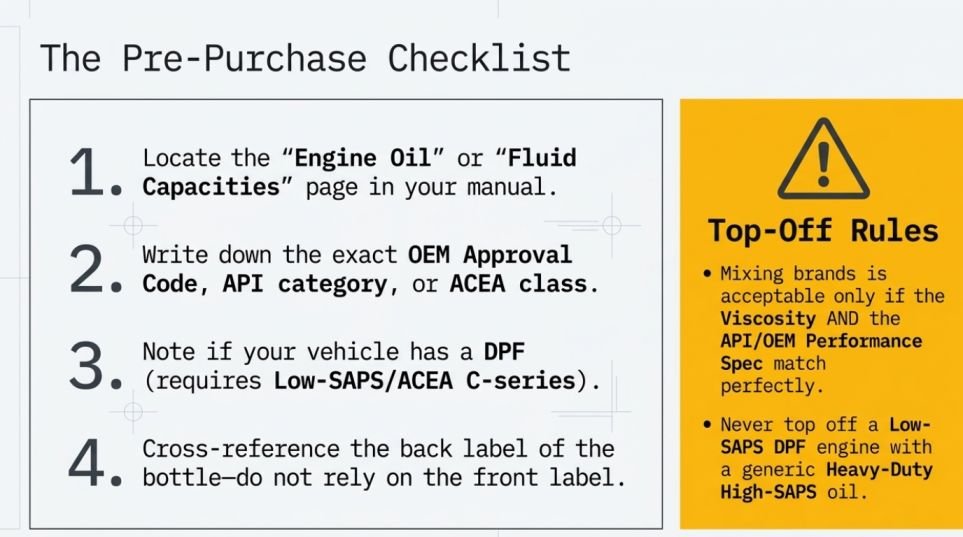
Diesel engines are picky about oil additive packages, because modern soot control depends on the right API and ACEA spec, not just viscosity. Buying the wrong formulation can upset emissions equipment and shorten service life even when the viscosity looks correct (like 5W-30). A quick checklist prevents that by matching the label to your engine’s required performance standard.
Start by reading the bottle for the exact viscosity (5W-30) and the approvals listed on the label, then cross-check them against your owner’s manual or the oil cap spec. If the manual calls for an ACEA C3 or C2, stick to that class rather than assuming all “diesel 5W-30” is the same.
For example, many light-duty diesels use low-SAPS oils (built for soot and catalyst protection), while some older diesels want higher-ash specs for different aftertreatment setups.
Tradeoffs That Affect What You Should Buy
Low-SAPS diesel oils are often the right match when your vehicle has DPF or SCR aftertreatment, because they control ash-forming additives that can clog filters. Higher-ash “heavy duty” formulations may be fine in engines that do not require low-SAPS, but using them where low-SAPS is required can accelerate emissions component buildup. Pay attention to what your manual requires, since two bottles both labeled “5W-30 diesel” can differ by ACEA class and additive chemistry, even if their viscosity rating matches.
15. Quick Take For Different Diesel Setups
Diesel engines commonly run on 5W-30 because it balances cold-start flow with hot-weather film strength, but the right answer depends on the oil specification your engine actually calls for. Medium-duty diesels and newer light-duty diesels can demand different additive packages for soot control, turbo wear protection, and emissions system durability. That is why “5W-30 for diesel” is a category, not a single universal formula.
For example, light-duty diesels in trucks and SUVs typically follow the manufacturer’s ACEA/ILSAC/API rules printed on the oil cap or in the owner’s manual, and many will specify a diesel-focused performance level like ACEA C3/C2 for certain aftertreatment setups.
In practice, if you run a diesel with a diesel particulate filter (DPF) or other emissions hardware, using the wrong low-SAPS or SAPS level can accelerate ash buildup and clogging. Stick to the exact viscosity plus the required performance spec, and treat “meets diesel” wording as secondary to the numbers on the label.
How To Choose Between “Diesel” 5w-30 Options
Start by matching the label’s performance standard to what your engine requires. Many manufacturers list the approved oil meeting ACEA and API codes, and those codes are what protect turbo bearings, manage soot, and keep aftertreatment operating correctly.
For instance, a 5W-30 that is “fine for diesel” in general can still be wrong if it has the wrong SAPS level for your DPF, or if it lacks the specific soot and oxidation resistance your engine’s oil calibration expects. If your vehicle manual specifies a named approval, prioritize that approval over brand marketing.
Quick Summary
5W-30 is mainly a viscosity grade, so diesel and gasoline engines can share the same 5W-30 number, but diesel oil is not “different” in weight only. Diesel engines also require the correct approvals and additive chemistry, because the bottle needs to meet diesel-specific standards, not just viscosity. The article emphasizes checking the label for diesel markers like ACEA B-series and API CK-4 or CJ-4, plus your vehicle maker’s “meets” or “approved” wording, especially on newer engines.
It also explains what “5W-30” tells you, where 5W relates to cold-start flow and 30 to thickness at normal operating temperature, and notes that diesel demands extra performance beyond viscosity, like soot handling and corrosion protection. For DPF or particulate filtration, low-SAPS is usually called out by ACEA or OEM requirements. It warns to avoid the wrong API category, giving gasoline-only API SP as an example, and to follow the owner’s manual maintenance chart for the exact oil spec and change interval, based on approval codes, not marketing.
| What to confirm on the jug | What the article says to look for |
|---|---|
| Viscosity grade | Match 5W-30 per the owner’s manual |
| Diesel performance category | ACEA B-series and/or API CK-4 or CJ-4, with the exact code depending on application |
| OEM approval | Approval text like “meets” or “approved” for your specific manufacturer spec |
| DPF/aftertreatment compatibility | Low-SAPS wording often called out by ACEA or OEM requirements |
Frequently Asked Questions
Is There A Different 5w-30 For Diesel Engines Compared To Gasoline Engines?
Yes. Diesel 5W-30 oil is usually built with different additive requirements to handle soot load and diesel-specific emissions systems, so you should follow the API/ACEA and OEM spec listed in your owner’s manual rather than assuming all 5W-30 is interchangeable.
Can I Use 5w-30 “Diesel” Oil In A Gas Engine If The Viscosity Matches?
Sometimes, but check the specs first. If the bottle’s API/ACEA category meets what your gas engine calls for, it is often okay to top off, but avoid using diesel oil that does not match the required ratings since emissions and wear protection targets can differ.
What Label Or Ratings Should I Look For On 5w-30 Diesel Oil?
Look for the API (like CK-4 or CJ-4 for many modern diesels) and the ACEA rating, plus any OEM approval number called out in your manual. If those ratings are missing or don’t match, don’t rely on viscosity alone.
Will Using The Wrong 5w-30 For A Diesel Engine Cause Problems Right Away?
Usually it’s not instant, but it can shorten engine life. The risk is more about long-term protection and emissions system durability, so if you put the wrong oil in, the safest move is to change it as soon as possible and use the correct spec.
Is 5w-30 Diesel Oil Compatible With DPF Or Other Emissions Systems?
It can be, but only if it is the right “approved” type. Many diesel engines with DPF require low-ash, emissions-friendly oils, so verify the bottle spec is compatible with your OEM requirements before you switch.
How Do I Choose 5w-30 Diesel Oil For Cold Weather And Extend Oil Life?
Start with 5W-30 for temperature and confirm it matches your diesel’s required API/ACEA and OEM approval. Then stick to your manufacturer’s change interval, because using the correct spec matters more than “just 5W-30” for wear protection and oil life.

- 2017 Dodge Grand Caravan Transmission Fluid Capacity: Dodge Grand Caravan Transmission - September 27, 2026
- How Many Gallons Of Transmission Fluid Does A 2017 Gmc Yukon 5.3 Slt Xl Hold: How Many - September 26, 2026
- 17 Gmc Yukon Transmission Fluid Capacity V8 (8l90) Quarts/liters - September 26, 2026