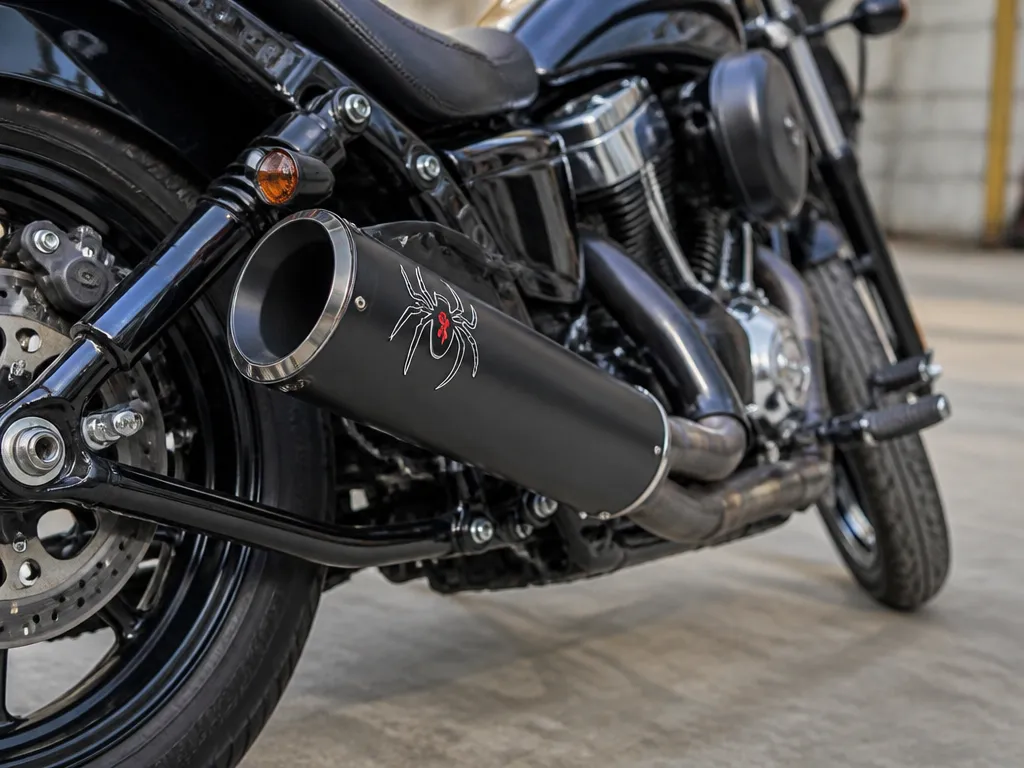
Every time somebody asks, “Are Black Widow exhausts any good?” it usually means one thing: they want a louder, better-sounding exhaust without buying twice. The tricky part is that “better” can mean sound only, or sound plus real-world gains, plus street legality and fitment that actually lines up.
Black Widow exhausts can be a solid buy if your priority is tone and value over big horsepower claims, and if you confirm fitment before ordering. Most setups are reviewed around sound quality and street usability, while power gains usually stay modest. Installation quality depends heavily on your exact model match and mounting hardware.
Are Black Widow Exhausts Any Good?
Black Widow exhausts can be a solid pick when you want a louder, more aggressive sound and are fine with typical aftermarket trade-offs like fitment quirks and noise limits depending on your model. Real-world feedback usually lands on the same themes: the tone is often the big win, while longevity and installation ease vary by bike and system style. Because source coverage is thin, this guide stays practical and sticks to what buyers generally report.
Bottom-line Verdict (What To Expect)
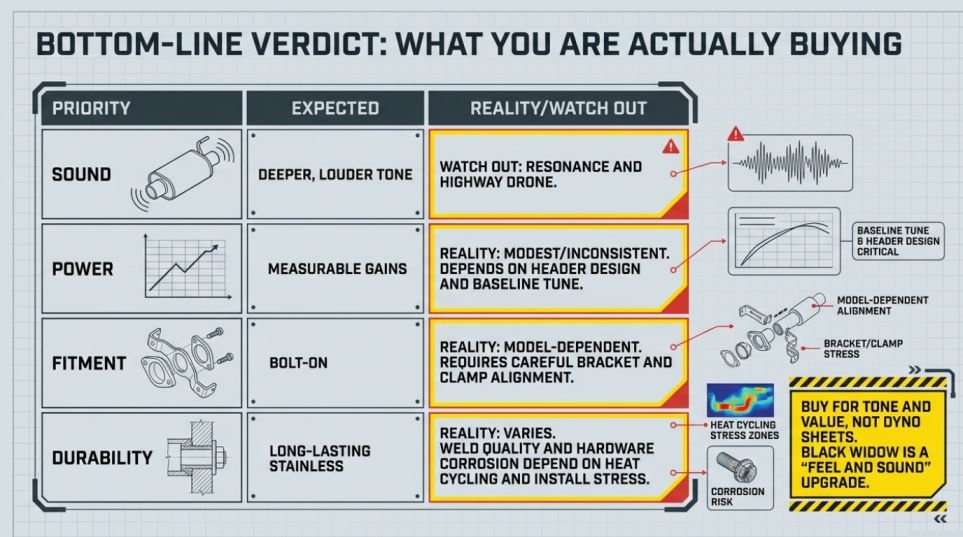
Black Widow is a value-focused aftermarket brand. If you’re buying for sound, you’ll likely be happier than someone chasing measurable power gains, since many customers treat these systems as “feel and sound” upgrades more than dyno-proven performance work.
Fitment quality and street usability are the main variables. Some setups go on with basic tools and minor adjustments, while others need extra hardware or careful alignment to avoid exhaust leaks and unwanted drone.
| Buyer priority | Typical Black Widow outcome | What to watch |
|---|---|---|
| Sound | Most consistent strength | Resonance and highway drone |
| Power/torque | Usually modest, inconsistent | Header design, tune, and baseline engine state |
| Street comfort | Can be loud | Community reports on drone and idle noise |
| Fitment | Model-dependent | Brackets, clamps, and alignment |
| Durability | Varies with corrosion and heat cycling | Weld quality, coating, and hardware material |
What This Guide Covers (So You Can Decide Fast)
This article breaks the decision into buyer-relevant areas so you can match an exhaust to your riding goals. Part 1 gives the straight verdict and sets expectations for sound, street manners, and value. The next section focuses on the actual Black Widow lineup, so you can connect that verdict to specific models.
Tip from shop experience: when an exhaust is “great tone, annoying drone,” riders often love it for short rides and hate it on long highway stretches. Tone and daily comfort are the trade-off, not the paperwork.
Black Widow Exhaust Lineup
Black Widow’s lineup mostly breaks down into two practical choices: slip-on mufflers for bikes that already have a header, and full exhaust systems that replace more of the factory piping. Riders usually buy slip-ons for a bolt-on tone change, while full systems are the route if you want a more consistent sound and potential airflow gains.
Slip-on Vs. Full Systems
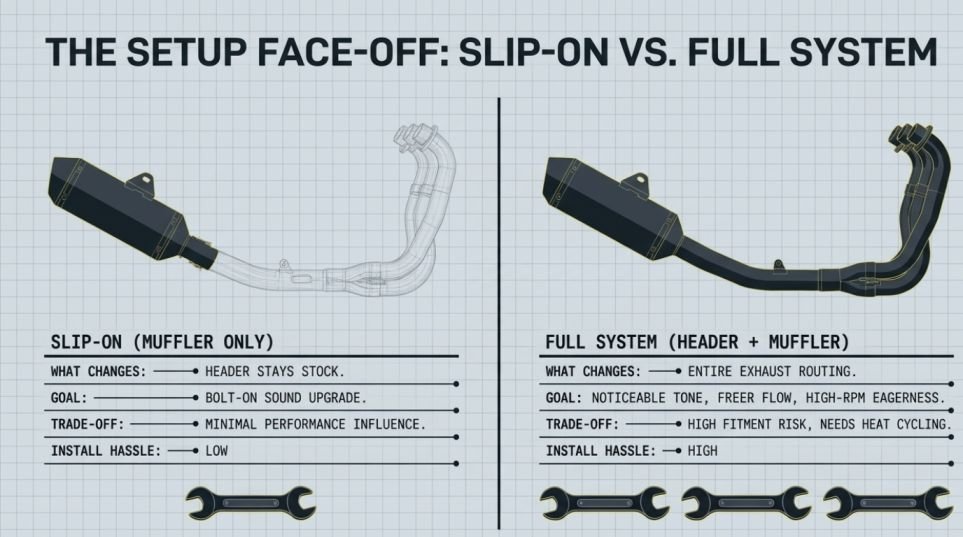
Slip-on kits are the easiest entry point. Most installs are designed to reuse the stock header and mounting points, so you keep your exhaust routing familiar and you avoid the most expensive part of the job.
Full systems replace the header section as well, which usually means more parts, more fitting time, and more chances you will need heat cycling and careful alignment. In exchange, you often get a louder or freer top-end character, and the tone is typically more uniform across the rev range because the whole path is changed.
| Option | What changes | Typical rider goal | Big trade-off |
|---|---|---|---|
| Slip-on | Muffler only (header stays stock) | Sound upgrade with minimal hassle | Less influence on performance gains |
| Full system | Header plus muffler (routing changes) | More noticeable tone and freer flow | More install time and fitment checking |
Muffler Types, Materials, And Durability
Black Widow builds their reputation around street-friendly sound, so their muffler designs usually aim for a deeper note without turning every light-throttle stop into a drone festival. Common materials you’ll see across the industry include stainless steel for tubes and baffling, with a heat-resistant finish meant to handle exhaust temperatures without quick rust or flaking.
Durability is where you should be picky. Look for consistent weld quality at the seams, tight fitment at the joint where the muffler meets the mid-pipe, and evidence of corrosion resistance at the end cap and mounting area. Any exhaust can discolor over time, but fast surface rust around clamps or poorly protected welds is where owners usually start complaining.
Model/year Applicability and Fitment Reality
Black Widow’s best results usually come when the kit matches your exact bike year and variant. Exhausts can be “close” but still require different spacing at the bracket, different clamp diameter, or different mid-pipe length, especially when manufacturers change subframes or mounting bosses mid-cycle.
Fitment difficulty is typically low for true slip-ons where the header stays stock, higher for full systems, and highest when a kit’s instructions assume you have specific stock components. Before buying, confirm the part’s compatibility for your exact model year, and be prepared for the small extras owners often forget to budget for, like fresh exhaust gaskets, correct clamp hardware, and time for alignment and heat cycling.
“Good slip-on results usually start with a perfect clamp fit. If the mounting points line up, the tone tends to be consistent. If they don’t, owners end up chasing rattles and alignment.”
Fitment And Vehicle Confirmations
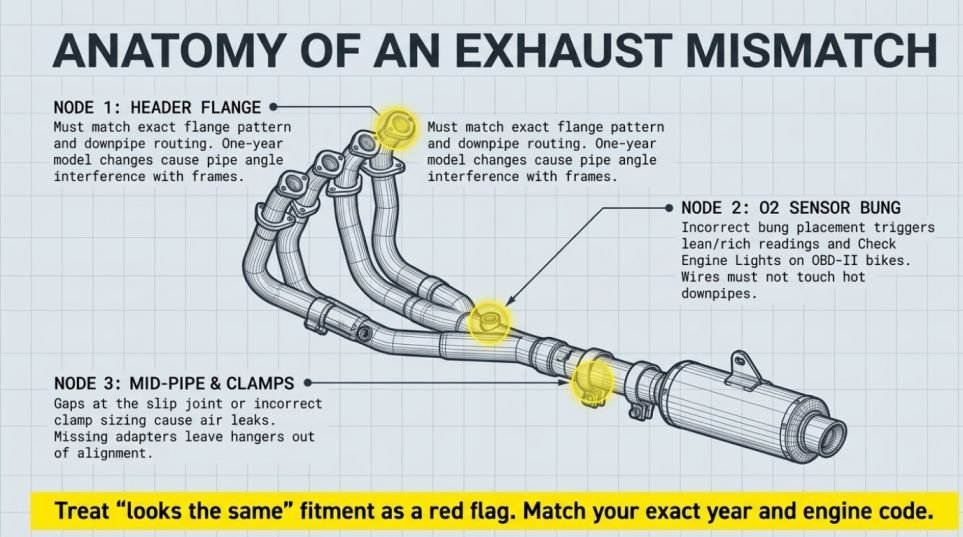
Most fitment issues come from mismatched header flanges, incorrect mid-pipe length, or missing mounting hardware.
Known-compatible Setups (What To Verify)
Because Black Widow listings usually tie kits to specific platforms, the safest approach is to cross-check your bike’s exact model designation (for example, “CBR600RR 2007” versus “CBR600RR 2008”) and emissions variant if applicable. On most motorcycles and ATVs, the full system (header plus mid-pipe plus silencer) has a much tighter fit than slip-on mufflers, since the header and collector shape dictate flange angle and O2 bung placement.
In practice, buyers most often confirm compatibility in one of two ways: a published year range on the product page, or community posts showing the same exact year and engine code. Coverage is inconsistent across models, so treat “looks the same” fitment as a red flag until the kit description explicitly references your year.
| Black Widow kit type | What must match for proper fit | Common mismatch points | Owner-check before purchase |
|---|---|---|---|
| Slip-on/muffler only | Header outlet diameter, strap locations, and can hanger style | Mid-pipe length, missing adapter, incorrect clamp size | Measure outlet diameter and verify the included clamp/adapter |
| Full system (header to silencer) | Header flange pattern, downpipe routing, O2 bung position | Flange mismatch, pipe angle interference with frame/engine guard | Confirm your year’s exhaust flange/O2 placement matches the listing |
| Mid-pipe required (2-piece or modular) | Mid-pipe length and collector angle to mate to your header | Fitment gaps at the joint, incorrect alignment of hangers | Verify the kit includes the correct mid-pipe for your engine generation |
Header/mid-pipe, Brackets, and Mounting Hardware
Header and mid-pipe compatibility is where most returns start. Even with “same bike” listings, one-year changes in exhaust routing can force you into a bracket swap or hardware sourcing, especially around heat shield tabs and passenger peg mounts.
Mounting hardware is the next biggest variable. Some systems rely on your factory rubber isolators and clamps, while others include new brackets, springs, and gaskets. Confirm what’s included in the box, then compare it to your current setup so you are not stuck reusing a clamp that no longer fits or trying to improvise alignment with longer exhaust bolts.
Quick rule: If the listing does not explicitly show your exact year, treat it as uncertain. If it does not say what header/mid-pipe is included, assume it might not match your factory exhaust and plan to verify flange and hanger geometry first.
Sound And Tone Range
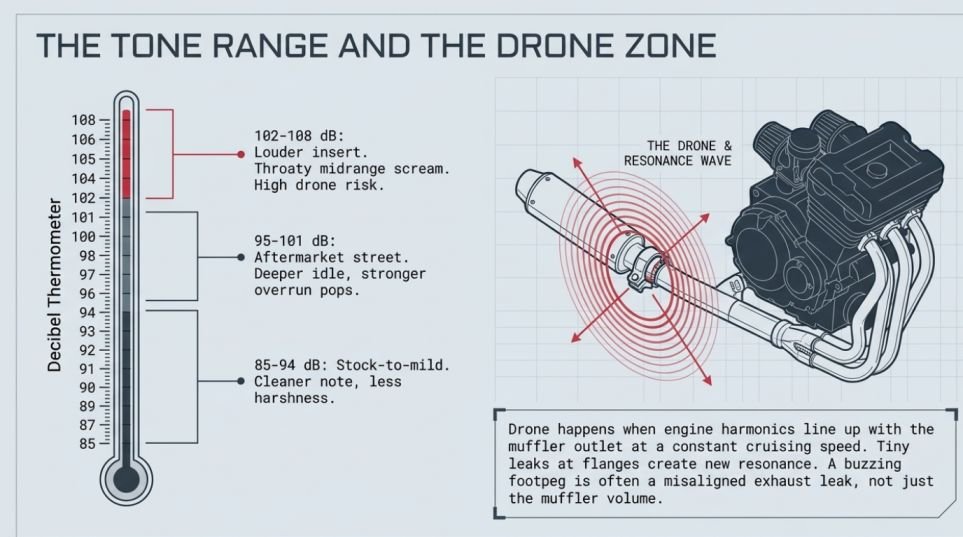
Black Widow exhausts tend to land in the “loud enough to notice” category, with tone that is usually deeper than straight pipes but still aggressive under throttle. Community chatter around these systems often points to noticeable volume at startup and a throatier, more raspy edge at higher RPM, depending on the bike and muffler type.
Expected Decibel Bands By Setup
Exact decibel readings are rarely consistent across different bikes, rider throttle habits, test method, and even tire noise, so treat any number as a rough band. Still, most aftermarket street systems with an aggressive muffler insert end up here in real-world terms.
| Setup type | Typical sound level band (real-world) | What you usually hear |
|---|---|---|
| Stock-to-mild change | ~85 to 94 dB | More presence, cleaner note, less harshness |
| Common aftermarket street | ~95 to 101 dB | Deeper idle, louder pull, stronger overrun pops/rasp |
| Louder muffler insert | ~102 to 108 dB | Throaty scream at midrange, more drone in steady cruising |
For Black Widow specifically, the “street-use” question usually comes down to how often you cruise at one steady RPM. The louder the muffler insert and the more open the internal baffle flow, the faster drone becomes a daily annoyance.
Drone Tendencies And Mitigation Tips
Drone risk is highest when the exhaust system creates a strong resonance at a cruising RPM, usually where engine order harmonics line up with the muffler outlet. Riders often notice it more on highways because speed stays constant long enough for the frequency to become annoying.
Mitigating drone usually comes down to keeping the system aligned and reducing exhaust leaks, since tiny leaks at flanges can create a new resonance.
For example, if you feel a “buzzing” sensation through the pegs, it is usually either a resonance from the muffler mounting or interference from the routing.
Insider tip: If you are sensitive to drone, judge the system by a 20-minute steady cruise at your usual speed before you decide it is “worth it.” Dyno pulls tell you how it sounds on command, cruising tells you if it will drive you crazy.
Performance Gains Realistically
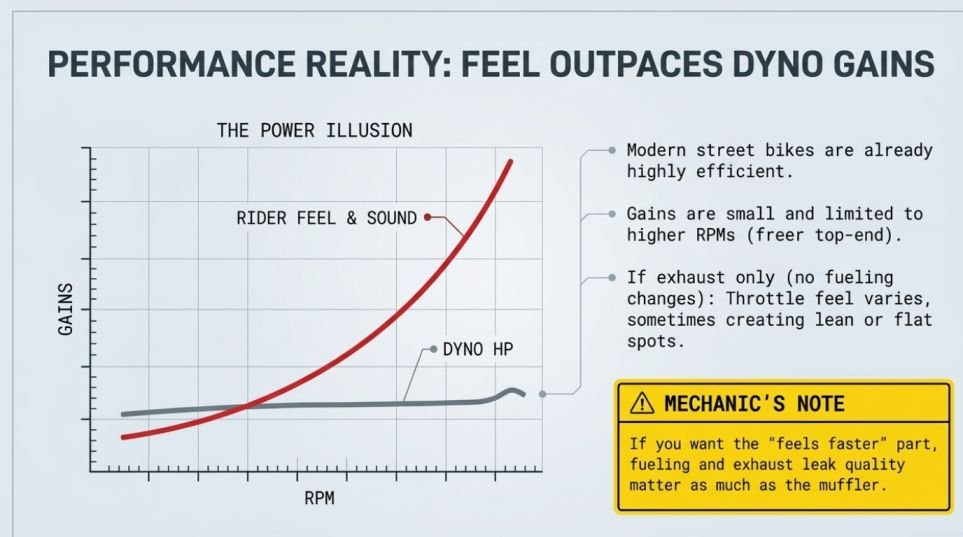
Black Widow exhausts usually gain more in sound and rider feel than in dyno numbers. On many street bikes and ATVs, the motor is already efficient enough that a slip-on or cat-back mostly changes airflow at higher RPM, where gains are small and inconsistent from bike to bike.
Marketing claims often talk about “more horsepower,” but most Black Widow setups are positioned for style and sound first. Actual measurable gains depend on your starting point: a bike with a restrictive stock exhaust and no cat-back breathing can show more improvement than a bike that already has a freer-flowing exhaust from the factory.
For example, two riders with the same brand exhaust can see different results because one has a mismatched baffle choice, a different model year, or a stock air filter and fuel map. Another common variable is whether the installation includes the correct gaskets, proper clamp alignment, and any required O2 sensor bung positioning, since exhaust leaks can ruin both power and drivability.
| Vehicle/Setup Type | Most Plausible Result | When You Notice It |
|---|---|---|
| Slip-on, near-stock intake | Small power change, clearer sound, slightly freer top-end | Higher RPM pulls and aggressive downshifts |
| Full system (header/cat-back) with proper fueling | More consistent mid- to top-end improvement | Rolling acceleration and longer freeway ramp-up |
| Exhaust only, no fueling changes | Tone change first, power gain can be muted | Throttle feel varies, sometimes lean or flat spots |
Insider tip: If you want the “feels faster” part, fueling and exhaust leak quality matter as much as the muffler. A correctly installed system with matched fueling is where the gains show up reliably.
In practice, Black Widow exhausts tend to be worth it when you want a noticeable sound character and a small, believable improvement in high-RPM eagerness. Riders chasing big torque gains typically need a broader package than an exhaust alone, like intake changes, ignition or fueling support, and sometimes suspension and gearing tuning to make the power usable.
Build Quality And Durability
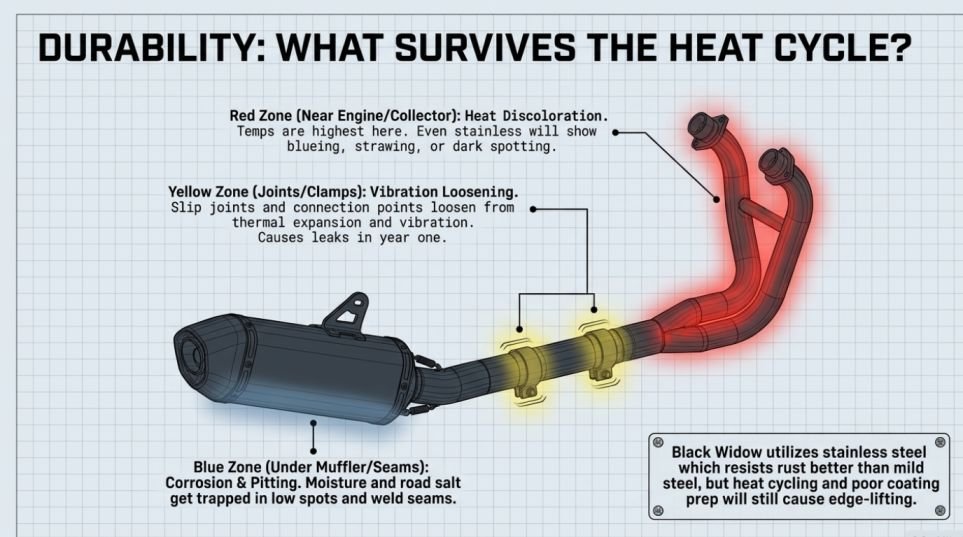
Black Widow exhausts are built like most mid-priced aftermarket systems: the quality is usually good enough for daily street use, but durability depends heavily on material choice, weld consistency, and corrosion protection. Expect stainless muffler and tubing options on many kits, yet you still need to watch weld seams and hardware because heat cycling is what kills exhausts over time.
Materials, Welding, And What Holds Up
Many Black Widow systems use stainless steel for at least part of the exhaust (common in mufflers and often in tubing), while some kits use a mix of stainless components and other metals depending on the specific model application. Stainless resists rust much better than mild steel, but it does not make a system immune to pitting where the coating is thin or where road salt and moisture trap at seams.
Welding quality is the biggest durability tell. Clean, consistent weld beads and strong joint fit reduce stress points, especially around header-to-muffler transitions and anywhere hangers pull the system slightly out of alignment.
Coatings, Heat Discoloration, And Corrosion Reality
Heat discoloration (bluing, strawing, or dark spotting) can happen even on stainless, especially near the collector and first few feet where exhaust temps are highest. Powder coat and other exterior coatings, when used, take the abuse first and can lift at edges if prep and curing quality are inconsistent.
Corrosion usually starts where water gets held: under the muffler, inside any low spots, and along welds or seams that collect salt.
In practice, the system lasts longer if you wash the underside regularly and avoid long periods of trapped moisture, particularly in winter or coastal areas.
| Potential issue | Where it shows up | Why it happens | How soon |
|---|---|---|---|
| Weld seam cracking | Tube joints and bend transitions | Heat cycling plus slight misalignment | Often months to a few years if fitment is off |
| Clamp interface leaks | Slip joints and connection points | Loosening from vibration and thermal expansion | Common in year one on some kits |
| Surface corrosion/pitting | Road-salt exposure zones | Moisture trapped at low spots and seams | Usually winter-dependent |
| Coating lifting | Externally coated muffler sections | Edge prep and heat exposure exceed coating durability | Often noticeable in the first season |
“After a couple of seasons, the exhaust that lasts is usually the one that stays aligned. If you can see the system sitting slightly twisted at the clamps, expect stress at the welds and joints first.”
Customer feedback themes (from community discussions) typically praise sound and fitment when installed correctly, while complaints tend to center on connection points loosening, early finish wear, or leaks that show up after heat cycles. Those issues point back to the same reality: check clamp condition, make sure the system is not preloaded, and re-check fasteners after the first heat cycles.
Value-wise, Black Widow can be a solid buy when the kit matches your exact vehicle application, and the build uses stainless components with a clean finish at the joints. If you live in heavy winter salt conditions, the durability gap versus top-tier premium brands often shows up as sooner cosmetic wear or faster corrosion at seams, since coatings and hardware grades vary more at this price level.
Installation Requirements
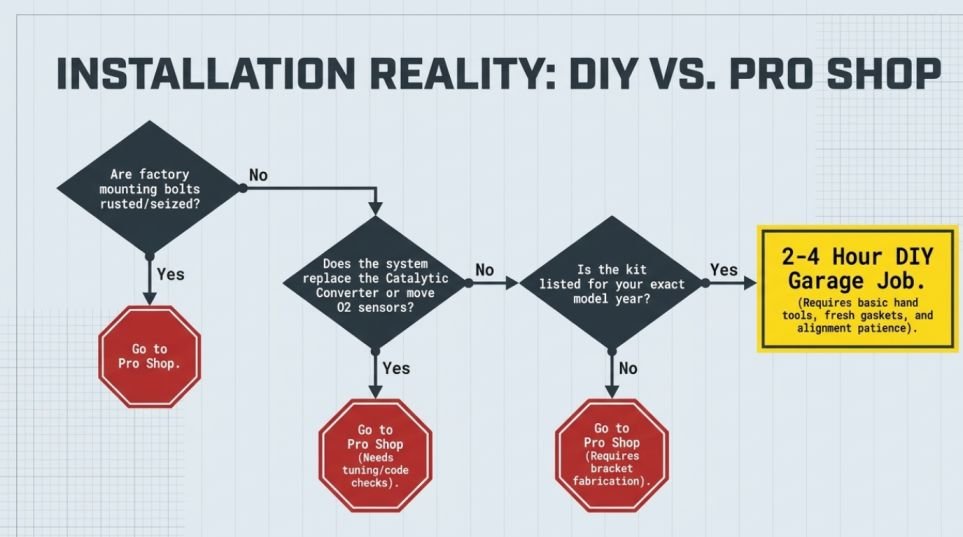
Black Widow exhausts are usually “bolt-on” systems, but the install quality depends on whether your specific bike or ATV model matches the listing exactly. Many kits include the basics, then expect you to address sensor fitment and any missing exhaust hardware (common with custom headers or older exhaust mounts).
What Usually Comes In The Box
Most Black Widow kits are packaged as a complete exhaust system for a specific application, so you typically get the muffler(s), mid-pipe or header section (varies by model), and the fasteners needed to attach the parts together. Expect included sealing parts, since exhaust joints leak air and fumes when they are installed dry or with the wrong gasket.
| Item | Common inclusion | Why it matters |
|---|---|---|
| Header flange gasket | Often included | Prevents exhaust leaks that cause loud ticking and false “exhaust smell” complaints |
| Band clamps | Often included | Slip joints need even tension to avoid drone and soot trails |
| O2 sensor spacer or harness adapter | Application-dependent | Wrong spacing can trigger lean/rich readings and trigger check-engine lights |
| Factory brackets | May be reused | Some bikes need new rubber isolators or different offset hardware to line up cleanly |
Cat And O2 Sensor Considerations (Where Installs Go Sideways)
Exhaust systems that include a catalytic section often require careful attention to O2 sensor placement. If the kit expects you to reuse the factory sensors, the sensor must thread in smoothly without cross-threading, and the wires must route away from heat or moving parts.
CAT/O2 installs also tend to be where legality and drivability concerns show up. If your machine uses an OBD-II style monitoring strategy, a mismatch in bung position or sensor extension length can cause repeating codes or unstable fueling, even if the exhaust sounds fine.
Mechanic tip: Before you bolt everything up, confirm the sensor reaches its connector with the same routing you had stock. A “close enough” harness route that touches the downpipe is a slow-motion failure.
Diy Vs. Professional Install Practicality
For many riders, fitment is a 2 to 4 hour DIY job with hand tools and basic exhaust hardware, assuming you can access the mounting bolts and the old exhaust isn’t seized. If you have to fight rusted fasteners, or your model needs extra bracket alignment, plan for more time or consider a shop install.
Professional install is worth it if you’re dealing with sensor faults, a cat section, or any exhaust setup that interrupts emissions monitoring. A shop can also check for code history and confirm the system’s heat routing is safe, which matters more than chasing perfect sound on day one.
Quick Summary

Black Widow exhausts are a value-focused aftermarket option that most riders consider for sound and day-to-day usability more than measurable performance. Street usability is also tied to resonance, because mild drone is a common complaint.
Real-world feedback in the article consistently points to deeper tone versus stock as the main praise, along with the trade-off of resonance at certain RPM ranges and possible highway drone. It also notes that durability depends on materials and hardware, with stainless-style parts generally holding up better while hardware can corrode with heat cycling. Before ordering, verify your year and model, confirm header or mid-pipe requirements, and check regional legality for noise limits and inspection risk, since tone upgrades can get loud.
| Buy goal | What to expect | Most common watch-out |
|---|---|---|
| Sound upgrade | Deeper, louder tone than stock | Resonance and mild drone at certain RPMs |
| Power/torque gains | Usually modest and inconsistent | Header design, baseline engine state, and tune matter |
| Street usability | Loudness varies by setup | Highway idle and long-ride comfort can suffer |
| Installation fitment | Model-dependent brackets, clamps, and alignment | Leaks or unwanted drone if alignment is off |
| Longevity | Stainless-style parts tend to last better | Hardware corrosion from heat cycling |
Frequently Asked Questions
Are Black Widow Exhausts Any Good For Daily Driving?
From what people discuss online, Black Widow exhausts get mixed opinions, so quality can depend a lot on the exact system and your expectations. If you are daily driving, you should focus on whether the system is tuned for your specific year and engine, not just the look and sound.
Do Black Widow Exhausts Sound Too Loud?
They can be, especially if you are swapping from a restrictive stock muffler or resonator setup. The safest way to judge is to find clips that match your exact vehicle and check for reports of drone at highway speed.
Are Black Widow Exhausts Worth The Money Compared To Other Brands?
It depends on your goal and how much fabrication and labor you will need. If you want a simple, fitment-accurate bolt-on and long-term refinement, you may find better consensus with brands that publish more vehicle-specific fitment details.
Will A Black Widow Exhaust Pass Emissions Or Inspection?
You cannot assume it will, because emissions compliance is usually vehicle-specific and depends on local rules. If your area is strict, check whether the system has documentation for your exact application before you spend money.
Do Black Widow Exhausts Require Special Tuning Or A Reflash?
Often, no tune is required just to install, but it can vary by model. If your exhaust change alters backpressure significantly, you may still need a correction depending on your vehicle, especially if you notice droning, poor throttle response, or check-engine lights.
What Are Common Problems People Run Into With Black Widow Exhaust Installs?
The most common issues are fitment and sealing, like exhaust joints leaking at the flange or hardware that does not align perfectly. Use proper gaskets and hardware, verify alignment before tightening fully, and check for leaks after the first drive.

- 2017 Dodge Grand Caravan Transmission Fluid Capacity: Dodge Grand Caravan Transmission - September 27, 2026
- How Many Gallons Of Transmission Fluid Does A 2017 Gmc Yukon 5.3 Slt Xl Hold: How Many - September 26, 2026
- 17 Gmc Yukon Transmission Fluid Capacity V8 (8l90) Quarts/liters - September 26, 2026