
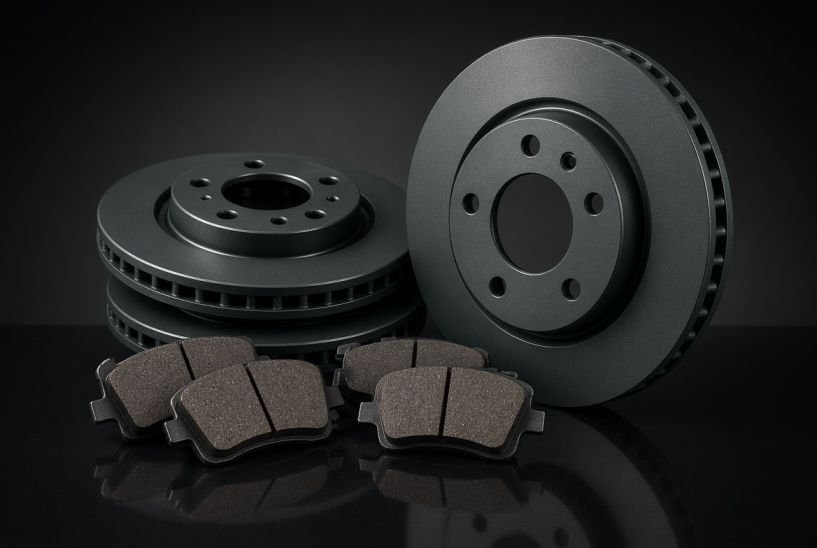
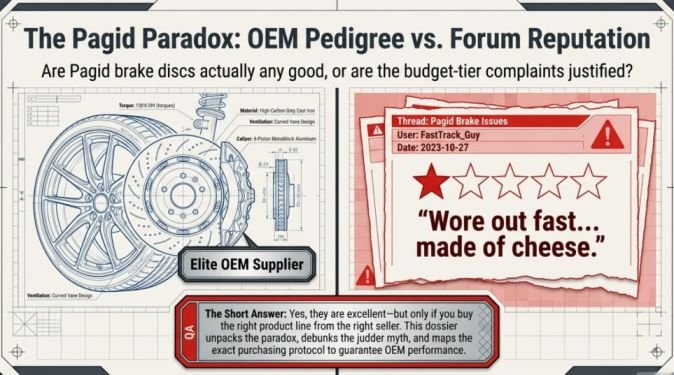
Yes, when you buy the right line from the right seller. Pagid brake discs are a genuine OE supplier product, but a chunk of the bad reviews online trace back to budget-tier stock sold through one specific retailer, not the brand itself.
Pagid has supplied brake components to VW, Ford, Porsche, and BMW since the 1960s and 80s, and it still holds OE contracts with Audi, Aston Martin, Mercedes-Benz, and Porsche today. That’s not a small claim. But “Pagid” on a box doesn’t always mean the same manufacturing tier, and that gap is exactly where most of the complaints live.
Key takeaways
- Pagid is a real OE brand, not just an aftermarket label, with current supply deals across VW, Audi, BMW, and Porsche.
- Discs are GEOMET coated for corrosion resistance and built to ECE R90 spec, covering 96% of the European car market.
- Judder complaints show up repeatedly, but several owners traced the real cause to pad deposits, not disc warping.
- Budget-sourced Pagid stock, especially through Euro Car Parts, gets far more negative feedback than discs bought through specialist or OE-focused retailers.
- Pagid Racing discs use directional vane cooling and cast iron formulated to resist cracking under sustained heat, aimed at track and hot hatch use.
- Prices run roughly £16 to £75+ per disc depending on the vehicle and coating spec.
Pagid’s OE credentials and what the tech specs actually mean
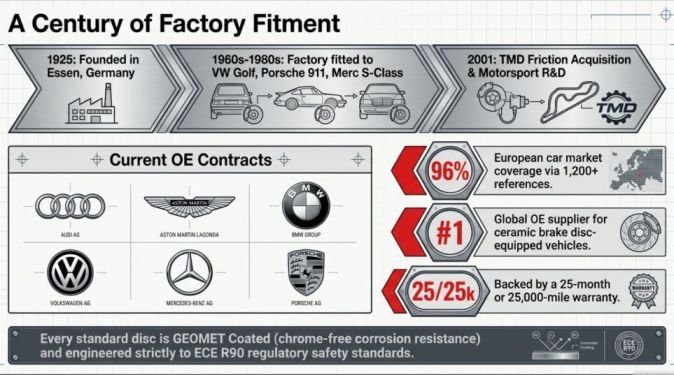
Pagid isn’t a boutique aftermarket brand chasing a reputation. It started making brake linings in Essen, Germany, back in 1925, took the Pagid name in 1950, and became an OE supplier for VW and Ford by the 1960s. By the 1980s, Pagid brakes were factory-fitted to the VW Golf and Scirocco, the Porsche 944 and 911, and the Mercedes S-Class. TMD Friction Group bought the company in 2001 and pushed further investment into R&D and motorsport.
That history matters because it explains why the brand still holds current OE contracts with Audi, Aston Martin, BMW, VW, Mercedes-Benz, and Porsche. Pagid also claims the top spot as the OE brand for vehicles fitted with ceramic brake discs, which is a specific and checkable claim, not vague marketing language.
On the technical side, Pagid’s disc range carries GEOMET coating across the board. That’s a chrome-free corrosion treatment that cuts down rust buildup, a common failure point on cheaper discs, and keeps the disc looking presentable behind alloy wheels for longer. The high-carbon range adds better heat transfer for drivers who brake harder or carry more weight. Discs are made to ECE R90 spec, the regulatory standard covering safety and durability, and the catalog spans more than 1,200 references covering 96% of the European car market. Pagid backs its discs with a 25-month or 25,000-mile warranty, whichever comes first.
None of this guarantees a perfect experience on every car. But it’s a meaningfully different starting point than a no-name budget disc with no coating spec and no warranty terms listed.
The genuine Pagid vs budget-sourced Pagid problem
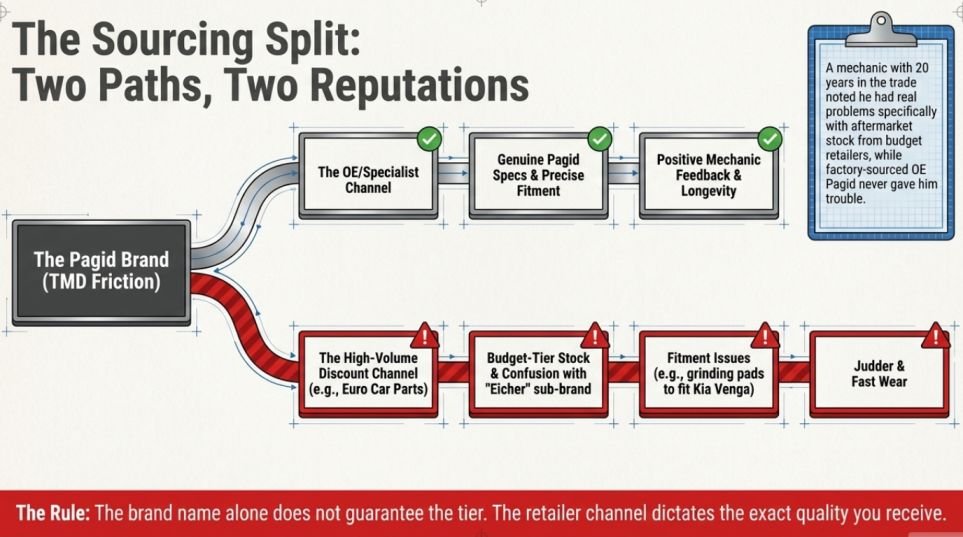
Here’s the pattern that shows up again and again in owner forums, and it’s the single most important thing to understand before you buy. Pagid sells through multiple channels, and the quality perception splits hard depending on where the parts came from.
One BMW-focused forum thread put it bluntly: Pagid discs and pads sourced from Euro Car Parts got described as wearing out fast and falling short of OEM quality, with one owner calling them “made of cheese.” The same thread had a counterpoint just a few replies later, with a specialist mechanic saying OE factory-fitted Pagid components are superior to the aftermarket versions, and that he’d had real problems specifically with the aftermarket parts while the factory-sourced stuff never gave him trouble.
A separate mechanic on a welding forum drew the connection even more directly, saying Pagid is owned by Euro Car Parts (a simplification, since TMD Friction owns Pagid and ECP is one of several retailers) and that he’d stopped buying from that channel after 90% of what he ordered turned out to be a poor fit or poor quality.
There’s also confusion between Pagid proper and Eicher, a separate budget brand also sold through ECP and made in the same TMD-linked factory network. One M3-focused forum thread flagged this directly: buyers sometimes think they’re getting Pagid when they’re actually getting the cheaper Eicher line, which explains a chunk of the quality complaints attributed to Pagid that may not belong to it.
The practical takeaway: the brand name alone doesn’t tell you which tier you’re buying. The retailer and the specific product line matter just as much.
Owner experiences with judder warping and pad deposits
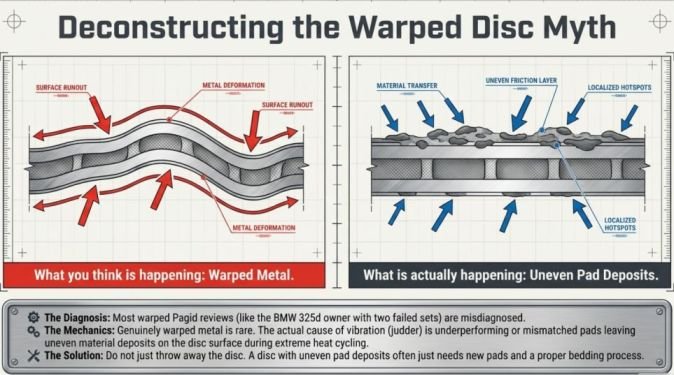
Judder after a fresh disc install is the complaint that shows up most, and it’s worth separating what’s actually happening from what riders assume is happening.
One BMW 325d owner went through two separate sets of Pagid discs and got brake judder both times. His supplier blamed the first failure on not replacing the pad springs during install. By the second failure, he suspected a bad batch of discs. But another poster in the same thread offered a different diagnosis entirely: the discs weren’t warped at all, the pads weren’t up to the job and had left uneven material deposits on the disc surface when they got hot, and that uneven deposit layer was what caused the vibration, not the disc itself. New discs paired with the same underperforming pads would just repeat the same failure.
This distinction matters because it changes what you replace. A genuinely warped disc needs a new disc. A disc with uneven pad deposits from heat cycling often just needs new pads and a proper bedding process, with the existing disc left in place or resurfaced.
On the flip side, plenty of owners report zero problems. One detailing forum contributor who’d run several BMW brake combinations called Pagid discs brilliant, with only average dust from the pads, ranking them ahead of ATE for stopping performance in his direct comparison. Another owner with two years of Pagid disc failures, both warping within six months on a Rover, ended up switching to TRW and had no issues over the following year, for what it’s worth as a single data point rather than a trend.
The instability in these reports lines up with the sourcing issue above. Genuine, correctly-matched Pagid parts tend to draw praise. Mismatched or budget-tier stock draws complaints about judder and short lifespan.
Pagid discs vs Brembo vs Zimmermann vs Textar
Here’s how Pagid stacks up against the brands it gets cross-shopped with most often.
|
Brand Name
|
Manufacturer/Parent Group
|
OE Status
|
Corrosion Protection
|
Owner Sentiment & Common Issues
|
Best Use Case
|
Price Position
|
Warranty Terms
|
|
|---|---|---|---|---|---|---|---|---|
|
Pagid
|
TMD Friction Group
|
Genuine OE supplier (Audi, Aston Martin, BMW, VW, Mercedes-Benz, Porsche)
|
GEOMET (chrome-free coating)
|
Mixed; high praise for OE-sourced parts but frequent reports of judder and warping when sourced via budget retailers; often misdiagnosed pad deposits.
|
Daily driving and OE-spec replacement; Racing line for track days and hot hatches.
|
Budget-to-Mid (£16 to £75+ per disc; roughly 50% cheaper than Brembo)
|
25 months or 25,000 miles
|
|
|
Textar
|
TMD Friction Group
|
OE supplier for BMW
|
Strong coating
|
Low judder reports; viewed as a consistent OE-grade middle ground option.
|
Buyers wanting a known OE-grade middle ground replacement.
|
Mid-to-Premium
|
Not in source
|
|
|
Brembo
|
Not in source
|
Not in source
|
Strong anti-corrosion treatment
|
Low judder reports; high consistency; highly favored by mechanics despite higher price point.
|
Long-term ownership and consistent performance.
|
Premium (roughly double Pagid pricing)
|
Not in source
|
|
|
Zimmermann
|
Not in source
|
Not in source
|
Strong (Z-Coat zinc coating)
|
Low judder reports.
|
Drivers prioritizing coating longevity and rust resistance.
|
Premium (similar to Brembo)
|
Not in source
|
One AutoDoc forum thread framed the price gap clearly: Pagid discs and pads from Euro Car Parts ran about half the price of a comparable Brembo set from GSF for the same E46 328ci application. A mechanic in that same thread, with 20 years in the trade, said he’d had more comebacks with Pagid than Brembo, specifically the Euro Car Parts stock, and suggested Textar as a middle ground since it’s OE for BMW and tends to perform more consistently over time.
A BMW owner comparing Brembo against Hella/Pagid on price alone found Pagid slightly more expensive in his market (AU$100 versus AU$85 per disc), which shows pricing isn’t universally in Pagid’s favor everywhere. He went with Pagid anyway based on brand trust, not price.
The pattern across these comparisons: Brembo and Textar draw fewer complaints but cost more. Pagid can match or beat them on performance when correctly sourced, and undercuts them on price, but carries more variance depending on where you buy it.
Are Pagid racing discs worth it for track use?
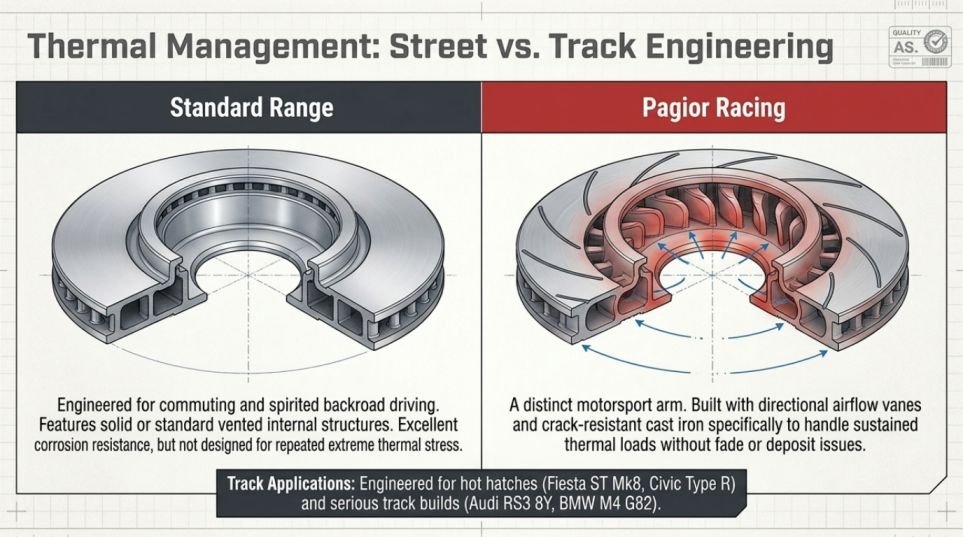
Pagid Racing operates as a distinct motorsport-focused arm of the brand, and it’s aimed at a different buyer than the standard passenger car disc range.
These discs use directional vane designs built for improved cooling airflow, paired with cast iron formulations engineered to resist cracking and warping under sustained thermal stress, the kind of repeated hard braking a standard road disc isn’t designed for. The groove pattern on the racing discs is developed specifically to work with Pagid Racing pads as a matched system, rather than being sold as a generic disc meant to pair with anything.
Pagid Racing lists applications for hot hatch platforms like the Fiesta ST Mk8 and Civic Type R FK8, where drivers want a disc that can take repeated hard use without the fade or deposit issues that show up on OEM components under that kind of abuse. For more serious track builds, on cars like the Audi RS3 8Y or BMW M4 G82, the range extends into compounds built to handle sustained thermal loads that would damage a standard road disc over time.
If your driving is limited to commuting with the occasional spirited backroad, the standard Pagid disc range covers you fine and costs less. If you’re doing actual track days or autocross events where sustained heat cycling is a regular occurrence, the Racing line is built for that specific stress in a way the standard range isn’t.
Common fitment and quality complaints tied to sourcing
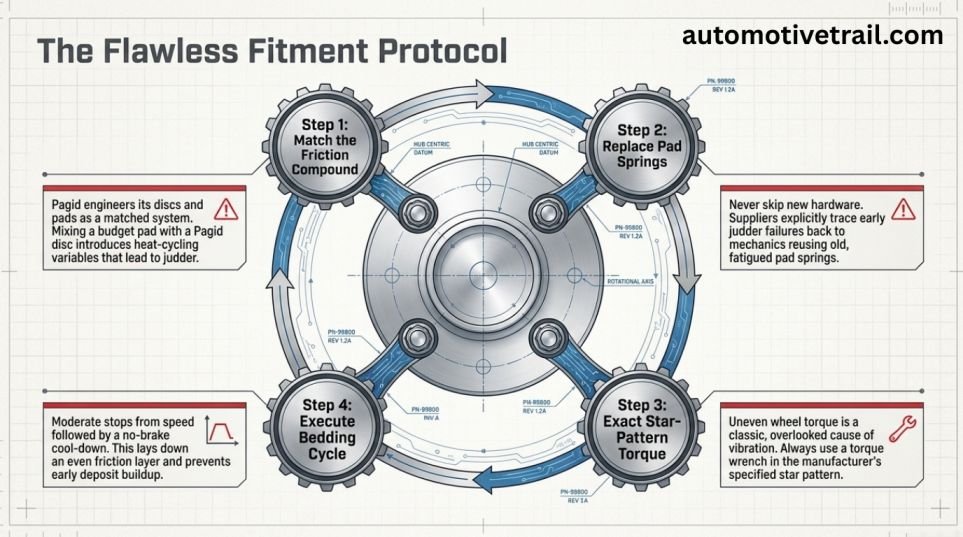
Beyond judder, two other complaints come up often enough to flag, and both trace back to the same sourcing issue.
Poor fitment requiring modification. One mechanic on a welding forum described fitting rear pads to a Kia Venga where the contact point shape barely matched the original parts, requiring him to grind material off before they’d sit without binding. He called it really poor quality, a strong statement from someone doing this professionally. This complaint centers on pads rather than discs specifically, but it’s relevant context for buyers assuming disc and pad quality track together within the same purchase.
Excessive dust and squeal on specific fitments. A UK MX-5 owner asking about Pagid discs for a mix of sporty road driving and occasional track days found the pricing attractive during a Euro Car Parts sale, front discs at £28 and rears at £16, a 30% discount off list. Separately, an Evo owner running Pagid pads described them as cheap but squealing, with bad pad deposits building up on the discs, a complaint that lines up with the judder-from-deposits pattern covered above.
The through-line in nearly every negative report: it’s tied to a specific budget retailer channel, not a universal quality failure across the brand. Buyers who sourced discs through specialist retailers or OE-focused suppliers report far fewer of these issues.
How to stop judder after fitting new Pagid discs
If you’ve already got judder after a fresh Pagid disc install, work through these steps before assuming the discs themselves are faulty.
- Check whether it’s actually the pads. Uneven pad material deposited on the disc surface during heat cycling causes vibration that feels identical to disc warping. If the pads are old, worn unevenly, or a mismatched budget compound, replace them alongside the discs rather than assuming the disc is the problem.
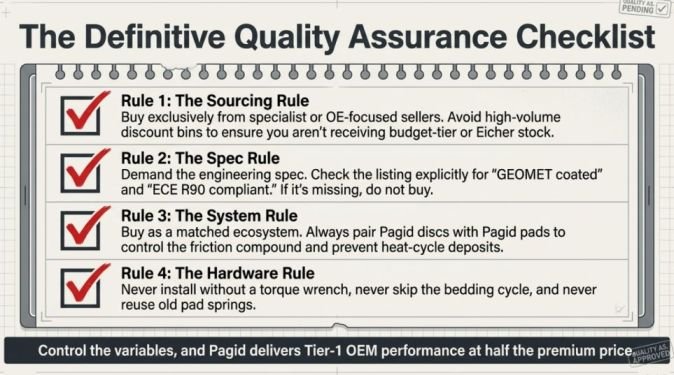
- Replace the pad springs and hardware. One supplier explicitly blamed judder on skipping new pad springs during a disc swap. These parts are cheap, and it’s a common corner cut during a DIY or rushed shop job.
- Torque the wheels correctly, in sequence. Uneven wheel torque is a classic and often overlooked cause of disc-related vibration that has nothing to do with the disc quality itself. Use a torque wrench and the manufacturer’s star pattern.
- Bed the new discs and pads together properly. A full bedding cycle, moderate stops from speed followed by a cool-down with no braking, lays down an even friction layer. Skipping this step is a common cause of early deposit buildup and judder.
- Confirm you’re using a matched pad compound. Pagid recommends pairing its discs with its own pads for the intended performance profile. Mixing a budget pad compound with a Pagid disc removes one of the variables the brand actually controls for.
Is Pagid OE-equivalent quality
Partly, and the honest answer depends heavily on which product line and vehicle you’re looking at. Pagid genuinely is OE on several platforms right now, not just historically. It holds current OE contracts with Audi, Aston Martin, BMW, VW, Mercedes-Benz, and Porsche, and claims the top spot as OE supplier for ceramic brake disc-equipped vehicles.
Retailers selling “Pagid Coated” rotors specifically market them as OEM type, built to the same dimensions and specs as the original factory design, with high carbon content for wear and thermal resistance. These are sold as direct fitment replacements for specific BMW chassis codes like the E32, E34, and E38, which suggests genuine engineering matching rather than a generic universal-fit disc.
Owner feedback on OE-equivalence is mixed but leans positive when the product is correctly matched to the vehicle. One BMW owner running Hella/Pagid two-piece rotors with aluminum hats, chosen specifically to match the OE rotor design, reported strong and true braking with minimal wear after six months. Another owner cross-shopping Pagid against Brembo on an E46 heard from a mate at Euro Car Parts who rated Pagid on par with OEM.
The caveat stands from earlier sections: OE-equivalent claims apply most reliably to the correctly sourced, correctly matched product line for your specific vehicle, not to every disc carrying the Pagid name regardless of retailer.
How to make sure you are buying genuine, correctly sourced Pagid discs
Given how much the reviews split by sourcing channel, a few practical steps reduce your risk significantly.
Buy the disc and pad as a matched set from the same manufacturer when possible. Pagid explicitly recommends pairing its own pads with its own discs for the performance profile they’re engineered around, and several judder complaints trace back to mismatched pad and disc combinations.
Check which specific line you’re buying, not just the brand name on the listing. Confirm it says Pagid, not Eicher or another TMD-linked budget sub-brand that shares a supply chain but not the same manufacturing spec.
Favor retailers with strong track records for that specific brand over the cheapest listing you can find. The complaints in this research cluster heavily around one high-volume budget retailer, while specialist and OE-focused sellers draw far fewer negative reports for the same brand name.
Look for the GEOMET coating spec and ECE R90 compliance listed explicitly in the product description. Genuine current-catalog Pagid discs carry these as standard features, and their absence from a listing is worth asking about before you buy.
Which Pagid disc setup fits your car and driving style
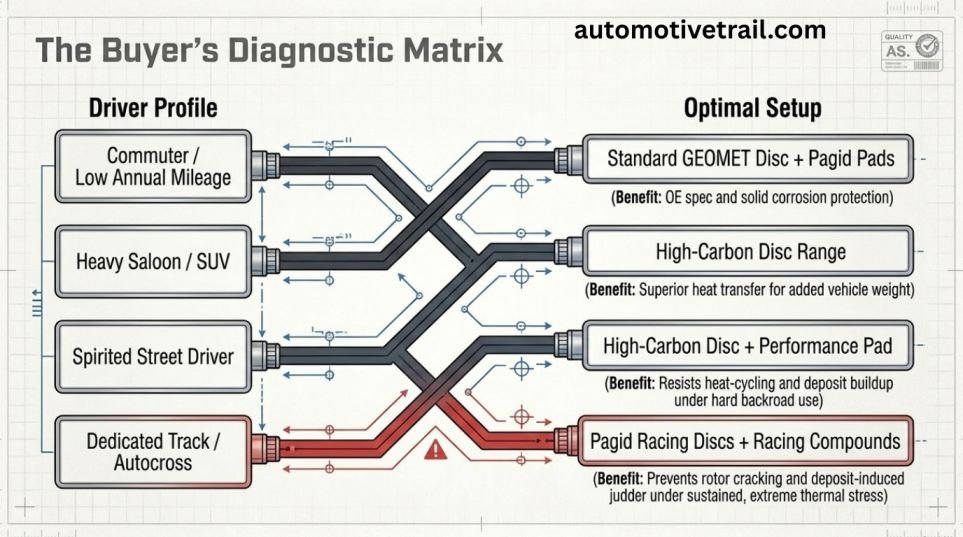
Match the disc line and pad pairing to how you actually use the car.
| Driving style | Recommended setup | Why |
|---|---|---|
| Daily commuting | Standard Pagid GEOMET coated disc + Pagid pads | Corrosion resistance, OE-spec manufacturing, proven on common platforms |
| Heavier saloon or SUV | Pagid high-carbon disc range | Better heat transfer for added vehicle weight |
| Spirited street driving | Pagid disc paired with a performance-oriented pad | Reduces deposit buildup that causes judder under harder use |
| Occasional track days, hot hatch | Pagid Racing disc, matched Racing pad | Directional vane cooling and cast iron built for repeated heat cycling |
| Sustained track use | Pagid Racing compounds for RS3/M4-tier applications | Engineered for thermal loads standard road discs can’t handle |
| Budget-conscious, low annual mileage | Standard Pagid disc from a reputable specialist retailer | Solid corrosion protection and OE spec at roughly half Brembo’s price |
If you’re unsure which category fits, the deciding question is heat cycling frequency. A car that sees occasional hard stops in traffic needs a very different disc than one doing repeated hard braking zones on a track day.
Pagid brake disc prices: what to expect
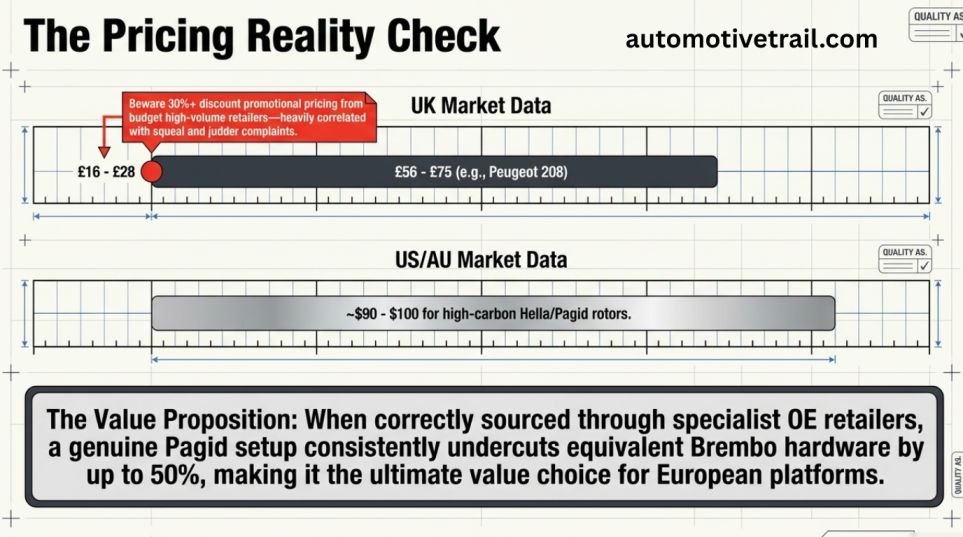
Pricing swings by market and vehicle, but recent listings give a solid baseline. In the UK, a single coated internally vented disc for a common application like a Peugeot 208 lists around £56 to £75 depending on retailer and discount timing. Budget promotional pricing through Euro Car Parts has put front discs as low as £28 each and rears at £16 each during sale periods, roughly 30% off list price.
In the US market, Hella/Pagid high-carbon coated rotors run around $90 to $100 per disc through specialist retailers like eBay-listed parts sellers, in line with the AU$100 per disc price one BMW owner reported when comparing against Brembo at AU$85.
Genuine BMW-specific Pagid Coated rotors sold through OE-focused retailers tend to sit toward the higher end of these ranges, reflecting the direct-fitment engineering and coating spec rather than a generic universal disc.
Compared to Brembo, Pagid consistently comes in cheaper, with one direct UK comparison putting Pagid at roughly half the price of an equivalent Brembo set for the same car. That price gap is the main reason Pagid keeps coming up as the budget-conscious alternative in forum threads, even among owners who ultimately prefer Brembo’s consistency.
Are Pagid brake discs worth buying? The real recap?
Pagid brake discs are worth buying if you source them correctly. The brand carries genuine, current OE contracts with Audi, BMW, VW, Mercedes-Benz, and Porsche, GEOMET coating as standard, and ECE R90 manufacturing compliance across a catalog covering 96% of the European car market. That’s a real engineering foundation, not marketing gloss.
The judder and quality complaints that show up repeatedly in owner forums trace overwhelmingly to one pattern: budget-sourced stock through high-volume discount retailers, sometimes confused with the separate Eicher sub-brand, paired with mismatched or worn pads that deposit unevenly and get misdiagnosed as disc warping. Buyers who sourced genuine Pagid discs through specialist or OE-focused retailers and paired them with matched Pagid pads report strong performance and minimal issues.
For track use, the Pagid Racing line is a legitimately different product built for sustained thermal stress, worth the upgrade if you’re doing real track days rather than the odd spirited drive.
If you drive normally and buy from a retailer with a solid track record for the brand, Pagid discs perform well and cost noticeably less than Brembo or Zimmermann. If you’re chasing the absolute lowest price from a high-volume discount seller, budget for the possibility of judder complaints and factor pad quality into that same purchase.
FAQ
Are Pagid brake discs better than Brembo?
Not universally, but they’re competitive at roughly half the price in several UK comparisons. Brembo tends to draw fewer judder complaints and carries stronger anti-corrosion treatment, while Pagid matches it closely when sourced correctly and costs significantly less.
Do Pagid brake discs warp easily?
Genuine reports of true warping exist but are less common than judder caused by uneven pad deposits, which gets misdiagnosed as warping. Pairing Pagid discs with quality, correctly-bedded pads reduces this risk substantially.
Is Pagid a good OE brand for brake discs?
Yes. Pagid currently holds OE contracts with Audi, Aston Martin, BMW, VW, Mercedes-Benz, and Porsche, and claims the top spot as OE supplier for ceramic disc-equipped vehicles.
Why do some Pagid brake discs get bad reviews?
Most negative reviews trace back to budget-sourced stock through one specific high-volume discount retailer, sometimes confused with the separate Eicher sub-brand. Discs bought through specialist or OE-focused retailers draw far fewer complaints.
How long do Pagid brake discs last?
Pagid backs its discs with a 25-month or 25,000-mile warranty. Real-world reports vary widely based on driving style, pad pairing, and sourcing, from owners getting years of trouble-free use to others reporting warping within six months on mismatched setups.
Should I buy Pagid discs and pads together?
Yes, if possible. Pagid designs its discs and pads to work as a matched system, and several judder complaints in owner reports trace back to mismatching a Pagid disc with a different or lower-quality pad compound.

- Top 10 Ranking Tire Brand for Minivan: Reviewed 2026 - October 5, 2026
- Model Y Tesla Long Range Automatic Wagon Tyre Fitment And Ratings - October 3, 2026
- What Is The Benefit Of Larger Rear Tyres On A Zero-turn Mower - October 3, 2026