
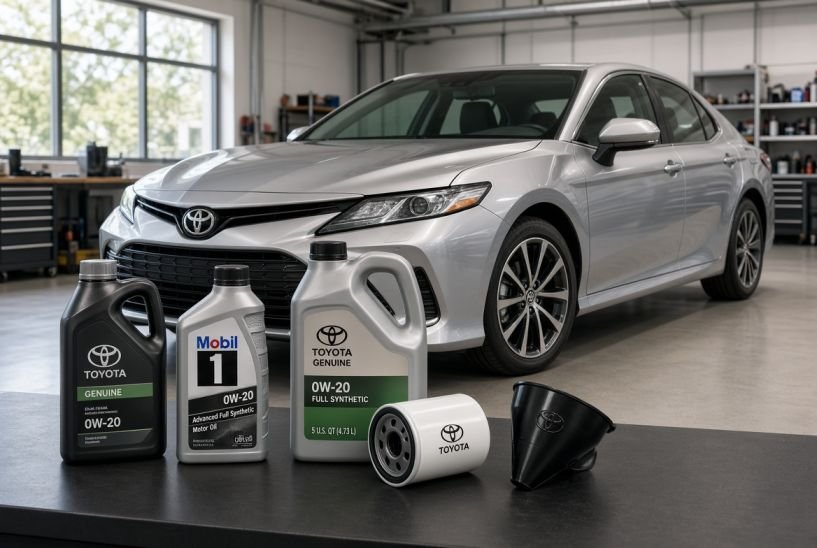
0W-20 full synthetic oil for Toyota — the short answer
0W-20 full synthetic oil is the factory-fill grade for most Toyota gas engines built since roughly 2007, including the Camry, Corolla, RAV4, Highlander, and Tacoma. It flows fast on cold starts and thins the film just enough at operating temperature to meet Toyota’s fuel-economy targets under API SN Plus/SP and ILSAC GF-6A ratings. Genuine Toyota Motor Oil (TGMO) is actually blended by Mobil, so most name-brand 0W-20 synthetics meet the same baseline spec even if the additive package isn’t identical.
Key Takeaways
- Toyota switched most gas engines to 0W-20 starting around 2007-2009 to meet tightening fuel-economy and emissions targets, not because the engines need thinner oil to survive.
- API SN Plus or SP with ILSAC GF-6A is the current standard; older ratings (SN, SM) are backward compatible but shouldn’t be your first choice on a newer engine.
- TGMO 0W-20 is manufactured by Mobil and typically runs $6-8 per quart at the dealer, cheaper than most people expect.
- Mobil 1 Advanced Fuel Economy 0W-20 is the closest off-the-shelf match to TGMO, though independent oil analysis shows TGMO carries meaningfully more molybdenum.
- The 2AR-FE four-cylinder (2009-2018 Camry, RAV4, and others) has a well-documented oil consumption problem tied to piston ring design, not the oil grade itself.
- 5W-20 is an approved emergency substitute per Toyota’s own manual, but should be replaced with 0W-20 at the next change; 5W-30 works too, and some owners run it deliberately on older, consumption-prone engines.
Why Toyota switched to 0W-20 in the first place
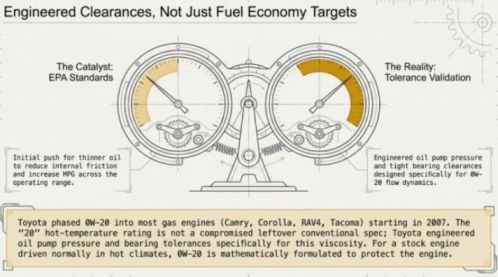
The move to 0W-20 wasn’t a random engineering choice. Toyota began the transition as part of a broader industry response to tightening EPA fuel-economy standards in the mid-2000s, and it phased 0W-20 in across most gas engines by the end of the decade. Thinner oil reduces internal friction, and less friction means a small but real bump in fuel economy across an engine’s operating range.
The tradeoff people worry about is high-temperature protection, since the “20” in 0W-20 refers to the oil’s viscosity at operating temperature, not just cold flow. Owners in hot climates sometimes ask whether this is too thin, and the honest answer is: for a stock engine driven normally, no. The additive package and oxidation stability matter more than the raw viscosity number in daily use. Toyota engineered clearances, oil pump pressure, and bearing tolerances around 0W-20 specifically, so it’s not simply the leftover conventional-oil spec with a synthetic label slapped on.
That said, the switch wasn’t without consequences. Thinner oil can accelerate oil consumption on engines that already have marginal piston ring sealing, which is exactly what happened with a specific Toyota four-cylinder a few years into the transition. More on that below.
Which Toyota models and engines require 0W-20
- Camry (2007-present, most trims): 2AR-FE 2.5L four-cylinder and 2GR-FE V6 both spec 0W-20 from roughly the 2012 model year onward.
- Corolla (2014-present): Most trims running the 1ZR-FE or later Dynamic Force engines use 0W-20; some newer hybrid variants have moved to 0W-16.
- RAV4 (2013-present): Gas models predominantly run 0W-20; RAV4 Hybrid and Prime variants often spec 0W-16 instead.
- Highlander and Tacoma: V6 applications (2GR-FE, 1GR-FE in some Tacoma trims) commonly call for 0W-20, though older or heavy-duty applications may still spec 5W-30.
- Prius and hybrid models: Frequently spec 0W-16 on newer generations, one step thinner than 0W-20, so don’t assume every hybrid uses the same grade as the gas lineup.
The safest confirmation is always the oil filler cap or the owner’s manual, since Toyota has moved individual models between 0W-20, 0W-16, and 5W-30 depending on model year and engine revision.
API SN Plus/SP vs older ratings — what the letters mean
The API service category tells you what generation of additive technology and engine-protection testing the oil passed, independent of viscosity grade.
| Brand / Product | Estimated Price | Key Additives & Features | Manufacturer / Blender | Recommended Use | API / ILSAC | Retail Availability | Pros & Cons |
|---|---|---|---|---|---|---|---|
| Genuine Toyota Motor Oil (TGMO) 0W-20 | $6–8/qt | High molybdenum; Toyota-specific additive package; factory-fill formula. | Mobil | Healthy engines; owners wanting factory-spec validation. | API SN Plus/SP; ILSAC GF-6A | Toyota dealers; online retailers. | Pros: High moly, affordable, factory-spec. Cons: Limited big-box availability. |
| Mobil 1 Advanced Fuel Economy 0W-20 | $25–32/5-qt jug | High film strength; close to TGMO; fuel-economy focused. | Mobil | All-around retail alternative; daily driving. | API SP; ILSAC GF-6A | Major retailers and big-box stores. | Pros: Widely available; frequent rebates. Cons: Lower moly than TGMO. |
| Valvoline Advanced Full Synthetic 0W-20 | $23–28/5-qt jug | Strong moly package; deposit protection. | Valvoline | Budget-conscious owners; daily-driver Toyotas without oil consumption issues. | API SP; ILSAC GF-6A | Most major retailers. | Pros: Budget-friendly; reliable performance history. Cons: Often viewed as a budget alternative to Mobil 1. |
| Liqui Moly Molygen New Generation 0W-20 | $10–12/qt | Moly-based friction modifier; high film strength; green UV dye. | Liqui Moly | High-mileage Toyotas (>100k miles); mild oil consumption, such as 2AR-FE. | API SP; ILSAC GF-6A | Online retailers; European-focused parts suppliers. | Pros: Friction protection; helps with engine wear. Cons: Most expensive; limited retail shelf presence. |
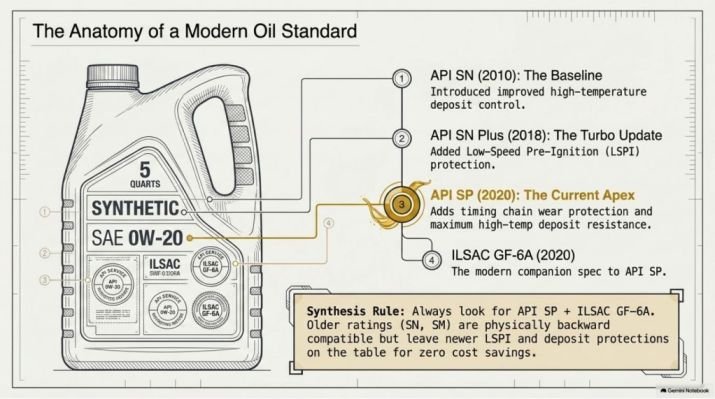
For a modern Toyota, look for API SP with ILSAC GF-6A on the bottle. Older ratings like SN or SM will physically fit and won’t harm the engine, but you’re leaving newer LSPI and deposit protection on the table for no real cost savings, since current-spec oil is the default at every major retailer now anyway.
Genuine Toyota 0W-20 (TGMO) review
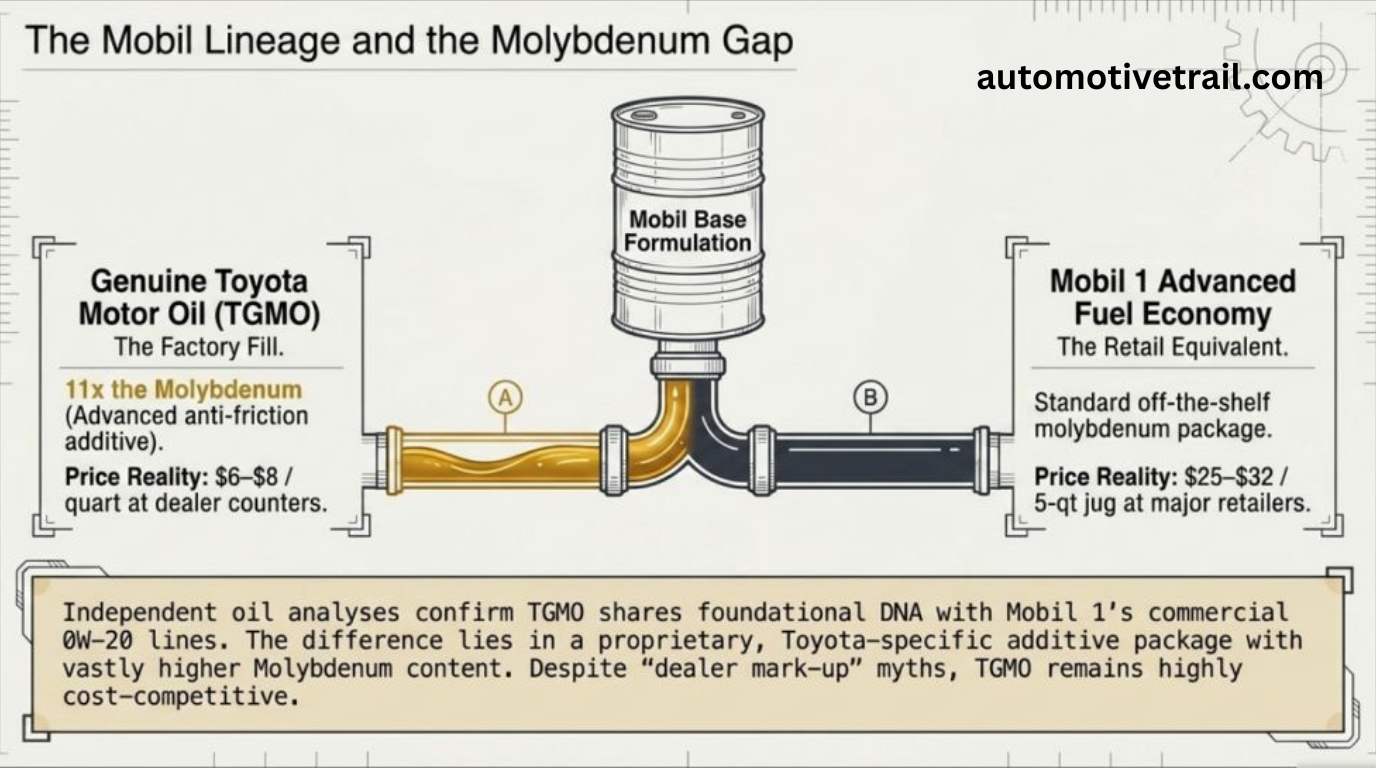
Toyota Genuine Motor Oil isn’t a mystery house brand. It’s blended by Mobil, and forum-sourced oil analysis confirms the base formulation shares real DNA with Mobil’s commercial 0W-20 lines, while carrying a Toyota-specific additive package. The most consistently cited difference is molybdenum content, an anti-friction additive that shows up at notably higher levels in TGMO than in Mobil’s off-the-shelf Advanced Fuel Economy variant, according to used and virgin oil analysis shared across BobIsTheOilGuy threads.
Price is the pleasant surprise here. Despite the “dealer oil” reputation for being marked up, TGMO commonly sells for $6-8 per quart at Toyota parts counters, which is often cheaper than name-brand synthetics at retail. Owners running it on a strict 5,000-10,000-mile interval report clean valve covers and no sludge even past 100,000 miles in multiple long-term reports.
If you want the exact formulation your engine was validated against, and you’re not paying a premium to get it, TGMO is a hard oil to argue against. The only real downside is convenience: it’s not stocked everywhere gas-station or big-box shelves are, so you may need to specifically visit a Toyota parts counter or order online.
Best aftermarket pick — Mobil 1 Advanced Fuel Economy 0W-20
Since Mobil already blends TGMO, it makes sense that their retail Advanced Fuel Economy line is the closest off-the-shelf match, and it’s the option most frequently recommended across Toyota-specific forums and independent testing roundups. One widely cited independent wear test ranked it among the top performers for film strength across eight competing 0W-20 oils.
The tradeoff versus TGMO comes down to that molybdenum gap. Whether an 11x difference in moly content translates to a meaningful real-world wear difference is genuinely debated among oil analysts, with most concluding both oils protect a stock Toyota engine adequately across a normal service interval. If maximum fidelity to the factory formula matters to you, TGMO wins; if convenience and broad retail availability matter more, Mobil 1 AFE is the practical choice.
Retail price runs $25-32 for a 5-quart jug at most retailers, and Mobil frequently runs mail-in rebates that bring the effective price close to store-brand synthetics.
Best budget pick — Valvoline Advanced Full Synthetic 0W-20
Valvoline’s Advanced Full Synthetic line meets current API SP and ILSAC GF-6A standards and shows up repeatedly in long-term owner reports as a reliable, lower-cost alternative to Mobil 1 or TGMO. Oil analysis shared on enthusiast forums shows Valvoline running a comparably strong moly package to TGMO in some batches, which is part of why it holds a loyal following among cost-conscious owners who still want more than a bargain-bin oil.
One owner who ran Valvoline’s synthetic line for 85,000 miles across regular 4,000-5,000-mile changes reported spotless internals at teardown, a data point worth more than marketing copy. Pricing typically sits at $23-28 for a 5-quart jug, occasionally undercutting Mobil 1 during sales.
This is the pick for a daily-driver Toyota with no consumption issues where you want a name-brand synthetic without paying the Mobil 1 premium every time.
Best for high-mileage or older Toyotas — Liqui Moly Molygen 0W-20
Liqui Moly’s Molygen New Generation line leans on a stronger molybdenum-based friction modifier package, marketed specifically around immediate lubrication at cold start and reduced internal friction over the life of the oil. For a Toyota already past 100,000 miles, or one already showing mild oil consumption, the added film strength this line offers can provide a bit more margin than a bargain synthetic.
It’s less common on general retail shelves than Mobil 1 or Valvoline, most reliably found through online retailers and European-focused parts suppliers, and it costs a bit more per quart as a result, typically $10-12 per quart versus $5-6 for Mobil 1 or Valvoline bought in bulk. For a car you’re trying to nurse past 200,000 miles with an engine that already has some wear, that premium is a reasonable insurance policy.
Can you use 5W-20 or 5W-30 instead of 0W-20
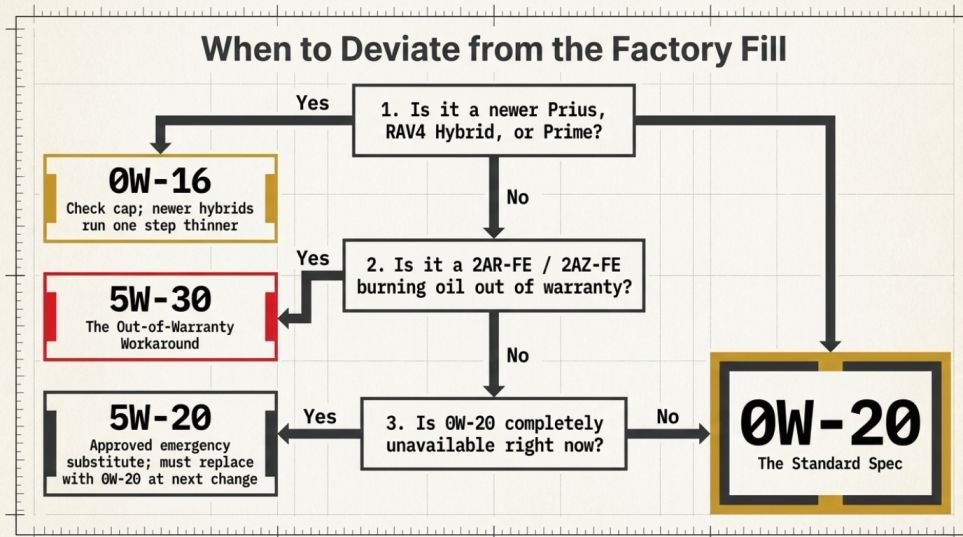
Toyota’s own owner’s manual addresses this directly: if 0W-20 isn’t available, 5W-20 can be used as a temporary substitute, but it should be replaced with 0W-20 at the next scheduled oil change. 5W-20 flows slightly slower at cold start than 0W-20, which matters most in genuinely cold climates, but it’s not a dangerous swap for a single interval.
5W-30 is a different conversation. It’s not the factory spec on most current 0W-20 Toyotas, but a meaningful number of owners, particularly those with the consumption-prone 2AR-FE engine, deliberately run 5W-30 instead once their car is well out of any factory oil-consumption warranty program. The thicker film reduces oil usage in an engine already burning oil past the piston rings, at a small cost to cold-start flow and a negligible hit to fuel economy. This is a workaround for a specific known issue, not a general recommendation to ignore your factory spec on a healthy engine.
Common complaints about 0W-20 in Toyota engines
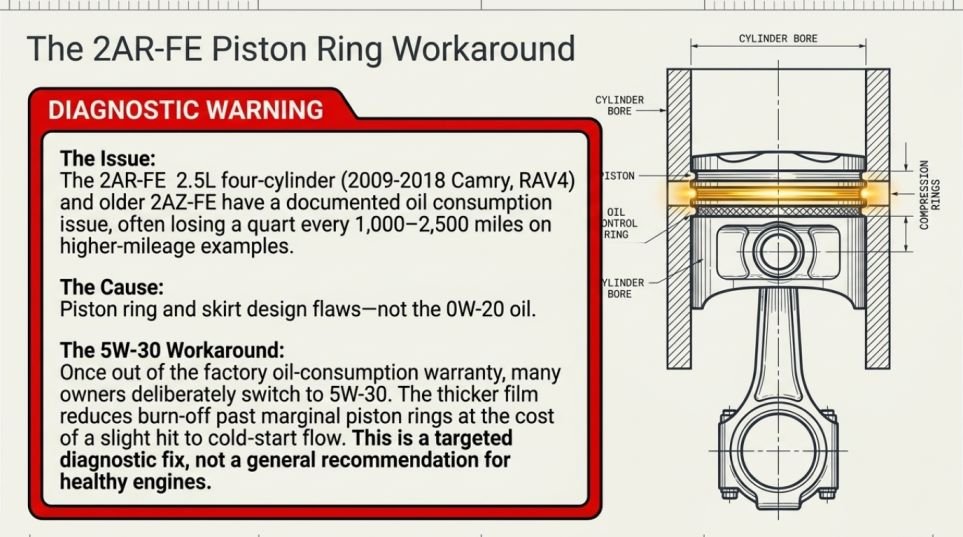
Oil consumption on the 2AR-FE. This is the complaint that dominates Toyota forums, and it’s well documented enough that Toyota issued a warranty enhancement program for the related 2AZ-FE engine covering certain 2007-2011 Camry, Corolla, RAV4, and Scion models built with that engine. The 2AR-FE that followed it has its own long-running consumption threads on ToyotaNation, with owners reporting a quart lost every 1,000-2,500 miles on higher-mileage examples, generally attributed to piston ring and skirt design rather than the 0W-20 oil itself. Running a slightly thicker oil, adding a catch can, or, in severe cases, rebuilding with revised pistons are the common fixes discussed in these threads.
Class-action litigation over excessive oil consumption. Toyota faced consumer lawsuits alleging certain four-cylinder and V6 engines burned oil at an unusually high rate, tied to the same piston ring and design concerns raised in owner forums. This reinforced, rather than caused, the consumer skepticism that already existed around 0W-20’s thin viscosity.
“Is 0W-20 too thin?” skepticism. A recurring theme, especially from owners coming from vehicles that ran 5W-30 or thicker, is doubt that a 20-weight oil can protect an engine in hot climates or under load. In practice, Toyota validated its clearances and oil pump specs around this viscosity, and the complaints that do hold up trace back to specific engine designs (the 2AR-FE above), not the viscosity grade applied broadly across the lineup.
Confusion over “not interchangeable” marketing claims. Some owners have been told by dealers that TGMO’s proprietary additive package makes it non-interchangeable with other 0W-20 synthetics. In practice, any oil meeting the same API and ILSAC ratings is functionally compatible; the real difference is formulation quality, not a compatibility risk.
Oil change intervals — 5,000 vs 10,000 miles
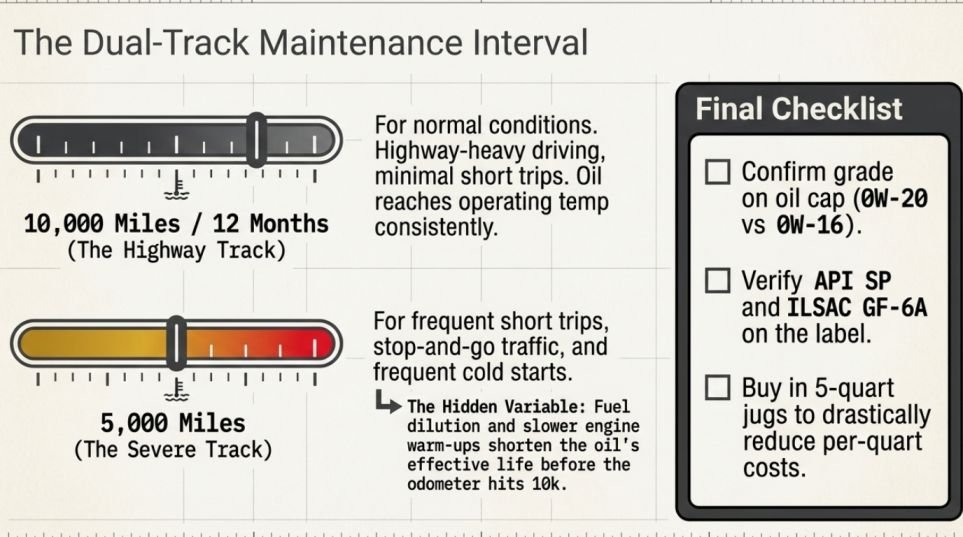
Toyota’s factory maintenance schedule for most 0W-20 vehicles targets 10,000 miles or 12 months between changes, based on the oil meeting current API SP specifications and reasonably normal driving conditions. Independent mechanics and long-term oil analysis on forums generally support this interval holding up fine for highway-heavy driving with minimal short trips.
Owners doing mostly short trips, frequent cold starts, or driving in stop-and-go traffic often see faster fuel dilution and slower engine warm-up, both of which shorten the oil’s effective life faster than the odometer suggests. Shortening the interval to 5,000-7,500 miles is a common, low-cost adjustment among enthusiast forums for exactly this driving pattern, and it’s a reasonable middle ground if your commute doesn’t match the highway-driving conditions Toyota’s factory interval assumes.
What to check before buying 0W-20 oil for your Toyota
- Confirm your exact grade on the oil cap or manual. Some Toyota hybrids and newer models have moved to 0W-16, not 0W-20.
- Look for API SP and ILSAC GF-6A on the label. These are the current standards and include LSPI protection that older ratings lack.
- Check for a known consumption issue on your specific engine code. The 2AR-FE and older 2AZ-FE are the two most commonly flagged; if yours is one of these, budget for more frequent oil-level checks between changes.
- Decide between TGMO and a name-brand alternative based on convenience, not fear. Both meet the same baseline spec; the difference is additive package strength, not safety.
- Buy in bulk (5-quart jugs) when possible. Per-quart cost drops meaningfully compared to buying individual quarts, especially for Mobil 1 and Valvoline.
- Watch for manufacturer rebates. Mobil 1 in particular runs periodic mail-in rebates that can make it price-competitive with TGMO.
Price and where to buy in 2026
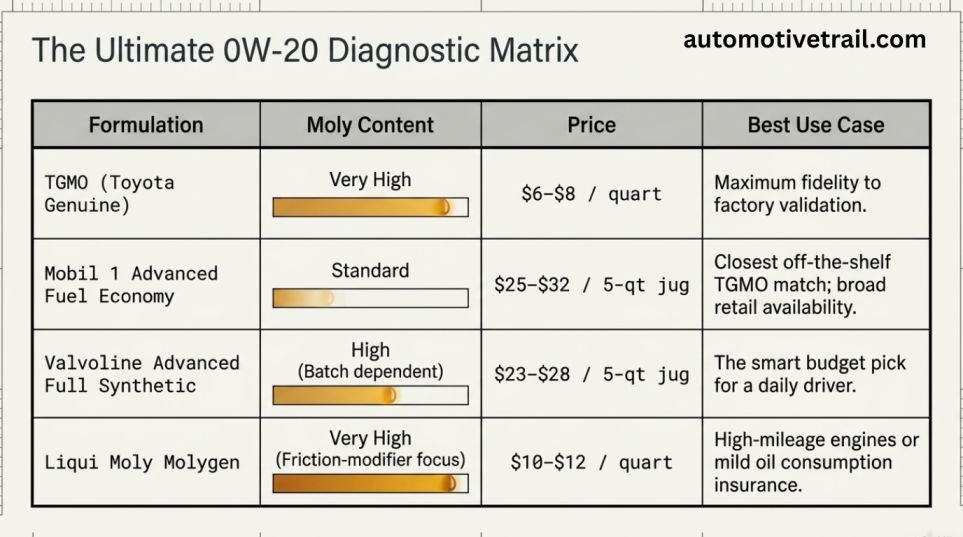
Genuine TGMO 0W-20 typically runs $6-8 per quart through Toyota dealer parts counters. Mobil 1 Advanced Fuel Economy 0W-20 runs $25-32 for a 5-quart jug at major retailers, occasionally lower with rebates. Valvoline Advanced Full Synthetic 0W-20 runs $23-28 for a comparable jug. Liqui Moly Molygen 0W-20 sits higher, typically $10-12 per quart, reflecting its narrower distribution and stronger friction-modifier package.
Bottom line — which 0W-20 oil to buy
For most Toyota owners with a healthy engine, this decision matters less than the marketing around it suggests. Any 0W-20 oil carrying current API SP and ILSAC GF-6A ratings will protect your engine through a normal service interval. Genuine TGMO is the closest match to what your engine was validated against, and it’s surprisingly affordable if you can get to a dealer parts counter. Mobil 1 Advanced Fuel Economy is the best all-around retail alternative given the shared manufacturing lineage. Valvoline is the smart budget pick for a daily driver with no known issues. If your Toyota runs a 2AR-FE or older 2AZ-FE engine and you’re already seeing oil consumption, talk to your dealer about warranty coverage first, and consider a slightly thicker oil or Liqui Moly’s stronger friction-modifier formula once you’re past any warranty window.
FAQ
Is 0W-20 too thin for a Toyota in hot weather? No, for a stock engine driven normally. Toyota engineered oil pump pressure and bearing clearances around this viscosity specifically, and the “20” hot-temperature rating reflects validated engineering, not a compromise made purely for fuel economy.
Can I use Mobil 1 instead of Toyota Genuine Motor Oil? Yes. Mobil actually blends TGMO, and their retail Advanced Fuel Economy 0W-20 line is the closest off-the-shelf match. The main difference documented in oil analysis is a lower molybdenum level than TGMO carries, which most owners and analysts don’t consider a meaningful real-world risk.
Why does my Toyota burn oil between changes? Certain four-cylinder engines, most notably the 2AR-FE used in many 2009-2018 Camry and RAV4 models, have a documented piston ring and design issue that causes oil consumption independent of the oil grade used. Toyota extended warranty coverage for the related 2AZ-FE engine specifically for this reason.
What happens if I put 5W-30 in a Toyota that specs 0W-20? It won’t damage a healthy engine over a single interval, and some owners with consumption-prone engines run it deliberately for the added film strength once out of warranty. It’s not the factory spec, and you’ll give up a small amount of cold-start flow and fuel economy.
How often should I change 0W-20 synthetic oil in a Toyota? Toyota’s factory schedule targets 10,000 miles or 12 months for most models under normal driving. Shortening that to 5,000-7,500 miles is a reasonable adjustment for frequent short trips or heavy stop-and-go driving.
Is genuine Toyota oil worth paying extra for? It’s rarely more expensive than name-brand alternatives in the first place, typically $ 6- $ 8 per quart at the dealer, so the “worth it” question is less about price and more about convenience. If you’re already at the dealer for service, there’s little reason to choose otherwise.

- Top 10 Ranking Tire Brand for Minivan: Reviewed 2026 - October 5, 2026
- Model Y Tesla Long Range Automatic Wagon Tyre Fitment And Ratings - October 3, 2026
- What Is The Benefit Of Larger Rear Tyres On A Zero-turn Mower - October 3, 2026