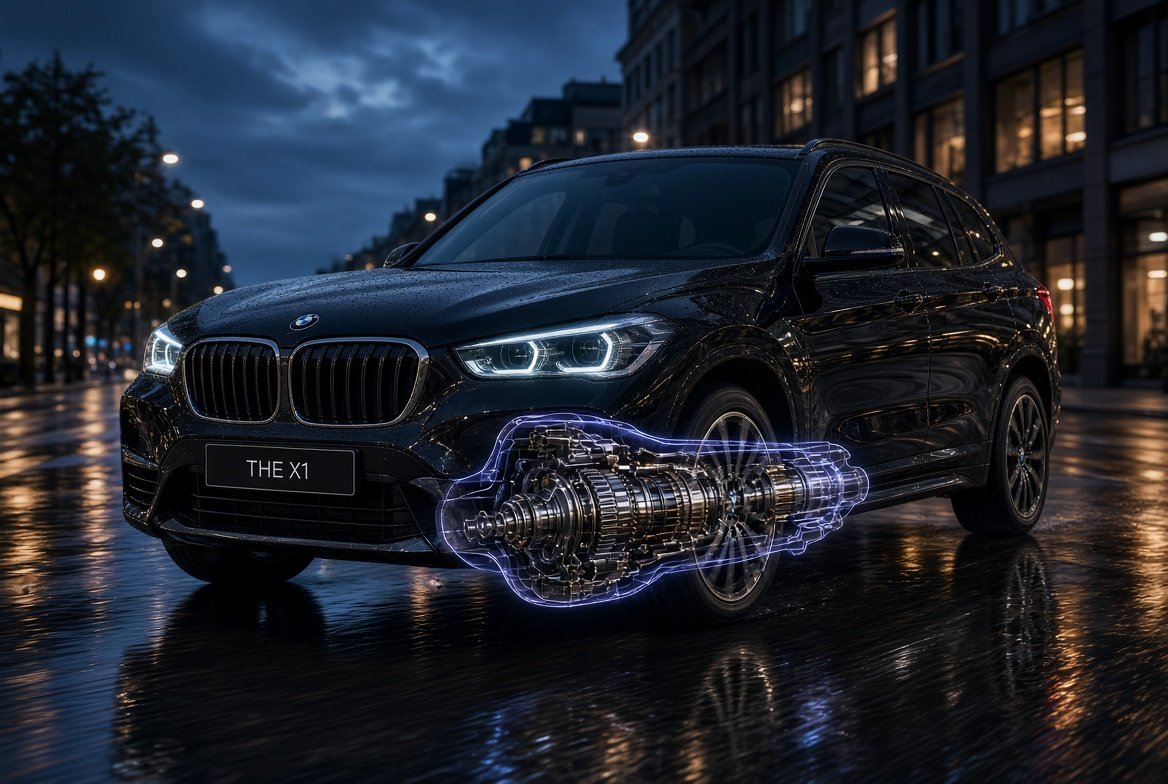
Short answer: the BMW X1 has an automatic gearbox, and since 2023 every combustion and plug-in hybrid X1 uses a 7-speed dual-clutch transmission (DCT) built by Getrag. The older 2016-2022 X1 (F48) used either a 7-speed Getrag DCT or an 8-speed Aisin torque-converter automatic, depending on engine and trim. Some older models, mainly in Europe, also had a manual. The fully electric iX1 has no multi-speed gearbox at all.
That’s the single most important fact if you’re cross-shopping model years, because the previous-generation X1 split its gearbox between two completely different designs depending on trim.
If you own or are looking at a 2023-or-newer X1, you have a DCT. If you’re looking at a 2016-2022 model, check the spec sheet closely, because you might have an Aisin torque converter automatic or a Getrag DCT, and they don’t behave the same way at all.
Key takeaways
- Current U11 X1 (2023+): 7-speed DCT across the entire range, including the M35i
- Previous F48 X1 (2016-2022): 8-speed Aisin automatic on higher-power/xDrive trims, 7-speed Getrag DCT on lower-power sDrive trims
- Who makes it: Getrag builds the X1’s dual-clutch units; Aisin (Japan) builds the older 8-speed automatic
- BMW never fitted a ZF automatic to any X1 generation, despite persistent forum claims
- Manual gearbox: offered on some older and European-market X1s, but not on the current U11
- DCT low-speed behavior is the most common complaint, especially in stop-and-go traffic and roundabouts
- BMW calls the fluid “lifetime,” but most independent techs and even some BMW service bulletins recommend a change around 50,000-90,000 km depending on the unit
- Overall, the X1’s mechanical reliability scores well in independent surveys; gearbox complaints are real but not epidemic
BMW X1 gearbox: what’s actually in your car
Start by figuring out which generation and trim you have, because “BMW X1 gearbox” isn’t one product. The current U11-generation X1, sold since 2023, uses a 7-speed dual-clutch transmission on every trim, from the base xDrive28i up through the M35i. That’s a real change from the previous generation, where the gearbox depended heavily on which engine you picked.
The outgoing F48 X1 (2016-2022) split down the middle. Lower-output front-wheel-drive models like the 18i and 20i sDrive got a 7-speed Getrag dual-clutch unit, largely because of its torque limits. Higher-output and xDrive all-wheel-drive models got an 8-speed Aisin torque-converter automatic instead, a conventional slushbox rather than a dual-clutch design.
One persistent myth worth killing here: some owners assume the X1 eventually got BMW’s well-regarded ZF 8-speed automatic, the one used in 3 Series, 5 Series, and X3 models. It never did. Every automatic X1, across both generations, ran either an Aisin or a Getrag unit, not a ZF box. If a listing or a forum post tells you otherwise, it’s wrong.
Who makes the BMW X1 gearbox?
Two suppliers cover every automatic X1:
- Getrag (now part of Magna) builds the 7-speed dual-clutch transmissions, from the older 7DCT300 to the current DCT400 and the hybrid HDT400.
- Aisin, the Japanese gearbox specialist, builds the 8-speed AWF8F35 torque-converter automatic used on higher-power and xDrive F48 models.
BMW doesn’t build these gearboxes itself; it specifies and tunes the software. That’s why the same Getrag DCT family also appears in other brands’ front-wheel-drive-based cars, and why the X1’s gearbox feels so different from the ZF-equipped rear-drive BMWs.
Is the BMW X1 gearbox a dual-clutch (DCT)?
On the current model, yes. The X1 uses a 7-speed dual-clutch automatic (known as the 7단 DCT in Korea and the cambio de doble embrague in Spanish-speaking markets). A dual-clutch box uses two clutches, one for odd gears and one for even gears, so the next gear is always pre-selected. That’s why shifts are so quick, and also why low-speed driving can feel less smooth than a torque-converter automatic.
On the older F48, only some trims had a DCT. If you’re asking whether your specific X1 has one, the trim and engine decide, as covered below.
Current-generation X1 (2023+): the 7-speed DCT explained
The U11 X1’s dual-clutch transmission is a newer design than the DCT used in the previous generation, and BMW made real changes to it. It’s electrically actuated rather than hydraulically actuated, which BMW says improves efficiency and response. The gear ratio spread is wider than before, and the software now factors in route topography, meaning it can hold a gear differently on a hilly road than on a flat highway.
It also allows coasting, letting the engine disengage from the wheels to save fuel, in every drive mode except when you’ve manually selected Sport via the gear selector. That’s a meaningful shift from older automatics, which generally kept some engine braking active by default.
On the M35i, the same basic DCT architecture is used but tuned for the higher-output engine, carrying a different internal code (DCT400 MPA) than the standard xDrive28i’s unit. In real numbers, the xDrive28i’s 241-hp engine and this transmission combination get the X1 to 60 mph in about 6.2 seconds, which is quick for the segment and a direct result of how fast a dual-clutch box can swap gears compared to a traditional automatic.
Electric iX1: the all-electric iX1 doesn’t have a conventional multi-speed gearbox. Its motors drive the wheels through a single-speed reduction gear, so everything in this article about DCT behavior applies only to the petrol, diesel, and plug-in hybrid versions.
Previous-generation X1 (2016-2022): Aisin 8-speed vs Getrag DCT
If you’re shopping used, this is the section that actually matters, because the two gearboxes feel and age differently.
| Generation | Years | Trim / Engine | Transmission | Manufacturer / Model | Gears | Driving Characteristics | Service Interval | Common Issues |
|---|---|---|---|---|---|---|---|---|
| U11 | 2023-present | Standard (e.g., xDrive28i) | 7-speed DCT | Getrag DCT300/DCT400 | 7 | Quick, efficient shifts; coasting; hesitant in stop-start traffic/roundabouts | 90,000–135,000 km or 6 years | Low-speed hesitation, especially high-torque trims |
| U11 | 2023-present | M35i (B48) | 7-speed DCT | Getrag DCT400 MPA | 7 | Higher-output tune; fast shifts; 0–60 mph in ~6.2 sec | 60,000–90,000 km or 6 years | Low-speed hesitation/jerkiness from torque modulation |
| U11 | 2023-present | Hybrid variants | 7-speed DCT | Getrag HDT400 | 7 | Varies by model | 80,000–125,000 km | Varies by model |
| F48 | 2016–2022 | Higher-power / xDrive AWD | Torque-converter automatic | Aisin AWF8F35 | 8 | Smooth, conventional; good for city driving and low-speed maneuvers | 80,000–120,000 km (proactive) | Jerky shifts at 40,000–60,000 km; declining shift quality |
| F48 | 2016–2022 | Lower-power sDrive (18i, 20i) | 7-speed DCT | Getrag 7DCT300 | 7 | Fast shifts; clunky at parking speeds; traffic hesitation | 50,000–90,000 km (independent) | Low-speed clunkiness and stop-and-go hesitation |
| F48 | 2016–2022 | 1.5 diesel (sDrive16d, mainly Europe) | Manual or 7-speed DCT (check build sheet) | Manual / Getrag 7DCT300 | 6 / 7 | Economy-focused; DCT version shares the low-speed behavior of other sDrive models | 50,000–90,000 km (DCT, independent) | Low-speed hesitation (DCT) |
| F48 | 2016–2022 | Manual models | Manual | Varies by model | Varies by model | Traditional manual operation | See manual | Jumping out of gear |
Neither box has a dominant reputation for outright failure. What shows up in forums and independent reliability write-ups instead is shift quality degrading over time on the Aisin, and low-speed clunkiness on the Getrag DCT that some owners never fully get used to. If you’re test-driving a used F48 X1, do it in stop-and-go traffic specifically, not just on the highway, since that’s where each gearbox shows its real character.
BMW X1 1.5 diesel gearbox (sDrive16d)
If you searched for the 1.5 diesel, you’re most likely looking at a European-market F48 sDrive16d. Its three-cylinder engine was offered with a 6-speed manual or a 7-speed Getrag dual-clutch automatic, and the 7-speed DCT version behaves like the other sDrive DCT cars: quick on the open road, a little hesitant in slow traffic. Larger 2.0 diesels, especially with xDrive, used the 8-speed Aisin automatic instead. Because options varied by country and year, confirm the gearbox from the build sheet or VIN rather than assuming from the engine alone.
How the X1’s DCT actually feels to drive
On the highway and at a steady cruise, owners generally have few complaints about either DCT generation. Gear changes are fast, the car doesn’t hunt for ratios, and paddle response is sharp when you want it.
The complaints cluster around low-speed, stop-start situations. One U11 owner in Italy described merging into busy roundabouts as consistently hesitant, even in Sport mode, and said the same gearbox felt smoother in a lower-powered rental with less torque to manage off the line. That’s a common pattern with dual-clutch transmissions generally: less torque to modulate at low speed usually means smoother clutch engagement, so a higher-output trim can actually feel jerkier pulling away than a base model.
If you’re coming from a traditional automatic or a manual, expect an adjustment period. New DCT owners are commonly warned not to treat it like a manual with a phantom clutch pedal, and not to attempt heel-toe downshifts, since the transmission’s own logic handles rev-matching and doesn’t respond well to inputs designed for a different kind of gearbox.
Is the BMW X1 gearbox reliable?
Broadly, yes, with specific caveats depending on which unit you have. What Car’s reliability survey placed the X1 eighth out of 34 cars in its class with a 96.6% score, ahead of the Audi Q3 and Mercedes GLE, and gearbox-related failures aren’t the primary driver of warranty claims across the range.
That said, gearbox issues do show up consistently enough in independent problem trackers to take seriously. Jerky automatic shifts developing between 40,000 and 60,000 km are a documented pattern on the Aisin-equipped cars. Separately, a gearbox jumping out of gear shows up more often on manual-transmission X1s than automatics, and a rattling noise from the dash area at higher speeds or under acceleration is flagged as an early warning sign worth investigating on a test drive rather than ignoring.
None of this puts the X1 gearbox in “known bad unit” territory the way some other manufacturers’ dual-clutch transmissions have landed. It’s closer to “pay attention during a test drive and don’t skip fluid service” territory.
DCT vs torque converter automatic: which X1 gearbox is better for you
If you’re choosing between a used sDrive DCT model and an xDrive Aisin automatic model, the decision usually comes down to how you actually drive, not which one is objectively better.
Pick the DCT if you mostly drive highway miles, want quicker gear changes, and don’t spend much time in heavy stop-and-go traffic. Pick the Aisin torque converter automatic if you do a lot of city driving, parking, and low-speed maneuvering, since it behaves more predictably at a crawl and doesn’t have the clutch-engagement hesitation a DCT can show off the line.
Neither choice is available on the current U11 generation, since every 2023+ X1 shares the same DCT. So this decision really only applies to used F48 shopping, where trim level effectively decides your gearbox for you rather than the other way around.
Does the BMW X1 come with a manual gearbox?
It depends on the generation and market. The current U11 X1 has no manual option; it’s DCT only. The previous F48 offered a 6-speed manual on some lower-output models, mainly in Europe and other markets, while US and Canadian cars were automatic only. If you’re asking about a manual X1 specifically, the common complaint is the gearbox occasionally jumping out of gear, so check for it on a test drive and look at the clutch wear as well. If you want a manual today, you’ll be shopping used F48 or older E84-generation X1s.
Manual shifting and paddle shifters on the X1
Both the current DCT and the previous-generation Getrag DCT support manual gear selection through the shifter or steering wheel paddles. Full manual control locks the transmission in the gear you’ve selected until you shift again or hit the rev limiter, unlike some “manual modes” on older torque-converter automatics that quietly overrule your input near redline.
Don’t expect it to behave like an actual manual transmission. There’s no clutch pedal, and trying to left-foot brake or anticipate a phantom clutch engagement is a common habit new DCT owners have to unlearn. Heel-toe downshifting doesn’t apply either, since the transmission’s electronics handle rev-matching automatically during a manual downshift.
In daily use, most owners report using the paddles occasionally on a fun road and leaving the car in full automatic the rest of the time, since the automatic logic in Sport mode already holds gears aggressively under hard cornering or acceleration.
X1 gearbox maintenance: fluid changes and service intervals
BMW markets the transmission fluid on most X1 models as “lifetime,” and that claim deserves real skepticism. Independent techs and even some published BMW service documentation for the current DCT units list actual change intervals, not “never.”
For the U11’s DCT (non-hybrid trims, DCT300/DCT400 codes), the documented interval is roughly every 90,000 to 135,000 km depending on driving style, or 6 years, whichever comes first. Hybrid variants with the HDT400 unit list a slightly shorter window, around 80,000 to 125,000 km. The M35i’s DCT400 MPA unit, paired with the higher-output B48 engine, has the shortest recommended interval of the group: roughly 60,000 to 90,000 km or 6 years.
For the older F48 Aisin automatic, BMW’s official position is still “lifetime,” but forum consensus among owners who’ve actually pulled the pan and inspected the fluid lands around 50,000 to 75,000 miles (roughly 80,000 to 120,000 km) for a proactive change, well short of BMW’s marketing language. The relevant BMW-branded ATF for that unit is part number 83 22 2 413 477, and a full service involves draining, refilling, cycling through each gear to redistribute fluid, then adjusting the level through an overflow plug at a specific fluid temperature, not just topping it off.
If you’re buying a used X1, ask directly whether the transmission fluid has ever been changed. A car with no service history on the gearbox by 70,000-80,000 miles (about 110,000-130,000 km) is a reasonable point to budget for the service yourself, regardless of what the sales sheet says about “lifetime” fluid.
Common X1 gearbox problems to watch for
A short list of the specific symptoms worth testing for, rather than vague reliability worries:
- Jerky or delayed gear changes, most often reported on Aisin-equipped cars starting around 40,000-60,000 km
- Hesitation pulling away from a stop, particularly on DCT-equipped cars in traffic or tight low-speed maneuvers like roundabouts
- A rattling noise from the dash area under acceleration or at speed, flagged by independent reviewers as an early gearbox warning sign
- Gearbox jumping out of gear, reported more frequently on manual-transmission X1s than on either automatic
If you hit any of these on a test drive, don’t talk yourself into it. These are documented patterns, not one-off complaints, and a pre-purchase inspection that includes a scan for stored transmission fault codes is worth the cost on any used X1 with an unclear service history.
Key takeaway: what to expect from your X1’s gearbox
If you’re buying new, you’re getting the current 7-speed DCT no matter which trim you pick (or no gearbox to speak of on the electric iX1), and it’s a genuinely quick-shifting, efficient unit that’s best in highway and open-road driving, with some documented low-speed hesitation in heavy traffic that a minority of owners find genuinely annoying.
If you’re buying used, figure out whether your specific F48 has the Getrag DCT, the Aisin automatic, or a manual before you judge the car’s driving feel, since they’re different transmissions with different personalities, not just different names for the same thing. Either way, don’t take “lifetime fluid” at face value. Budget for a transmission service somewhere in the 50,000-90,000 km range depending on which unit you have, and treat it as normal maintenance rather than an optional extra.
FAQ
What gearbox does the BMW X1 have? Every 2023-and-newer petrol, diesel, or plug-in hybrid X1 has a 7-speed dual-clutch automatic. The 2016-2022 model had either a 7-speed Getrag DCT (lower-power sDrive) or an 8-speed Aisin automatic (higher-power and xDrive), plus a manual on some European versions.
Who makes the BMW X1 transmission? Getrag makes the dual-clutch units, and Aisin makes the older 8-speed torque-converter automatic. BMW did not use a ZF gearbox in the X1.
Is the BMW X1 automatic transmission a dual-clutch? On the current model, yes. On the F48, it depends on the trim: sDrive models have a dual-clutch, while xDrive and higher-power models have a conventional torque-converter automatic.
Does the BMW X1 have a manual transmission option? Not on the current U11, and not in North America on recent generations. Some markets and earlier E84-generation X1s offered a manual, and the F48 had a 6-speed manual on certain European models. US and Canadian F48 and U11 cars come exclusively with an automatic (DCT or torque converter).
Which gearbox does the BMW X1 1.5 diesel have? The F48 sDrive16d was sold with a 6-speed manual or a 7-speed DCT depending on the market. Check the build sheet for your car.
Is the X1’s DCT the same gearbox used in BMW’s M cars? No. BMW’s M-car DCTs are built for much higher torque loads and come from a different design lineage. The X1’s DCT, whether the older Getrag unit or the current 7-speed, is a smaller-capacity transmission built for the X1’s four-cylinder and three-cylinder engines.
Why does my BMW X1 hesitate at low speed? This is a known characteristic of the dual-clutch design, most noticeable when pulling away from a stop or navigating roundabouts. It’s more pronounced on higher-torque trims and isn’t necessarily a sign of a fault, though persistent jerkiness is worth having checked if it’s new or worsening.
How much does it cost to replace an X1 gearbox? Costs vary widely by region and whether you go through a dealer or independent specialist, and BMW doesn’t publish a fixed number. Get a specific quote based on your VIN and gearbox code rather than relying on a generic figure, since Aisin and DCT units are priced very differently.
Can I change the transmission fluid myself? Yes, on both the Aisin automatic and the DCT units, though the DCT procedure typically requires more specialized tools and precise fluid-temperature monitoring during the fill process. Many owners with mechanical experience do it themselves using the correct BMW-spec fluid and a service manual.
Which BMW X1 gearbox is more reliable, the DCT or the Aisin automatic? Neither has a dramatically worse track record than the other in independent reliability data. The Aisin shows more reports of shift quality degrading with age; the DCT shows more low-speed hesitation complaints. Neither pattern rises to a widespread failure issue.

- Top 10 Ranking Tire Brand for Minivan: Reviewed 2026 - October 5, 2026
- Model Y Tesla Long Range Automatic Wagon Tyre Fitment And Ratings - October 3, 2026
- What Is The Benefit Of Larger Rear Tyres On A Zero-turn Mower - October 3, 2026