Group 4 synthetic oil brands are the brands that use polyalphaolefin (PAO) base stock in at least some of their motor oils. The clearest PAO-based lines are AMSOIL Signature Series, Red Line, Motul 300V, and select Mobil 1 products. Most oils labeled “full synthetic” are actually Group 3 hydrocracked mineral oil, so the brand name alone does not tell you what is in the bottle.
Suppose you are looking for Group 4 synthetic oil brands; the list below shows which brands use PAO, how strong the evidence is for each, and which popular “synthetics” are not Group 4. You will also find a simple method to confirm PAO on any oil using its data sheet, and a clear explanation of when PAO matters over Group 3 or Group 5 for your engine.
Quick Answer: Group 4 (PAO) Oil Brands List
Here is the short version. “Confirmed” means the manufacturer states PAO in its marketing or data sheets. “Partial” means PAO is present in some products or grades, but you must check the exact product. “Not Group 4” means the oil is commonly sold as synthetic but is built on a different base stock.
| Brand | Product line | PAO / Group 4 status |
|---|---|---|
| AMSOIL | Signature Series | Confirmed (PAO-based) |
| Red Line | Motor oils (PAO + ester) | Confirmed (PAO/ester blend) |
| Motul | 300V competition range | Confirmed (ester core with PAO) |
| Mobil 1 | FS 0W-40 and some European-market grades | Partial: verify each grade |
| Royal Purple | Select synthetic lines | Partial: verify each product |
| Castrol | Edge (select formulations) | Partial: varies by grade and region |
| Shell Rotella | T6 full synthetic diesel (esp. 5W-40) | Partial: verify your grade |
| Pennzoil | Ultra Platinum | Not Group 4 (GTL, a Group 3+ process) |
These are the brands that show up most often in PAO oil brand searches. Because formulas change by viscosity, region, and batch, treat this table as a starting point and confirm with the data sheet before buying.
1. What Is Group 4 Base Oil (PAO)?
The American Petroleum Institute (API) classifies lubricant base stocks into five groups. Group 4 is specifically reserved for polyalphaolefin (PAO) base oils, which are chemically synthesized rather than refined from crude oil. PAO base stock is made by a small number of producers and then sold to oil blenders, which is why many brands can offer a PAO-based oil without making the base stock themselves. That molecular uniformity is what gives PAO its performance characteristics.
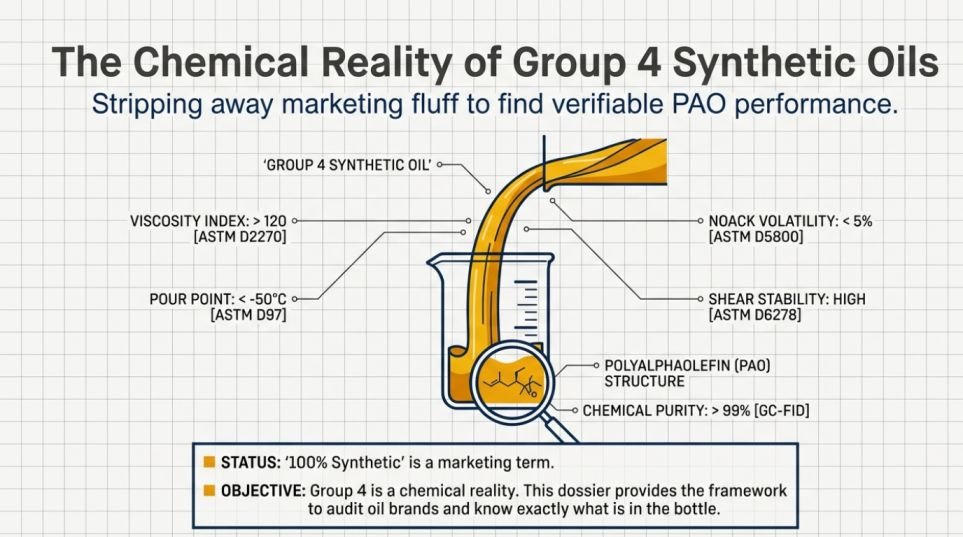
In practical terms, PAO engine oil offers three measurable advantages over conventional or Group 3 base stocks: a lower pour point (better cold-start flow), lower NOACK volatility (less oil burn-off at high temperatures), and stronger oxidation resistance (longer stable performance under heat). These properties make Group 4 PAO oil especially relevant for turbocharged engines, extreme cold climates, towing applications, and drivers who want maximum margin within OEM-approved drain intervals.
However, “Group 4” is a base oil category, not a finished-oil category. Most finished motor oils are blends. A product may use a PAO-dominant base with some Group 3 or Group 5 (ester) co-base stocks plus an additive package. The key is how much PAO is in the formulation and whether the manufacturer discloses it, which is what the verification section below covers.
2. Group 4 PAO Oil Brands List (Product-Level Breakdown)
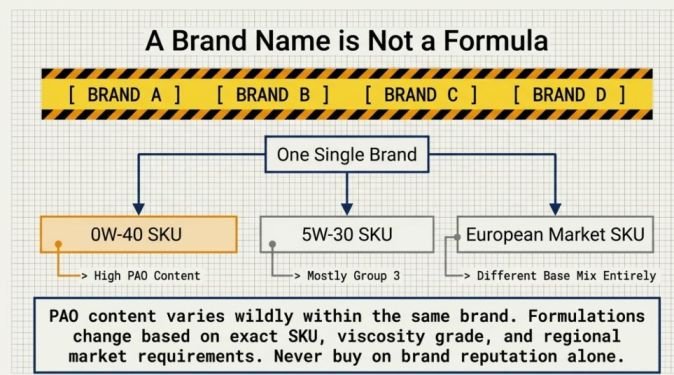
This is the detailed version of the table above. Each brand has at least one product line where PAO content is either stated by the manufacturer or well documented by independent oil analysis. The list is organized by how clearly the PAO claim is supported, not by brand popularity.
Brands With Explicit PAO Disclosure
AMSOIL Signature Series — AMSOIL openly markets its Signature Series line as PAO-based and provides data sheets listing PAO as the primary base stock. Available in common grades including 0W-20, 5W-30, and 0W-40. The Signature Series consistently shows strong pour point and NOACK numbers in published data, which aligns with PAO chemistry. AMSOIL also sells other product tiers (OE, XL) that may use different base stock blends, so confirm the exact product line.
Red Line — Red Line has long marketed its motor oils as PAO and ester-based formulations. Their product data sheets typically reference polyol ester and PAO chemistry. Red Line oils are popular in performance and motorsport applications and are available in a wide range of viscosities. The ester content (a Group 5 component) helps with seal conditioning and detergency alongside the PAO base.
Motul 300V — Motul’s 300V competition line is marketed as an ester-core technology with PAO involvement. Motul provides detailed data sheets for the 300V range. Their standard H-Tech and 8100 lines use different base stock strategies, so only the 300V family should be treated as a confirmed PAO/ester product without additional verification.
Brands With Documented PAO In Select Products
Mobil 1 — Mobil 1 has historically been associated with PAO base stocks, and several product lines (particularly Mobil 1 FS 0W-40 and the European-market formulations) have shown PAO presence in independent oil analyses. However, Mobil 1 does not always explicitly list “PAO” on every product’s data sheet, and some viscosity grades (like certain 5W-30 formulations) have shifted toward Group 3-heavy blends in recent years. Always check the data sheet for the specific viscosity and market version you are buying.
Castrol Edge (select formulations) — Castrol’s product line is large, and base stock composition varies significantly by viscosity grade and region. Some Castrol Edge products have shown PAO content in independent analyses, while others rely primarily on Group 3 base stocks. Castrol does not consistently disclose PAO on product data sheets, so this brand requires per-SKU verification. Do not assume Edge equals PAO across the board.
Shell Rotella T6 — Shell Rotella T6 is a full synthetic diesel oil that has shown PAO content in some independent analyses (particularly the 5W-40 grade). Like other Shell products, the base stock strategy can vary. Confirm via the data sheet for your specific grade before treating it as a Group 4 product.
Royal Purple — Royal Purple markets its oils as synthetic and uses proprietary additive technology (Synerlec). Some product lines have shown PAO content, but Royal Purple’s data sheets do not always break down the base oil group clearly. Per-product verification is recommended.
Popular “Synthetics” That Are Not Group 4 PAO
Pennzoil Ultra Platinum — Pennzoil’s Ultra Platinum line uses Shell’s PurePlus GTL (gas-to-liquid) base oil technology, which is a Group 3+ process, not Group 4 PAO. Some formulations may blend a small amount of PAO alongside the GTL base, but it should not be assumed to be PAO-dominant without specific data sheet confirmation. It is included here because it frequently appears in Group 4 discussions. It is still an excellent oil; it is simply not a PAO oil.
The same caution applies to most mainstream “full synthetic” oils sold at big-box retailers. Unless the data sheet names PAO, assume the base stock is Group 3 hydrocracked oil.
How This List Should Be Used
Even within confirmed PAO brands, the exact base oil blend can change by viscosity grade, market region, and production batch. The brands in the “explicit disclosure” tier above are the safest starting point if PAO content is your priority. For brands in the “documented in select products” tier, always pull the data sheet for the specific product name and viscosity before buying. The verification process below shows you exactly how to do that.
3. How To Verify Group 4 PAO On Any Oil
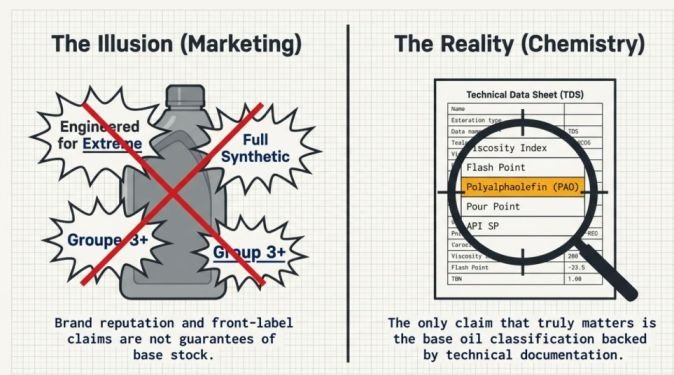
Brand labels and marketing language are not reliable indicators of base oil classification. The only way to confirm Group 4 PAO content is through the manufacturer’s documentation or independent oil analysis. Here is a practical process you can follow for any oil product.
Step 1: Find The Technical Data Sheet (TDS) Or Product Data Sheet (PDS)
Go to the manufacturer’s website and search for the exact product name and viscosity grade. The TDS is usually available as a downloadable PDF under product specifications or technical resources. If you cannot find it, contact the manufacturer or distributor directly and request the TDS for the specific SKU.
Step 2: Look For Base Oil Language
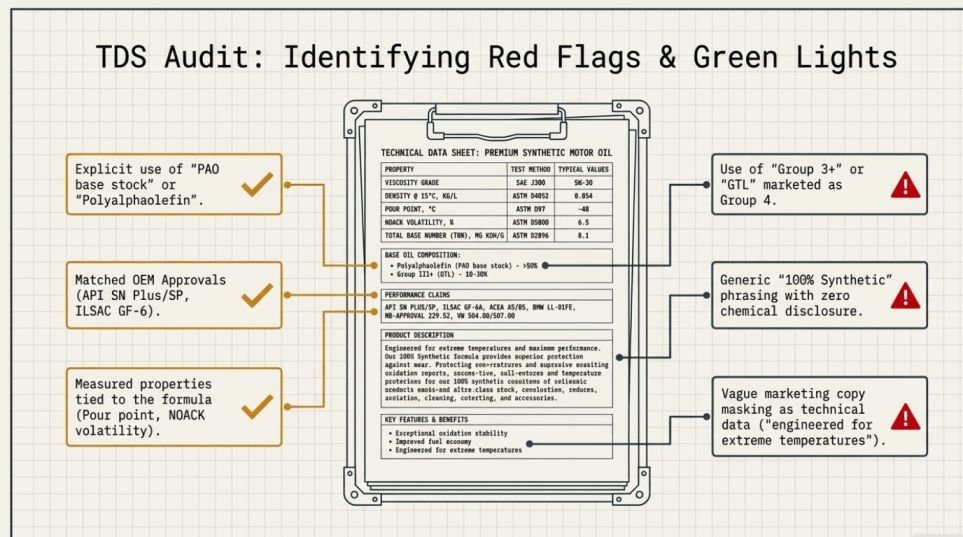
On the TDS, look for a base oil section or composition description. Confirmed Group 4 indicators include language like “PAO base stock,” “polyalphaolefin,” “PAO synthetic base oil,” or a base oil blend description that explicitly names PAO as a component. If the TDS only says “synthetic” or “full synthetic” without specifying the base oil type, that is a marketing description, not a base oil classification. Treat it as unverified for Group 4 purposes.
Step 3: Cross-Check Performance Data
Even when PAO is listed, cross-check the measured properties on the TDS against what PAO chemistry typically delivers. A PAO-dominant oil will usually show a pour point well below the SAE grade requirement, NOACK volatility in the lower range for its viscosity class, and strong viscosity index numbers. If these numbers look similar to a Group 3 product in the same grade, the PAO content may be minimal, or the oil may be a PAO/Group 3 blend rather than PAO-dominant.
Step 4: Check Independent Oil Analysis (Optional)
For buyers who want the highest confidence, independent used oil analysis services (such as Blackstone Laboratories) can test a sample and provide base stock indicators. Online oil analysis databases and enthusiast forums also compile results that can help you compare products. This step is optional but useful for verifying expensive or niche products.
Red Flags That Suggest Mislabeling
Watch for these warning signs when evaluating Group 4 claims: the product page says “Group IV” or “Group 4” but the TDS makes no mention of PAO; the product uses terms like “Group 3+” or “hydrocracked synthetic” as if they are equivalent to PAO; the brand uses GTL (gas-to-liquid) technology but markets it under Group 4 language; or the manufacturer’s response to a base oil inquiry is vague or delayed. Any of these patterns suggest the Group 4 claim is promotional rather than technical.
4. Group 4 Vs Group 3 Vs Group 5 Synthetics
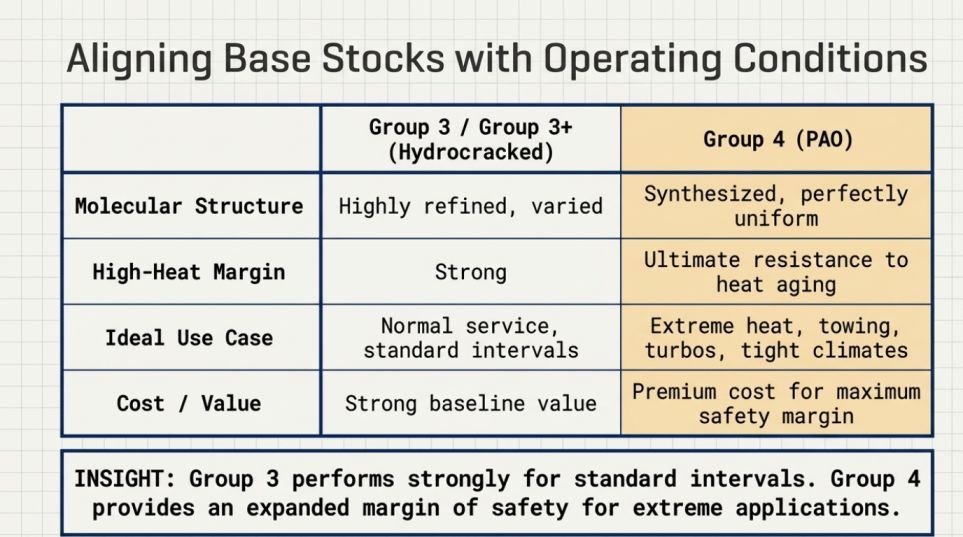
Understanding the differences between base oil groups helps you decide whether Group 4 is worth the premium for your application, and whether Group 5 (ester) oils deserve consideration as well.
Group 3 (Hydrocracked Mineral Oil)
Group 3 base stocks are severely hydrocracked mineral oils that can legally be called “synthetic” in most markets. They perform well for standard driving under normal drain intervals and meet most OEM specifications at a lower cost. The tradeoff is that Group 3 can be more sensitive to oxidation and thermal breakdown compared to PAO, especially under extended stress. For most daily drivers following OEM intervals, a well-formulated Group 3 oil with the correct API/ILSAC or ACEA approval is a strong, cost-effective choice.
Group 4 (PAO)
Group 4 PAO offers better molecular uniformity, stronger oxidation resistance, and superior cold-flow performance compared to Group 3. It is often the preferred base stock for turbocharged engines, extreme cold climates, high-temperature towing, and applications where maximum thermal margin is desired within the OEM-approved drain interval. PAO is not a substitute for following the manufacturer’s oil-change schedule, but it can provide more headroom before the oil degrades.
Group 5 (Esters And Other Synthetics)
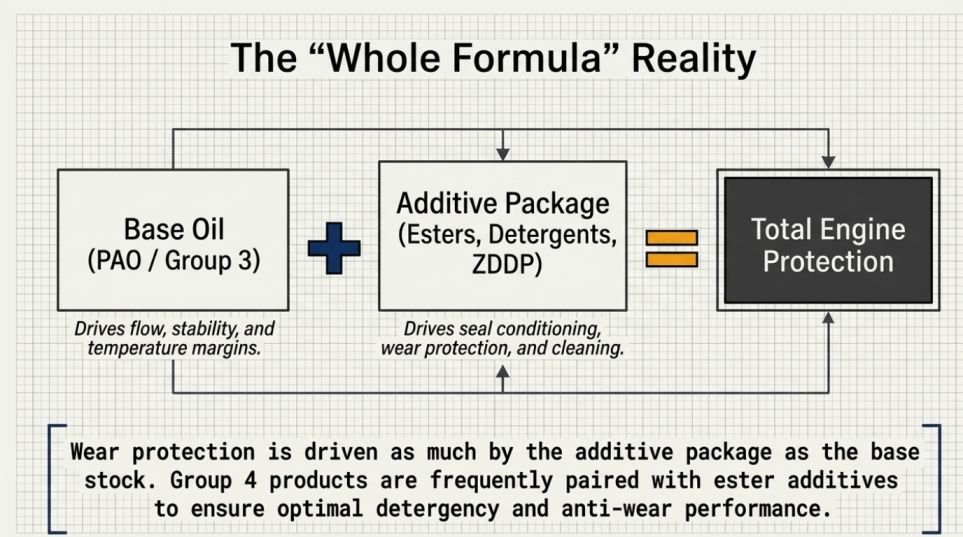
Group 5 is a catch-all category for base stocks that do not fit Groups 1 through 4. The most performance-relevant Group 5 oils are esters (polyol esters and dibasic acid esters), which are used in aviation, motorsport, and high-performance automotive lubricants. Ester base stocks are naturally polar, which means they cling to metal surfaces better than PAO and can provide excellent detergency and seal conditioning.
In automotive motor oils, you rarely find a pure Group 5 ester product. Instead, esters are commonly blended with PAO (Group 4) to combine PAO’s thermal stability with ester’s surface adhesion and solvency properties. Brands like Red Line and Motul 300V use this PAO/ester blend approach. If you see “Group 4 and 5” referenced together, it typically means a PAO base with an ester co-base stock, which is considered a premium formulation strategy.
Which Group Should You Choose?
The right base oil group depends on your engine requirements and operating conditions, not on which group number sounds more impressive. Match the engine’s required API/ILSAC or ACEA approval and the viscosity grade first, not just the base oil group on the label. A well-formulated Group 3 oil that meets your OEM spec will protect your engine better than a Group 4 oil that does not carry the correct approval. If you want PAO performance, select a product from the list above that also meets your vehicle’s exact specification requirements.
Who Should Pay For Group 4 PAO Oil?
PAO is worth the extra cost in these situations: turbocharged or direct-injection engines that run hot, very cold climates where cold-start flow matters, regular towing or track use, and owners who want extra thermal margin inside the OEM drain interval. For a naturally aspirated daily driver in a mild climate on normal intervals, a quality Group 3 synthetic with the right approval is usually enough.
Quick Summary
Group 4 synthetic oil brands use PAO (polyalphaolefin) base stocks, which deliver strong cold-start performance, low volatility, and high oxidation resistance. Brands with the clearest PAO documentation include AMSOIL Signature Series, Red Line, and Motul 300V. Mobil 1, Castrol Edge, Shell Rotella T6, and Royal Purple have PAO content in select products but require per-SKU verification. Pennzoil Ultra Platinum is GTL-based and is not Group 4.
Group 3 oils are a strong value for standard driving, while Group 5 esters are typically blended with PAO in premium formulations (Red Line, Motul 300V). Do not assume Group 4 content based on “synthetic” labeling or brand reputation alone. Always verify through the TDS for the specific product name and viscosity grade, and confirm that the oil meets your vehicle’s required API, ILSAC, or ACEA approvals.
| What to check | What to look for |
|---|---|
| Base oil classification | Explicit PAO or polyalphaolefin in the PDS/TDS, not just “synthetic” or vague Group IV wording |
| Viscosity grade | Match your manual — common PAO grades include 0W-20, 5W-30, 0W-40, and 5W-40 |
| Approvals and specs | Verify API SP, ILSAC GF-6, or relevant ACEA spec matches your vehicle |
| Mislabeling red flags | Watch for “Group 3+” or GTL marketed as Group 4, and TDS that says “synthetic” without naming PAO |
| Performance cross-check | PAO-dominant oils typically show lower pour point and lower NOACK volatility than Group 3 equivalents in the same grade |
PAO Oil Brands: Group 4 Motor Oil Brands At A Glance
“PAO oil brands”, “Group IV oil brands” and “Group 4 oil brands” all mean the same thing: brands that build at least some of their motor oils on polyalphaolefin (PAO) base stock. This quick list groups the PAO synthetic oil brands by how clearly they disclose it:
| PAO motor oil brand | PAO engine oil line | How clear is the PAO evidence? |
|---|---|---|
| AMSOIL | Signature Series | Strong: marketed as PAO-based |
| Red Line | Full range of motor oils | Strong: PAO plus ester |
| Motul | 300V competition oils | Strong: ester core with PAO |
| Mobil 1 | Selected grades (e.g. some 0W-40 / Extended Performance) | Partial: varies by grade and region |
| Royal Purple | Selected synthetic lines | Partial: check each product |
| Liqui Moly | Synthoil range | Partial: check each grade’s data sheet |
PAO + Ester Oil Brands
Some of the most robust Group 4 full synthetic oils blend PAO with Group 5 esters for better film strength and seal conditioning. The best-known PAO ester oil brands are Red Line, Motul 300V and AMSOIL Signature Series. These are the oils people usually mean when they ask for the best PAO oil brands for track use or very long drain intervals.
Is Mobil 1, Pennzoil, Amsoil Or Royal Purple Group 4?
| Question | Short answer |
|---|---|
| Is Mobil 1 a Group 4 oil? | Some Mobil 1 grades contain a lot of PAO, but Mobil does not label them as Group 4, and many current grades are Group 3/PAO blends. Check the specific grade. |
| Is Pennzoil Ultra Platinum a Group 4 oil? | No. It is made from gas-to-liquid (GTL) base oil, which is classed as Group 3, not PAO. |
| Is Amsoil a Group 4 oil? | AMSOIL Signature Series is PAO-based. Some of AMSOIL’s cheaper lines use more Group 3. |
| Is Royal Purple Group 4? | Many Royal Purple synthetics use PAO, but the base oil mix varies by product, so verify the grade. |
For whether PAO is worth paying extra for in your car, read Group 4 engine oils: are they worth the money?.
Frequently Asked Questions
What Does “Group 4 Synthetic Oil” Mean, And Which Brands Actually Use Group 4 Base Stocks?
Group 4 refers to oils made from PAO (polyalphaolefins). Brands with the strongest PAO documentation include AMSOIL Signature Series, Red Line, and Motul 300V. Mobil 1, Castrol Edge, Shell Rotella T6, and Royal Purple have PAO content in select product lines, but exact base stock composition varies by SKU, viscosity, and region. A brand name alone is not a guarantee of Group 4 content — always verify through the TDS for the specific product.
Is Full Synthetic Oil The Same As PAO Or Group 4?
No. “Full synthetic” is a marketing and legal term that can describe Group 3 hydrocracked oil, GTL oil, PAO, or ester blends. Only a data sheet or manufacturer statement naming PAO confirms Group 4 content.
Is Mobil 1 A Group 4 PAO Oil?
Partly. Some Mobil 1 products, such as FS 0W-40 and certain European-market grades, have shown PAO presence, but not every Mobil 1 grade is PAO-dominant. Check the data sheet for your exact viscosity and market version.
Is Pennzoil Ultra Platinum A Group 4 Oil?
No. It uses Shell’s GTL base oil technology, which is a Group 3+ process. It is a high-quality synthetic, but it is not a PAO oil.
How Can I Tell If A Synthetic Oil Brand Is Really PAO (Group 4) And Not Group 3?
The product data sheet (TDS/PDS) is the most useful document for this question because it may identify the base stock directly. Look for the words “PAO,” “polyalphaolefin,” or “Group IV base stock” in the base oil section. Marketing terms like “full synthetic” describe a product category but do not confirm PAO. If the TDS only says “synthetic,” treat the Group 4 claim as unverified.
What Is The Difference Between Group 4 And Group 5 Synthetic Oil?
Group 4 is PAO (polyalphaolefin), valued for thermal stability and cold-flow performance. Group 5 is a catch-all category that includes esters, silicones, and other non-PAO synthetics. In automotive oils, the most relevant Group 5 component is ester, which adds metal-surface adhesion and detergency. Premium oils from brands like Red Line and Motul 300V blend Group 4 PAO with Group 5 ester. You rarely find a pure Group 5 motor oil — it is almost always used as a co-base stock alongside PAO.
Are Group 4 Synthetic Oil Brands More Expensive, And What’s A Realistic Price Expectation?
Group 4 PAO oils typically cost more than Group 3 synthetics because PAO base stock is more expensive to produce. Expect to pay roughly 30–60% more per quart compared to a Group 3 synthetic in the same viscosity grade and API spec. Pricing varies significantly by retailer, product line, and quantity (5-quart jugs vs individual quarts). Compare per-quart cost for the same spec (like API SP) and the same SAE grade to get a fair comparison.
Can I Use A Group 4 Synthetic Oil For Extended Drain Intervals?
You can follow longer intervals only if the oil meets your vehicle’s required specs and your driving conditions support it (avoid extended drains with frequent short trips, extreme heat, or heavy towing unless the oil brand explicitly approves it for your application). PAO’s oxidation resistance can provide more margin, but the safe approach is to follow the OEM interval unless you are running oil analysis to confirm the oil’s condition at the extended mileage.
Will Switching To A Group 4 Synthetic Oil Cause Leaks Or Seal Damage?
Modern engine seals are designed to handle synthetic oils, including PAO formulations. The risk of leaks when switching is usually tied to old, already-degraded seals or prior contamination rather than the oil itself. If your engine was already leaking before the switch, the Group 4 oil is not the cause. Avoid aggressive flushing additives that can loosen accumulated sludge and make existing seal weaknesses more apparent.
What’s The Biggest Mistake When Shopping For Group 4 PAO Oil?
The most common mistake is treating a brand name or the word “synthetic” as proof of PAO base stock. Product formulas change over time, and even within the same brand, different viscosity grades may use entirely different base oil blends. The second most common mistake is prioritizing base oil group over OEM specification compliance — a Group 4 oil that does not carry your engine’s required API or ACEA approval can cause more harm than a correctly specified Group 3 product.
What are the best Group 4 synthetic oil brands?
AMSOIL Signature Series, Red Line and Motul 300V are the clearest PAO-based choices. Some Mobil 1 grades also use significant PAO.
What are PAO synthetic oil brands?
Brands that build oils on polyalphaolefin (Group 4) base stock: mainly AMSOIL Signature Series, Red Line, Motul 300V and selected Mobil 1, Royal Purple and Liqui Moly grades.
Is Group 4 full synthetic oil better than regular full synthetic?
PAO has better cold flow and heat stability than Group 3, which helps in extreme cold, heavy towing, racing and long drain intervals. For normal daily driving, a good Group 3 synthetic that meets your car’s spec is usually enough.

- “Does Higher Tire Pressure Improve Fuel Economy? Recommended PSI Explained” - November 25, 2026
- Best Tires for Minivans 2026: 10 Best Minivan Tires Reviewed - October 5, 2026
- Best Tires For Tesla Model Y Long Range (2026) - October 3, 2026