Yes, for daily driving on a tight budget, as long as you know what you’re buying. Callahan brake kits are made in China, sold through a US-based company, and priced well below OEM and premium aftermarket brands. Performance lands somewhere between “fine” and “frustrating” depending on the specific kit and how well it survives shipping.
The reviews split hard, and that split follows a pattern. Owners who get a good batch report smooth, quiet stops and painless installs. Owners who get a bad batch deal with vibration and rotor imbalance that keeps coming back even after a second replacement. Neither group is lying. Budget-tier manufacturing tolerances are just looser, so the outcome depends more on luck than it does with a premium brand.
Key takeaways
- Callahan rotors are made in China. Callahan’s own Amazon Q&A confirms the parts aren’t US-made, even though the company selling them is.
- Callahan and Power Stop share some parts. One owner found identical rotor part numbers and country-of-origin stamps between a Power Stop kit and a cheaper Callahan kit, with the pads being the main difference.
- Complaints cluster around rotor balance and repeat vibration, not outright failure. Steering shake after a few months is the most common issue reported.
- Positive reviews are just as common, describing easy installs, no squeal, and smooth stops straight out of the box.
- Warranty is 12 months or 12,000 miles, shorter than what premium brands typically offer.
- Price runs roughly $87 to $400+ depending on whether you’re buying pads and rotors only or a full kit with calipers.
What Callahan Brake Parts actually is
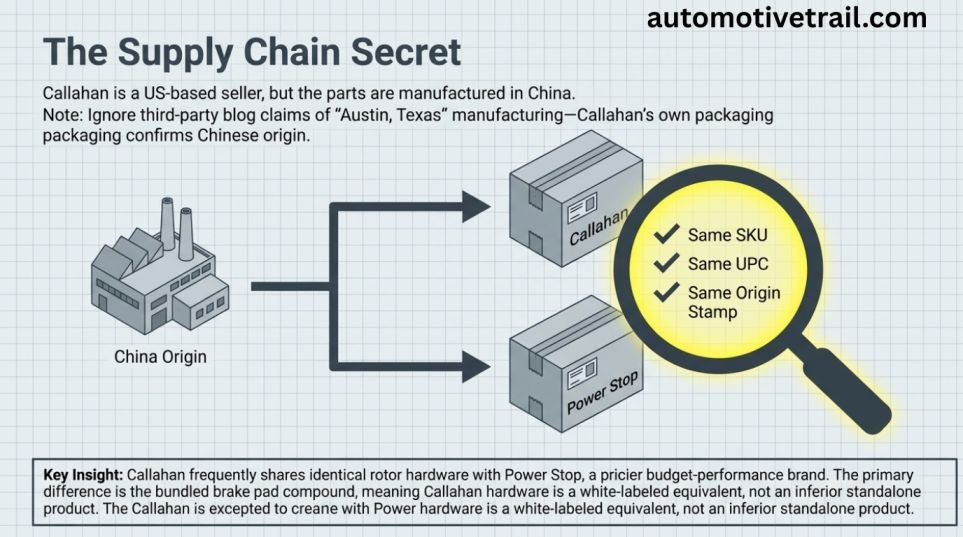
Callahan Brake Parts sells budget aftermarket brake kits online through eBay, Amazon, and Walmart, covering pads, rotors, calipers, and hardware for a wide range of vehicle makes. The company itself is based in the US, but the parts are manufactured overseas. Callahan’s own response to an Amazon customer question makes this distinction directly: the parts weren’t made in the USA, but the company selling them is.
eBay listings back this up with specific country-of-origin data, showing China listed on Callahan rotor packaging. One owner thread went further and connected Callahan to Power Stop, a more established budget-performance brand. After receiving a Power Stop kit with an incorrect rear pad, the buyer switched to a cheaper Callahan kit and found the drilled and slotted rotors were the exact same part, same SKU, same UPC code, same China origin stamp. The only real difference was the brake pads themselves.
That’s worth sitting with for a second. It means at least some Callahan rotors aren’t a separate manufacturing operation; they’re the same rotor sold under a lower-cost badge with cheaper pads bundled in. That’s not necessarily bad, since Power Stop has its own reasonable reputation in the budget-performance space, but it does mean you’re not getting a unique product just because the name on the box is different.
One third-party blog claims Callahan brakes are manufactured in Austin, Texas. That claim conflicts directly with Callahan’s own Amazon statement and the eBay country-of-origin listings, so treat it with real skepticism rather than as settled fact.
Owner experiences the good side
A lot of owners are genuinely happy with what they got. One buyer on an E46 BMW forum paid $148 shipped for front rotors, pads, and a wear sensor, and reported the install went easier than the factory parts had, no squeaking at all after years of putting up with OEM squeal, and smooth, confident stops with no grabbiness right before coming to a halt. He called the drilled and slotted rotors good-looking on the car as a bonus.
On an Audi forum, one owner running Callahan cross-drilled and slotted rotors alongside Power Stop Z23 pads described the rotors as decent and noted they resist rust well thanks to their coating treatment. He also pushed back on blanket China-bashing in the same thread, pointing out that Brembo rotors are frequently made in China too, and that people who trash Callahan for its origin often don’t realize their praised premium brand shares the same manufacturing base.
These aren’t outlier cases. Across multiple threads, the pattern for satisfied owners is consistent: easy fitment, quiet operation, and stopping performance that matches or slightly beats worn OEM parts, all at a fraction of the price.
Owner experiences the recurring complaints
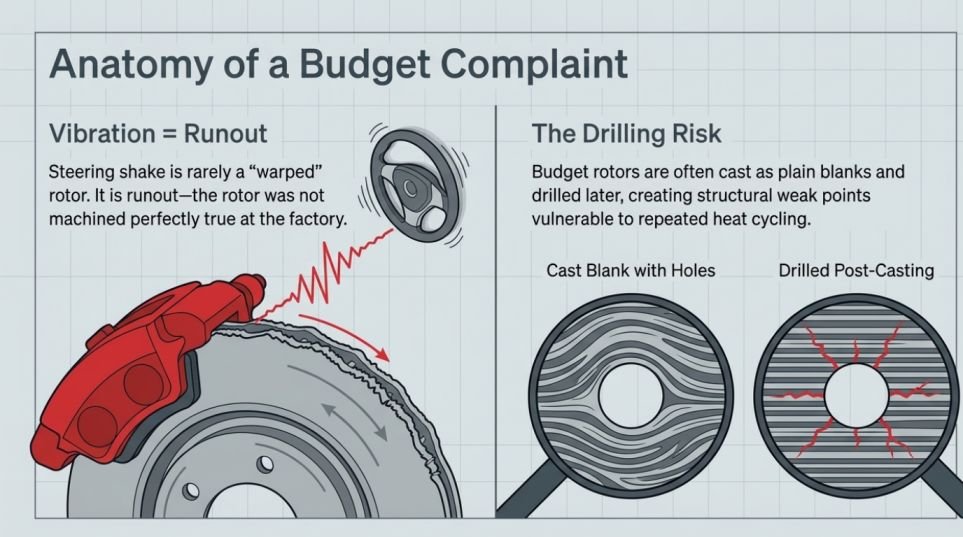
The complaints follow their own consistent pattern, and it’s worth naming clearly. A Honda Pilot owner described buying a full front and rear set of Callahan drilled and slotted rotors with ceramic pads, only to keep replacing the rotors due to shaking under braking. After installing a fresh set, the shake returned within a couple of months, even though the pads still had plenty of material left, which pointed the problem squarely at the rotors rather than pad wear.
A dedicated review breaking down Callahan-specific complaints found the pattern clusters around three things: rotor balance, noise, and early warping. Steering wheel shake under braking soon after installation points to rotor runout, meaning the rotor wasn’t machined perfectly flat and true. Drilled rotor setups in particular draw more chatter and squeal complaints than plain rotors, and the review notes that budget-tier rotors carry looser manufacturing tolerances than OEM or premium parts, which shrinks the margin for error during install.
That last point matters. It means the same install mistake, like slightly uneven torque or skipping the bedding process, is more likely to cause a problem on a budget rotor than on a tighter-tolerance premium one. The rotor isn’t necessarily defective. It just has less room to forgive a shortcut.
Are Callahan rotors cast or drilled from a blank?
This is a specific manufacturing question that shows up in enthusiast forums, and it matters more than it sounds. A rotor can be cast with drilled/slotted patterns built into the mold from the start, which keeps the metal structure consistent around each hole. Or it can be cast as a plain blank and then drilled afterward, which can leave stress points around each hole that make the rotor more prone to cracking under hard, repeated heat cycling.
One skeptical forum commenter reviewing a Callahan kit raised exactly this concern, questioning whether the rotors were cast that way from the start or drilled into a plain blank afterward, and noting there was no way to verify from the listing which method was used. He called them cheap ass Chinese rotors that might use inferior metal and might not be cast correctly, though he was speculating rather than citing verified data.
For normal daily driving, this distinction rarely matters. Drilled-into-a-blank rotors can handle routine stop-and-go braking fine for years. The risk shows up under sustained heavy braking, mountain descents, towing, or track use, where repeated heat cycling is more likely to expose a weak point around a drilled hole. If your driving involves any of that, a plain (non-drilled) rotor is the safer structural choice regardless of brand, and it’s also the cheaper option in most Callahan listings.
Callahan vs Power Stop vs oem what you actually give up
Here’s how Callahan compares against the brands it gets cross-shopped with most.
| Product Category | Origin | Price Range | Warranty | Common User Feedback | Best Use Case | Manufacturing Tolerance (Inferred) |
|---|---|---|---|---|---|---|
| Pads and Rotors Only (Standard Kit) | China | $87–$150 | 12 months / 12,000 miles | Smooth, quiet stops and easy installation are common positives. Some users report rotor imbalance, vibration, or shaking. | Daily commuting and mixed city/highway driving on a tight budget. | Looser/budget-tier; more batch-dependent variance than OEM. |
| Performance/Drilled & Slotted Kit | China | $150–$210+ | 12 months / 12,000 miles | Good aesthetics and some rust-resistance reports. Higher risk of chatter, squeal, and heat-related cracking if drilled from blanks. | Heavier SUVs or trucks needing extra cooling and budget-friendly styling. | Moderate to loose; shared hardware with Power Stop but cheaper pad compounds. |
| Full Kit with Calipers | China | $365–$400+ | 12 months / 12,000 miles | Convenient all-in-one setup that reduces sourcing and labor. Reliability is similar to standard kits. | Complete brake-system overhauls for older vehicles on a budget. | Budget-tier; inspect calipers for casting defects such as nicks or gouges before installation. |
The Power Stop comparison is the most direct one available, since one owner confirmed identical rotor part numbers between a Power Stop kit and a Callahan kit, with pad quality being the real differentiator. That suggests Callahan’s rotor hardware isn’t a lesser product on its own merits; it’s the same hardware at a lower price point with a cheaper pad compound bundled in.
Against OEM, the gap is more about consistency than raw capability. OEM parts are engineered and tested specifically for your vehicle’s weight, caliper design, and braking demands. Callahan’s kits are described as engineered to match OEM specifications, but “matching a spec” and “manufactured to the same tolerance every single unit” are different claims, and the batch-dependent complaints in owner threads suggest the second one isn’t guaranteed.
How to spot a bad batch before it costs you
Budget rotors carry more manufacturing variance, so a quick inspection at unboxing catches most problems before they become a safety issue on the road.
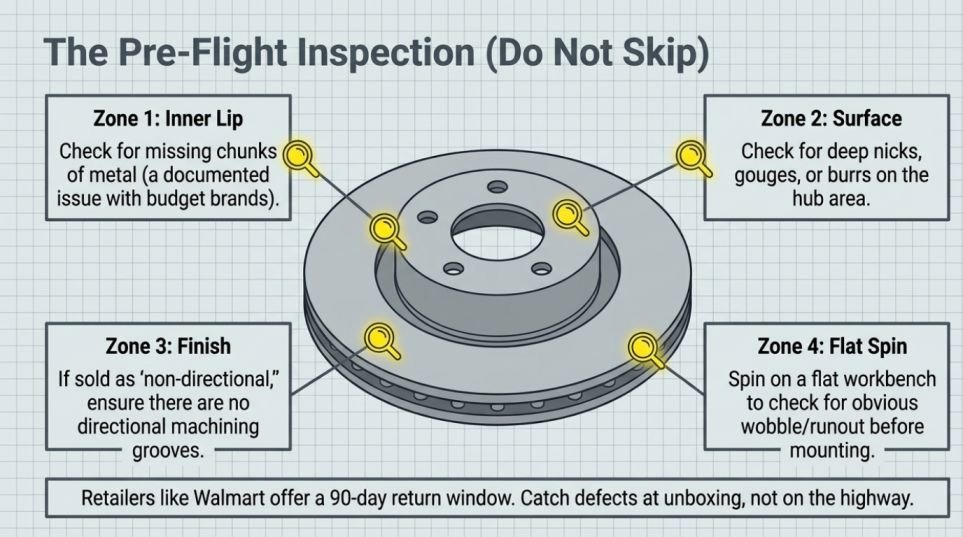
Check the rotor face for nicks, gouges, or a section of metal missing from the inner lip. A cautionary account from a different budget rotor brand (Centric, purchased cheap through Amazon) described exactly this: a chunk of metal missing from the inside lip on the first rotor, and a replacement that arrived even worse, with a quarter-inch directional groove running around a rotor that was supposed to have a non-directional finish, plus a partial ring of loose metal on the inside edge. That’s not a Callahan-specific story, but it’s a useful template for what to look for on any budget rotor, Callahan included.
Run your fingers around the full circumference of both the face and the inner hub area, feeling for anything that shouldn’t be there: burrs, loose material, or an uneven surface. Spin the rotor on a flat surface if possible and check for obvious wobble before it’s even mounted. If the packaging lists a non-directional finish and you can see or feel a directional groove pattern instead, that’s a manufacturing defect worth returning, not something to bed in and hope it disappears.
How to make Callahan brakes last
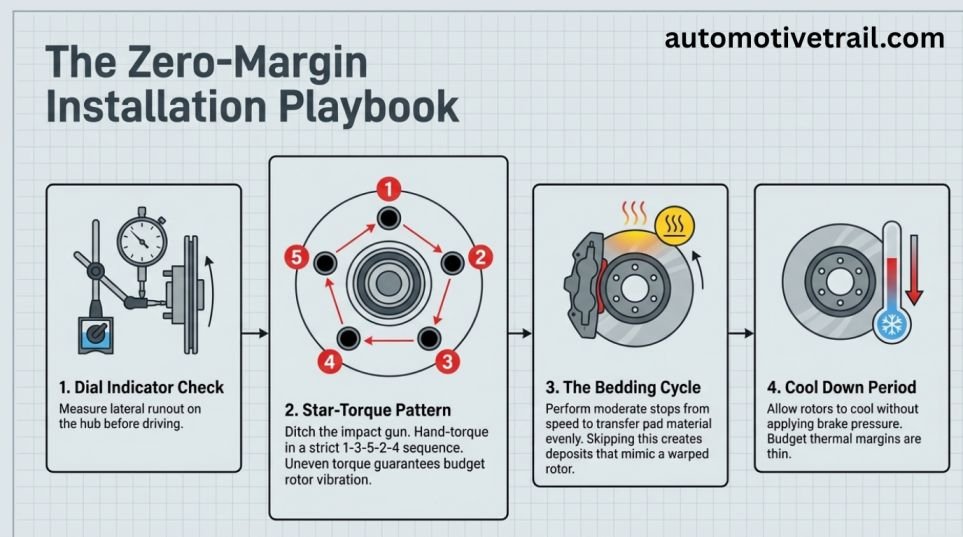
If you’ve already got a set installed and want to minimize your odds of joining the vibration-complaint crowd, these steps address the most common failure points directly.
- Torque the wheels in the correct star pattern to spec. Uneven torque is one of the most common causes of brake vibration that has nothing to do with rotor quality, and it’s an easy thing to get wrong with an impact gun instead of a torque wrench.
- Bed the pads and rotors together properly before normal driving. Do a full bedding cycle of moderate stops from speed followed by a cool-down period with no braking. Skipping this step is a common cause of uneven pad deposits, which cause vibration that mimics a warped or imbalanced rotor.
- Avoid repeated hard stops from high speed in the first few hundred miles. Budget rotors have less thermal margin than premium ones. Aggressive heat cycling early on is more likely to expose any casting or tolerance weakness.
- Check rotor runout with a dial indicator if you have access to one. This catches an out-of-true rotor before it’s driven on, rather than after the shake shows up weeks later.
- Choose plain rotors over drilled and slotted if your driving is mostly commuting. Plain rotors carry less structural risk under repeated stress and cost less in most Callahan listings, so there’s little reason to pay more for a feature (drilled cooling vents) that a commuter mostly doesn’t need.
Warranty and return policy: what is actually covered
Callahan backs its parts with a 12-month or 12,000-mile warranty, whichever comes first. That’s shorter than what several premium brake brands offer, and it’s worth knowing that window before you buy, since some of the vibration complaints in owner threads showed up right around or after that mark.
Retailers selling Callahan kits, like Walmart, list a 90-day return window on top of Callahan’s own warranty terms. That gives you a reasonable buffer to catch an early manufacturing defect, like the imbalance or runout issues covered above, without being stuck with a bad rotor. If you’re buying from Amazon or eBay instead, check that specific listing’s return policy separately, since it may differ from Callahan’s direct terms.
Given the batch-dependent nature of the complaints, it’s worth inspecting your rotors within the first week of installation rather than waiting for the return window to lapse. A rotor that’s going to show imbalance usually does it early.
Is Callahan safe for daily driving
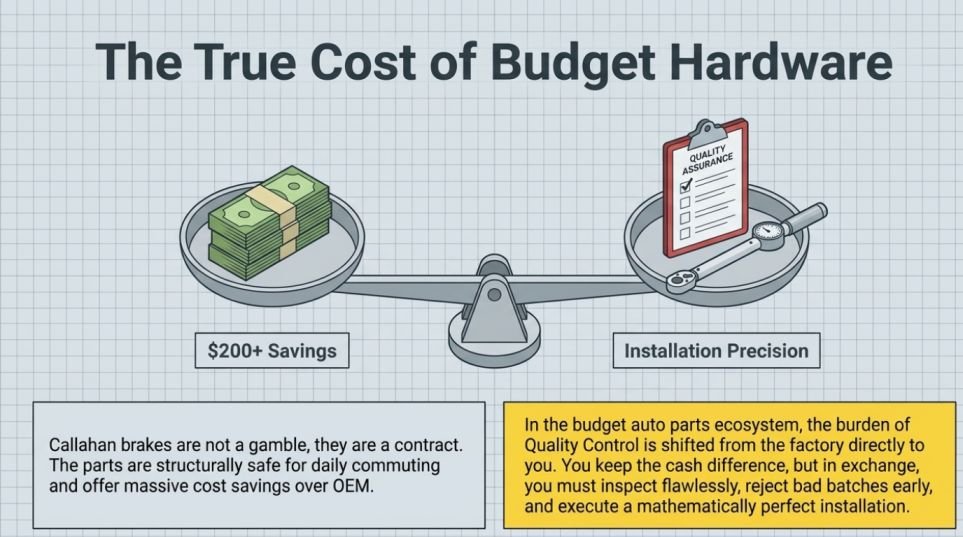
Yes, for most daily driving, with the same caveat that applies to any budget brake part: inspect it before you trust it, and don’t push it into conditions it wasn’t built for. The complaints in owner threads center on comfort and consistency issues, vibration, noise, repeat replacement, not sudden brake failure. Nobody in this research reported an outright stopping-power failure tied to Callahan parts specifically.
That said, “safe” and “ideal” aren’t the same thing. If you’re regularly hauling a heavy load, towing, driving mountain routes with long descents, or doing any kind of spirited or track driving, the tighter tolerances and better heat management of a premium rotor buy you a real safety margin that a budget part doesn’t guarantee. For a commuter car doing normal city and highway driving, a properly inspected and correctly installed Callahan kit is a reasonable, safe choice.
The honest risk isn’t the brand’s engineering; it’s manufacturing consistency. That’s a real risk, but it’s a manageable one if you inspect the parts at unboxing and don’t skip the bedding process.
Which Callahan kit fits your use case, or when to skip it
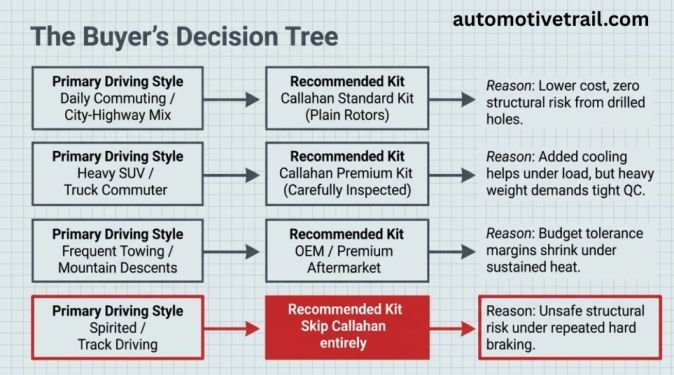
Match the kit to how you actually drive and what margin for error you’re comfortable with.
| Driving style | Recommended approach | Why |
|---|---|---|
| Daily commuting, city/highway mix | Standard Callahan pad and rotor kit (plain rotors) | Lower cost, adequate performance, less structural risk than drilled rotors |
| Heavier SUV or truck | Callahan premium drilled/slotted kit, inspected carefully at unboxing | Added cooling helps under load, but check tolerance closely given the weight demand |
| Frequent towing or mountain driving | Consider OEM or a premium aftermarket brand instead | Budget tolerance margin shrinks fastest under sustained heat |
| Spirited or track driving | Skip Callahan, go premium | Drilled rotor structural risk and looser tolerances aren’t worth it under repeated hard braking |
| Tight budget, low annual mileage | Callahan full kit is a reasonable fit | Lower stakes if a batch issue shows up, and the price gap versus OEM is largest here |
If you’re unsure which bucket you’re in, the deciding question is how often you’re doing hard, repeated braking, like mountain descents or track days, rather than routine stop-and-go traffic. Budget parts handle the second scenario fine. The first is where tolerance and heat management differences actually show up.
Callahan brake kit prices: what to expect
Pricing scales with what’s included. Pad-and-rotor-only kits without calipers run in the $87 to $150 range depending on the vehicle, based on current Walmart listings for models like the Mazda CX-5, Subaru Legacy, and Nissan Rogue. Larger or performance-oriented vehicles, like a Buick Regal front kit, push closer to $210.
Full kits that include calipers alongside pads and rotors run significantly higher, generally $365 to $400+, reflecting the added parts and labor those kits save you from sourcing separately. A Ford Mustang rear kit with calipers included, for example, is listed at $394 to $400 depending on model year.
Compared to OEM, Callahan consistently comes in well below dealer pricing for the same vehicle, which is the entire draw for budget-focused buyers. Compared to Power Stop specifically, given the shared rotor hardware documented in owner reports, Callahan often undercuts it on price for what may be functionally the same rotor with a different pad compound.
Is Callahan worth it? The real recap
Callahan brake rotors and pads are worth it if you’re a budget-conscious daily driver willing to inspect your parts before trusting them and skip the drilled/slotted upsell unless you actually need the extra cooling. The parts are made in China, sold through a US-based company, and in at least one documented case share identical rotor hardware with the pricier Power Stop brand, just paired with a cheaper pad.
The complaints that show up repeatedly, rotor imbalance and returning vibration, trace back to looser manufacturing tolerances rather than a fundamentally unsafe product. That means the outcome depends heavily on the specific unit you receive and how carefully you install and bed it in. Owners who inspect their rotors at unboxing, torque wheels correctly, and bed the parts properly report smooth, quiet performance that rivals what they had running OEM. Owners who skip those steps, or who get an unlucky batch, end up back in the shop within months.
For heavy towing, mountain driving, or track use, spend the extra money on a premium brand with tighter tolerances and better documented heat management. For a normal commuter car on a tight budget, Callahan is a reasonable bet, as long as you go in with realistic expectations about batch variance rather than assuming every unit will be flawless.
FAQ
Are Callahan brake rotors made in the USA?
No. Callahan’s own response to an Amazon customer question confirms the parts aren’t manufactured in the USA, even though the company selling them is based there. eBay listings list China as the country of origin for Callahan rotors.
Is Callahan the same company as Power Stop?
Not officially, but they appear to share manufacturing. One owner found identical rotor part numbers, UPC codes, and China origin stamps between a Power Stop kit and a cheaper Callahan kit, with the brake pads being the main difference between the two.
Do Callahan brake rotors warp easily?
Reported issues center more on rotor imbalance and runout, which cause vibration that can feel like warping, rather than confirmed warping itself. Budget-tier manufacturing tolerances make this more common than with OEM or premium rotors.
How long do Callahan brakes last?
Callahan backs its parts with a 12-month or 12,000-mile warranty. Real-world reports vary widely, from owners getting years of smooth performance to others facing repeat vibration within a few months, largely tied to individual batch quality and install care.
Are Callahan brakes safe?
For normal daily driving, yes, based on available owner reports, none of which describe outright stopping failures. The main risks are comfort and consistency issues like vibration and noise, not sudden brake loss, though heavier use cases like towing carry more risk with any budget part.
Should I buy drilled and slotted or plain Callahan rotors?
Plain rotors are the safer structural choice for most daily commuters and cost less. Drilled and slotted rotors add cooling benefits for heavier vehicles or harder driving but carry more risk if they were drilled into a blank rather than cast with the holes built in.
- 2 Hole Vs 4 Hole Injectors 5.3 Vortec: Swap Rules + Fitment Check - September 12, 2026
- What Oil Does 2012 Honda Civic Use: What Oil Does Honda Civic Use & Spec - September 12, 2026
- 2014 Ram 2500 5.7 Hemi Sparkplugs: Ram 5.7 Hemi Sparkplugs: Oe Vs Fitment, Swap Steps - September 12, 2026