
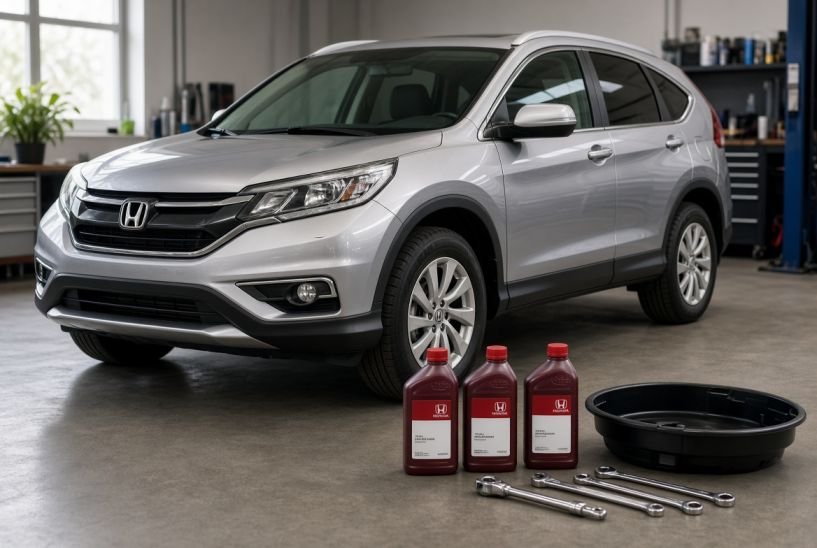
The 2016 Honda CR-V’s owner’s manual lists 3.9 quarts for 2WD and 4.5 quarts for AWD. Neither number is what the transmission actually holds, and that gap has confused owners for years.
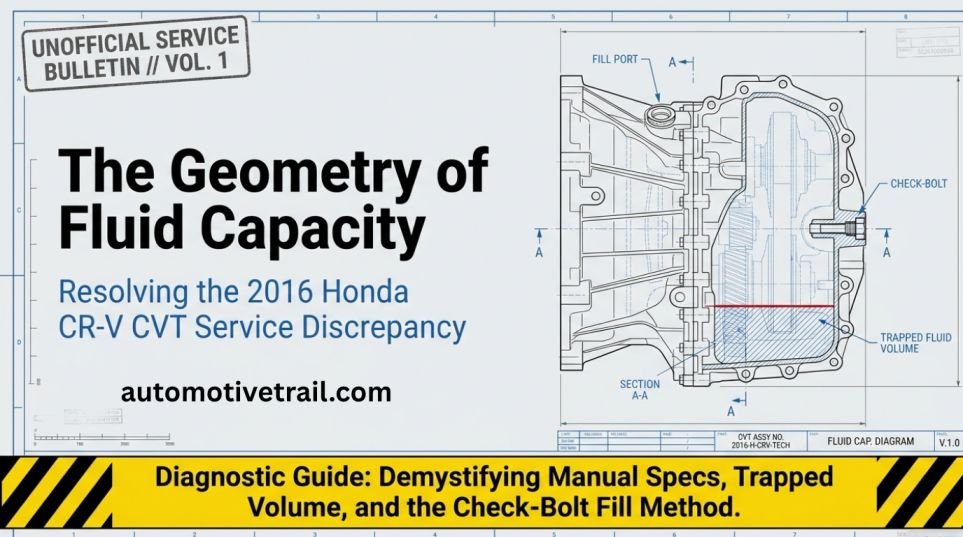
Quick answer: Total system capacity, per Honda’s own service bulletin, is 5.3 quarts (5.0 L) for 2WD and 6.0 quarts (5.7 L) for AWD. A routine drain-and-refill pulls out and puts back somewhere between 2.5 and 5 quarts, depending on how completely the old fluid drains. The fluid is Honda HCF-2 (part 08200-HCF2), and the real fill spec isn’t a quart count at all — it’s a check bolt that tells you when the level is correct.
Key takeaways
- Manual spec (3.9 qt 2WD / 4.5 qt AWD) is a reference number, not the transmission’s actual capacity.
- Total dry-fill capacity is 5.3 qt (2WD) or 6.0 qt (AWD) per Honda’s July 2016 Service News bulletin.
- Real-world drain-and-fill amounts range from 2.5 to 5 quarts depending on the car.
- Use Honda HCF-2 only. Regular ATF will cause slipping and can wreck the belt-and-pulley system.
- The check bolt overflow method, not a fixed quart count, determines when the fill is correct.
- Buy 4 to 5 quarts for a routine service and return what you don’t use.
2016 Honda CR-V CVT transmission fluid capacity: quick answer
Here’s the number breakdown, straight, before the explanation of why they differ.
| Drivetrain | Manual Fill (qt) | Dry Fill (qt) | Drain & Refill (qt) | Required Fluid | Level Check | Service Interval |
|---|---|---|---|---|---|---|
| 2WD (FWD) | 3.9 | 5.3 | 2.5–4.0 | Honda Genuine HCF-2 08200-HCF2 |
Overflow bolt; fill until fluid trickles out on level ground with warm engine | Maintenance Minder 3 Typically 20,000–30,000 mi |
| AWD | 4.5 | 6.0 | 4.5–5.0 | Honda Genuine HCF-2 08200-HCF2 |
Overflow bolt; fill until fluid trickles out on level ground with warm engine | Maintenance Minder 3 Typically 20,000–30,000 mi |
If you’re doing a standard drain-and-fill on a CR-V that’s never had the transmission apart, plan around the middle row’s neighbor, the drain-and-refill range, not the total capacity. The total capacity number only matters if you’ve got a bone-dry case, like a reman transmission fresh off the shelf.
Why the owner’s manual number doesn’t match what drains out
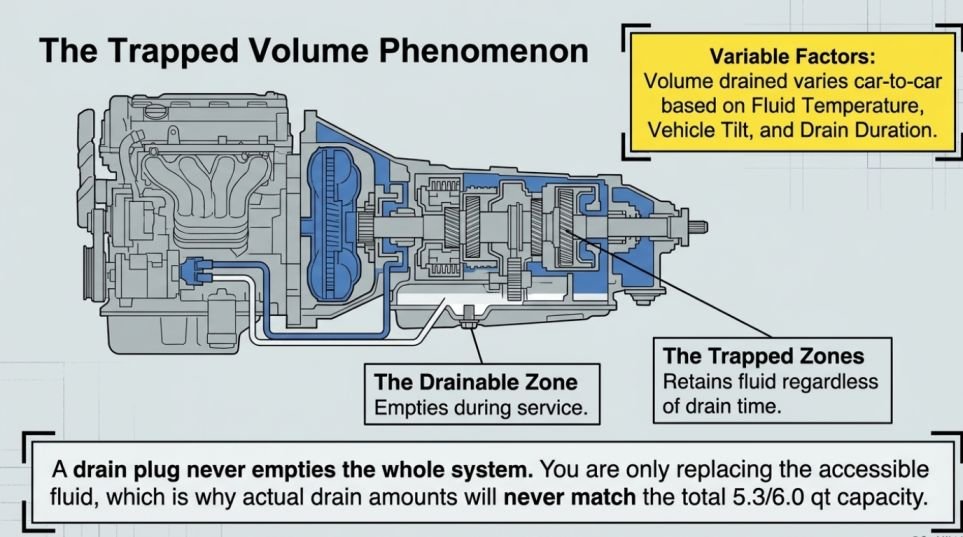
Owners have been posting about this discrepancy on forums since the car was new. One 2016 CR-V owner drained his AWD EX-L at 67,000 miles and measured exactly 5 quarts coming out, well over the 4.5-quart manual spec. Another with a 2WD SE only got 2.5 quarts before fluid started overflowing from the check bolt hole, despite the manual saying 3.9.
Both readings are normal. A drain plug never empties the whole system. Fluid stays trapped in the cooler lines, the torque converter equivalent, and pockets in the case no matter how long you let it drip. So the amount that comes out, and the amount you put back in, is always going to be less than the transmission’s true capacity, and it’ll vary car to car based on temperature, how level the car sat, and how long you let it drain.
The manual figure is Honda’s rounded reference for a typical service fill. It was never meant to be an exact target you hit to the ounce.
Manual spec vs. total capacity vs. drain-and-fill amount
The source that settles this is Honda’s own July 2016 Service News bulletin, aimed at techs installing replacement CVTs. It exists because dealers were under-filling reman transmissions and causing comebacks.
“Since the service information doesn’t include fill amounts for a replacement CVT, refer to this chart for those amounts: CR-V (2WD) 5.0 L / 5.3 qt. CR-V (4WD) 5.7 L / 6.0 qt.” — American Honda Service News, July 2016
That bulletin is the clearest official number for what the case actually holds from start to finish. It’s higher than the manual’s 3.9/4.5 quart figures because it covers a completely empty transmission, not a drain-and-refill on a car that already has fluid sitting in the lines and cooler.
What CVT fluid the 2016 CR-V takes
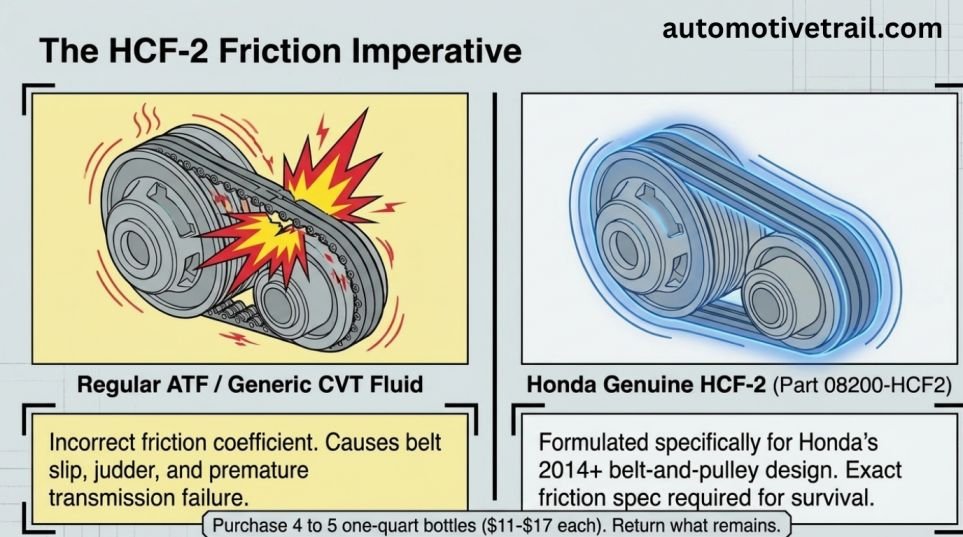
Use Honda Genuine HCF-2, part number 08200-HCF2. It comes in 1-quart bottles and runs about $11 to $17 each depending on where you buy it. This is a second-generation CVT fluid, formulated for the belt-and-pulley design Honda started using in 2014-and-up CVTs, including the CR-V’s.
Don’t reach for a generic “universal CVT fluid” unless the bottle specifically states it meets Honda’s HCF-2 spec. A CVT depends on the fluid’s exact friction coefficient to keep the steel belt from slipping against the pulleys. Regular automatic transmission fluid, or a CVT fluid built for a different manufacturer’s design, doesn’t hit that spec. The result is belt slip, shudder, and in bad cases, a transmission that needs to be replaced years early.
How to check the fluid level correctly
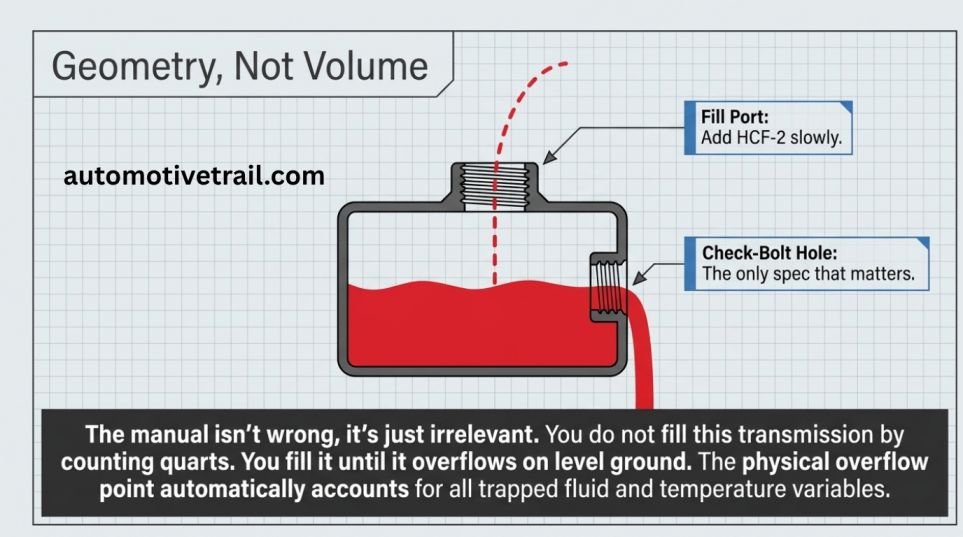
There’s no dipstick on this transmission. The correct level is set with a check bolt (also called an overflow bolt) on the side of the case, and it’s the only real spec that matters.
Here’s how it works: you fill the transmission until fluid just starts to trickle out of the check bolt hole, then you stop. That’s full. It doesn’t matter if that took 2.5 quarts or 5. The overflow point accounts for everything the manual’s quart figure can’t, like leftover fluid still sitting in the system from before you started.
This is also why forum threads about “the manual is wrong” mostly aren’t about a wrong manual. They’re about owners expecting a fixed quart count to match a level that’s actually set by geometry, not volume.
Step-by-step: draining and refilling the CVT
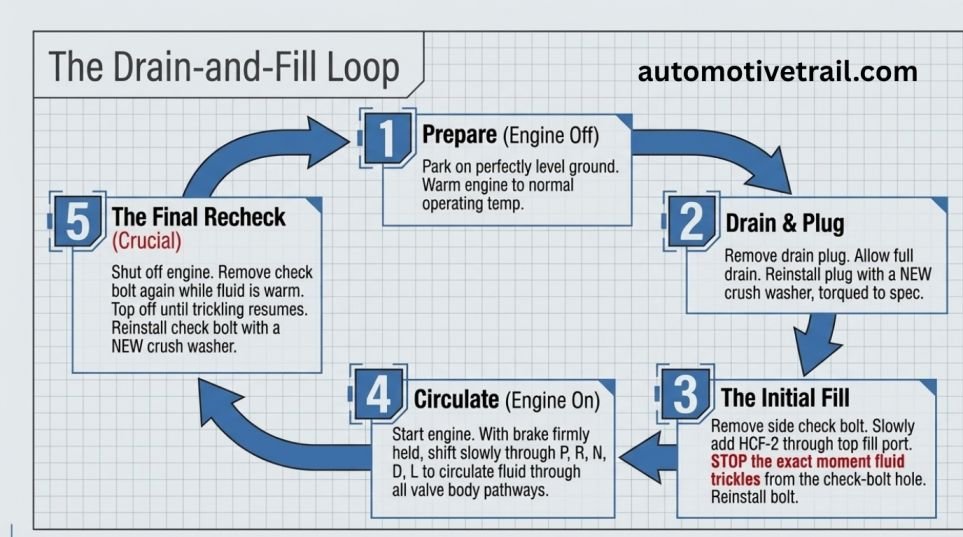
- Warm the engine to normal operating temperature, then park on level ground. A tilted car throws off the check bolt reading.
- With the engine off, remove the drain plug and let the old fluid fully drain into a pan. Have a new crush washer ready; don’t reuse the old one.
- Reinstall the drain plug with the new washer, torqued to spec.
- Remove the check bolt from the side of the case.
- Add Honda HCF-2 slowly through the fill port, checking as you go.
- Stop the moment fluid starts to trickle from the check bolt hole. That’s your level.
- Reinstall the check bolt with a new crush washer.
- Start the engine, shift through P, R, N, D, and L with the brake held to circulate the fluid, then shut off and recheck the check bolt once warm. Top off if it’s not trickling out.
2WD vs. AWD: what’s different
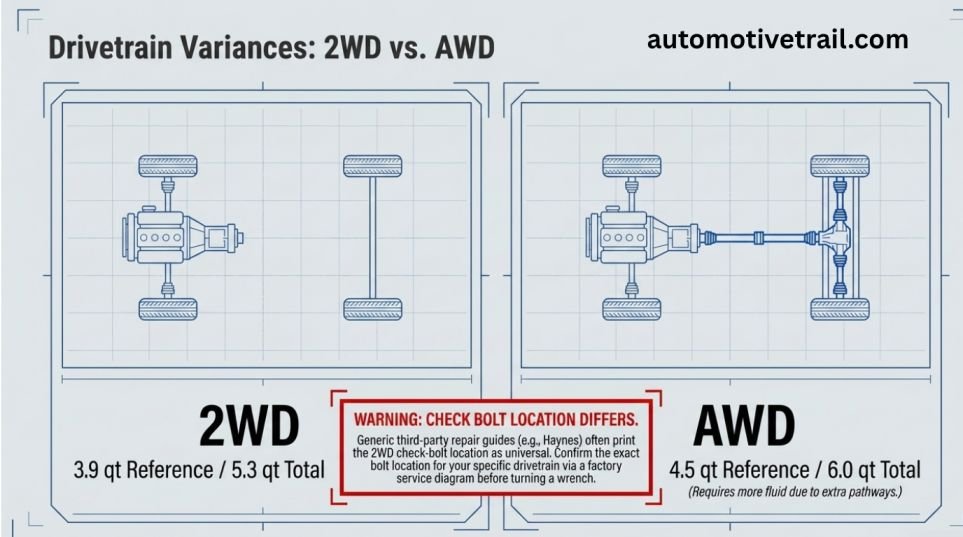
The AWD CR-V takes more fluid across the board: 4.5 quarts manual reference versus 3.9 for 2WD, and 6.0 quarts total capacity versus 5.3. That’s because the AWD system adds a rear differential and extra fluid pathways the front-drive car doesn’t have.
The check bolt is also in a different physical spot depending on drivetrain. Owners working from a generic Haynes manual have gotten tripped up here, since some print the 2WD bolt location as if it applies to both. Confirm the location for your specific drivetrain before you start, either from a factory service manual or a parts diagram for your exact trim.
How often to change it
Honda ties CVT fluid service to the Maintenance Minder system, which flags it with sub-code 3 rather than a fixed mileage number. In practice, most CR-V owners and independent shops land somewhere around 20,000 to 30,000 miles for a drain-and-fill, often doing two back-to-back fills at that interval instead of one full flush, since a single drain never exchanges all the old fluid anyway.
Watch for judder or a rough vibration when you first pull away from a stop. That’s a common early sign the fluid has broken down, and it can show up before the Maintenance Minder says anything. A CVT is less forgiving of old fluid than a conventional automatic, so plenty of owners change it more often than the dash tells them to, especially once the car passes 100,000 miles.
Cost to DIY vs. dealer
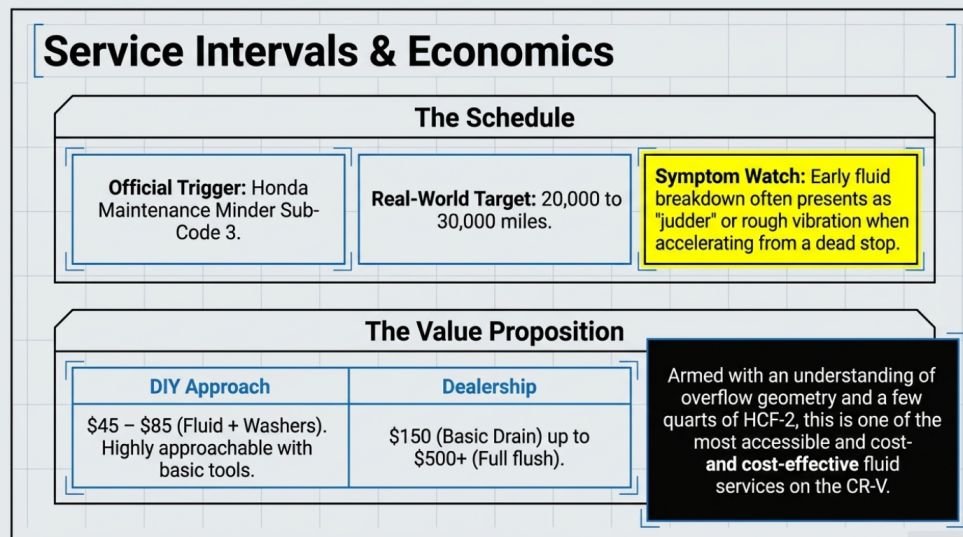
Doing it yourself: 4 to 5 quarts of HCF-2 at roughly $11 to $17 a bottle puts total fluid cost around $45 to $85, plus a couple of dollars for crush washers. Dealers have quoted CR-V owners anywhere from $150 for a basic fluid exchange up to $500-plus for a full flush service, depending on the shop and region.
The fluid itself isn’t cheap compared to regular ATF, which is part of why dealer labor markups sting more here. If you’re comfortable under the car with a drain pan and a torque wrench, the check-bolt method makes this one of the more approachable fluid services on the car.
Common mistakes that cause overfill or underfill
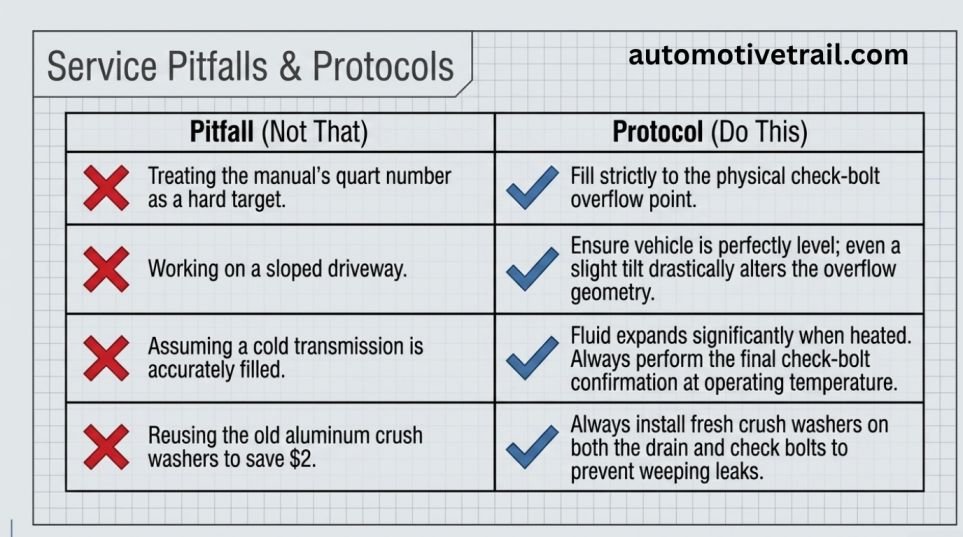
- Trusting the manual’s quart number as an exact target. It’s a reference, not a hard stop. Fill to the check bolt instead.
- Filling on an incline. Even a slight slope throws off where fluid starts to overflow from the check bolt hole.
- Reusing old crush washers. They’re cheap. A weeping drain plug or check bolt isn’t worth saving two dollars.
- Mixing up 2WD and AWD check bolt locations when working from a generic repair manual instead of one specific to the drivetrain.
- Assuming the transmission is “topped off” right after a cold start. Fluid expands when warm; always do the final check bolt confirmation with the engine at operating temperature.
- Using leftover ATF from another car’s service instead of buying dedicated HCF-2.
Summary: how much fluid to actually buy and how to know it’s full
For a routine drain-and-fill, buy 4 to 5 quarts of Honda HCF-2. That covers the real-world range owners report (2.5 to 5 quarts) with room to spare, and unused sealed bottles are usually returnable. Don’t fixate on matching the owner’s manual’s 3.9 or 4.5 quart figure exactly. That number is a rough reference for a typical service, not the car’s real capacity.
The number that actually matters is zero: the point where fluid starts trickling out of the check bolt hole. Hit that on level ground with the engine warm, and the transmission is correctly filled regardless of how many quarts it took. Save the 5.3 qt (2WD) or 6.0 qt (AWD) total capacity figure for the one scenario where it applies: filling a completely dry case, like a replacement transmission.
FAQ
How many quarts of CVT fluid does a 2016 Honda CR-V take? For a routine drain-and-fill, expect 2.5 to 5 quarts depending on drivetrain and how much old fluid drains out. The owner’s manual lists 3.9 quarts for 2WD and 4.5 for AWD as reference figures, but the check bolt, not a quart count, sets the actual level.
Can I use regular ATF instead of Honda HCF-2 in the CR-V’s CVT? No. Regular ATF doesn’t match the friction coefficient a CVT belt-and-pulley system needs, and it can cause slipping and early transmission wear. Use Honda HCF-2 (part 08200-HCF2) only.
Is the CR-V’s CVT capacity 3.9 quarts or 4.5 quarts? Both, depending on the drivetrain. 3.9 quarts is the 2WD manual reference, and 4.5 is the AWD reference. Neither is the transmission’s total capacity, which is higher: 5.3 quarts for 2WD and 6.0 for AWD per Honda’s own service bulletin.
How do I know when the CVT is full if there’s no dipstick? Use the check bolt on the side of the transmission case. Fill slowly until fluid starts trickling out of that hole with the car level and the engine warm. That’s the correct level, regardless of the quart count.
How often should I change the CVT fluid on a 2016 CR-V? Most owners and independent shops target 20,000 to 30,000 miles per drain-and-fill, though Honda’s Maintenance Minder (sub-code 3) sets the official trigger. Judder on takeoff from a stop is a common early sign it’s overdue.
Why did my drain only produce 2.5 quarts when the manual says 3.9? A drain plug never empties the whole system; fluid stays trapped in the cooler lines and case. That’s normal and doesn’t mean the manual is wrong or that your transmission is low. Confirm the level with the check bolt rather than comparing the drained amount to the manual figure.

- 2 Hole Vs 4 Hole Injectors 5.3 Vortec: Swap Rules + Fitment Check - September 12, 2026
- What Oil Does 2012 Honda Civic Use: What Oil Does Honda Civic Use & Spec - September 12, 2026
- 2014 Ram 2500 5.7 Hemi Sparkplugs: Ram 5.7 Hemi Sparkplugs: Oe Vs Fitment, Swap Steps - September 12, 2026