
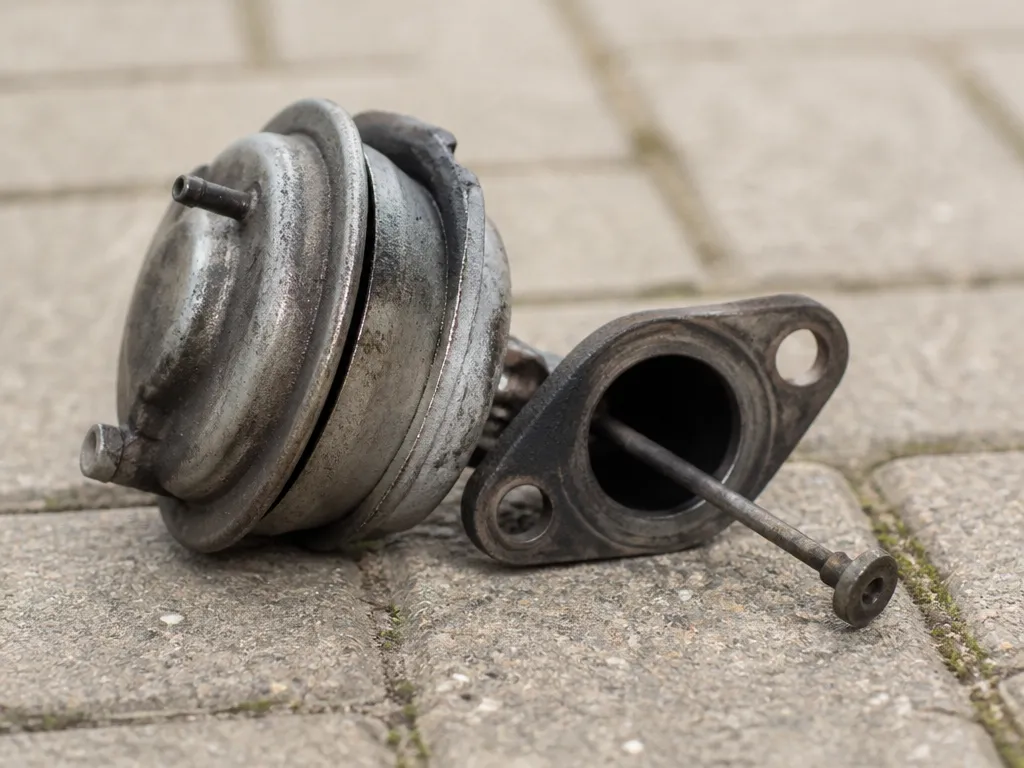
If your Renault Laguna 3 feels slow, jerks under boost, or drops into limp mode, the turbo’s boost control is a prime suspect. But the part you need to check depends on your engine: petrol turbo Lagunas use a true wastegate, while most diesel Lagunas (dCi) use a variable-geometry turbo (VGT) with a vane actuator instead. The symptoms look alike, and the diagnosis is similar, but the parts are different.
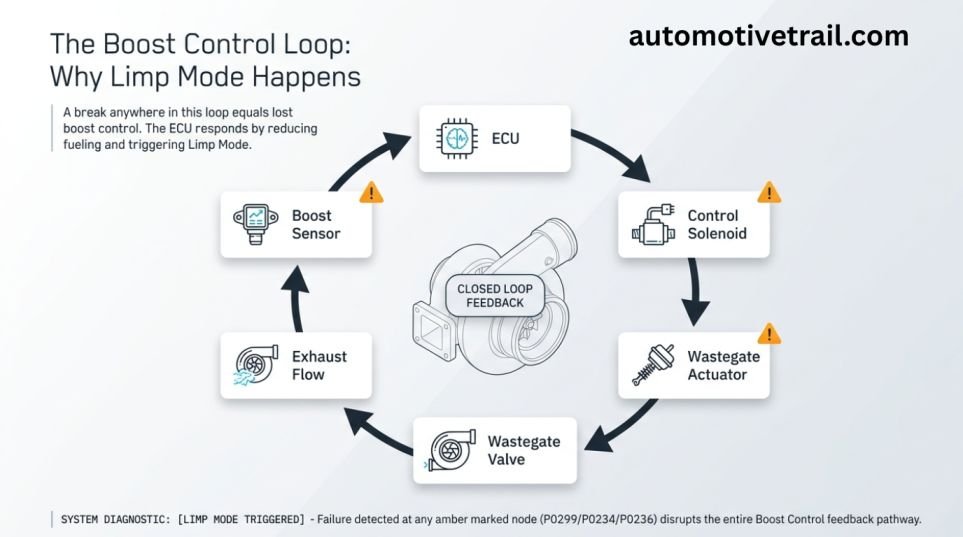
Fastest route: scan for fault codes, compare requested vs. actual boost on live data, check for boost and vacuum leaks, then test whether the actuator moves freely. Most cases end with a hose, a control solenoid, a sticking actuator, or carbon build-up. A turbo replacement is the last step, not the first.
Faulty Wastegate on a Laguna 3: Which Engine Do You Have?
| Engine | Boost control part | What usually fails |
|---|---|---|
| 2.0 petrol turbo | Wastegate with pneumatic actuator, controlled by a solenoid | Actuator diaphragm or rod, control solenoid, split boost hoses |
| 1.5 dCi, 1.9 dCi, 2.0 dCi, 3.0 dCi diesel | Variable-geometry turbo (VGT) vanes moved by a vacuum or electric actuator | Carbon-stuck vanes, actuator or linkage, vacuum line or solenoid, position sensor |
Check your engine code and turbo part number before buying anything. Actuator type (vacuum or electric) varies by engine and model year, so confirm it against your VIN or a Renault parts lookup. The rest of this guide uses “wastegate/actuator” for both, and points out where the diesel differs.
Symptoms of a Faulty Wastegate or Boost Actuator
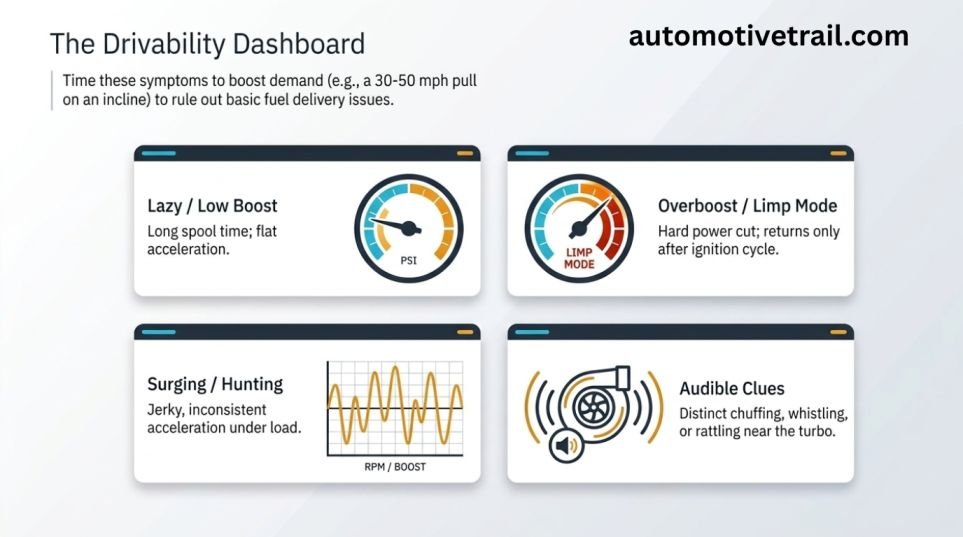
- Flat, lazy power when you ask for boost (wastegate or vanes stuck open).
- Overboost and sudden limp mode (stuck closed, or a control fault).
- Surging or hunting boost on steady throttle.
- Rattling or buzzing near the turbo (worn linkage).
- Black smoke on diesels when boost is lower than the ECU expects.
- Engine warning light with a boost-related code.
Test on a steady pull from 2,000 rpm in third or fourth gear. If the problem only appears when boost builds, suspect boost control or a leak, not the fuel system. Compare a cold start with a warm engine: sticking parts and carbon often behave worse when cold.
If the car keeps dropping into limp mode and you’re not sure why, our guide to Renault Laguna 3 limp mode causes covers the other common triggers beyond the turbo.
Fault Codes to Expect
Use a scanner that reads Renault-specific data (for example, a Renault CAN Clip or a good aftermarket Renault tool). A basic code reader may miss manufacturer codes and live data.
| Code (typical) | Meaning | Check first |
|---|---|---|
| P0299 | Turbo underboost | Boost leaks, stuck-open vanes or wastegate, solenoid |
| P0234 | Turbo overboost | Stuck-closed vanes or wastegate, vacuum supply, actuator |
| P0045 to P0048 | Boost control solenoid circuit or performance | Solenoid, wiring, connector, vacuum lines |
| P2563 | Turbo boost control position sensor (where fitted) | Electric actuator, sensor, calibration |
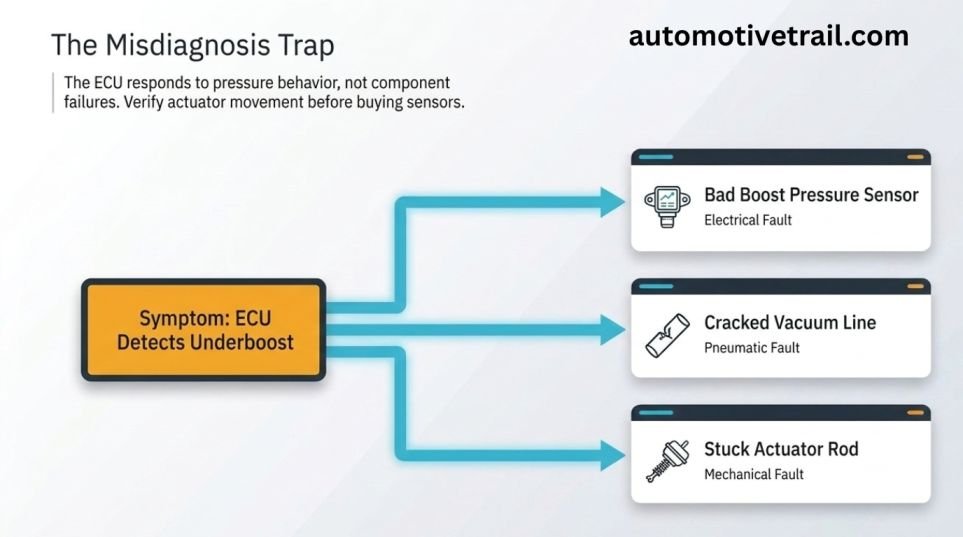
Code numbers and wording vary by engine and ECU. Treat them as pointers, then confirm with live data. A code like P0299 can be caused by leaks, a bad boost sensor, or air metering faults, not only the actuator.
Step-by-Step Diagnosis
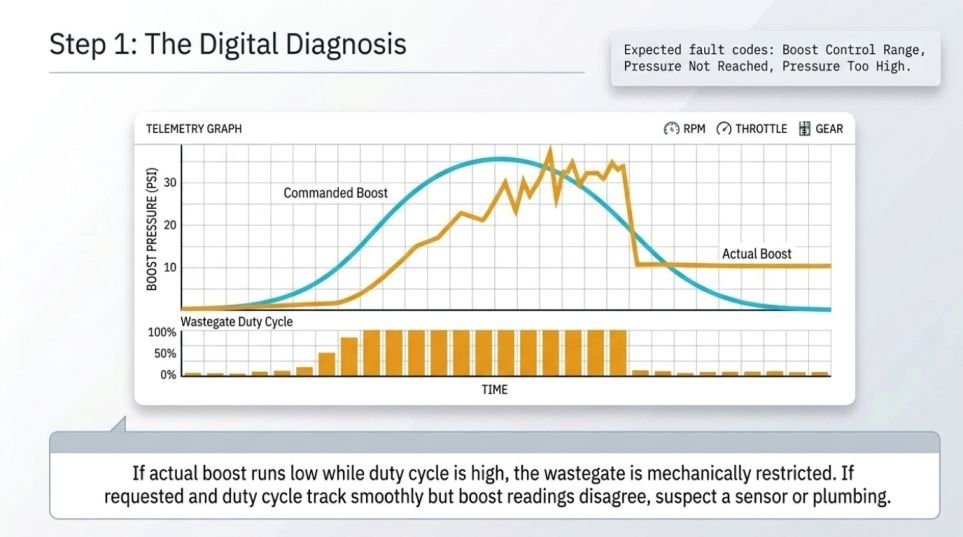
- Scan and save freeze-frame data. Note RPM, load, and boost when the fault sets.
- Visual check (5 to 10 minutes). Look at charge pipes, clamps, vacuum lines, and the intercooler for splits and oily soot trails.
- Read live data. Compare requested boost, actual boost, and actuator duty cycle or position on a steady pull.
- Test for leaks. Do a low-pressure smoke test of the intake and charge system.
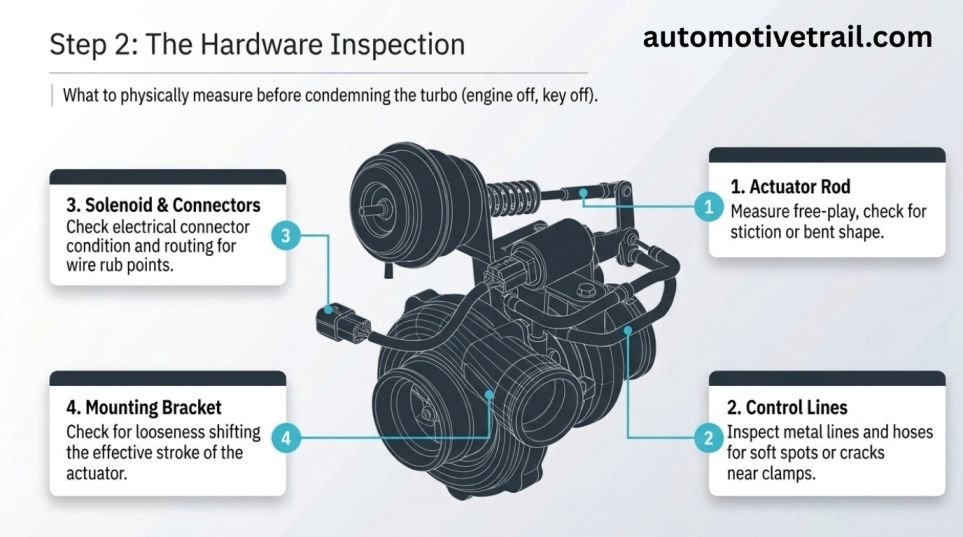
- Test actuator movement. Vacuum type: use a hand vacuum pump and watch for smooth travel that holds vacuum. Electric type: command it with the scan tool and watch for full, smooth movement.
- Inspect the linkage. With the engine off, move the rod by hand. It should move freely with no sticking or excessive play.
How to read what you see:
| Live data pattern | Likely cause |
|---|---|
| Actual boost low, command high | Actuator not moving, stuck vanes, or a boost leak |
| Actual boost above request, command says “open” | Wastegate or vanes stuck closed, or a bad vacuum supply |
| Command and actuator track smoothly, but sensors disagree | Boost or MAP sensor, or plumbing |
Write down the values and take a screenshot. It helps a shop confirm the diagnosis and prevents guessing.
Stuck Actuator vs Boost Leak
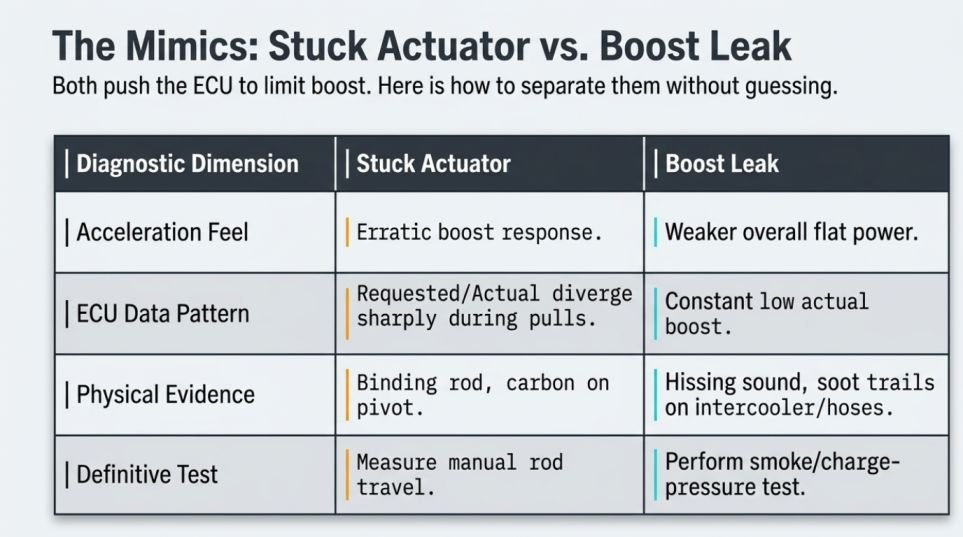
This is the most common misdiagnosis. A leak makes actual boost fall short, so the ECU keeps adjusting the actuator, and the car looks like it has a faulty wastegate.
- Leak: weaker acceleration overall, sometimes a hiss, oily residue around joints and intercooler ends.
- Stuck actuator or vanes: erratic boost, requested and actual boost diverge on a pull, limp mode after a hard push.
Smoke-test the charge system before replacing anything. Our guide on how to smoke test a turbo boost leak shows the method. Intercooler end tanks and hoses fail often on Renault diesels, as in our Renault Trafic leaking intercooler case, which shares similar dCi plumbing.
Common Causes and the Right Repair
| Cause | Repair | Rough cost (parts + labor)* |
|---|---|---|
| Split vacuum or boost hose, loose clamp | Replace hose or clamp | Low (about $20 to $120) |
| Boost control solenoid | Replace solenoid, check connector | About $80 to $250 |
| Carbon-stuck VGT vanes (diesel) | Clean or recondition the turbo, or replace it | Medium to high (about $250 to $1,000+) |
| Weak or leaking actuator diaphragm, worn rod | Replace actuator if serviceable, otherwise turbo | About $150 to $600 |
| Worn turbo (shaft play, oil in intake) | Replace turbo, fix the cause (oil feed, filter, leaks) | About $700 to $1,800+ |
*Estimates only. Prices vary widely by country, shop, and whether you use new, remanufactured, or used parts. Get a written quote.
Actuator-only jobs often take 1 to 3 hours. A turbo replacement can take 4 to 8 hours. Match parts to your turbo part number and linkage type, since generic “Laguna 3 actuator” listings can be wrong. For a fuller breakdown, see our Renault Laguna 3 turbo replacement cost guide.
Safety: keep hands, hair, and clothing clear of the fan and belts, and avoid the hot exhaust when checking actuator movement on a running engine.
After the Repair: Reset and Verify
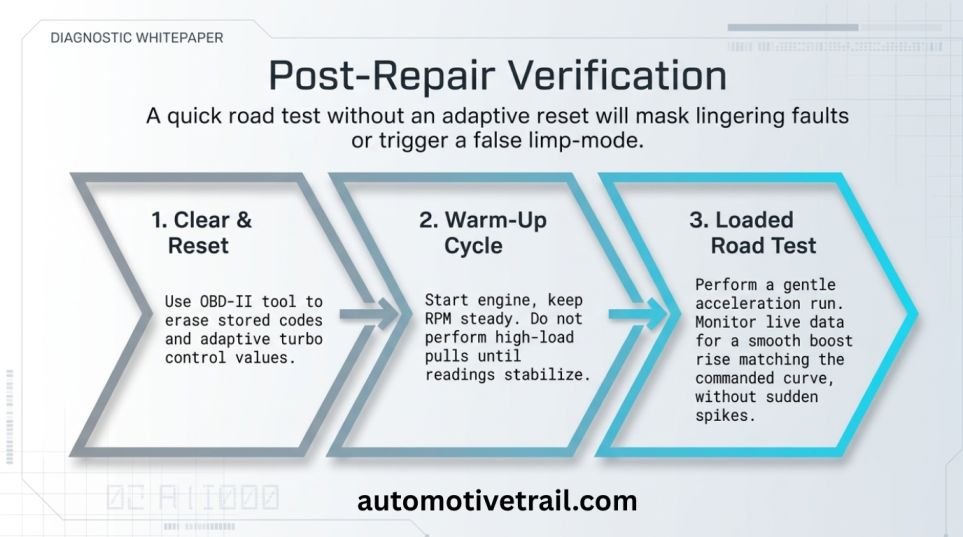
- Clear codes, then recheck for pending faults.
- If you fitted an electric actuator or turbo, run any calibration or learning procedure your scan tool offers.
- Watch live data on a gentle warm-up drive, then a steady loaded pull.
- Look for smooth, stable boost that tracks the request, not a spike and drop.
- Rescan after the drive. If the code returns quickly, the underlying cause is still there.
When to Stop Driving
Get the car checked soon if you see blue or white smoke, oil in the intake pipes, a loud siren-like whine, or repeated limp mode. These can point to turbo bearing damage rather than a simple actuator fault, and continuing to drive can cause expensive engine damage.
Quick Summary
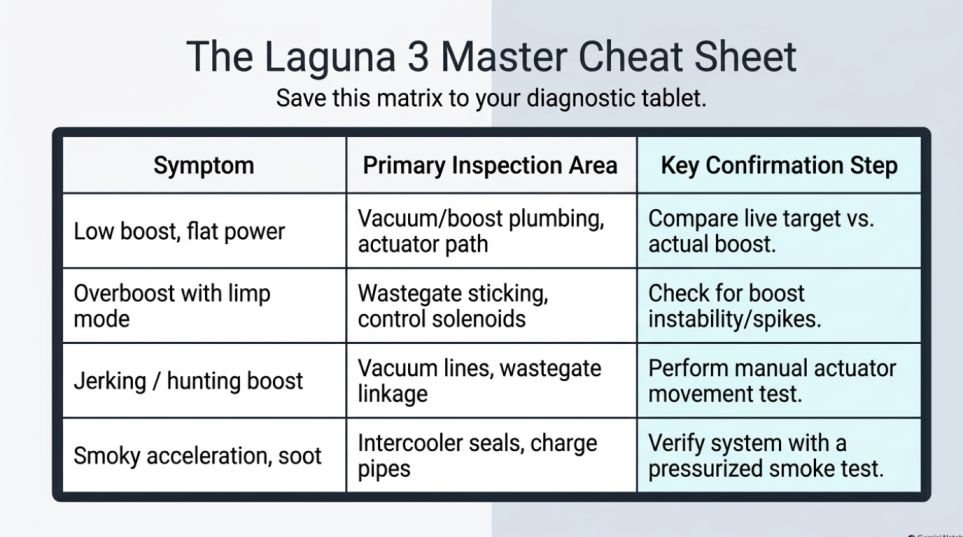
| Symptom | Inspect first | Confirm with |
|---|---|---|
| Low boost, flat power | Hoses, intercooler, actuator, solenoid | Smoke test, target vs actual boost |
| Overboost, limp mode | Stuck-closed wastegate or vanes, vacuum supply | Actuator movement test, codes |
| Jerking or hunting boost | Solenoid, vacuum lines, sticking linkage | Live duty cycle and boost trace |
| Whine, smoke, oil in intake | Turbo bearings and seals | Shaft play check, professional inspection |
Frequently Asked Questions
What are the symptoms of a faulty wastegate on a Laguna 3?
Sluggish acceleration, surging or unstable boost, overboost with limp mode, rattling near the turbo, and a boost-related fault code.
Does the diesel Laguna 3 even have a wastegate?
Most dCi diesels use a variable-geometry turbo with a vane actuator rather than a conventional wastegate. The petrol turbo uses a wastegate. The diagnosis steps are similar, but the parts differ.
Can a faulty wastegate cause limp mode?
Yes. If boost does not match the ECU target, the ECU limits power to protect the engine.
How much does it cost to fix?
Hoses and solenoids are usually the cheapest fixes. An actuator is mid-range. A new or reconditioned turbo is the most expensive. See the cost table above and get a written quote.
How do I test the actuator before replacing it?
Scan for codes, check hoses, then test movement with a hand vacuum pump (vacuum type) or a scan-tool command (electric type). It should move smoothly through full travel and hold vacuum.
Could a boost leak be mistaken for a bad wastegate?
Yes, very often. Smoke-test the charge system before replacing any turbo parts.

- “Does Higher Tire Pressure Improve Fuel Economy? Recommended PSI Explained” - November 25, 2026
- Best Tires for Minivans 2026: 10 Best Minivan Tires Reviewed - October 5, 2026
- Best Tires For Tesla Model Y Long Range (2026) - October 3, 2026