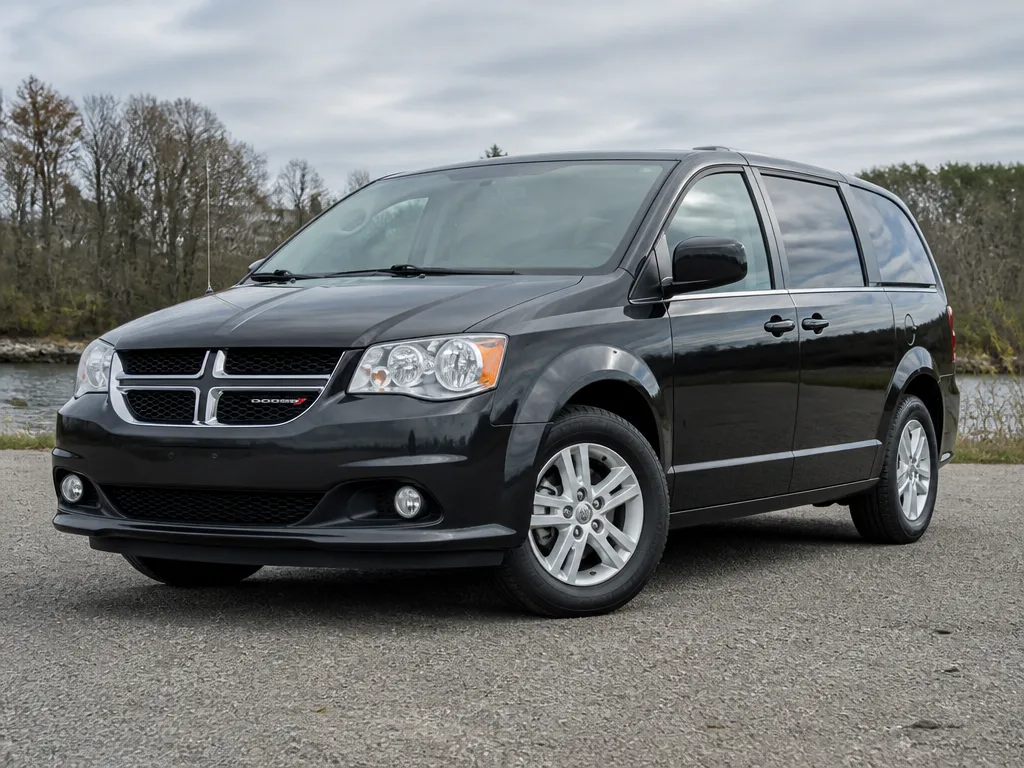
Your 2017 Dodge Grand Caravan is acting a little “off” (flare on shifts, delayed engagement, or a harsh 2-1 downshift), and you’re wondering how much transmission fluid it actually takes. The confusing part is that capacity depends on which gearbox and service method you’re doing: drain-and-refill versus a full line fill.
Typical 2017 Grand Caravan service involves filling to the correct level, not pouring in a fixed amount. Because fluid capacity varies by transmission configuration, this guide walks you through identifying your exact unit (VIN/transmission code), then gives the practical amount used for drain-and-refill versus a more complete service, and the proper temperature-based level check so you don’t overfill.
2017 Dodge Grand Caravan transmission fluid capacity depends on the transmission type and how the service is performed, so there is no single universal quarts number for every unit. Use the VIN or transmission code to confirm the gearbox, then set the fluid level using the dipstick or fill plug at the specified temperature. Drain-and-refill usually replaces less than the total system volume.
2017 Dodge Grand Caravan Transmission Fluid Capacity: Exact Figures By Configuration
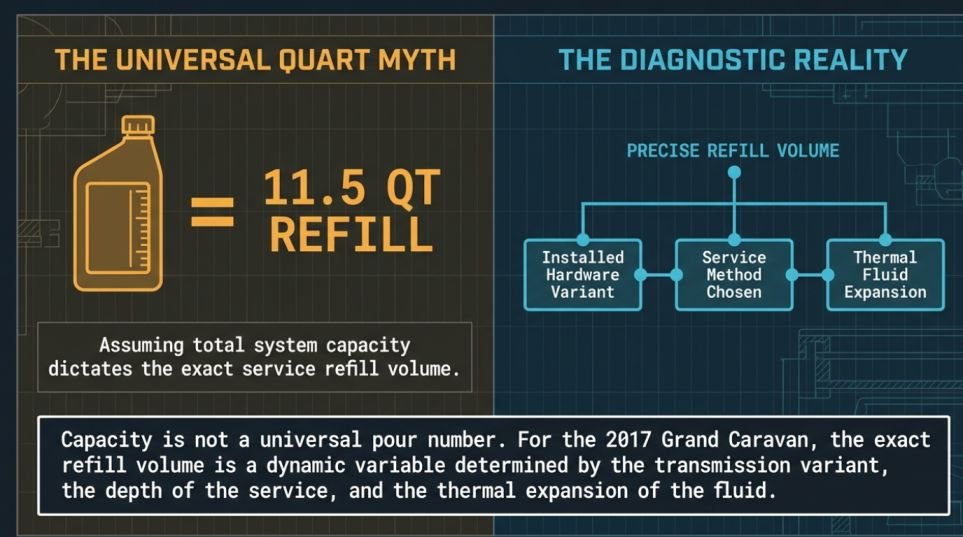
The 2017 Dodge Grand Caravan with the 62TE six-speed automatic takes about 11.0 to 11.5 quarts (about 10.4 to 11.0 L) of transmission fluid for a dry fill to the correct operating level. Service fill amounts can land below that range because a drain and refill replaces only the fluid you remove, while a converter fill and a pan-only change update different portions of the total capacity.
Capacity Numbers You Should Plan Around
Most owner confusion comes from mixing up three different “quantities”: total system capacity, pan drain volume, and refill volume. The total system number for the 62TE is the one you use when you are filling the whole system correctly after a complete drain, and it is the number that matters if you are estimating how much fluid you will buy for a full service.
Alternate capacities can apply if the van is equipped with a different transmission variant than the 62TE. Matching the capacity to the installed transmission is why the next step in this guide focuses on verifying the exact transmission type.
| 2017 Grand Caravan transmission configuration | Approx. total transmission fluid capacity | Practical note for service quantity |
|---|---|---|
| 62TE six-speed automatic | 11.0 to 11.5 qt (10.4 to 11.0 L) | Drain-and-refill usually uses less than total capacity because some fluid remains in the valve body and torque converter. |
Reality check: A “level check” should be done with the transmission at the specified temperature and with the correct procedure. A simple “add until it looks right” approach can overfill or underfill, which can cause harsh shifts or foaming.
For this guide’s numbers to stay accurate, confirm the van has the 62TE before you estimate fluid purchase quantities. The next section will help you verify the installed transmission using VIN and vehicle labels.
Confirm Transmission Type Via VIN and Labels
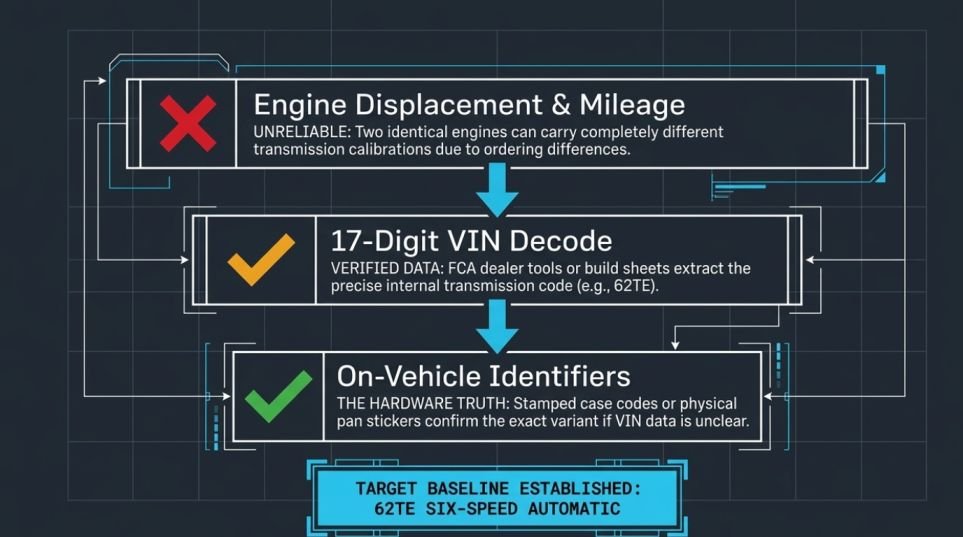
2017 Dodge Grand Caravan uses different powertrain codes that can pair with different transmissions, so fluid capacity checks only stay accurate when you confirm the transmission variant first. The key identifiers are the VIN, the transmission code in FCA dealer tools, and any stamped or sticker labels on the transmission case or pan.
Use the VIN to Pull The Transmission Code
Start with the full 17-digit VIN from the dash (driver side), the door-jamb label, or the registration. Have a Chrysler/Dodge dealer or an independent shop with FCA service access decode it and return the build data, then look specifically for the transmission description or internal transmission code.
In practice, the most common service confusion comes from mixing up a 62TE six-speed automatic with other internal variants that can appear similar in appearance. VIN decoding avoids guessing based on engine size or mileage because ordering differences can change the transmission pairing.
| What to confirm | Where to find it | Why it affects fluid capacity |
|---|---|---|
| Transmission type/code (example: 62TE) | VIN decode in dealer/service system, build sheet | Internal calibration and hardware differences can change drain/refill quantities |
| Case or pan labels | Sticker on case, stamping near pan, or pan identification | Confirms the hardware variant when VIN data is unclear |
| Build information | Factory build sheet (sometimes accessible through dealer records) | Locks in the exact configuration the vehicle left with |
Verify On-vehicle Identifiers (Pan Markings And Case Labels)
For a physical check, inspect the transmission pan area and case for markings. Common findings include a stamped code on the case, a label that lists the transmission model, or a pan identifier that ties to the same build. If the labels are missing or paint-corroded, take clear photos and compare them to what the dealer build data shows.
Shop tip: Don’t rely on engine displacement alone. Two Grand Caravans with the same engine can still carry different transmission calibrations or variants, and that drives the “drain vs. refill” mismatch people run into during service.
If VIN decoding and the case/pan labels disagree, treat the on-vehicle labels as the “hardware truth” and ask the dealer to re-check the decode against the exact vehicle. Once the transmission variant is confirmed, the correct capacity figures apply cleanly to the right service procedure.
Total Vs Service Quantities Explained
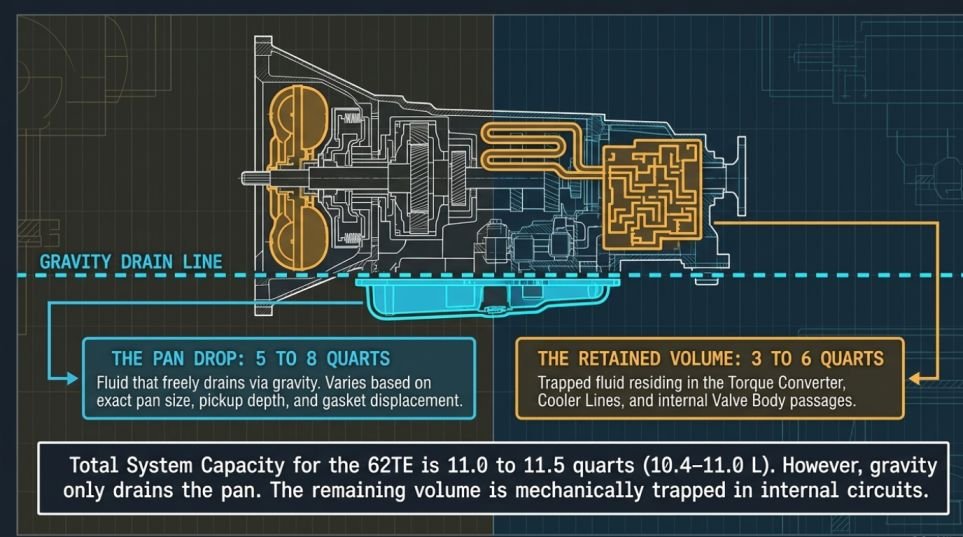
In a 2017 Dodge Grand Caravan with the 62TE six-speed automatic, the total transmission fluid fill is roughly in the 11.0 to 11.5 quart range (about 10.4 to 11.0 liters). What you add during service can be far less because a drain-and-fill only replaces the fluid that leaves the pan and lines.
Drain-and-fill (Pan Drop) Replacement Math
Drain-and-fill service typically replaces about 5 to 8 quarts, depending on how much fluid actually drains out once the pan is dropped and how clean the pan is. The remaining fluid stays inside the torque converter and internal passages, so the amount you pour in is usually less than the total system capacity.
In practice, the shop will usually add fluid, run through the selector positions, then confirm the level at the correct temperature. If the procedure is done correctly, you may still end up with only a partial exchange even though you poured a “near total” amount.
Full Exchange And Flush Quantities
A full transmission fluid exchange aims to replace nearly all of the old fluid by moving it out under controlled flow. For that kind of job, plan on about 11 quarts or more, because the machine needs additional fluid to purge what sits in the converter and cooler lines.
For example, if a drain-and-fill only gets you partway there, a full exchange is more like “batch replacement” where you add fluid while old fluid is pushed out. The goal is volume replacement, then final level verification to avoid overfilling.
| Service type | How much fluid is typically replaced | Why it differs from total capacity |
|---|---|---|
| Drain-and-fill (pan drop) | About 5 to 8 quarts | Converter and internal passages keep old fluid |
| Full exchange/flush (machine) | About 11 quarts or more | Extra volume is needed to purge cooler lines and converter |
Key takeaway: “How many quarts the transmission holds” is a system total. “How many quarts you add” depends on service method, amount drained, and whether a machine purges the converter and cooler circuit.
Fill Procedure And Level Check
For a 2017 Dodge Grand Caravan, the correct way to check fluid level is temperature-dependent because the transmission control needs stable operating heat for an accurate reading. Use the dipstick method if your van has one, or use the electronic level-check procedure from the factory service manual if it uses an internal fill/level sensor.
For example, if you add fluid based on a cold reading, the level can end up overfilled at full operating temperature, which can aerate fluid and cause shifting or noise issues. If you have to correct the level, add small amounts and recheck after the fluid has circulated.
Pro tip: If the van has been sitting cold, do not try to “average it out.” Bring it back to operating temperature, then check level the same way you did the first time so your reading is repeatable.
| What you observe | Likely meaning | What to do next |
|---|---|---|
| Fluid level is low and fluid color is normal | May be a slow leak or normal fluctuation after service | Top to the correct level using the proper temperature/check procedure |
| Fluid level is low with burnt smell or very dark fluid | Possible overheating or internal wear | Pause further filling and get a transmission inspection |
| Fluid looks foamy/aerated | Overfill, aeration from incorrect procedure, or a system issue | Verify temperature and re-check per manual; do not keep adding |
Why Capacity Can Vary In Practice
How much fluid you see on the dipstick or how many quarts you drain depends on what parts are above the fluid level and what the shop removes with the pan. On a 2017 Dodge Grand Caravan, a basic pan drain pulls only the fluid in the pan, while the converter, cooler lines, and valve body passages keep extra fluid trapped until you do a more aggressive exchange.
Pan Size, Filter Assembly, And Gasket Effects
Pan and filter design changes the “drainable” amount. A larger pan or a filter that sits deeper in the pan will let you remove more fluid in a drain-and-refill, while different pan shapes or pickup depths can leave more residual fluid below the pickup.
Gasket material also matters because it displaces fluid when it compresses during reinstallation, and it changes the final seal height slightly.
In practice, the difference usually shows up as a quart or two variation in what you refill during “pan service,” even when the transmission is the same overall design.
Torque Converter, Cooler Lines, And Internal Passages
Fluid retention beyond the pan is the biggest reason “capacity” and “service refill amount” do not match. The torque converter and the hydraulic circuits (valve body and internal passages) keep fluid up in internal chambers, and cooler lines hold a volume of fluid that does not drain back through the pan.
For example, a shop that drains the pan and refills to the correct level can still use only a portion of the system’s total fill, because most of the rest sits in the converter and lines. A shop that connects a machine and runs an exchange through the cooler circuit can move much more of that retained fluid out and replace it with fresh fluid.
| Service method | What gets removed first | Why it changes the refill amount |
|---|---|---|
| Pan drain and refill | Pan fluid plus some filter media fluid | Converter and cooler lines remain full or partially full |
| Machine-connected exchange | Pan fluid, cooler circuit fluid, part of converter fluid | Flow through cooler lines replaces more trapped fluid |
Insider mechanic tip: Two shops can report different “fluid used” numbers after “the same service.” The difference comes from how much fluid they exchange through the cooler circuit versus what they leave behind in the converter and internal passages.
Full Flush Style Exchanges Vs Simple Drains
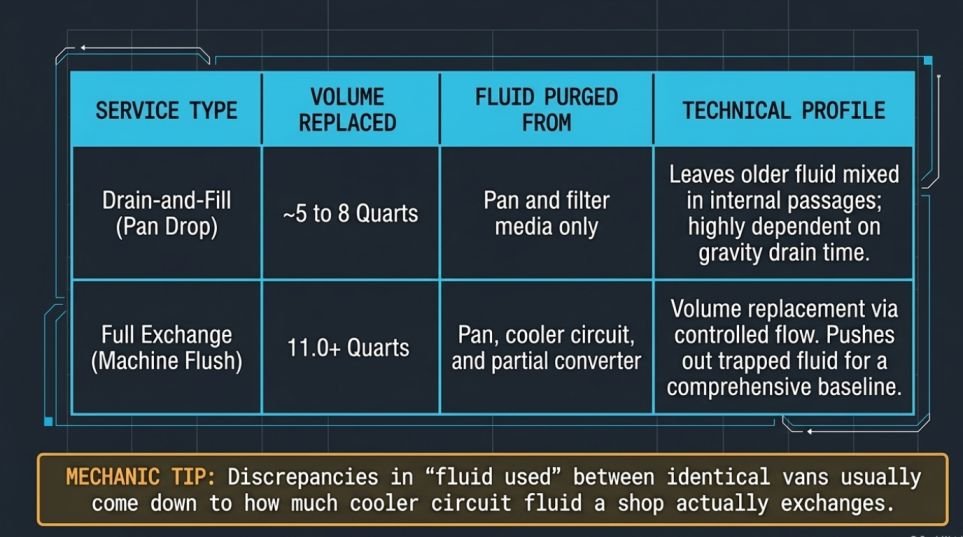
Some shops perform a true “full exchange” using a machine connected to the transmission cooler lines, with the engine speed and line flow controlled while fluid is pumped out and replaced. That approach replaces more fluid than a simple pan drain and usually reduces the old-to-new fluid ratio in the system.
Shops that do a partial exchange (or a drain only) typically stop earlier and refill based on the level procedure, which is the right approach for many maintenance schedules. The trade-off is straightforward: more exchange generally uses more fluid and time, while pan service is simpler and leaves more old fluid mixed in the converter and internal passages.
Fluid Type And Compatibility Notes
2017 Dodge Grand Caravan models with the 62TE 6-speed automatic transmission typically use ATF that meets Chrysler spec requirements that are often associated with Dexron VI. Because Chrysler also has footnotes by build date and valve-body calibration, the safest move is to match the exact ATF specification printed in your owner’s manual or on the under-hood fluid label.
Dexron VI is a common baseline for many Chrysler/62TE applications, but “Dexron VI” printed on a bottle is not a guarantee it matches your transmission’s required Chrysler performance spec. Mixing fluids from different specification families (for example, Dexron III, Mercon, or “universal” ATFs) can change friction characteristics and shift feel, especially when the fluid is warmed and working.
What To Look For Before You Pour
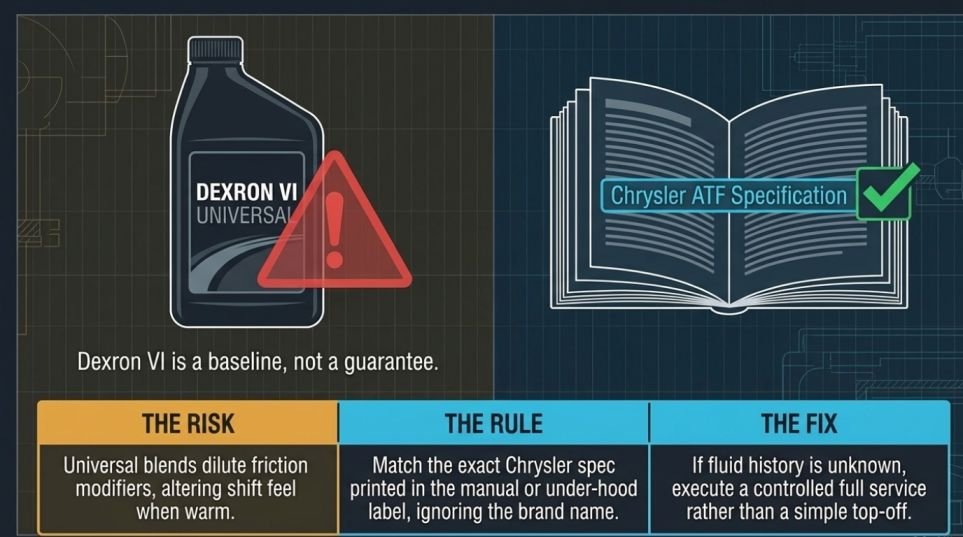
Fluid compatibility comes down to the spec the transmission expects, not the brand name you choose. For a Caravan, confirm the exact wording in the manual, then cross-check the bottle’s certification claims against that wording.
Avoiding Misuse During Service
Fluid service on this van is where mistakes happen, especially during partial drain and refills when mixed fluid remains in the system. A “complete” flush is also where people grab the wrong product, so the bottle spec needs to match before the first ounce is added.
Mechanic tip: If you are switching from an unknown or mixed ATF, assume the friction modifiers are already diluted. The cleanest fix is to correct the fluid spec in a controlled service, then re-check level at the specified temperature using the factory procedure.
| Common misconception | Why it causes trouble |
|---|---|
| “Dexron VI is always the right fluid.” | Chrysler spec wording can include performance requirements beyond the label, and some builds do not match every “Dexron VI” bottle claim. |
| “Universal ATF works for top-offs.” | Universal blends can still be different in friction tuning, and partial mixes can change shift behavior. |
| “Color tells you what’s inside.” | ATF color varies by brand and age, and it does not prove spec compatibility. |
Before spending money, confirm the exact ATF specification in your Caravan’s manual for your specific transmission configuration. If your fluid history is uncertain, correct the spec with the proper service approach rather than continuing to top off.
Safety And Final Verification Tips
Correct fluid level is the difference between crisp shifts and a transmission that runs hot and wears out early. Overfilling can cause foaming, shift-quality issues, leaks, and thermal stress, while underfilling leads to clutch slip, overheating, and accelerated wear. Final leveling must be done at the proper temperature, because the fluid expands as it warms up.
Final Level Check, Not A “Fill And Forget” Mindset
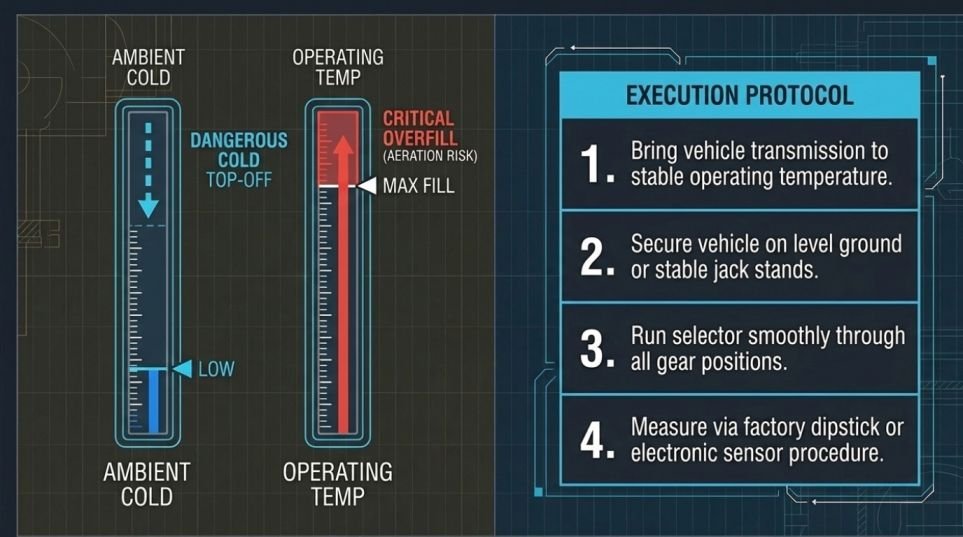
After you drain and refill, always re-check the level once the Grand Caravan is fully warmed. A cold check can read low even when the correct hot level is right on target, and a hot check after an incorrect cold fill can push you into overfill.
For safety and accuracy, keep the vehicle level and follow the shifter position and engine idle conditions in your procedure. If you are working on jack stands, use stable support and keep your hands and clothing clear of the fans, belts, and exhaust area.
What The Wrong Level Usually Looks Like
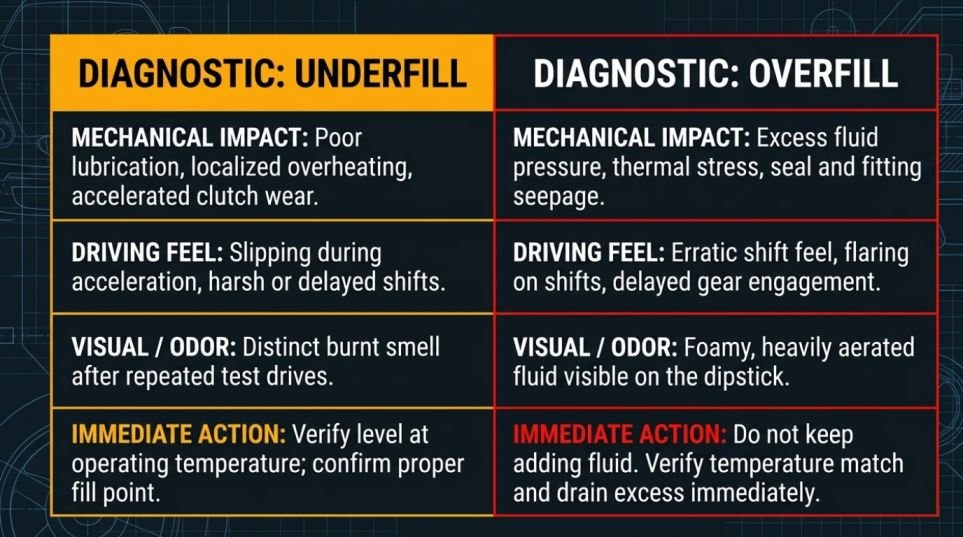
Overfilled fluid often foams and aerates, which can feel like delayed engagement, flaring on shifts, or erratic shift feel. Overfill also raises internal pressure and can contribute to seepage from seals and fittings.
Underfilled fluid usually shows up as overheating and slip, especially during acceleration or higher-load driving. You may also notice a burnt odor after repeated drives, which is a sign to stop and re-check the level and condition of the fluid.
| Condition | Typical symptoms after service | What to verify immediately |
|---|---|---|
| Overfill | Foaming, shift irregularities, leaks, elevated temps | Correct hot level, level-check method, temperature match |
| Underfill | Slipping, harsh shifts, overheating | Fluid level at correct temperature, confirm correct fill point |
Tip: After your first short test drive, park on level ground, let heat stabilize briefly, then re-check the level at the correct temperature window. This catches common “it read fine cold” mistakes and prevents an overfill situation from worsening.
Quick Summary
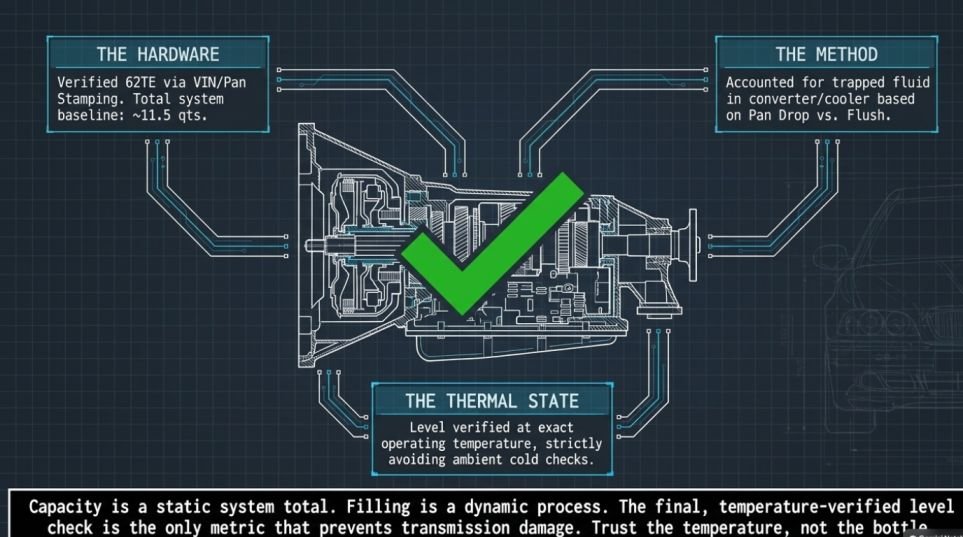
For a 2017 Dodge Grand Caravan, transmission fluid capacity is not a single fixed quarts number, because it depends on the installed transmission and whether you do a drain-and-refill or a more complete service. The article focuses on the 62TE six-speed automatic, which takes about 11.0 to 11.5 quarts, or roughly 10.4 to 11.0 L, for a dry fill to the correct operating level. It also points out that service fill quantities can be lower since some fluid remains in the torque converter and valve body.
The practical takeaway is to confirm your exact gearbox first, using the VIN and FCA transmission code, plus any labels on the transmission case or pan, before you estimate what to buy or how much to add. A proper level check is temperature sensitive, and the correct procedure should set the level at the specified fluid temperature rather than adding fluid until it “looks right.” Overfilling can lead to shifting issues and fluid aeration risk, while underfilling can cause poor lubrication, heat, and wear.
| 2017 Grand Caravan condition | Transmission | Approx. fluid capacity noted in article |
|---|---|---|
| Dry fill to correct operating level | 62TE six-speed automatic | 11.0 to 11.5 qt (10.4 to 11.0 L) |
| Drain-and-refill | 62TE or other matched variant | Typically less than total capacity; exact amount depends on what is removed |
Frequently Asked Questions
What Is The Transmission Fluid Capacity For A 2017 Dodge Grand Caravan?
It depends on whether you are filling through the drain and refill or doing a full system exchange, because the fluid volume differs by method. The most reliable number is in your service information for your exact transmission (model and build), since capacities are not always identical across variants.
How Many Quarts Of Transmission Fluid Does The 2017 Grand Caravan Need After A Drain And Refill?
For a drain and refill, you typically add only the amount that comes out through the pan, so you will not use the full “system” amount. Plan to check the level on the dipstick or via the correct procedure, and add in small increments until it reads right.
How Much Fluid Do You Add For A Complete Transmission Fluid Change On A 2017 Grand Caravan?
A complete exchange usually needs more fluid than a drain and refill because it replaces fluid throughout the system. If you are having it done, ask the shop what procedure they are using, then confirm they are setting the level correctly after the service.
What’s The Correct Way To Check Transmission Fluid Level On A 2017 Dodge Grand Caravan?
You need to follow the level-check procedure for your transmission, including driving the vehicle enough to reach the correct operating temperature and then checking on level ground. The big mistake is checking cold or overfilling, which can cause shifting issues.
Can Overfilling The Transmission Fluid On A 2017 Grand Caravan Cause Problems?
Yes. Too much fluid can lead to foaming or excess fluid pressure, which may affect shift quality and transmission behavior. If you suspect the level is off, have it corrected using the proper warm-check procedure rather than “draining a little” blindly.
Does The 2017 Grand Caravan Transmission Fluid Capacity Change By Transmission Type?
Yes, it can. The Grand Caravan uses different transmissions depending on drivetrain and configuration, and that can change the exact fill amount. Match the number to your transmission ID and the service method (drain and refill vs. exchange).
- 2017 Dodge Grand Caravan Transmission Fluid Capacity: Dodge Grand Caravan Transmission - September 27, 2026
- How Many Gallons Of Transmission Fluid Does A 2017 Gmc Yukon 5.3 Slt Xl Hold: How Many - September 26, 2026
- 17 Gmc Yukon Transmission Fluid Capacity V8 (8l90) Quarts/liters - September 26, 2026