
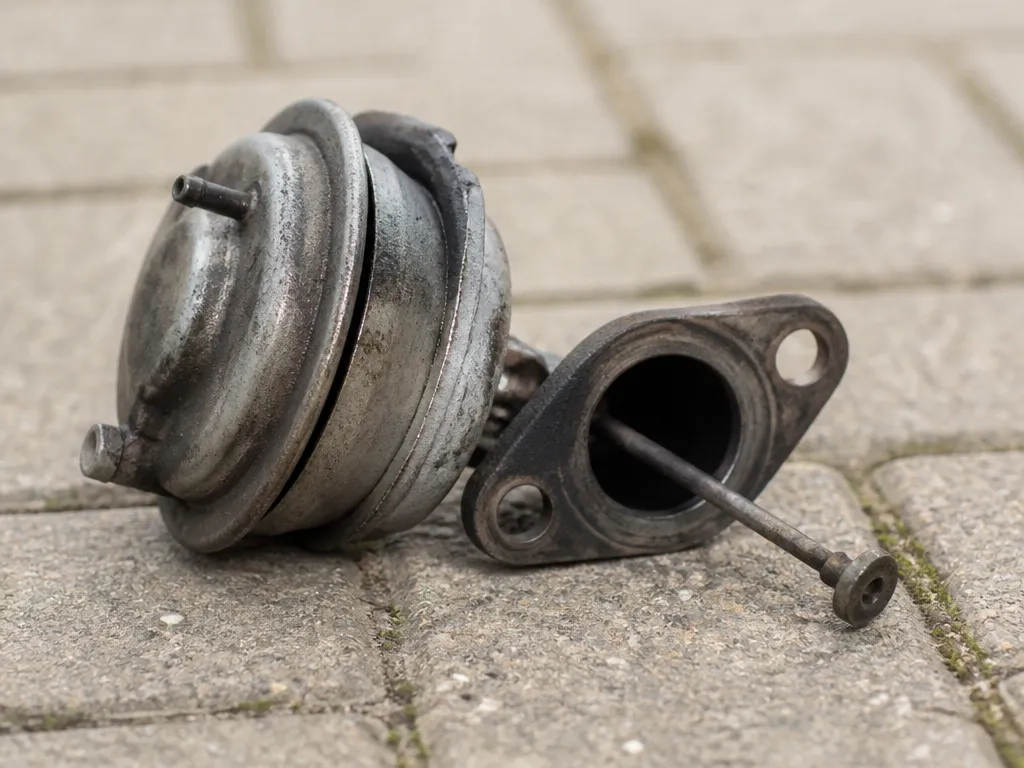
If your Laguna 3 turbo feels lazy, hits limp mode, or starts jerking on boost, a faulty wastegate is a real suspect. The catch is it can be mechanical (actuator or linkage) or control-related (vacuum/boost solenoids, hoses, sensors). This guide walks you through symptoms, quick checks, common fault codes, and the right repair path so you do not waste money.
Most wastegate failures show up as low boost, hunting boost, rattling near the turbo, or overboost/limp mode. The fastest way to confirm is to scan codes, compare target vs. actual boost on live data, then pressure-check vacuum and boost plumbing. Expect the fix to be a solenoid, hose/line, or the wastegate actuator, unless boost leaks or turbo damage are the real cause.
1. Faulty Wastegate On Laguna 3
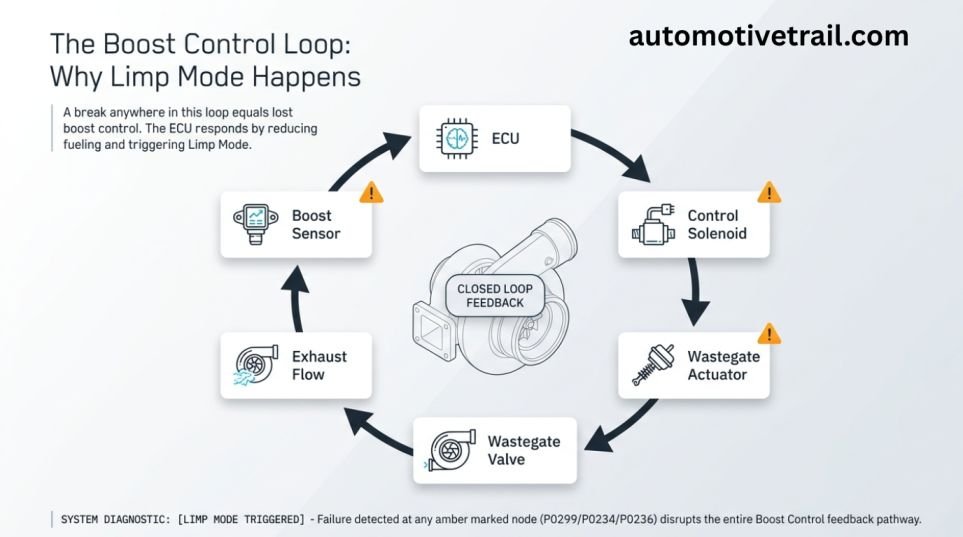
Wastegate problems land on the Laguna 3 because the turbocharger uses the wastegate to control boost pressure, and a sticky or weak actuator can let boost overshoot or fall short under load. When that control is off, the ECU may reduce fueling, and you can feel hesitation during acceleration, especially on sustained climbs or high-speed merges. This item is in the list because wastegate faults often mimic other boost-related issues, like sensor faults, so the fix needs to be targeted.
In practice, common signs include unstable boost (surging or flat power), audible turbo whistle or chuffing under load, and limp mode triggered by boost rationality checks. For a quick sanity check, look for vacuum/boost-control issues tied to the wastegate actuator linkage, since many actuator setups are controlled through small lines or an electrical solenoid depending on engine variant.
Parts availability varies by Laguna 3 engine and turbo model, so expect the repair to be actuator-only or whole turbo/wastegate assembly replacement depending on inspection findings. Tool time is usually 2 to 4 hours for diagnosis plus disassembly and test-fit, and additional time can be needed if fasteners are heat-soaked.
Why It Gets Misdiagnosed
On the Laguna 3, a faulty wastegate can look like a bad boost pressure sensor, a tired vacuum supply, or even an air leak, because all of those can produce similar drivability symptoms. Boost control logic compares requested versus actual pressure, so the ECU response is driven by pressure behavior, not by which component is wrong. That is why inspection should start with verifying the actuator command and actual movement under the correct conditions, then checking for sticking, broken linkage, or leaks in the control plumbing before replacing parts.
Reader takeaway: If boost is unstable or power drops under load, treat the wastegate and its actuator/control lines as the first suspect on a Laguna 3, and confirm actuator movement and boost response before you spend money on sensors.
2. Laguna 3 Wastegate Symptom Checklist
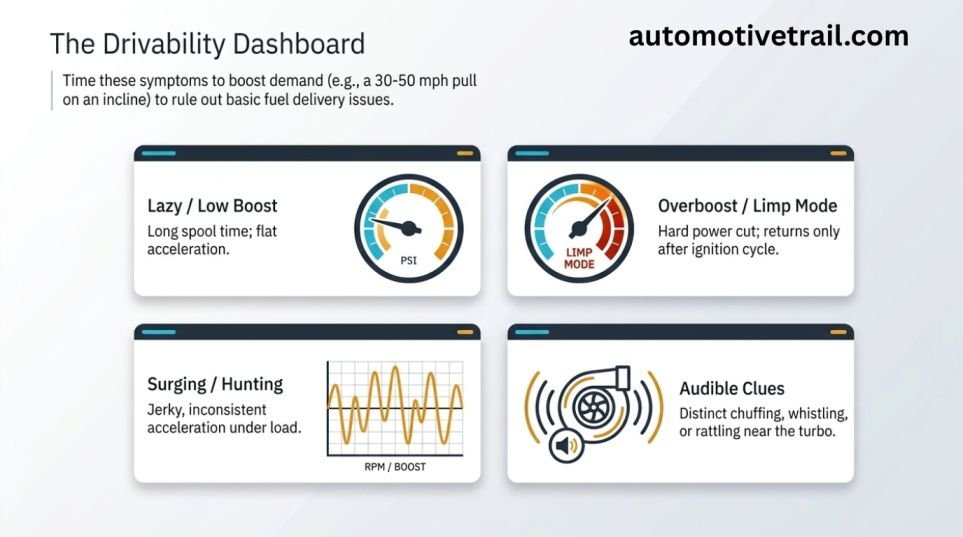
A wastegate that sticks or loses control can swing turbo boost off-target, and on the Laguna 3 that quickly shows up as unstable power and odd drivability. This item is in the list because the same wastegate control faults often create a repeatable mix of boost lag, surging, and smoke patterns that you can spot before you ever open the hood.
In practice, the most useful clues show up during quick throttle changes, hill climbs, or any time you request boost.
For example, a stuck-open wastegate can cause long spool time and “lazy” acceleration, while a stuck-closed or bleeding actuator can make boost arrive too hard, then feel inconsistent.
Typical diagnostic workflow starts with confirming any boost-related fault codes and then checking the vacuum (or electronic) control path to the wastegate actuator. Parts and labor vary widely because some Laguna 3 turbo setups use an actuator and arm serviceable as a unit, while others require turbo assembly replacement; plan around a few hours of labor when access is tight.
What To Watch For On The Road
Time the symptoms to boost demand: floor the accelerator briefly from 30 to 50 mph, then repeat on a similar incline. If the problem only appears when boost rises, that points toward wastegate control or boost reference leaks rather than a fuel pump issue. In cold weather, sticking wastegate mechanisms may be worse at first, so compare the first few accelerations after a cold start to what happens after the engine warms up. If you get a clear power cut and it returns only after cycling the ignition, treat it like a protection strategy and get it checked soon to avoid running with persistent overboost behavior.
3. Wastegate Control Codes To Expect
Wastegate control faults matter because the turbo uses a pressure regulation valve, and when the ECU sees boost control not matching commanded targets, it will log specific OBD-II codes. On a Laguna 3 with a sticking or weak wastegate actuator, you will usually see codes related to boost pressure regulation range, turbocharger underboost, or actuator circuit behavior. These codes help narrow whether the issue is electrical, vacuum/boost control, or the mechanical valve not moving.
In practice, scan with a capable OBD-II tool and record freeze-frame data (RPM, load, and boost at the time the fault set). Common code sets to expect for a wastegate-style boost control problem include “Turbocharger/Supercharger Boost Control” variants, “Boost Pressure Not Reached,” and “Boost Pressure Too High,” plus actuator control circuit codes when applicable. Use a code list and live data together because the same code name can map to different control strategies depending on the engine calibration.
For example, if you see an overboost code with limp behavior, expect the driver request and boost actual to diverge sharply, which points toward a wastegate that is not opening properly or a control pressure problem holding it closed.
How To Interpret Codes Without Chasing The Wrong Part
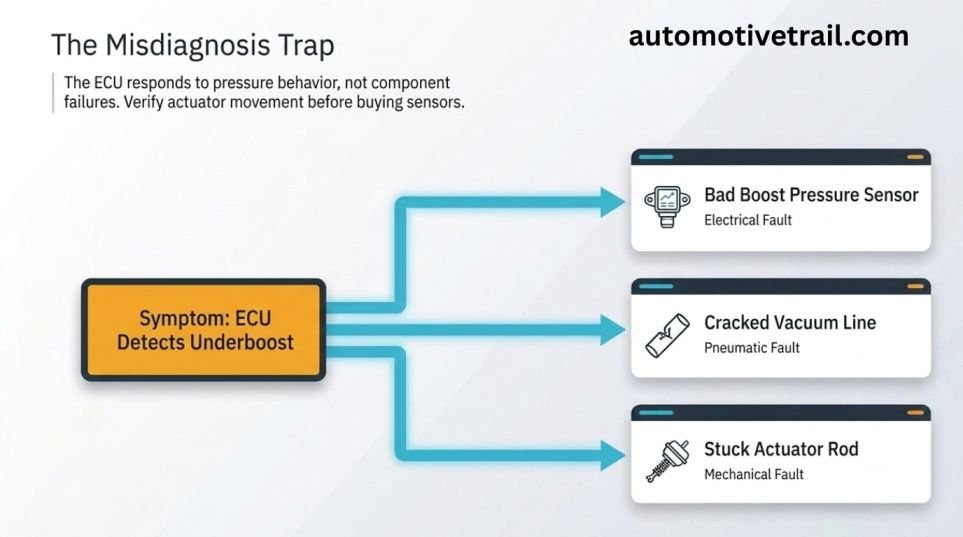
Codes like “boost not reached” can be caused by more than the wastegate, including charge leaks, a faulty boost pressure sensor, or air metering issues that change the ECU’s commanded boost. If the actuator circuit codes appear alongside boost regulation codes, focus on the control path first (wiring, connectors, solenoid operation, and whether the ECU sees the expected position or pressure response). When only boost regulation codes appear, mechanical sticking or a vacuum/pressure delivery restriction becomes more likely. If you have access to live boost readings, compare commanded versus actual during a steady pull, then correlate that with the code type (underboost versus overboost) before replacing any turbo or actuator hardware.
Live Data Checks For Boost Control
Live data matters for a Laguna 3 wastegate because the wastegate position and boost target are monitored in real time when the turbo is under load. If the actuator sticks or the control circuit is slow, you typically see boost lag, overshoot, or a mismatch between requested and actual boost during throttle changes. Scanning live data is the fastest way to separate an air leak or sensor issue from a wastegate control fault.
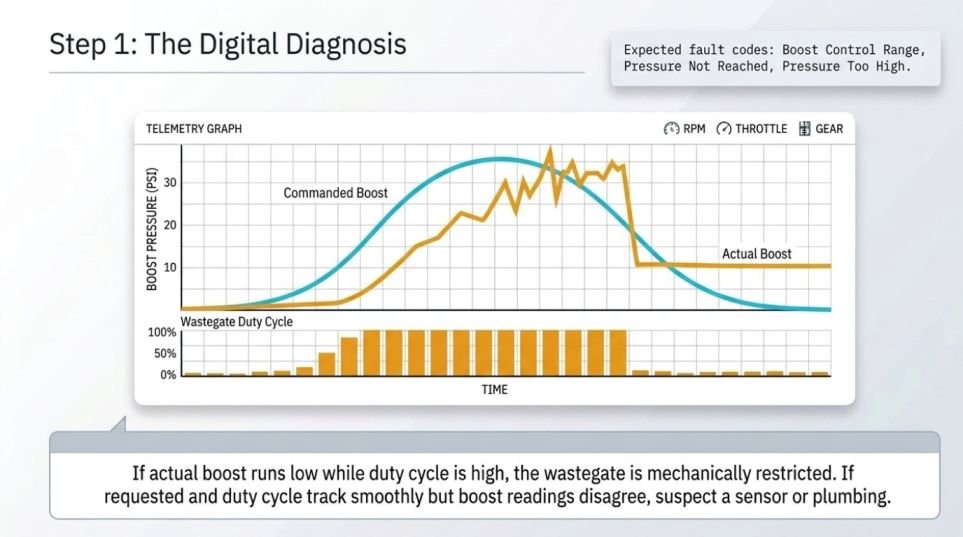
In practice, watch requested boost (or boost pressure target), actual boost, and wastegate duty cycle/position during steady acceleration and a few short ramp pulls (for example, 1500-2500 rpm in the gear range where the turbo is active). If actual boost runs low while duty cycle is high, the wastegate may not be moving or may be mechanically restricted. If actual boost is higher than requested while the control command calls for the wastegate to open, the valve may be stuck closed, or the control strategy may be being fooled by an intake/boost reference issue.
What To Record Before Any Parts Get Ordered
Before you condemn the wastegate actuator or the turbo, write down the exact PIDs you have available, the rpm/load you were at, and what changed between a normal pull and a failing pull.
For example, if requested boost rises quickly but actual boost lags with a corresponding high wastegate duty cycle, that pattern supports an actuator or linkage problem. If requested boost and duty cycle track smoothly but boost readings disagree with each other, a sensor or plumbing concern is more likely. A screenshot or two with timestamped RPM and boost values is often enough for a parts decision and helps a shop confirm the diagnosis without guessing.
Wastegate Parts To Inspect
Wastegate problems on the Laguna 3 often trace back to wear or misadjustment in the actuator and the control linkage, since that is what physically moves the wastegate to control boost. On turbo-equipped engines, even small play in the actuator rod, sticking pivots, or cracked vacuum/boost hoses can create unstable boost and trigger stored fault codes. Inspecting these parts first saves time, because the turbo itself usually gets blamed when the control components are the real issue.
Start with the actuator assembly (vacuum or electronic on different turbo setups), then check the wastegate actuator arm and rod for bent shape, seized ball joints, and excessive movement. Inspect the hose(s) and any metal lines for soft spots, cracking near clamps, and leaks around quick-connects, since leaks can mimic an actuator failure. Use a tape measure to confirm the actuator rod length and compare it to the spec in the service manual for your exact engine and turbo code, because “close enough” adjustments can cause underboost or overboost.
What To Measure Before Condemning The Turbo
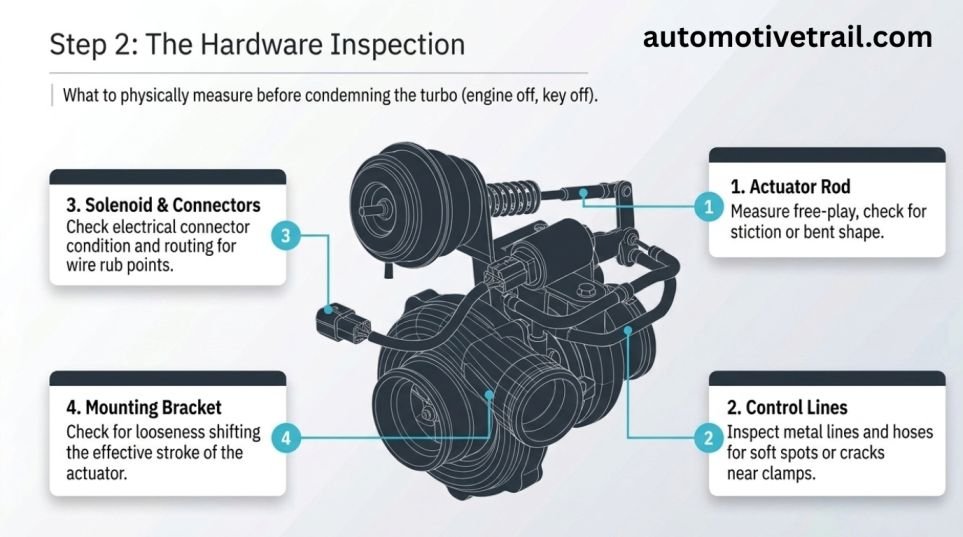
Before you pull the turbo, measure free play at the actuator linkage by moving the rod by hand (engine off, key off) and checking for stiction, then verify the lever moves through its full travel without hitting hard stops. Look closely at the actuator-to-turbo mounting points, since a loose bracket can shift the effective stroke even if the actuator itself tests “okay.” If you have an electronic actuator, compare the observed movement response to what the control strategy commands using a scan tool, because a lazy motor or broken feedback circuit can still move “a little” at rest but fail under boost.
Laguna 3 Diagnostic Workflow Steps
Wastegate faults on the Laguna 3 often show up as boost control problems, so this item belongs in the list because a repeatable workflow prevents guessing between a sticking wastegate, a leaking vacuum line, or a control signal issue. The key benefit is speed: checking command, tracking actual boost behavior, and inspecting the actuator hardware in order usually narrows the cause faster than random part swapping.
Start by scanning for OBD-II codes and freeze-frame data, then compare what the ECU commanded versus what the turbo system actually achieved. Use live data for boost target, boost actual, and any wastegate or boost control solenoid states, since a mismatch points to actuator or pneumatic control rather than wiring alone.
In practice, a quick visual inspection of the turbo compressor side plumbing for split hoses and loose clamps is worth 5 to 10 minutes before deeper checks.
Focus the next pass on the wastegate control system type on the Laguna 3 (vacuum-operated or electronically controlled, depending on engine and turbo setup). Replace any suspect vacuum hose, check for leaks around fittings, and confirm the actuator rod moves through its full travel range when commanded. A clean, functional actuator typically responds crisply; a delayed, sticky, or uneven movement often indicates sticking vanes or a worn pivot.
How To Confirm Whether The Wastegate Itself Is Sticking
When the data shows the ECU is commanding wastegate change, but boost remains off-target, you want to prove whether the actuator can move the wastegate mechanism freely. Use controlled tests that match the system type: for vacuum systems, apply regulated vacuum to the actuator and watch for smooth movement without rapid vacuum loss; for electronic control, command the actuator through the ECU routine (or a suitable scan tool function) and confirm response. If movement is inconsistent even with good vacuum supply, carbon deposits on the wastegate pivot or worn linkage are common culprits. If the actuator moves correctly but boost control still fails, shift attention to exhaust leaks, boost sensor plausibility, or solenoid control strategy.
Stuck Actuator Vs Boost Leak
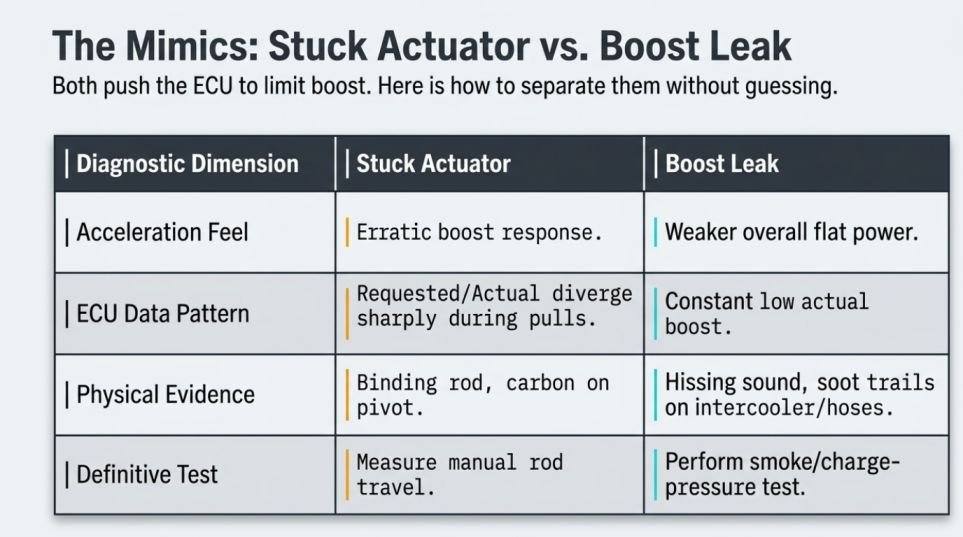
Laguna 3 turbo complaints often get blamed on the wastegate, but a sticking actuator and a boost leak can mimic each other because both push the ECU to limit boost. Differentiating them quickly saves money by keeping you from replacing an actuator when the real issue is air escaping under pressure. Common real-world causes include a wastegate actuator rod that does not return smoothly, or a loose/failed hose, intercooler seal, or clamp that bleeds boost.
For example, a stuck actuator tends to show up as erratic boost response, where requested boost and actual boost diverge during pulls, then the car may feel flat until the ECU backs off. Boost leaks usually cause weaker overall acceleration and sometimes a hiss, especially after lifting and reloading throttle.
In practice, inspect the charge plumbing for oil film and soot trails around hose connections and intercooler ends, since pressurized leaks often leave residue. A simple smoke test or pressure test is usually faster than guessing, and it helps you keep the diagnosis clean before touching the turbo hardware. When sourcing an actuator, replacement aftermarket kits sold as “turbo wastegate actuator sets” vary widely, so match your turbo model and linkage style before ordering.
How To Tell What Failed Without Guessing
Start with logic: if the charge system cannot hold pressure, the ECU will see low actual boost and may keep commanding wastegate changes, which makes a leak look like an actuator fault. When the actuator is stuck, the pressure control problem comes from the wastegate not moving to the intended position, so you often see boost that behaves strangely relative to load changes.
In practice, perform a charge-pressure test with the engine off and follow up with a visual check for cracked hoses, loose clamps, and degraded intercooler end-tank seals. If you find no leak paths and the boost control still behaves erratically, the next step is checking actuator movement and vacuum/pressure supply to the wastegate per the correct vehicle procedure.
Repair Direction For Each Scenario
Wastegate faults on the Laguna 3 matter because the turbo cannot regulate boost pressure correctly, which can lead to flat power, overboost conditions, and repeated drivability complaints. This repair section is included to map the most likely fix paths based on what fails in the control chain, since a stuck actuator behaves differently than a boost-control solenoid or a leaking diaphragm. Matching the symptom to the failed component keeps diagnosis efficient and avoids swapping the wrong parts.
In practice, start with electrical checks if your Laguna 3 has stored boost-control codes, then verify mechanical movement of the wastegate actuator (by measuring actuator rod travel and checking for binding or a loose linkage). If boost control is erratic, inspect the vacuum/boost control lines for splits, loose clamps, and cracked plastic fittings before condemning the turbo. Safety note: keep hands and clothing clear of the engine fan and hot exhaust when verifying actuator movement on a running engine.
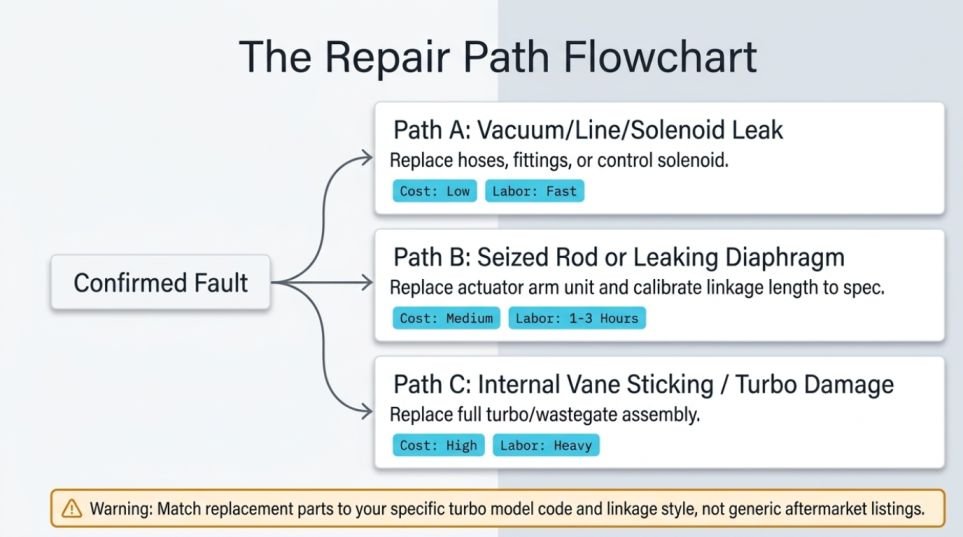
For example, if the actuator rod is seized or the diaphragm leaks, the direction is to replace the actuator or the wastegate assembly depending on what your turbo design allows. If the actuator tests good but control is inconsistent, replace the boost control solenoid and confirm proper line routing and electrical connector condition. Some replacement kits list compatibility for multiple European applications (often via actuator arm or actuator set listings), so rely on your Laguna 3 turbo model code and connector style rather than a generic listing title. Typical labor time for actuator-related turbo control repairs is often 1 to 3 hours, with parts commonly ranging from budget aftermarket actuator assemblies to higher-priced turbo/wastegate service components, so expect a wide cost spread.
When The Right “Scenario” Changes The Labor Plan
In practice, a Laguna 3 that only surges under load usually points to control strategy issues (solenoid, line leakage, or incorrect boost reference), while a car that feels dead all the time often indicates a wastegate that is stuck open or an actuator that cannot build commanded preload. A slow actuator can also mimic a vacuum leak, so take measurements rather than guessing by feel. If you have intermittent symptoms, track the connector condition and harness routing for rub points near the turbo area, since heat cycling can create high resistance that behaves like a weak actuator. When replacement is required, match the part to the turbo actuator mounting and arm geometry, then clear codes and perform a road test to confirm stable boost control.
Post-repair Verification And Reset
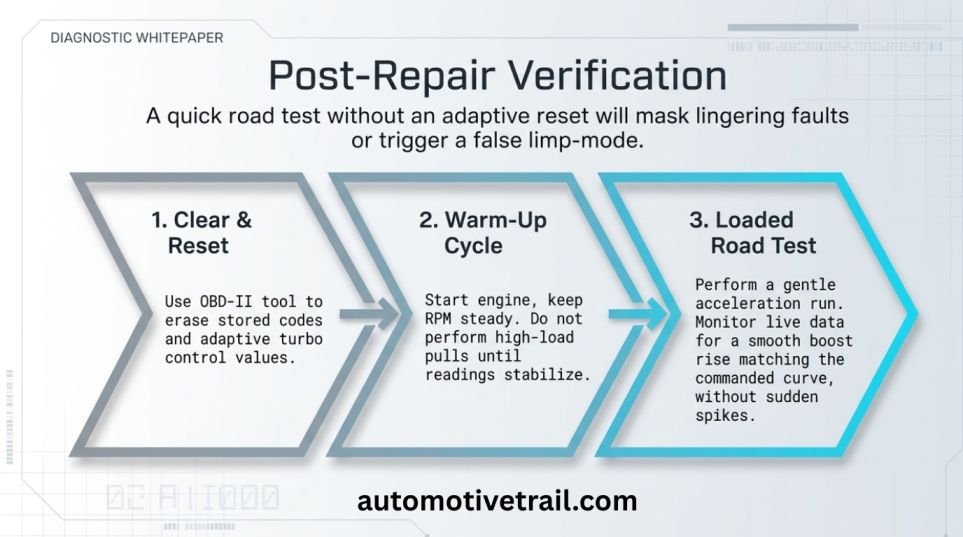
After fixing a wastegate issue on the Laguna 3, verification matters because the turbo control system can keep using old adaptive values until you clear and confirm the actuator control strategy. A quick road test without reset can mask a lingering overboost or underboost fault. This item is on the list because getting the wastegate to command correctly and holding stable boost is what prevents repeat limp mode.
For Laguna 3 use, plan for a full scan afterward with the same diagnostic tool that read the original turbo or boost control codes, then clear stored and pending codes and recheck readiness. Cycle the ignition, start the engine, and watch live data for commanded versus actual boost and wastegate position or duty cycle (depending on what your scan tool exposes). Safety note: keep RPM steady during checks; avoid high-load pulls until you see stable readings on the first warm-up. If your repair involved replacing an actuator or internal linkage, expect a short relearn period where boost may feel slightly different for a couple of drive cycles.
How To Confirm The Wastegate Is Behaving After Reset
For example, during the first drive, do a gentle acceleration run and compare the shape of boost rise to what you see after a healthy reset; you are looking for smooth control rather than a spike and fall.
In practice, if the wastegate command stays high while actual boost lags, the controller may be compensating for a sticking actuator or a linkage position error. If the readings track well at light load but drift under moderate throttle, you may be dealing with a vacuum or pressure supply issue to the actuator (or an internal turbo/control problem). In any case, repeat the scan if a code returns, because a single cleared light that comes back quickly is a strong sign the reset did not correct the underlying control mismatch.
Quick Summary
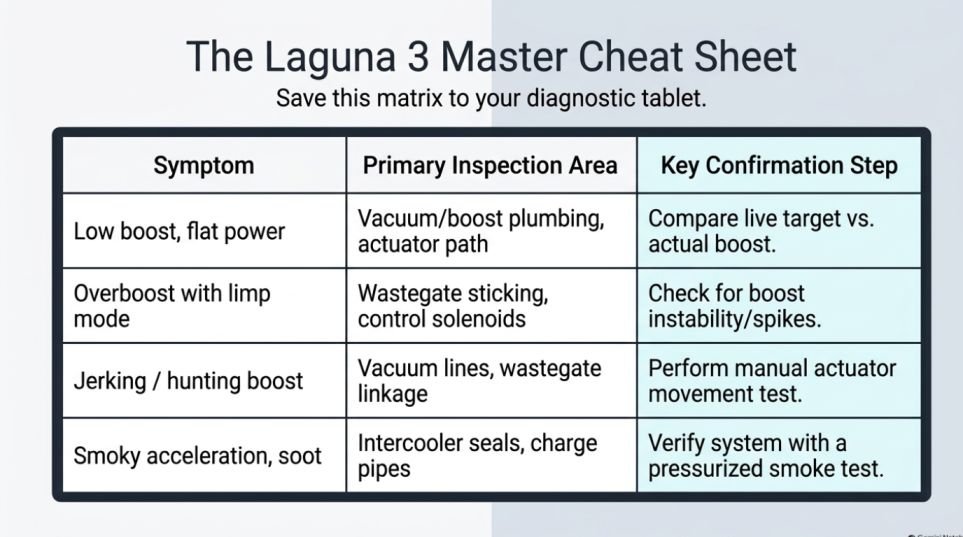
On a Laguna 3, a wastegate issue can show up as low boost, overboost with limp mode, or unstable boost that makes the car jerk on throttle. The article stresses that the problem can be mechanical, like a weak actuator or linkage, or control-related through vacuum and boost solenoids, hoses, and sensors. Because boost control logic compares target vs. actual pressure, you should scan codes first, then use live data to confirm whether the ECU request matches what the turbo is actually doing.
For diagnosis, the fastest path is scan first, guess second: look for turbo or wastegate-related codes, then confirm actuator response and check vacuum hoses and boost lines for cracks or looseness that can cause low or overboost. The guide also warns that “wastegate-like” symptoms can come from boost leaks such as intercooler or charge-pipe leaks, and that a failed boost control solenoid can mimic a bad actuator. After repair, clear codes, road-test under load, and verify the boost response returns to normal.
| Laguna 3 symptom | Most likely area to inspect first | Key confirmation step |
|---|---|---|
| Low boost, flat power | Vacuum/boost plumbing, actuator/command path | Compare live target vs actual boost |
| Overboost with limp mode | Control command and wastegate sticking, hoses/solenoids | Check for boost instability and ECU rationality triggers |
| Jerking on boost, hunting boost | Vacuum control issues or stuck wastegate mechanism | Inspect hoses, then test actuator movement |
| Soot around turbo outlet, smoky acceleration | Seal/worn areas plus boost control faults | Verify after repair with a loaded road test |
Frequently Asked Questions
What Are The Symptoms Of A Faulty Wastegate On A Laguna 3?
With a stuck or weak wastegate actuator, you can get boost control problems like sluggish acceleration or inconsistent boost. You may also notice the engine runs rough under load, and the ECU stores a boost or turbo control-related fault code, so it is worth scanning for codes before guessing.
Can A Faulty Wastegate on a Laguna 3 Cause Limp Mode?
Yes, it can. If the ECU sees boost control not matching its target, it can trigger limp mode to protect the engine, especially if the turbo cannot hold the requested pressure.
How Much Does It Usually Cost To Fix A Faulty Wastegate On A Laguna 3?
Cost varies a lot depending on whether you need just an actuator/lever repair or a full turbo replacement, plus labor time. As a rough expectation, expect a bigger bill if the turbo has to come off, while actuator-only repairs are typically cheaper, but you should budget after a proper diagnostic scan and inspection.
How Do I Test The Laguna 3 Wastegate Actuator Before Replacing Parts?
You can start with a scan tool to confirm you have a wastegate or turbo boost control code, then do a visual inspection of hoses and the actuator linkage. If the actuator is vacuum- or pressure-controlled, check for leaks and verify the actuator movement when commanded, because replacing a part without confirming movement is a common mistake.
Could A Leaking Vacuum Hose Or Boost Pipe Be Mistaken For A Faulty Wastegate On Laguna 3?
Yes. A split hose, loose clamp, or leaking charge pipe can cause boost to fall off or behave erratically, which looks like a wastegate problem in drive symptoms, so you should pressure or smoke check the boost/vacuum plumbing before condemning the actuator.
What Is The Fastest Way To Confirm The Wastegate Is Actually The Problem On A Laguna 3?
Get the car scanned first, then check for wastegate actuator response and plumbing leaks, because you are trying to prove whether control is failing mechanically or due to a supply leak. If the actuator does not move when commanded, or it moves but boost response is still wrong, that is when replacement planning makes sense.

- 2017 Dodge Grand Caravan Transmission Fluid Capacity: Dodge Grand Caravan Transmission - September 27, 2026
- How Many Gallons Of Transmission Fluid Does A 2017 Gmc Yukon 5.3 Slt Xl Hold: How Many - September 26, 2026
- 17 Gmc Yukon Transmission Fluid Capacity V8 (8l90) Quarts/liters - September 26, 2026