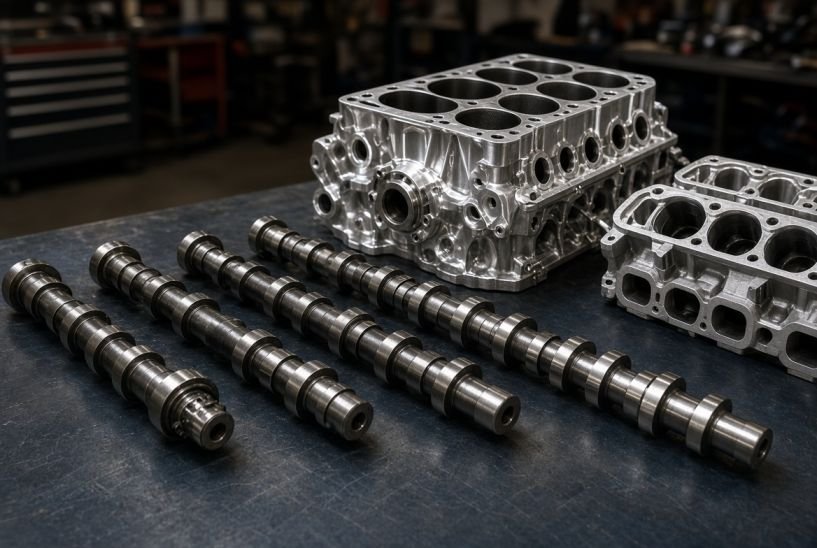
Two cams can share almost identical duration numbers and still make torque 30 lb-ft apart, because the lobe separation angle and the intake centerline are doing more work than the duration spec everyone fixates on.
Direct answer: for a street-driven 383 small block, the torque sweet spot sits around 210 to 224 degrees of duration at .050″, a lobe separation angle of 108 to 112 degrees, and .450″ to .500″ of lift. That combination builds cylinder pressure low, which is where torque actually comes from. Comp Cams’ Xtreme Energy XE268H and Lunati’s Voodoo 60121 both land in that window and show up constantly in real 383 builds for exactly that reason.
Key takeaways
- Torque comes from cylinder pressure at low RPM, not from big duration numbers. A shorter duration cam with a tighter LSA almost always beats a bigger cam below 4,000 rpm.
- Lobe separation angle matters more than most builders think. Tightening from 114 to 108 degrees can add real low-end torque at the cost of some idle smoothness and a slightly lower vacuum signal.
- A 383 is already a torque-heavy combination because of the extra 33 cubic inches over a 350. Don’t pick a cam sized for a 350; you can run less duration than the catalog defaults to.
- Match the cam to your converter stall speed and rear gear, not just your horsepower goal. A great torque cam behind the wrong converter will feel worse than a milder one.
- [INTERNAL LINK: how to degree a camshaft] matters as much as the spec sheet. A cam installed four degrees advanced or retarded from the card changes the torque curve more than swapping to a different grind.
- Budget $250 to $400 for the cam alone, and closer to $800 to $1,500 once lifters, springs, and machine work are included.
Why a 383 already leans toward torque
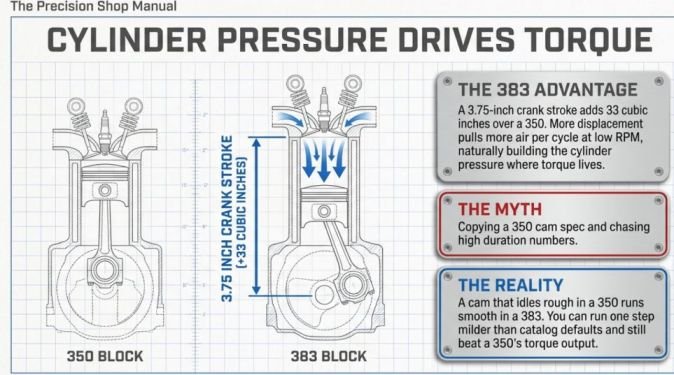
A 383 is a 350 block bored and stroked with a 3.75″ crank instead of the stock 3.48″, which adds roughly 33 cubic inches of displacement. More displacement means more air moved per cycle at the same RPM, and more air moved at low RPM is exactly what builds cylinder pressure and torque. This is why engine builders say a 383 is a “torque monster” even with a mild cam.
That extra displacement changes cam selection in a specific way: a duration spec that felt aggressive in a 350 often reads as mild in a 383. A cam that made a 350 lopey and cranky at idle can idle clean in a 383 because the bigger engine fills the cylinders more completely at low RPM even with more valve overlap. Builders who carry over a cam spec from a 350 build without adjusting for the extra cubes usually end up with more cam than they need.
The practical result: you can often run one step milder than a cam catalog’s default recommendation and still make more torque than the same cam would in a 350, while keeping better idle quality and vacuum for power brakes and a stock-style converter.
The cam specs that control torque
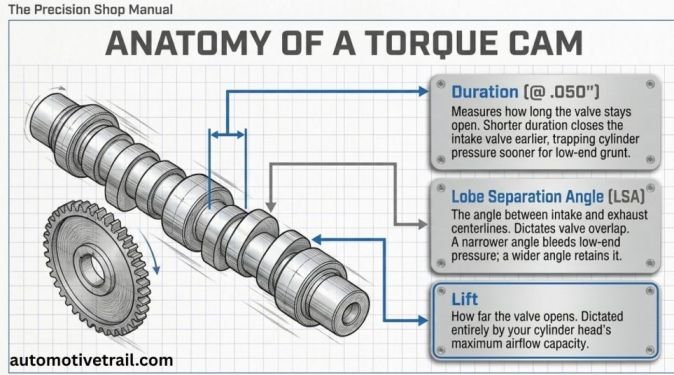
Three numbers on a cam card decide where your torque curve lives, and they interact with each other.
Duration at .050″ is how long the valve stays open past .050″ of lift, measured in crankshaft degrees. Shorter duration closes the intake valve earlier, trapping cylinder pressure sooner and building torque lower in the RPM band. Longer duration keeps the valve open into higher RPM, moving the torque peak up and usually raising the horsepower ceiling at the cost of low-end grunt.
Lobe separation angle (LSA) is the angle between the intake and exhaust lobe centerlines. A narrow LSA, around 106 to 110 degrees, increases overlap, the period when both valves are open near TDC. More overlap can help cylinder scavenging at high RPM but bleeds off low-end cylinder pressure. A wider LSA, 112 to 116 degrees, reduces overlap and holds cylinder pressure at low RPM, which is why torque-focused grinds usually sit on the tighter half of that range rather than the wide end.
Lift determines how far the valve opens and how much airflow the head can flow at peak lift. More lift helps if the heads flow well beyond .450″ to .500″; on stock or mildly ported heads, lift past that point often stops adding torque because the head can’t flow any more air regardless of how far the valve opens.
Duration at .050: where to land for max torque
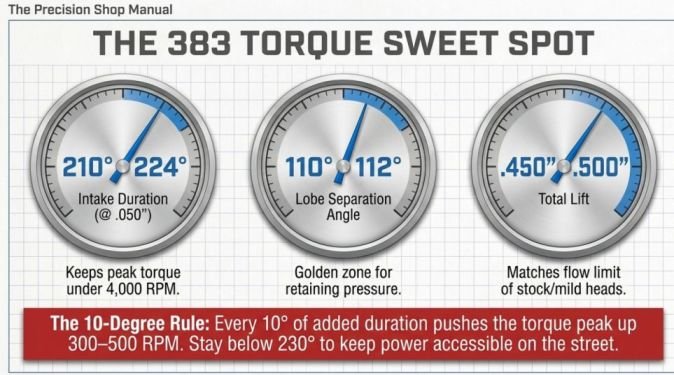
For a street 383 with a stock-style converter and 3.42 to 3.73 rear gears, 210 to 224 degrees of duration at .050″ on the intake side is the range that consistently shows up in dyno-proven torque builds. Below 210 degrees, you start giving up top-end power without much torque gain to show for it. Past 230 degrees, the torque peak moves up past 3,500 rpm, and the engine loses the low-RPM shove that makes a torque cam worth building in the first place.
A useful way to think about it: every 10 degrees of added duration at .050″ moves the torque peak up roughly 300 to 500 rpm and the horsepower peak up by a similar or larger amount. If your 383 will spend its life between idle and 4,500 rpm behind a Turbo 350 or TH400 with a stock-stall converter, there’s no reason to run a cam whose torque peak lands at 4,000 rpm plus. That’s a cam built for a different engine’s job.
Dual-pattern cams, where the exhaust duration runs 6 to 12 degrees longer than the intake, help scavenge exhaust on engines with restrictive exhaust manifolds or smaller header primaries. If you’re running full-length 1-5/8″ headers with a decent 2.5″ exhaust, you have more freedom to run a tighter single-pattern or mild dual-pattern grind without a scavenging penalty.
Lobe separation angle: narrow vs wide for torque
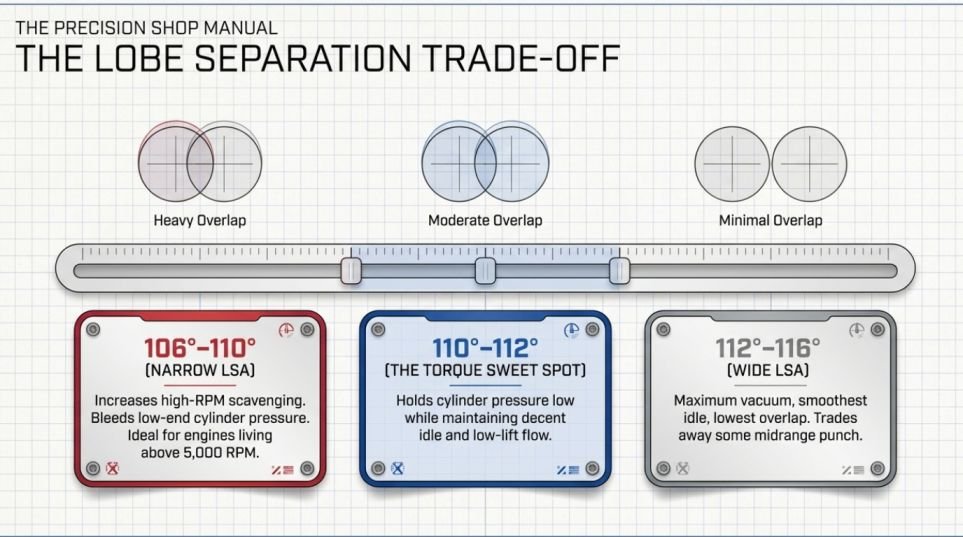
This is the spec builders get backward most often. The instinct is that a bigger cam equals more power, so a narrower LSA with more overlap should mean more torque. It’s the opposite at low RPM.
A wide LSA, 112 to 114 degrees, reduces overlap and keeps intake charge from getting pushed back out during valve overlap at low RPM. That holds cylinder pressure and produces a fatter torque curve from idle through the midrange, along with a smoother idle and stronger vacuum, which matters if you’re running power brakes or a vacuum-referenced ignition advance.
A narrow LSA, 106 to 110 degrees, trades some of that low-RPM cylinder pressure for better cylinder filling and scavenging at higher RPM, which raises peak horsepower and moves the whole power band up. That’s the right call for a car that spends real time above 5,000 rpm. It’s the wrong call for a street cruiser or tow vehicle that lives between idle and 4,000 rpm.
For a genuine torque build, 110 to 112 degrees LSA is the common landing spot: enough separation to hold cylinder pressure low, without going so wide that idle quality and overlap-driven low-lift flow suffer. Comp’s XE268H ships at 110 degrees LSA for exactly this reason, and Lunati’s Voodoo 60121 splits it at 112/106 with an asymmetrical lobe centerline that leans the intake side toward torque.
Flat tappet vs hydraulic roller: which supports torque goals
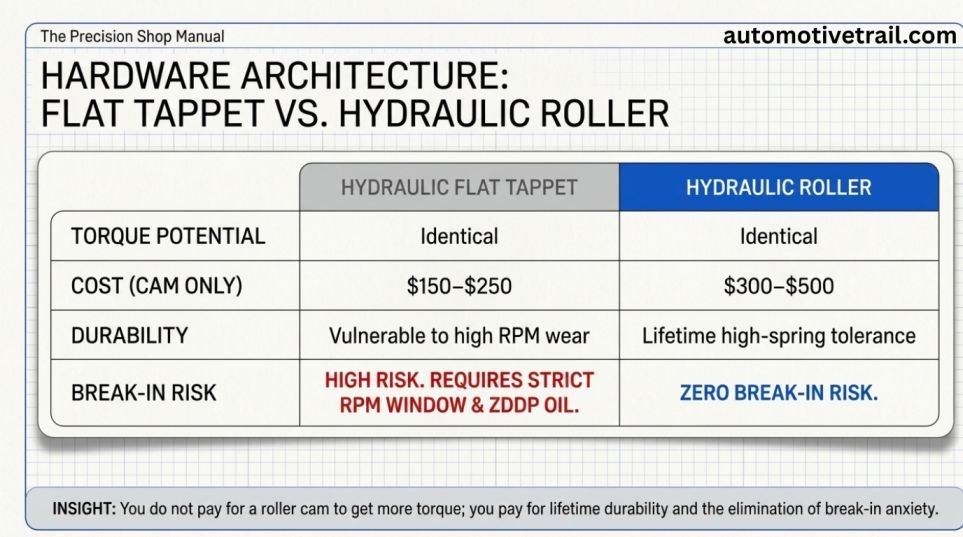
Base circle diameter and lobe profile differ between flat tappet and roller cams, and it affects how aggressively a cam can open the valve without hurting durability, but it does not fundamentally change the duration/LSA torque relationship described above. Both cam types can be ground to torque-friendly specs.
Hydraulic flat tappet cams cost less, around $150 to $250 for the cam alone, and work fine in a torque-focused build since the aggressive ramp rates that flat tappets can’t handle are mostly a high-RPM horsepower concern. The tradeoff is a break-in procedure that requires zinc-rich break-in oil and a specific startup RPM to avoid wiping a lobe, plus more sensitivity to valve spring pressure than roller cams.
Hydraulic roller cams cost more, typically $300 to $500 for the cam alone, need a roller-compatible block (all 383 stroker blocks built from a two-piece rear main seal 350 casting are roller-ready) and lifters, but tolerate higher spring pressure and hold their lobe profile longer with no break-in risk. For a build that will see real miles, the roller’s durability is usually worth the extra cost even though it doesn’t add torque by itself.
One thing worth knowing before you buy a flat tappet torque cam: aggressive-ramp grinds like Comp’s XE series have a long, well-documented history of wiping a lobe during break-in or within the first few hundred to few thousand miles. Builders report it across multiple forums, and the pattern is consistent. It’s almost always traced to mismatched valve spring pressure, insufficient break-in RPM, or reduced ZDDP levels in modern oil, not a defective cam. If you’re set on a flat tappet torque cam, buy the exact spring the cam manufacturer specifies rather than reusing an old set, and don’t skip the break-in procedure even if the shop doing the install is in a hurry.
Torque cam recommendations for a 383
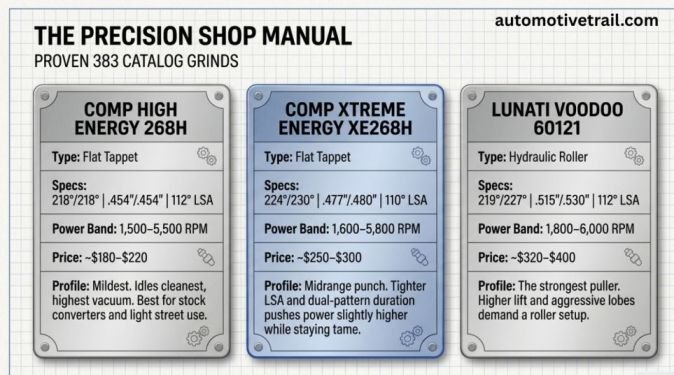
| Camshaft Model | Duration @ .050 (I/E) | Lift (I/E) | LSA | RPM Range | Cam Type | Approx. Price | Primary Benefit |
|---|---|---|---|---|---|---|---|
| Comp Cams Xtreme Energy XE268H | 224°/230° | .477″/.480″ | 110° | 1,600–5,800 RPM | Hydraulic flat tappet | $250–300 | Strong midrange pull with tame idle. |
| Lunati Voodoo 60121 | 219°/227° | .515″/.530″ | 112° | 1,800–6,000 RPM | Hydraulic roller | $320–400 | Strong midrange pull; highest lift and modern lobe profile. |
| Comp Cams High Energy 268H | 218°/218° | .454″/.454″ | 112° | 1,500–5,500 RPM | Hydraulic flat tappet | $180–220 | Clean idle; highest vacuum for power brakes. |
The High Energy 268H is the mildest of the three, a single-pattern grind that idles the cleanest and holds the most vacuum, best suited to a stock-converter automatic and light street use. The XE268H’s dual-pattern duration and tighter LSA push it slightly further into the midrange while staying tame at idle. The Voodoo’s higher lift and roller lobe profile make it the strongest midrange puller of the three, at the highest price and the requirement for roller lifters.
Real-world numbers back this up. One 383 build with AFR 190 aluminum heads, an Edelbrock Performer RPM intake, 1.6:1 roller rockers, and an XE268H pulled 424 hp and 440 lb-ft at the flywheel on an engine dyno. On a different 383 with stronger-flowing 180cc AFR heads, swapping from a single-pattern XE262 up to the longer-duration dual-pattern XE268 only added a small amount of peak horsepower and cost meaningful torque below 4,000 rpm, because the head’s exhaust port was strong enough that the shorter, single-pattern cam scavenged just as well without sacrificing low-RPM cylinder pressure. The lesson holds across both examples: past a certain point, more duration trades torque for horsepower you may never use on the street.
Matching the cam to your combo
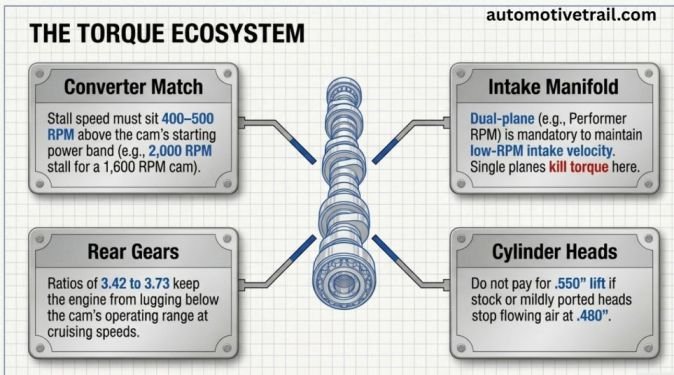
A cam card describes the cam in isolation. What it actually does in your car depends on the rest of the drivetrain.
- Converter stall speed. The standard rule among converter builders is to pick a stall speed roughly 400 to 500 rpm above where the cam’s power band starts. A cam rated for a 1,600 to 5,800 rpm operating range wants a converter stalling around 2,000 to 2,200 rpm, not the stock 1,600 to 1,800 rpm range. A stock-stall converter behind a cam whose torque comes in above 2,500 rpm will feel soft off the line no matter how good the cam is, because the converter is fighting to get the engine into its powerband instead of helping it there.
- Rear gear ratio. Steeper gears (3.73 and up) let a slightly bigger cam feel strong off the line by keeping engine RPM in the torque band longer at low speed. Taller gears (3.08 to 3.42) favor a milder, lower-RPM torque curve so the engine isn’t lugging below the cam’s operating range.
- Cylinder heads. A cam’s lift and duration only matter up to the point the heads can flow. Stock iron heads or lightly reworked Vortec heads typically stop benefiting from lift past about .480″ to .500″; better-flowing aluminum heads can use more.
- Intake manifold. A dual-plane intake, like an Edelbrock Performer or Performer RPM Air Gap, complements a torque cam by keeping intake velocity high at low RPM. A single-plane intake works against a torque-focused cam by favoring high RPM airflow the cam isn’t built to use.
Common mistakes that kill torque on a 383 build
- Copying a 350’s cam spec onto a 383. The extra displacement means you usually need less cam, not the same or more.
- Chasing lift past what the heads can flow. Paying for .550″ lift on heads that stop flowing more air at .480″ buys nothing but valvetrain wear.
- Running a single-plane intake for a “torque build.” It undercuts the exact low-RPM cylinder filling the cam is trying to create.
- Ignoring converter stall speed. The best torque cam in the catalog feels weak behind a converter that doesn’t match its operating range.
- Skipping the degree-in. Installing the cam straight up off the timing set without checking the actual intake centerline can shift the whole torque curve by several hundred RPM in either direction.
Installation notes that affect torque
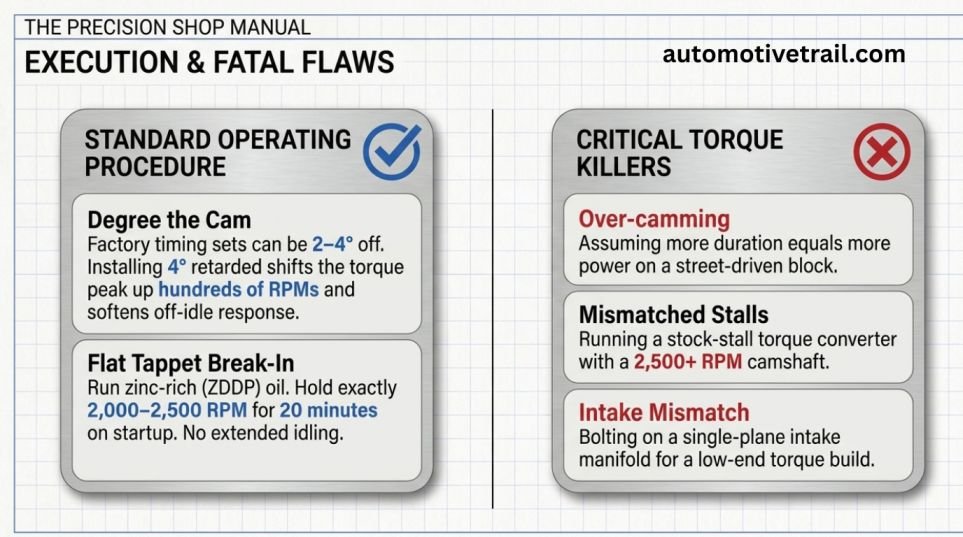
Degreeing the cam on install, rather than trusting the timing set’s factory index marks, is the single most overlooked step that changes real-world torque output. Timing chains and gears have enough manufacturing tolerance that the actual intake centerline can land two to four degrees off the cam’s advertised number without any part being defective. Four degrees of unintended retard can push the torque peak up several hundred RPM and soften throttle response off idle, which feels exactly like “the cam isn’t as strong as advertised” even though the cam itself is fine.
For a flat tappet cam, break-in matters just as much. Run zinc-rich break-in oil (ZDDP additive levels above what most modern API SN/SP-rated oils contain), hold RPM between 2,000 and 2,500 for the first 20 minutes after startup, and avoid extended idle during that window. A wiped lobe from a bad break-in doesn’t just cost you the cam; it usually takes a lifter or two with it.
Cost breakdown: cam, lifters, springs, install
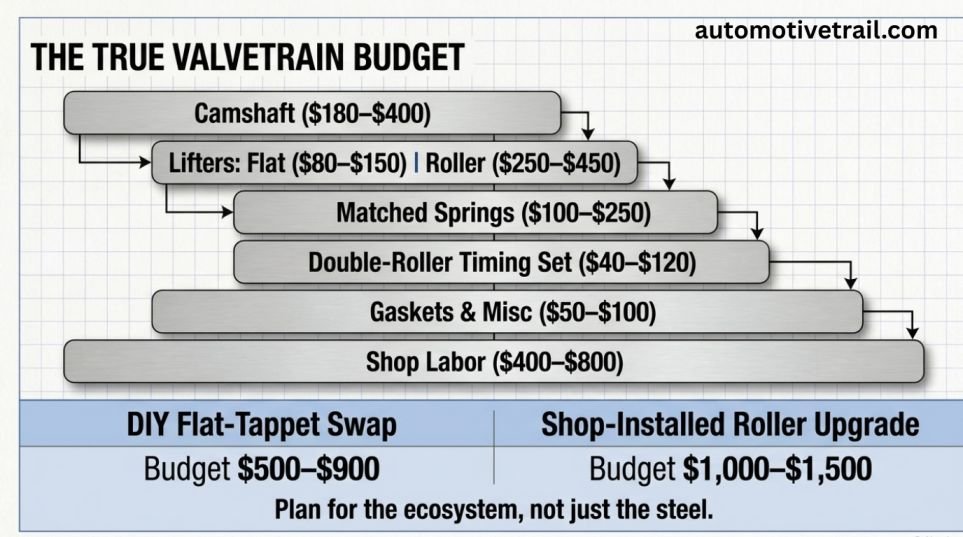
Budgeting a torque cam swap on a 383 realistically means pricing the whole valvetrain, not just the cam.
- Cam only: $180–$400 depending on flat tappet vs roller and brand.
- Lifters: $80–$150 for a flat tappet set, $250–$450 for a hydraulic roller set.
- Valve springs (if upgrading): $100–$250 for a matched set rated for the new cam’s lift and RPM range.
- Timing set: $40–$120 for a quality double-roller chain and gear set.
- Gaskets, degree wheel rental or purchase, and misc: $50–$100.
- Machine shop or shop labor if not doing it yourself: $400–$800 for cam swap labor alone, more if heads come off.
A DIY cam swap with a flat tappet cam and no head work typically lands between $500 and $900 in parts. Add roller lifters, springs, and shop labor and a full torque-cam upgrade commonly runs $1,000 to $1,500.
Bottom line: the actual decision framework
A high torque cam for a 383 Chevy comes down to three numbers working together, not one big spec on a box. Duration at .050″ in the 210 to 224 degree range, an LSA of 110 to 112 degrees, and lift matched to what your heads can actually flow will build the low-RPM cylinder pressure that makes torque. Everything else- the dual-plane intake, the converter stall, the gear ratio, and a proper cam degree-in- decides whether that torque curve actually shows up on the street the way the cam card says it should.
If you’re building a street 383 behind a stock-stall automatic with a dual-plane intake and mild gears, start with something in the Comp XE268H or Lunati Voodoo 60121 range and build the rest of the combination around it rather than chasing a bigger cam later. The 383’s extra displacement is already doing a lot of the torque work for you.
FAQ: high torque cam for 383 Chevy questions
What LSA is best for torque on a 383? 110 to 112 degrees is the common range for a street torque build. Wider LSA (114+) trades some torque for smoother idle and better vacuum; narrower LSA (106-108) shifts the power band higher and gives up low-end torque.
How much duration do I need for a torque cam in a 383? Most torque-focused 383 builds land between 210 and 224 degrees of duration at .050″. Going past 230 degrees typically moves the torque peak above 3,500 rpm, which works against a low-end torque goal.
Is a flat tappet or roller cam better for torque? Neither inherently makes more torque than the other at the same duration and LSA. Roller cams cost more and last longer under higher spring pressure. Flat tappet cams cost less but need careful break-in; aggressive-ramp grinds have a documented history of wiping a lobe when the valve spring pressure doesn’t match the cam maker’s spec or the break-in RPM runs too low, so use the exact spring they call for and follow their procedure closely.
Do I need a single-plane or dual-plane intake with a torque cam? Dual-plane. A dual-plane intake like an Edelbrock Performer keeps intake velocity high at low RPM, which works with a torque cam instead of against it. Single-plane intakes favor high-RPM airflow.
Will a bigger cam make more torque in a 383? Not necessarily, and often the opposite. Past a certain duration, an added cam moves the torque peak higher in the RPM band and can reduce torque in the RPM range a street-driven car actually uses most.
What rear gear works best with a high torque cam? Gears in the 3.42 to 3.73 range pair well with most torque-focused 383 cams behind an automatic. Taller gears (3.08 and up) can leave the engine below the cam’s effective RPM range at cruise, while steeper gears (3.90+) work better with cams that carry the torque curve slightly higher.
- 2 Hole Vs 4 Hole Injectors 5.3 Vortec: Swap Rules + Fitment Check - September 12, 2026
- What Oil Does 2012 Honda Civic Use: What Oil Does Honda Civic Use & Spec - September 12, 2026
- 2014 Ram 2500 5.7 Hemi Sparkplugs: Ram 5.7 Hemi Sparkplugs: Oe Vs Fitment, Swap Steps - September 12, 2026