
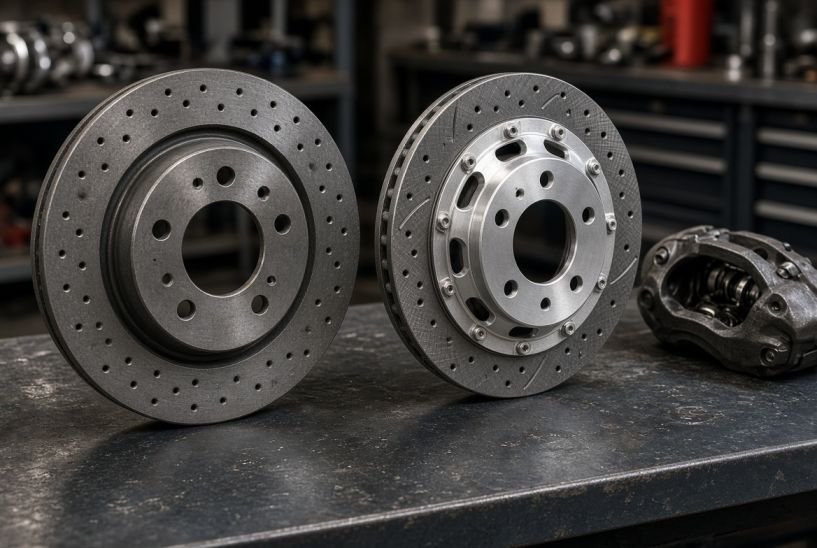
A truck rotor in one-piece cast iron weighs 22 to 26 pounds. The 2-piece version of the same rotor, with an aluminum hat, comes in noticeably lighter. That single fact drives most of this decision.
Quick answer: if you drive normally, tow occasionally, or just need reliable stopping power, a 1-piece rotor does the job for a fraction of the price. If you’re tracking your car, hauling heavy loads down long grades, or chasing every pound of unsprung weight, a 2-piece rotor earns its cost through better heat control and less stress on your hub bearings.
Key Takeaways
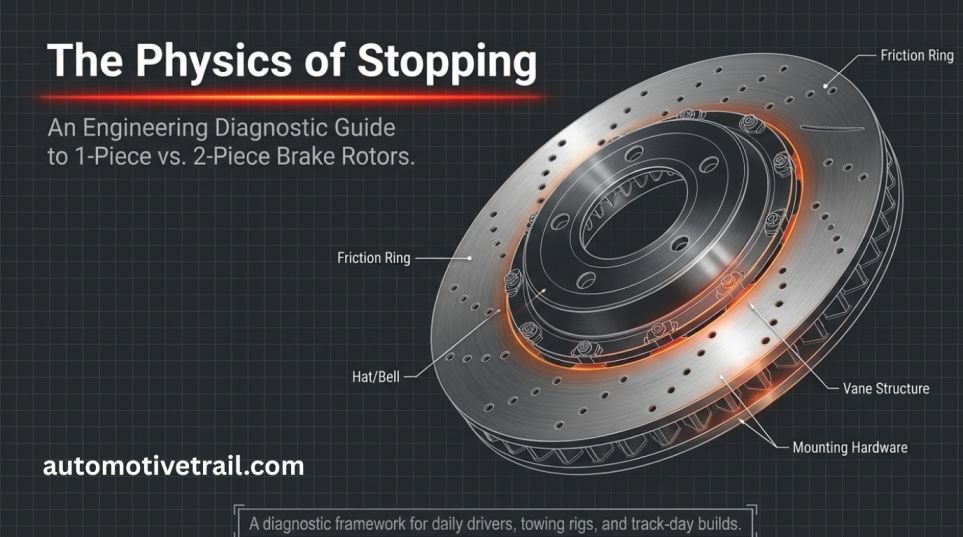
- 1-piece rotors are a single cast-iron disc; 2-piece rotors bolt a separate ring (usually iron) to an aluminum hat.
- 2-piece rotors run lighter, often shaving several pounds per corner off unsprung weight.
- Floating 2-piece designs resist warping better because the ring expands independently of the hat.
- Floating rotors can rattle or click at low speed. Fixed 2-piece rotors stay quiet but lose some of that thermal advantage.
- A 2-piece kit can run $750 to $2,000 per axle, versus $100 to $300 for a 1-piece replacement rotor.
- Most daily drivers, and even most weekend track cars on stock power, never generate enough heat to need a 2-piece setup.
1-piece vs 2-piece brake rotor — what actually separates them
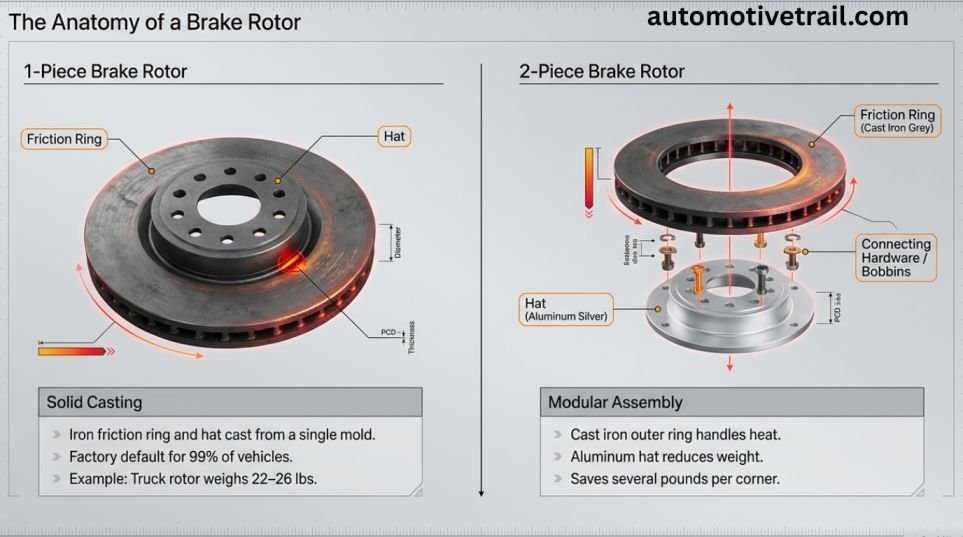
A 1-piece rotor is one solid casting. The friction ring, where your pads clamp down, and the hat, which bolts to your hub, come out of the mold as a single piece of iron. That’s what’s on nearly every car that rolls off a factory line.
A 2-piece rotor splits those two jobs between two parts. The outer ring stays cast iron, because iron handles friction and heat better than anything cheaper. The hat gets swapped for aluminum, then bolted or pinned to the ring.
That split sounds minor. It isn’t. Iron and aluminum expand at different rates when they heat up, and separating them changes how the whole rotor handles a hard stop. Everything else in this guide traces back to that one design choice.
Fixed vs floating 2-piece rotors
Not all 2-piece rotors behave the same way, and this is the part most comparisons skip.
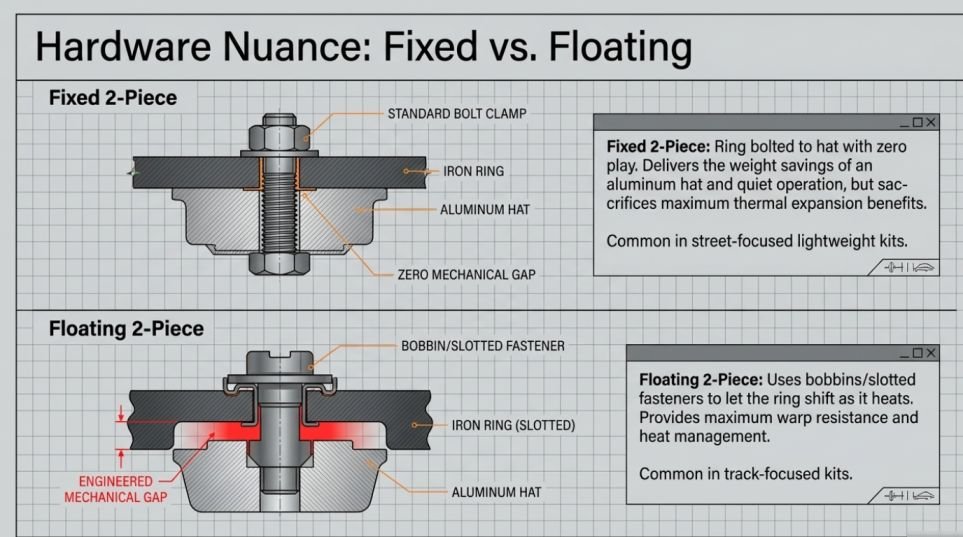
A fixed 2-piece rotor bolts the ring to the hat with zero play. It behaves almost like a 1-piece rotor: quiet, predictable, consistent pedal feel. You get the weight savings from the aluminum hat, but not the full thermal benefit, since the ring still can’t move freely.
A floating 2-piece rotor uses bobbins or slotted fasteners that let the ring shift slightly relative to the hat as it heats up. This is where the real warp resistance comes from. The tradeoff is noise. At low speed, floating rotors can click, rattle, or ping as the ring settles, especially right after a hard stop while everything cools. That noise is normal, not a defect, but it surprises a lot of first-time owners who expect dead silence.
If you’re buying a 2-piece kit for a street car, ask specifically whether it’s fixed or floating. Track-focused kits skew floating. Street-focused “lightweight replacement” kits often skew fixed.
Weight and unsprung mass
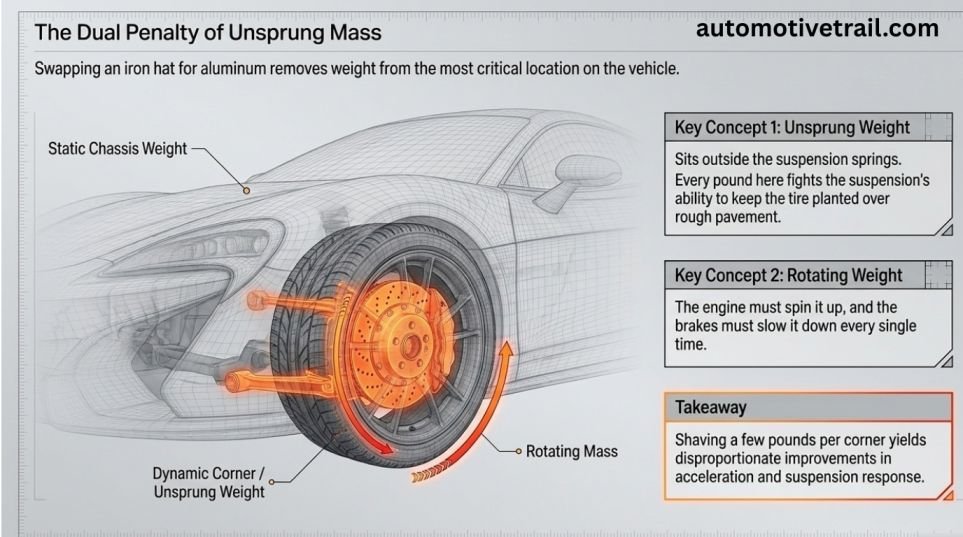
This is the easiest number to point to. Swapping an iron hat for aluminum removes weight from a spot that matters more than almost anywhere else on the car: a rotating, unsprung component.
Unsprung weight sits outside the suspension springs, so every pound there resists your suspension’s ability to keep the tire planted over bumps. Rotating weight adds a second penalty, since the engine has to spin it up and the brakes have to slow it down every single time. Cut weight at the rotor, and you feel it in both acceleration and how the car settles over rough pavement.
The exact savings depend on rotor size and hat design, but a few pounds per corner is typical on a mid-size performance rotor. On a car with four rotors, that adds up to real, measurable unsprung mass reduction, the kind that shows up in lap times more than in daily commuting.
Heat, warping, and why 1-piece rotors crack
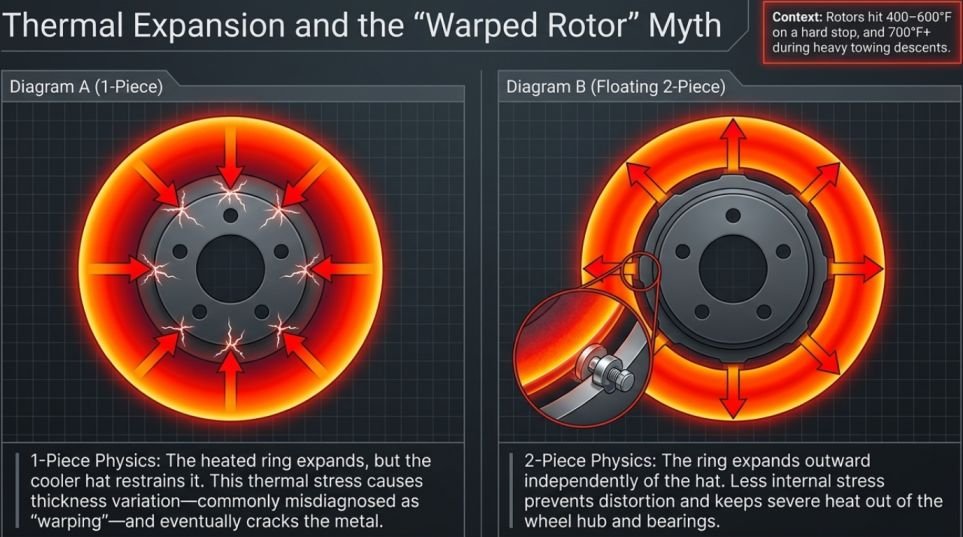
Push a rotor hard, and the friction ring can hit 400 to 600°F on a single sustained stop, or climb past 700°F on repeated towing descents. Metal expands when it heats. In a 1-piece rotor, the ring can’t expand freely because it’s cast as one piece with the cooler hat holding it in check.
That constraint is where warping comes from. The ring wants to grow, the hat won’t let it, and the resulting stress distorts the rotor face over repeated heat cycles. Mechanics call this “warped rotors,” though it’s really thickness variation from thermal stress, not an actual bend.
A 2-piece floating rotor sidesteps this. The ring can expand outward relative to the hat instead of fighting it. Less internal stress means less distortion and a lower chance of cracking under repeated hard use. It’s also why a 2-piece design keeps more heat out of your wheel hub and bearings, since the aluminum hat and the mechanical gap between the pieces slow down heat transfer into the hub.
Noise and long-term reliability tradeoffs
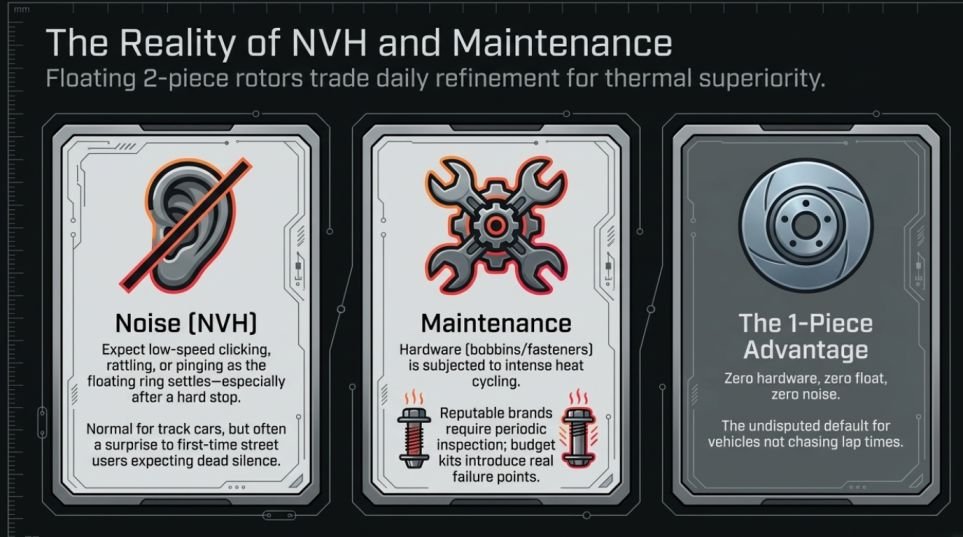
Nothing here is free. A floating 2-piece rotor trades some refinement for its thermal advantage. Expect occasional rattling or a faint clunk at low speed, more noticeable on a quiet street car than a loud track car where you’d never hear it anyway.
There’s also hardware to maintain. The bobbins or fasteners connecting the ring to the hat can wear or loosen over years of heat cycling. On a well-made kit from a reputable brand, this is a non-issue with periodic inspection. On a budget kit, it’s a real failure point.
A 1-piece rotor has none of this. No hardware, no float, no noise. It’s also the reason 1-piece rotors remain the default on nearly every car that isn’t chasing lap times.
Cost: upfront price and replacement over time
The price gap is the biggest practical barrier for most buyers.
| Rotor Type | Construction | Typical Cost | Weight | Heat Management & Warp Resistance | Noise & Refinement | Ideal Use | Long-Term Maintenance |
|---|---|---|---|---|---|---|---|
| 2-Piece (Floating) | Iron friction ring attached to an aluminum hat via bobbins or slotted fasteners for controlled movement. | $750–$2,000 per axle | Lighter than 1-piece; saves several pounds of unsprung and rotating mass per corner. | Superior; independent ring expansion reduces warping and heat transfer to the hub. | May click, rattle, or ping at low speeds; less refined for quiet street use. | Track days, high-power builds, frequent heavy towing on long grades. | Reusable hat; replace outer ring only. Bobbins can wear or loosen and need maintenance. |
| 2-Piece (Fixed) | Iron friction ring bolted to an aluminum hat with zero play. | $750–$2,000 per axle | Lighter than 1-piece; saves several pounds of unsprung and rotating mass per corner. | Less thermal benefit than floating designs because the ring cannot move freely during expansion. | Silent and predictable; no hardware rattle. | Street-focused lightweight upgrades and weight-conscious builds. | Reusable hat; replace outer ring only. Inspect hardware periodically. |
| 1-Piece | Single solid casting with the friction ring and hat formed as one iron piece. | $100–$300 per rotor | Heavier; truck rotors can weigh 22–26 lb, adding unsprung and rotating mass. | Ring cannot expand freely; high heat can cause distortion (warping) or cracking. | Silent and predictable; no hardware to rattle. | Daily driving, errands, occasional spirited driving, moderate towing. | Full rotor replacement required; no hardware maintenance. |
ing the outer ring once the hat is bought. In practice, that math only pays off if you’re wearing through rings fast enough for the savings to matter, which mostly means track use. For a street car doing normal mileage, you’ll likely still be on your original 1-piece rotor’s second or third life by the time the 2-piece owner replaces one ring.
1-piece vs 2-piece rotor for daily driving
For commuting, errands, and normal highway miles, a 1-piece rotor is the right call and not a compromise. Daily braking loads rarely push a rotor anywhere near the temperatures that cause warping in a healthy, quality casting. You’re not generating the heat cycles that justify the extra cost or the occasional floating-rotor rattle.
Stick with a reputable 1-piece rotor, replace pads on schedule, and you’ll get years of predictable, quiet stops. The savings versus a 2-piece kit are better spent on good pads and fresh brake fluid, which do more for daily stopping performance than a lighter hat ever will.
1-piece vs 2-piece rotor for towing and heavy-duty trucks
Towing is a heat problem, but it’s usually a slow, sustained one rather than the sharp repeated spikes you get on track. Long downhill grades with a loaded trailer can push rotors past 700°F, which is real stress on a 1-piece rotor.
Even so, most heavy-duty truck applications stick with 1-piece rotors, mainly because durability and cost matter more than shaving a few pounds when the truck itself weighs thousands more than the rotor savings could offset. If you tow constantly and are seeing warping or brake fade on a 1-piece setup, a quality floating 2-piece rotor built for towing (not a track kit) is worth pricing out. For occasional towing, a good 1-piece rotor with properly bedded pads handles it fine.
1-piece vs 2-piece rotor for track days and performance builds
This is where 2-piece rotors make the clearest case. Repeated hard braking from high speed, lap after lap, is exactly the heat-cycling scenario that cracks lower-quality 1-piece rotors and stresses even good ones.
That said, experienced track drivers often recommend starting conservatively: run quality 1-piece OEM-style discs with good pads, fresh fluid, and brake ducts first. If you’re doing that without constant cracking or fade, you likely won’t notice the difference a 2-piece rotor makes. Move to 2-piece once you’re pushing past what a 1-piece setup can consistently handle, not before.
How to choose — a quick decision framework
| Your situation | Best fit | Why |
|---|---|---|
| Daily commuting, occasional spirited driving | 1-piece | Handles the heat load easily, far cheaper |
| Regular towing, moderate grades | 1-piece (quality brand) | Durability and cost outweigh weight savings |
| Frequent heavy towing, long grades | 2-piece (floating, towing-rated) | Better heat rejection into the hub |
| Weekend autocross, light track days | 1-piece first, upgrade if you outgrow it | Most stock-power builds never need more |
| Regular track days, high-power builds | 2-piece (floating) | Resists warping under repeated hard stops |
| Weight-obsessed builds, big brake upgrades | 2-piece | Meaningful unsprung mass reduction |
Summary: which rotor actually fits your driving
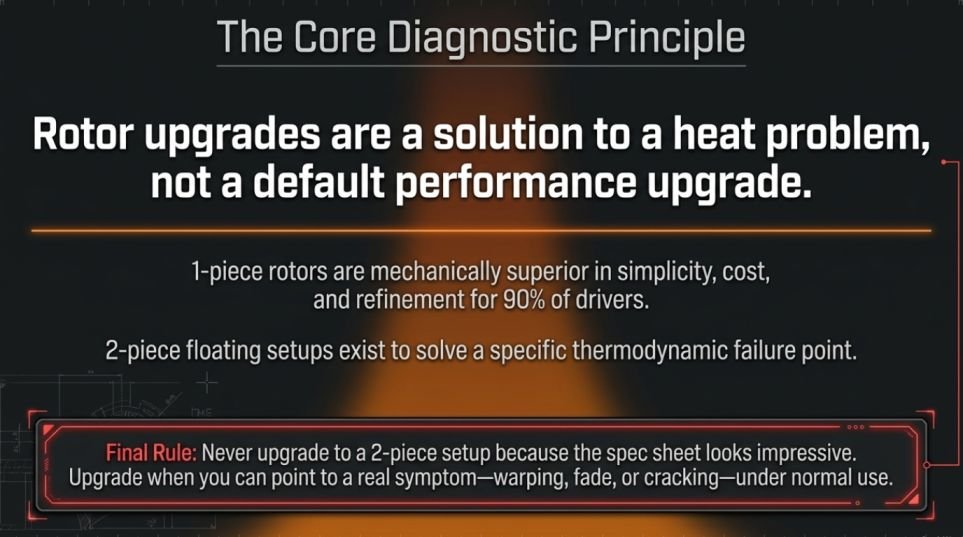
Everything in this comparison comes down to how much heat you actually put into your brakes on a regular basis. A 1-piece rotor is simpler, cheaper, and completely adequate for the vast majority of driving, including most towing and casual spirited driving. A 2-piece rotor, especially a floating one, solves a specific problem: repeated high-heat cycling that stresses a solid casting past its limit.
If you’re not sure which camp you’re in, start with a quality 1-piece rotor and good pads. It’s the cheaper mistake to make, and most drivers never outgrow it. Upgrade to a 2-piece setup only once you can point to a real symptom- warping, fade, or cracked rotors under normal use- rather than upgrading because the spec sheet sounds better.
FAQ
Are 2-piece rotors better than 1-piece rotors? Not universally. They’re better for heat management and weight under hard, repeated braking, like track use. For daily driving and light towing, a quality 1-piece rotor performs just as well at a much lower cost.
Do 2-piece rotors make noise? Floating 2-piece rotors can click or rattle at low speed, especially right after a hard stop as the ring cools. Fixed 2-piece rotors stay closer to silent, though they lose some of the floating design’s warp resistance.
How much lighter are 2-piece rotors than 1-piece rotors? It varies by size and hat design, but a few pounds per corner is typical on performance-sized rotors. That weight comes off rotating, unsprung mass, so the effect on handling and acceleration is bigger than the raw number suggests.
Can I replace just the ring on a 2-piece rotor? Usually yes, that’s one of the main selling points. The aluminum hat is designed to be reused across multiple rings, which can lower long-term cost if you’re wearing through rotors fast enough for it to matter.
Do 2-piece rotors warp less than 1-piece rotors? Floating 2-piece rotors resist warping better because the ring expands independently of the hat instead of fighting against it. Fixed 2-piece and 1-piece rotors both rely more on the metal’s own strength to survive that thermal stress.
Are 1-piece rotors good enough for towing? For occasional or moderate towing, yes, especially with a quality brand and properly bedded pads. Frequent heavy towing on long grades is one of the few street scenarios where a 2-piece rotor’s heat management genuinely pays off.
- Top 10 Ranking Tire Brand for Minivan: Reviewed 2026 - October 5, 2026
- Model Y Tesla Long Range Automatic Wagon Tyre Fitment And Ratings - October 3, 2026
- What Is The Benefit Of Larger Rear Tyres On A Zero-turn Mower - October 3, 2026