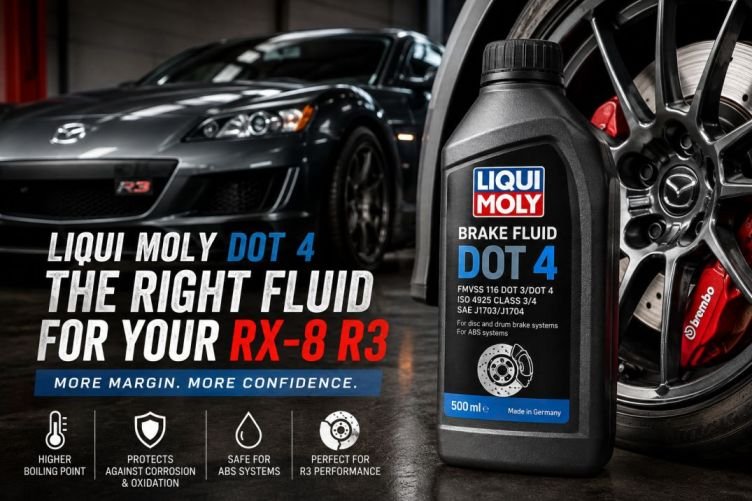
Yes. Liqui Moly DOT 4 meets the RX-8’s factory DOT 3 requirement and exceeds it. It’s a synthetic glycol-based fluid rated for ABS systems, and the R3’s bigger rotors and stiffer suspension make the extra thermal margin worth having. It’s not overkill, and it’s not the wrong spec. It’s a straightforward upgrade over the fluid that came in the car from the factory.
Key takeaways
- The R3’s owner’s manual calls for SAE J1703/FMVSS 116 DOT 3, and DOT 4 fluid satisfies that spec plus more.
- < cite index=”12-1″>Liqui Moly DOT 4 is certified to FMVSS 116 DOT 3/DOT 4, ISO 4925 Class 3/4, and SAE J1703/J1704</cite>, so there’s no compatibility gap with the factory system.
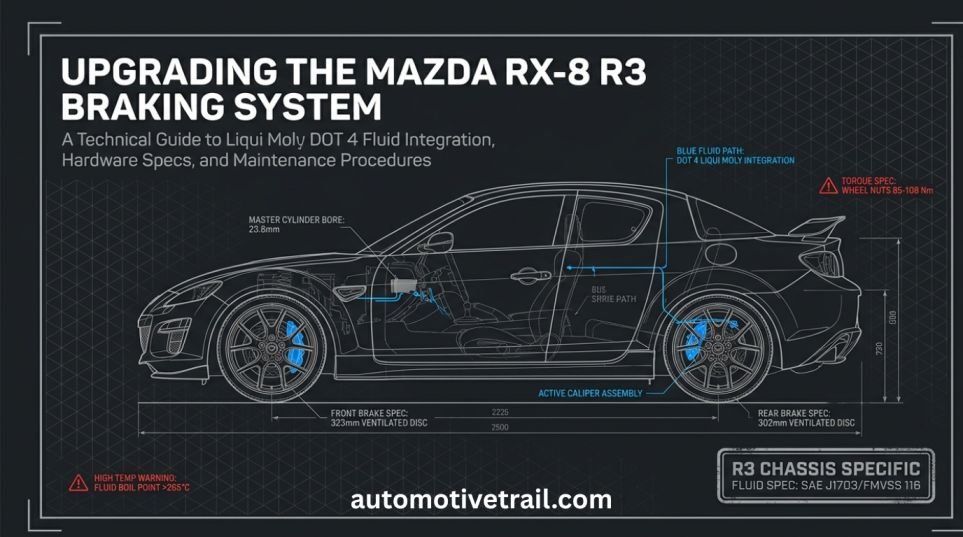
- < cite index=”36-1″>R3 models run 323mm front and 302mm rear rotors</cite>, larger than the ~290mm rotors on standard-suspension RX-8s, which means more heat reaches the fluid.
- < cite index=”7-1″>The R3’s master cylinder has no bleed nipple</cite>, which changes the standard RX-8 bleed order.
- If you track the car, Liqui Moly’s Race DOT 4 line offers a higher boiling point than the standard formula.
- A full flush beats a top-off. Mixing brands works in a pinch, but < cite index=”17-1″>Liqui Moly’s fluid only hits its full service life when used alone</cite>.
What brake fluid does the Mazda RX-8 R3 actually need?
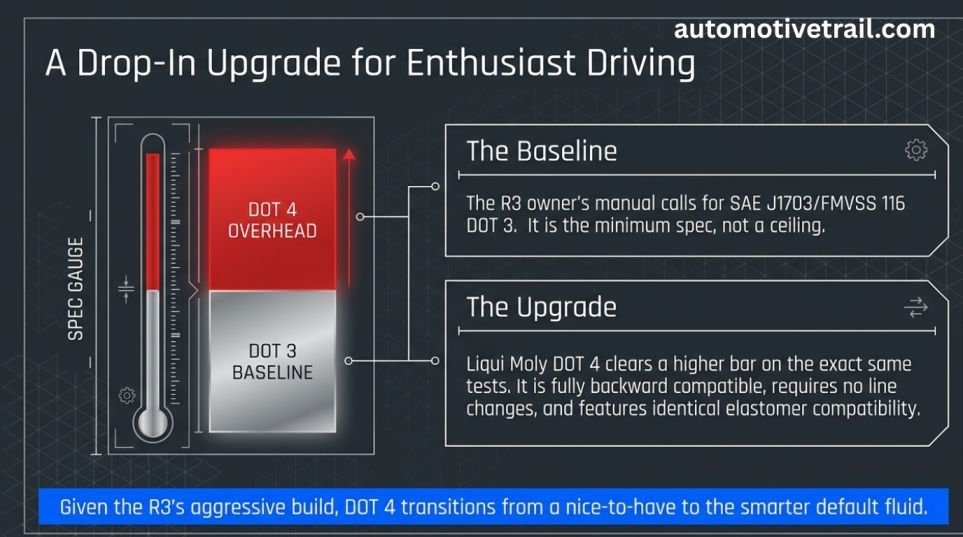
Mazda built every RX-8, R3 included, around a DOT 3 baseline. The service manual language is SAE J1703 or FMVSS 116 DOT 3, and that’s what left the factory in the reservoir. DOT 3 isn’t a bad fluid. It’s just the minimum spec, not a ceiling.
DOT 4 fluid is legal in any system spec’d for DOT 3, because DOT 4 has to clear a higher bar on the same tests. It doesn’t attack seals differently, and it doesn’t require different lines or a different master cylinder. It’s a drop-in upgrade in the truest sense of the phrase.
That matters for the R3 specifically. This trim wasn’t built for grocery runs. < cite index=”30-1″>The R3 sport package brought a more aggressive front and rear bumper, and it’s aimed at drivers who actually push the car</cite>. A base-spec DOT 3 fluid, especially one that’s a year or two old and has picked up moisture, gives you less margin before the pedal starts to feel soft under hard, repeated stops.
So the short version: your R3 needs DOT 3 at minimum, DOT 4 is fully legal and backward compatible, and given how the car is built, DOT 4 is the smarter default rather than a nice-to-have.
Why the R3’s brakes are different from a base RX-8
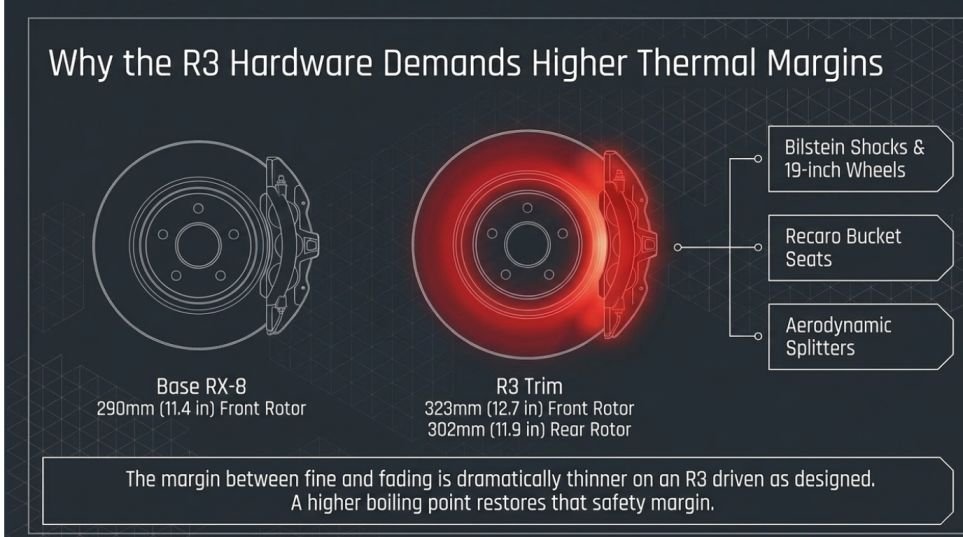
This is the part most brake fluid guides skip, and it’s the reason a generic “DOT 4 is fine” answer isn’t good enough here.
Rotor size splits by suspension package, not by trim badge. < cite index=”36-1″>Sport, Grand Touring, R3, and 40th Anniversary cars with the Sport suspension package run 323mm (12.7 in) front rotors and 302mm (11.9 in) rear rotors, while standard-suspension RX-8s use roughly 290mm (11.4 in) fronts</cite>. Bigger rotors mean more swept area and, under hard braking, more heat soaked into the caliper and, eventually, the fluid inside it.
The R3 stacks more on top of that. < cite index=”29-1″>It adds stiffer suspension with Bilstein shocks, 19-inch wheels, more supportive Recaro seats, and a rear spoiler</cite>, all signals that Mazda built this trim for drivers who corner harder and brake later than the average RX-8 owner. < cite index=”37-1″>The R3 also got a different front bumper with a lower splitter, side sills, and a bigger rear spoiler</cite>, which is cosmetic, but it tells you who Mazda was building this car for.
None of this means DOT 3 will fail you on a normal commute. It means the margin between “fine” and “fading” is thinner on an R3 than on a base Sport model, simply because the car generates more brake heat when driven the way it’s designed to be driven. A higher boiling point buys you room before that margin runs out.
Liqui Moly DOT 4 specs, explained
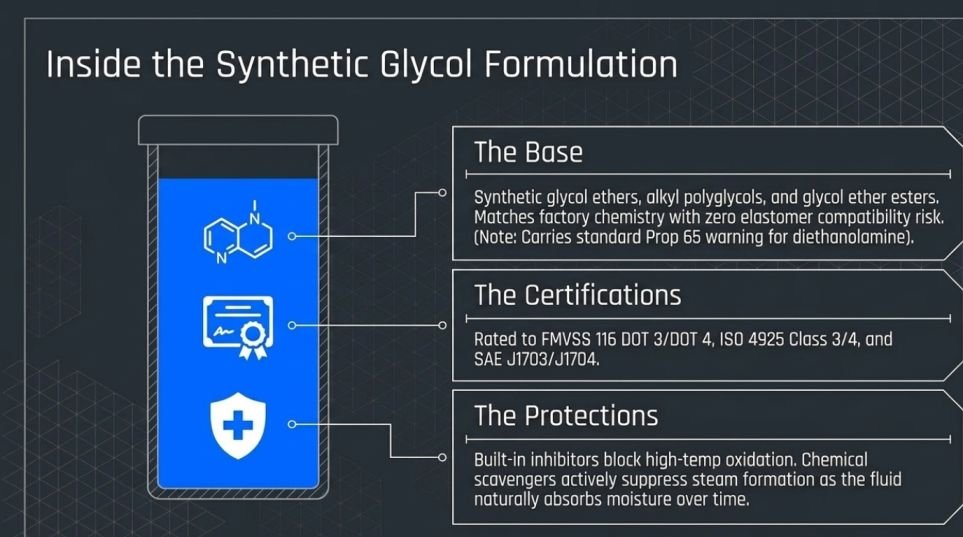
Here’s what’s actually in the bottle, not just marketing copy.
< cite index=”12-1″>Liqui Moly DOT 4 is a synthetic formulation built on glycol ethers, alkyl polyglycols, and glycol ether esters</cite>. That base is standard for DOT 4 fluids generally, and it’s the same chemistry your RX-8 already runs, so there’s no elastomer compatibility risk.
On certifications, < cite index=”12-1″>it’s rated to FMVSS 116 DOT 3/DOT 4, ISO 4925 Class 3/Class 4, and SAE J1703/J1704</cite>. That covers both the RX-8’s factory DOT 3 spec and the tighter DOT 4 standard in one product.
Functionally, < cite index=”12-1″>it carries a high wet and dry boiling point along with inhibitors for corrosion and oxidation protection at high temperatures, and it uses scavengers designed to suppress steam formation as the fluid absorbs moisture over time</cite>. That last part is the practical benefit: as any glycol fluid ages, it pulls in water from the air, and that water lowers the boiling point. The scavengers slow that decline.
It’s also rated for more than just brakes. < cite index=”15-1″>Liqui Moly DOT 4 works in disk and drum brake systems and clutch hydraulic systems, and it’s suitable for ABS-equipped vehicles</cite>, which covers every RX-8 trim since ABS is standard across the lineup.
One more note worth flagging: the safety data sheet carries a California Prop 65 warning for diethanolamine, which is standard for this category of fluid and not unique to Liqui Moly.
Liqui Moly DOT 4 vs. DOT 3 in the R3
| Brake Fluid | Type | Dry Boiling Point | Wet Boiling Point | Best Use | ABS | Base Chemistry | Key Features |
|---|---|---|---|---|---|---|---|
| Liqui Moly Race DOT 4 | DOT 4 | 320°C (608°F) | 195°C (383°F) | Track days, HPDE, repeated high-speed stops | Yes | Glycol-based | 40°C+ higher wet boiling margin vs. standard; street/track use. |
| Liqui Moly DOT 4 | DOT 4 Also meets DOT 3 |
Varies | Varies | Daily driving, spirited use, occasional track | Yes | Synthetic: glycol ethers, alkyl polyglycols, glycol ether esters | Corrosion/oxidation inhibitors; steam suppression; less hygroscopic than DOT 3. |
| Factory Brake Fluid | DOT 3 | Varies | Varies | Daily driving, light use | Yes | Glycol-based | OEM-spec factory fill. |
The takeaway from the table isn’t that DOT 3 is unsafe. It’s that DOT 4 gives you a bigger cushion for the same category of car, and on an R3 that cushion gets used more often than on a base Sport trim. If your RX-8 sees mostly highway miles and light city driving, DOT 3 will do the job. If you drive it the way Mazda built the R3 to be driven, DOT 4 is the fluid that matches the car.
Liqui Moly DOT 4 vs. Liqui Moly Race DOT 4: which one for your R3
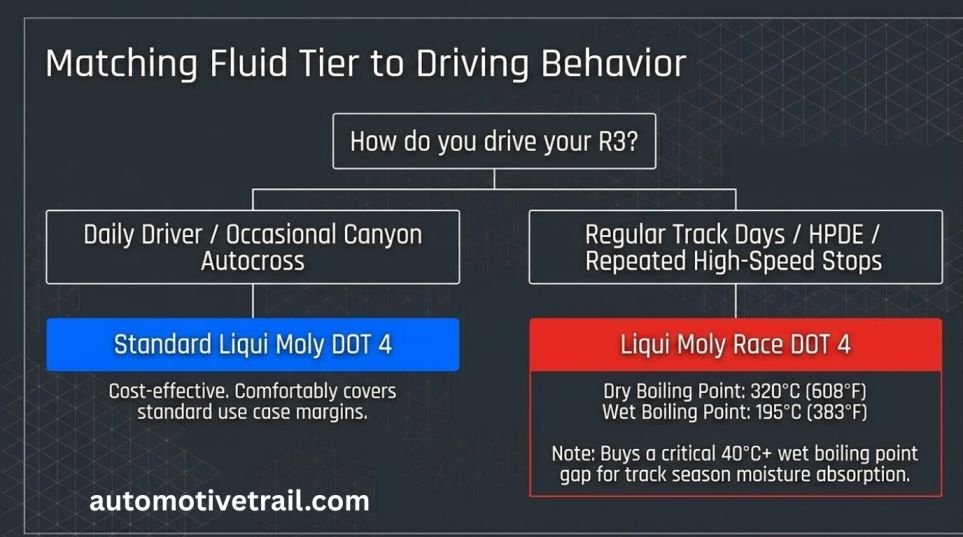
Liqui Moly sells two relevant tiers, and picking the wrong one either wastes money or leaves you short on margin.
Standard Liqui Moly DOT 4 is built for street use, spirited driving included. It handles hard braking on a mountain road or an autocross weekend without drama.
< cite index=”27-1″>Race DOT 4 pushes further, with a dry boiling point of 320°C (608°F) and a wet boiling point of 195°C (383°F), and Liqui Moly positions it as a dual-purpose street and track fluid</cite>. < cite index=”27-1″>Even with that higher spec, it’s still recommended for annual replacement in street use</cite>, so it’s not a fluid you install once and forget.
Here’s the decision in plain terms:
- Daily driver, occasional canyon run, or autocross: Standard Liqui Moly DOT 4. The boiling point margin comfortably covers this use case, and the price is lower.
- Regular track days, HPDE events, or repeated hard stops from high speed: Race DOT 4. The 40°C-plus gap in wet boiling point over standard DOT 4 buys real headroom when the fluid has absorbed some moisture between flushes, which every track fluid does over a season.
- Show car or garage queen: Either works, but standard DOT 4 is the more cost-effective pick since you’re not generating meaningful brake heat.
Most R3 owners land in the first category. Buy Race DOT 4 only if you’re actually putting the car on a track surface, because the extra cost buys margin you won’t use on the street.
Is Liqui Moly DOT 4 compatible with your R3’s existing fluid?
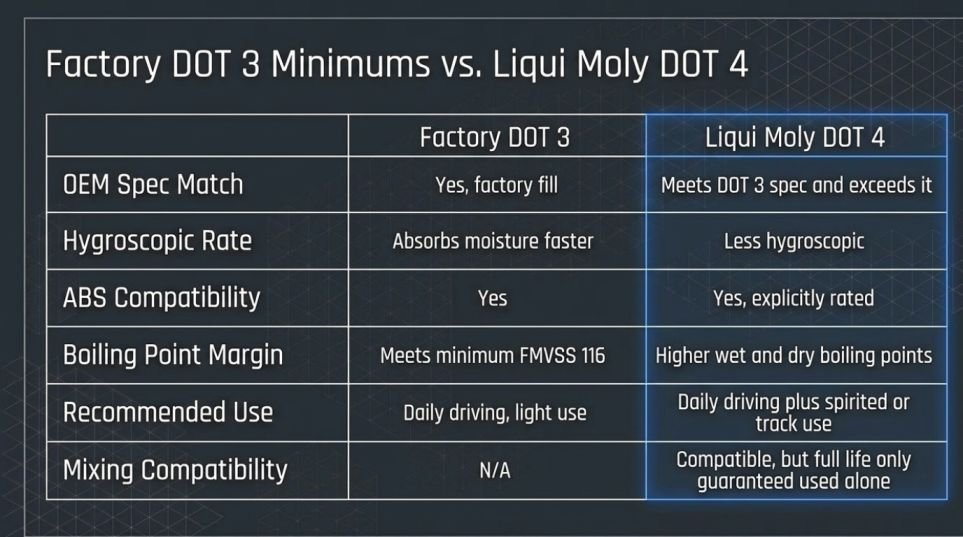
Compatibility comes down to two questions: chemistry and the ABS system. Both check out.
On chemistry, your RX-8 runs a glycol-based DOT 3 fluid from the factory. Liqui Moly DOT 4 is also glycol-based. < cite index=”7-1″>DOT 4 and DOT 5.1 are compatible with each other and don’t require a special flush process to switch between them</cite>, and the same logic holds moving from DOT 3 to DOT 4, since DOT 4 sits on the same glycol chemistry, just formulated to a tighter spec.
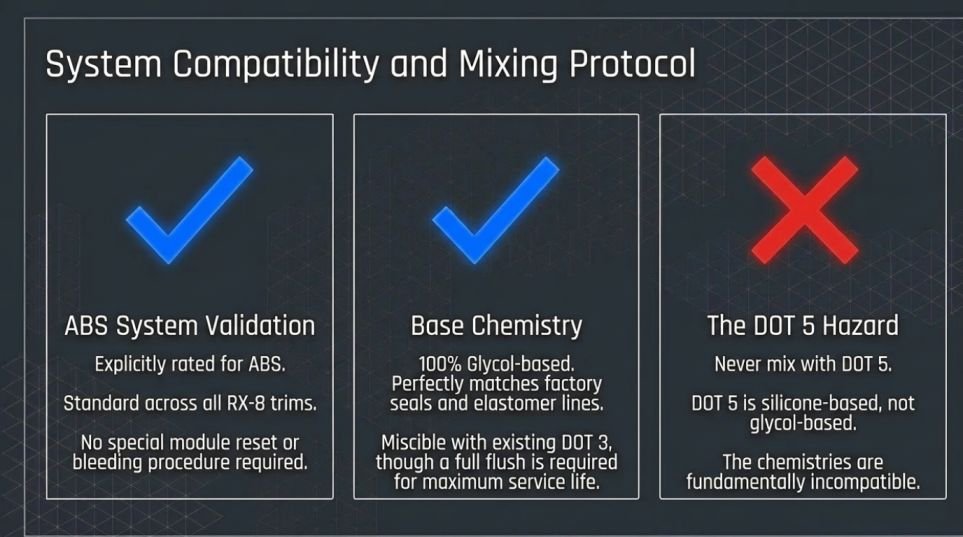
On the ABS question, < cite index=”15-1″>Liqui Moly DOT 4 is explicitly rated for use in ABS brake systems</cite>, and every RX-8 trim, R3 included, has ABS as standard equipment. There’s no special bleeding procedure or module reset needed for a fluid swap on this car.
The one thing to avoid: don’t mix in DOT 5 fluid. DOT 5 is silicone-based, not glycol-based, and the two chemistries don’t mix. You won’t accidentally end up with DOT 5 in an RX-8 since it’s not a common fitment for this car, but it’s worth knowing if you’re buying fluid off a shelf and grabbing the wrong bottle.
For best results, do a full flush rather than a top-off. < cite index=”17-1″>Liqui Moly’s fluid is miscible with other high-quality synthetic fluids, but its optimal service life is only guaranteed when it’s used alone</cite>, meaning mixed fluid still works; it just won’t hit the full interval Liqui Moly rates it for.
How to flush brake fluid on an R3 (and why it’s not like other RX-8 trims)
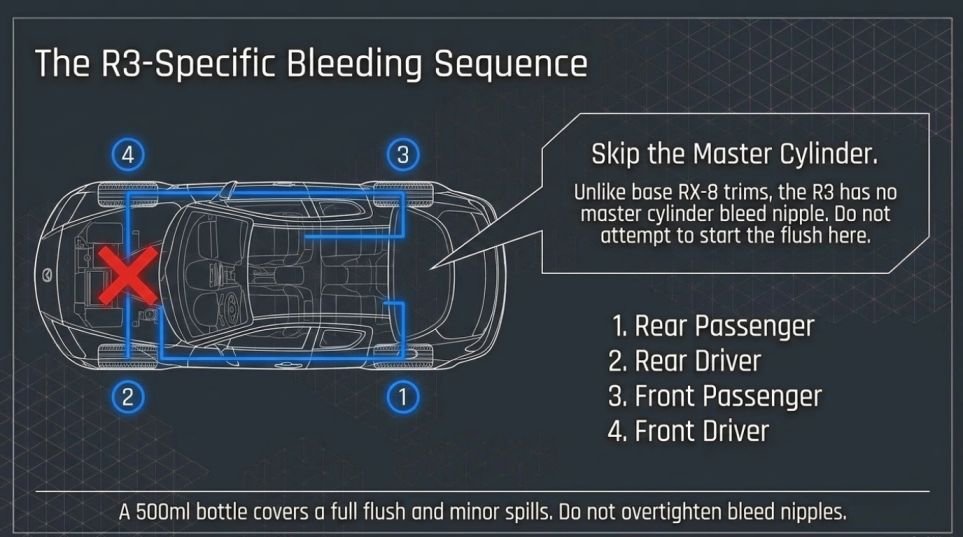
Most RX-8 guides assume a standard bleed order. The R3 breaks that pattern in one specific way.
- Confirm your suspension package first. If you’ve got the R3, you already have Sport suspension and the larger rotors, so no separate check needed there.
- Gather enough fluid. Buy at least one 500ml bottle. A full flush uses more than a simple top-off, and you don’t want to run short mid-bleed.
- Start at the corner farthest from the master cylinder. < cite index=”7-1″>The accepted sequence is rear passenger, rear driver, front passenger, front driver</cite>.
- Skip the master cylinder bleed step. < cite index=”7-1″>Unlike other RX-8 trims, the R3 has no master cylinder bleed nipple</cite>, so you can’t start there even if that’s your normal habit on other cars.
- Watch pedal feel as you go. < cite index=”7-1″>A properly bled system should feel stiff with the engine off, moving down slightly before it bites and holding firm. Spongy means air is still in the system. Slow sinking to the floor means a leak</cite>.
- Don’t overtighten the bleed nipples. < cite index=”7-1″>They need enough torque to seal but not so much that they get crushed</cite>.
- Budget about half an hour once you know the process, though your first flush will likely take longer while you get a feel for the rhythm.
If you’re not comfortable bleeding your own brakes, a shop flush on an RX-8 typically runs $80 to $150 depending on region and whether you supply the fluid yourself.
How often to change brake fluid in an RX-8 R3
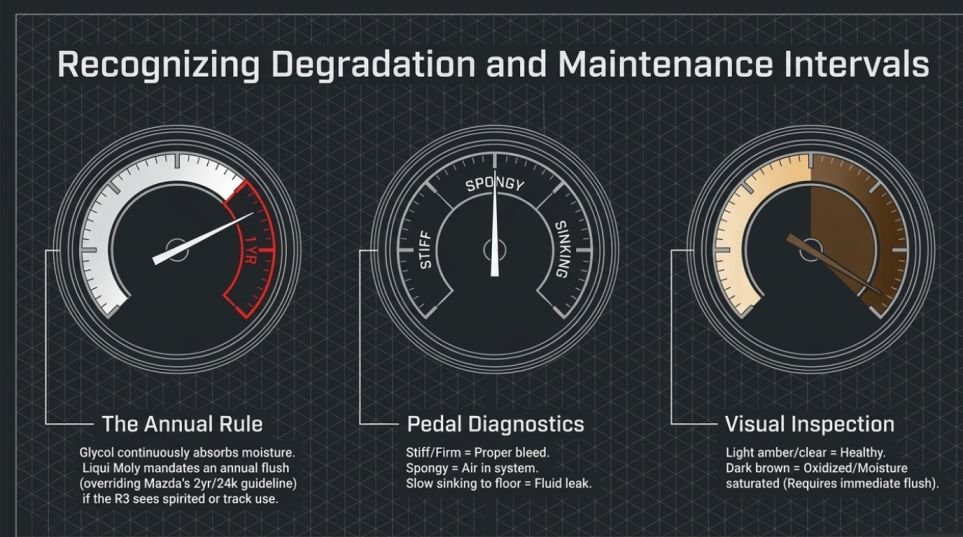
Glycol-based fluid absorbs moisture from the air continuously, whether the car is parked in a garage or driven daily. That’s true of DOT 3, DOT 4, and Race DOT 4 alike, and it’s why every one of these fluids comes with a change interval instead of a “lifetime fill” claim.
< cite index=”17-1″>Liqui Moly recommends an annual change, or whatever interval your vehicle manufacturer specifies, whichever applies</cite>. Mazda’s own service schedule for the RX-8 generally calls for a brake fluid inspection or change around the 2-year or 24,000-mile mark, though owners who drive hard or track the car should shorten that to annual regardless of mileage.
A few signs your fluid needs attention sooner than the calendar suggests:
- Pedal feels softer or sinks further than it used to.
- Fluid in the reservoir looks dark brown instead of light amber or clear.
- You’ve had a track day or several hard mountain-road drives since the last flush.
- It’s been over a year since your last change, and you drive the car regularly.
For an R3 owner who tracks the car even occasionally, treat the annual interval as a hard rule, not a suggestion. The bigger rotors and harder use mean the fluid works harder between changes than it would in a base RX-8 driven gently.
Where to buy Liqui Moly DOT 4 for your R3
Liqui Moly DOT 4 is widely stocked, so pricing and availability aren’t a real obstacle here.
< cite index=”15-1″>AutoZone carries it, with customer reviews consistently pointing to reliable performance under high-temperature and track conditions</cite>, which lines up with the spec sheet claims. Specialty retailers like GenRacer and EDO Performance also stock the standard 250ml and 500ml bottles, and both typically ship it alongside their Race DOT 4 line if you decide you want the higher-spec version instead.
A single 500ml bottle is enough for a full flush on most RX-8s, R3 included, since the brake system doesn’t hold a large fluid volume. If you’re buying for a full flush plus a bit of margin for spills or a second bleed pass, grab one bottle, and you’ll have enough.
Price generally lands in the $12 to $20 range per 500ml bottle depending on retailer, which is a small cost relative to what a full flush protects against, namely brake fade under hard use.
Bottom line: should you use Liqui Moly DOT 4 in your RX-8 R3
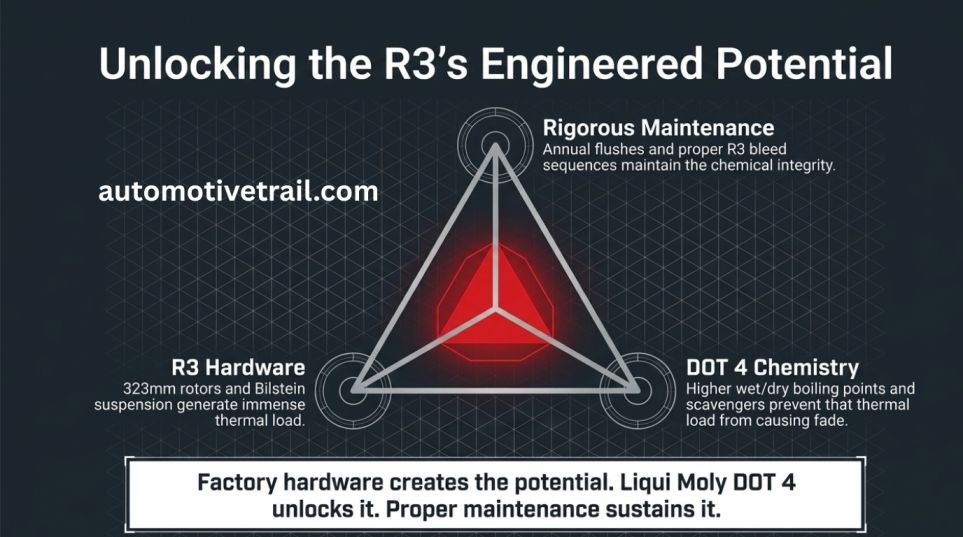
Yes, and the case for it holds up under scrutiny rather than falling apart once you check the specs.
< cite index=”12-1″>Liqui Moly DOT 4 clears the RX-8’s factory DOT 3 requirement, and the tighter DOT 4 spec in the same product</cite>. < cite index=”15-1″>It’s rated for ABS systems</cite>, which every RX-8 has. And the R3’s larger rotors and enthusiast-focused build mean the extra thermal and moisture margin over stock DOT 3 gets used, not wasted.
If your driving is mostly commuting and highway miles, standard Liqui Moly DOT 4 covers you with room to spare. If you’re tracking the car regularly, step up to their Race DOT 4 for the extra 40-plus degrees of wet boiling point margin. Either way, do a full flush rather than a top-off, remember the R3’s master cylinder has no bleed nipple, and set a calendar reminder for an annual change regardless of which fluid you pick.
That’s the whole decision. Match the fluid tier to how you actually drive the car, flush it properly, and don’t let it sit past a year.
FAQ
Can I mix Liqui Moly DOT 4 with my RX-8’s factory brake fluid?
Yes. Both are glycol-based DOT 3/DOT 4 fluids, so mixing won’t cause a chemical reaction or damage seals. That said, a full flush gets you the fluid’s full rated service life, while mixing shortens it somewhat.
Is Liqui Moly DOT 4 safe for ABS brakes?
Yes. It’s explicitly rated for ABS-equipped vehicles, and every RX-8 trim, R3 included, comes with ABS as standard equipment. No special bleeding procedure or module work is needed for the swap.
What size bottle do I need to flush an RX-8’s brake system?
A single 500ml bottle covers a full flush on most RX-8s, including the R3. If you want margin for spills or a second bleed pass, that one bottle is still usually enough.
Does Liqui Moly DOT 4 void my Mazda warranty?
No. Using a DOT 4 fluid that meets or exceeds the factory DOT 3 spec doesn’t void your warranty, since it’s a compliant fluid, not an unauthorized modification. Keep your receipt if you’re doing the flush yourself for your records.
Can I use DOT 5 brake fluid in an RX-8 R3 instead?
No. DOT 5 is silicone-based rather than glycol-based, and it’s not compatible with the glycol fluid your RX-8 runs from the factory. Stick with DOT 3, DOT 4, or DOT 5.1, all of which share the same base chemistry.
How much does a full brake fluid flush cost on an RX-8 R3?
A shop flush typically runs $80 to $150 depending on region and labor rates. Doing it yourself costs the price of one 500ml bottle of fluid, roughly $12 to $20, plus whatever bleeding equipment you already own or need to buy.

- Top 10 Ranking Tire Brand for Minivan: Reviewed 2026 - October 5, 2026
- Model Y Tesla Long Range Automatic Wagon Tyre Fitment And Ratings - October 3, 2026
- What Is The Benefit Of Larger Rear Tyres On A Zero-turn Mower - October 3, 2026