
You searched “2016 Ford F-150 6R80 transmission oil capacity” because you’re about to drain-and-fill the transmission, top it off, or plan a full service. The problem is simple: the number changes depending on whether you just pull the pan drain, or you do a complete refill that includes the torque converter. If you buy fluid blindly, overfill or underfill is easy.
Key facts: 6R80 capacity depends on the service method (pan drain-and-fill vs full refill or exchange), and level is set at a specific ATF temperature. This guide will give the correct ATF spec to buy, the capacity figures you need for each method, and the exact check procedure so you set the level right the first time.
6R80 transmission oil capacity for a 2016 Ford F-150 depends on service type. Use pan drain-and-fill capacity for a simple drain and refill, and use the full refill amount for a complete service that replaces fluid from the torque converter and cooler circuits. Verify level with the Ford procedure at the specified ATF temperature range.
2016 Ford F150 6r80 Transmission Oil Capacity
The 6R80 capacity depends on how much transmission fluid you’re trying to replace, drain, or refill. A pan drain-and-fill replaces mostly the fluid in the pan, while a full refill requires a different total volume. Because Ford level checks use temperature and a specific check method, the “correct” amount is tied to how you set the fluid level, not just a number from a chart.
What This Article Will Pin Down
This article section-by-section breaks out the fluid volume for common service types so you can buy the right amount before you start. The next section covers the pan drain-and-fill volume, then following sections address larger-volume refills that bring fluid level to spec. This first section focuses on why capacities change by method and how to verify level so you don’t underfill or overfill the 6R80.
Because there was no single universal “drop-in” volume that covers every shop procedure, this page treats capacity as a range tied to the service style. Your exact result can shift with how long the vehicle sits, whether the converter was drained, and whether the technician measures the fluid at the correct temperature window. Overfilling is a real problem on the 6R80, since excess fluid can aerate and push fluid out through the vent, creating additional mess and drivability issues.
Why Service Type Changes The Amount
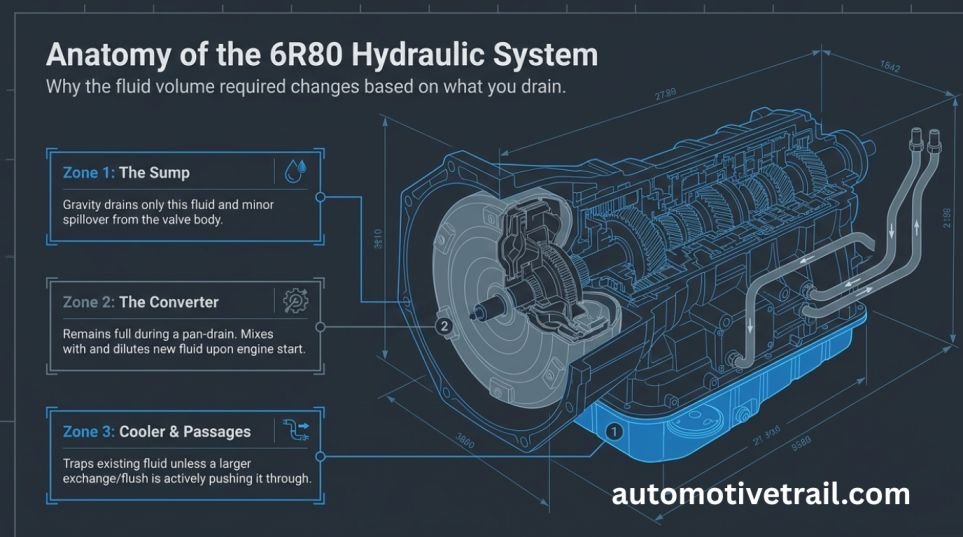
Fluid level on the 6R80 is corrected with a temperature-based procedure using either the dipstick, if equipped for that model, or the fill/check plug method. Pan drain-and-fill mainly changes the fluid that’s already in the pan, so you can’t expect it to match the volume required for a full circuit refill. Full refills and fluid exchanges move more fluid out of the torque converter and cooler circuit, which is why the total volume is higher.
Capacities are useful for shopping fluid, but level verification is what keeps the transmission in the safe operating range.
| Service approach | Why the “capacity” changes |
|---|---|
| Pan drain-and-fill | Replaces mostly pan fluid; converter and cooler passages keep their existing fluid until a larger exchange is done. |
| Total refill/exchange | Moves fluid from more of the hydraulic circuits and can include more converter fluid depending on the procedure. |
| Level verification step | Final fluid amount is set by temperature-corrected level measurement, not by fluid poured. |
Pan Drain-and-fill Capacity
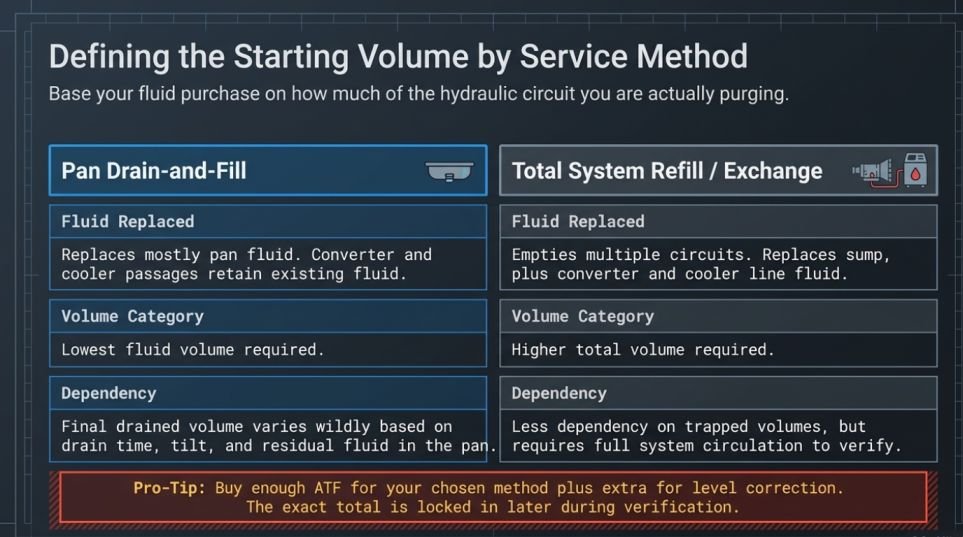
Pan-only service on the 2016 F-150 6R80 is typically a “partial refill,” meaning you remove fluid from the pan, refill that amount, and then set the level through the transmission’s check procedure. The exact quart amount varies by how much fluid drains before flow stops and how closely you match fluid temperature to the spec, so you should plan on buying enough ATF for the pan drain plus a small top-off.
What Actually Drains During A Pan-only Job
During a drain-and-fill that only opens the pan, gravity drains the fluid that sits in the sump and any spillover from the valve body area exposed by the pan removal. The torque converter remains full, and the internal pump keeps circulating fluid only after you start the engine, which is why your refilled level is set by the correct temperature range and check method.
Converter Involvement In Pan-fill Scenarios
The torque converter matters because it dilutes your “newness” and affects where the level ends up once the transmission is running and the fluid is flowing. After refilling the pan and starting the engine, converter fluid mixes into the system, so the level you see on the dipstick or at the fill/check port is the real target, not the number of quarts you poured in.
In practice, that means pan-only services can end up with a surprisingly wide “fluid in the box” range even when the job is done correctly. Shops manage this by refilling, warming to the specified temperature window, then checking level at the correct port and adjusting in small increments.
| Service method | What gets replenished | Why capacity varies |
|---|---|---|
| Pan drain and refill | Pan/sump portion first, then mixes with converter fluid after warm-up | Drain time, residual fluid, and correct warm temperature for level check |
| Converter drain or full system service | More total fluid exchanged, closer to full capacity | More circuits emptied, less dependency on residual trapped volumes |
Pro tip: Plan to check level after warming the transmission to spec. If you base decisions on how many quarts you poured in, you can overfill or underfill because the converter and internal passages change how much fluid returns to the pan during the check.
Notes On Variability By Service Method
Pan drain amounts vary based on how long you let it drip, whether the vehicle sat level, and whether the transmission is checked at the correct temperature range. Even a careful technician can see different “drained volume” results compared to another shop because drain time and fluid temperature change the residual amount left in the pan and cooler pathways.
For a reliable result on your driveway, follow the level-check procedure exactly (dipstick or fill/check plug), then adjust with small top-offs until the level lands in the prescribed range. That approach is safer for the 6R80 than guessing a single pan-only quart number and calling it done.
Total System Refill Capacity
On the 2016 Ford F-150 6R80, total refill volume depends on how much of the hydraulic circuit you actually drain and replace. A pan-only drain-and-fill only swaps fluid in the sump, while a true “system refill” including the converter and cooler/lines takes more fluid because used ATF remains in those circuits.
What Counts Toward The Total
Total system refill capacity is the fluid needed to bring the entire transmission, including the converter and cooler/lines, back to the correct level. For service planning, the key point is that the torque converter holds a meaningful amount of ATF that a basic pan service does not fully remove. The external cooler circuit (radiator cooler and any lines) also holds fluid that flows out only when you do a full exchange method.
Torque Converter And Line Involvement
Converter participation is the biggest reason a “complete refill” takes more ATF than a pan refill.
In practice, even with a thorough drain, converter fluid mixes during operation and only leaves in measurable amounts during a fluid exchange or when the drivetrain is cycled, and the level is corrected at the proper temperature. Cooler/line involvement matters because some exchange methods push new fluid through the cooler circuit, while others do not.
Insider tip: Treat “total system” capacity as a range until you confirm the level procedure. The 6R80 uses a temperature-based check, so the “correct” volume is the one that results in the proper ATF level at the specified fluid temperature.
Typical Refill Ranges And Why Verification Is Required
Because different shops use different exchange techniques (pan drain only, vacuum extraction, hose-and-run exchange, or machine exchange), the practical refill total can vary. What stays consistent is the level specification method, which is temperature- and transmission-position-dependent.
| Service method | What gets replaced | Refill planning guidance |
|---|---|---|
| Pan drain-and-fill | Sump fluid mainly | Lowest fluid volume; converter and cooler stay partially filled. |
| Full exchange-style approach | Sump plus additional converter/cooler fluid | Higher volume needed because fluid is pushed through lines and converter. |
Verification is the final step because the “total” you end up using is tied to how much you successfully purge from the converter and cooler circuit, plus how the ATF level is set. Use the correct 6R80 level check procedure on the dipstick or fill/check port at the specified fluid temperature, then top up only to the mark or flow specification.
For owners planning fluid purchases, the safest approach is to buy enough ATF for a complete exchange process, plus a little extra for level correction, then rely on the temperature-based level check to “lock in” the correct final amount. This keeps you from assuming two vehicles with the same transmission code will consume the exact same number of quarts.
ATF Specification for 6R80
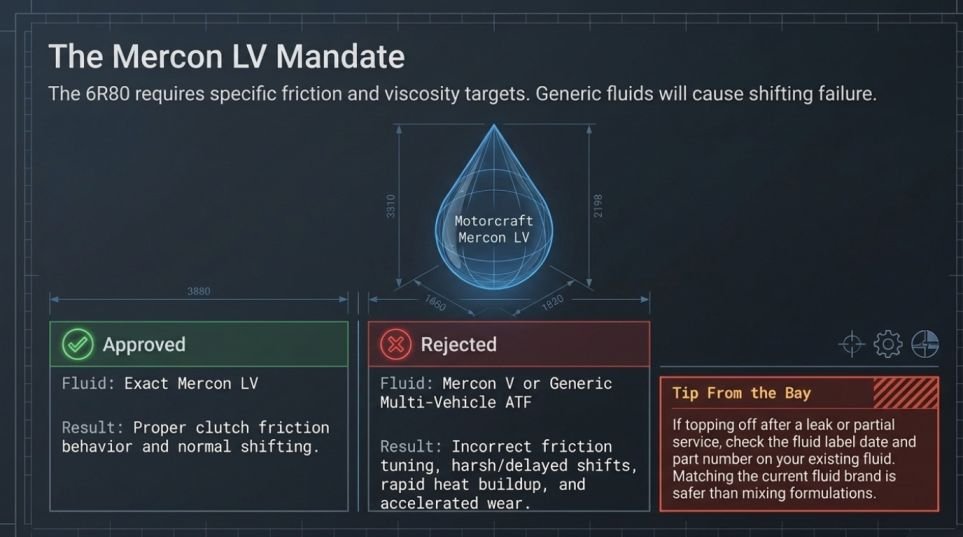
Ford specifies Mercon LV ATF for the 6R80 transmission used in the 2016 F-150. Mixing other ATFs or using a “universal” fluid is a gamble, because the friction and viscosity targets are different for Mercon LV.
Ford-approved Fluid And What To Buy
For 2016 F-150 6R80 service, buy Motorcraft Mercon LV (or a product that explicitly states it meets Ford Mercon LV requirements). If the bottle does not clearly say “Mercon LV,” skip it, even if it claims “multi-vehicle” or “compatible with Mercon.”
| What the label says | Fit for 6R80 (2016 F-150) | What can go wrong |
|---|---|---|
| Mercon LV | Yes | Normal shifting and proper clutch friction behavior |
| Mercon V or Mercon | No | Harsh or delayed shifts, heat buildup, accelerated wear |
| Generic “ATF” (no Mercon LV callout) | No | Incorrect friction tuning and viscosity mismatch |
Mercon LV Compatibility Notes (Read The Fine Print)
Mercon LV is designed to work with the 6R80’s internal clutch materials and valve body calibration. Some fluids marketed as “compatible with Mercon LV” are still trace-dependent on formulation and approvals, so the safest route is to buy a bottle that explicitly meets the Ford Mercon LV spec.
Tip from the bay: If you are topping off after a leak or a partial service, check the fluid label date and part number for the exact Mercon LV you planned to use. Mixing different Mercon LV brands usually is better than using the wrong spec, but the cleanest approach is to match what is already in the transmission when you can.
Mercon LV compatibility also matters because the 6R80 can feel “fine” at first with an incorrect fluid. The problems often show up as shift feel changes under load, longer engagement times, or accelerated fluid breakdown after repeated heat cycles.
Level-check Method for 6R80
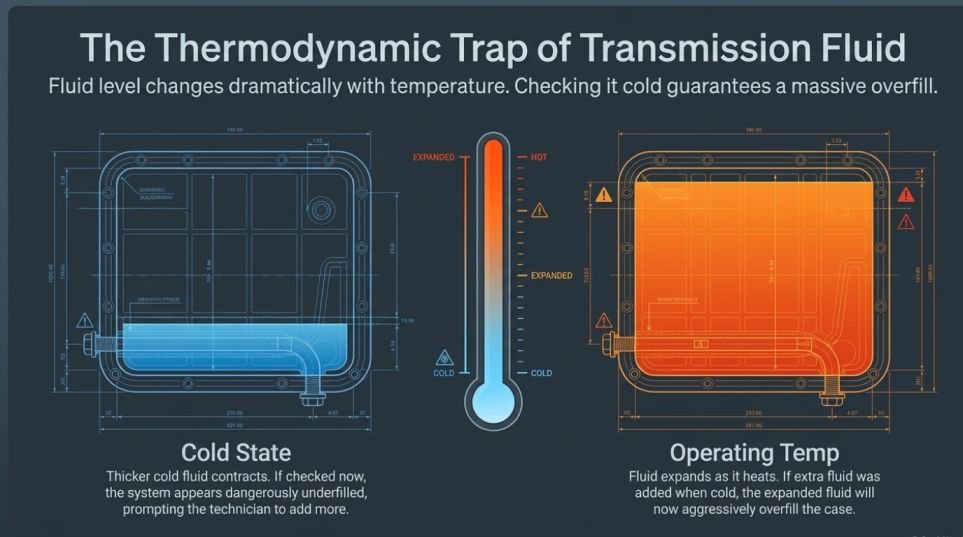
2016 F-150 with the 6R80 uses a level-check method based on the transmission’s fluid temperature, and the procedure differs depending on whether you are checking on the dipstick or at the fill/check plug. Most owners can avoid overfill by using the fill/check plug method, since the correct fluid level is set when fluid just begins to run out at the specified temperature range.
Dipstick Vs Fill/check Plug Approach
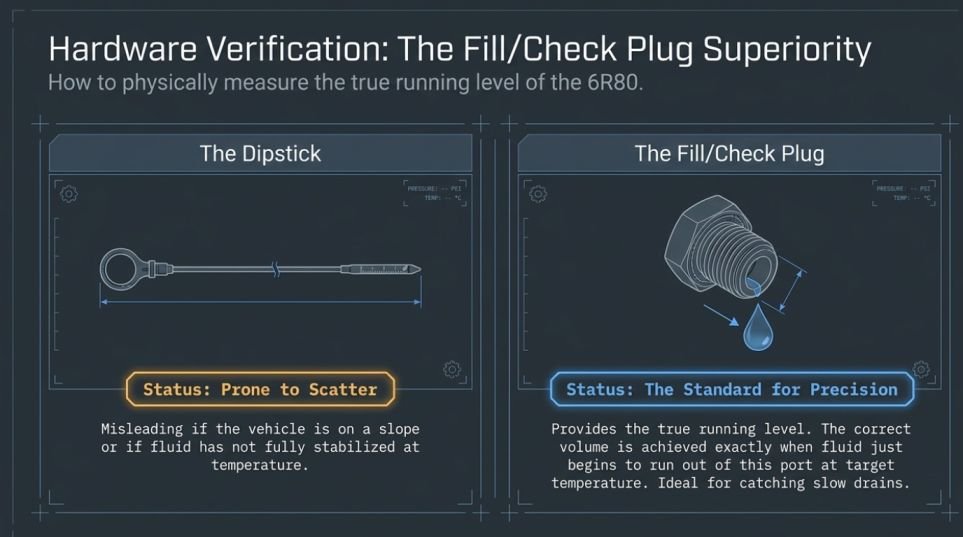
Dipstick checks are common on many Ford transmissions, but the 6R80’s level is more reliable when set at the fill/check plug. The big reason is that the 6R80 fluid level changes as temperature changes, and a dipstick reading can be misleading if the ATF is not in the target range.
Fill/check plug checks are also the best way to confirm you did not miss a slow drain.
In practice, the fill/check plug method tells you the true “running level” for the transmission under the correct conditions, while dipsticks are more prone to scatter when the vehicle is on a slope or when the fluid has not fully stabilized.
When To Perform The Level Check
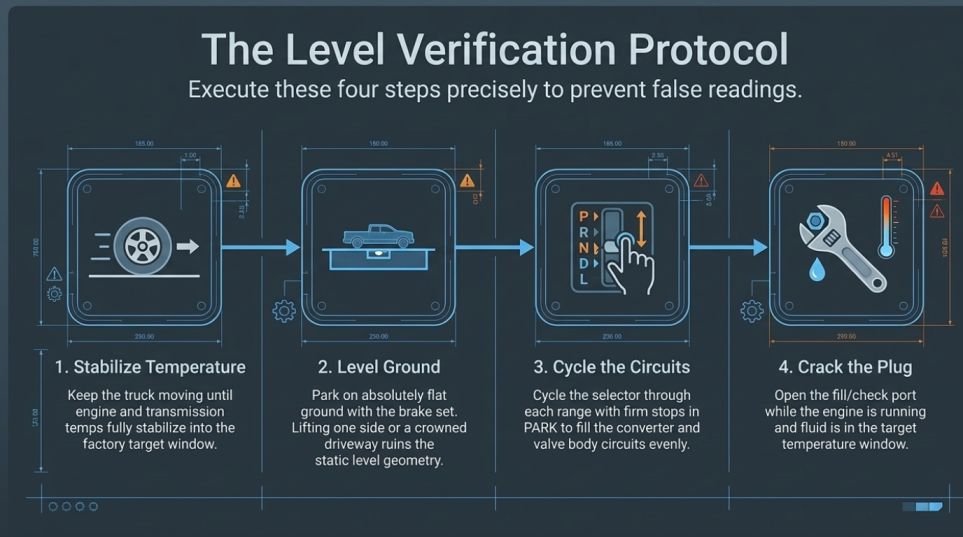
Perform the level check after the transmission has reached the target fluid temperature, not cold and not “just after a test drive.” The 6R80 needs time for fluid to circulate through the converter and valve body, and that circulation affects where the fluid sits in the pan and main case passages.
Before you crack the plug, keep the truck level on the ground. Lifting one side or parking on a crowned driveway can change the static fluid level at the check point and lead you straight to an overfill or underfill.
Insider tip: Overfilling is a common mistake during home service because the fluid expands quickly with temperature. If you are unsure which method your 2016 uses for your exact build, verify through the factory service information or follow the procedure that matches your vehicle’s dipstick and check-plug layout.
Temperature Targets And Procedure
6R80 fluid level checks are only accurate when the transmission fluid temperature is within the Ford target range, because fluid expands and moves as temperature changes. Aim for the temperature window specified in the service manual for the exact check point you are using.
Target Temperature Range And Why It Matters
Use the scan tool or a thermometer at the pan to hit the correct fluid temperature before you crack the check plug. On the 6R80, the level is set when the fluid is at operating temperature, then the correct amount drains or stands at the check port. Checking cold is the fastest way to overfill, since thicker cold fluid can trick you into thinking the level is low.
For safety and repeatability, keep the vehicle moving until the engine and transmission temps stabilize, then park on level ground with the parking brake set. Run the gear selector through each range for a few seconds each, with firm stops in PARK (or the required position from the manual), so the converter and valve body circuits fill evenly.
What To Do If Temperatures Are Off
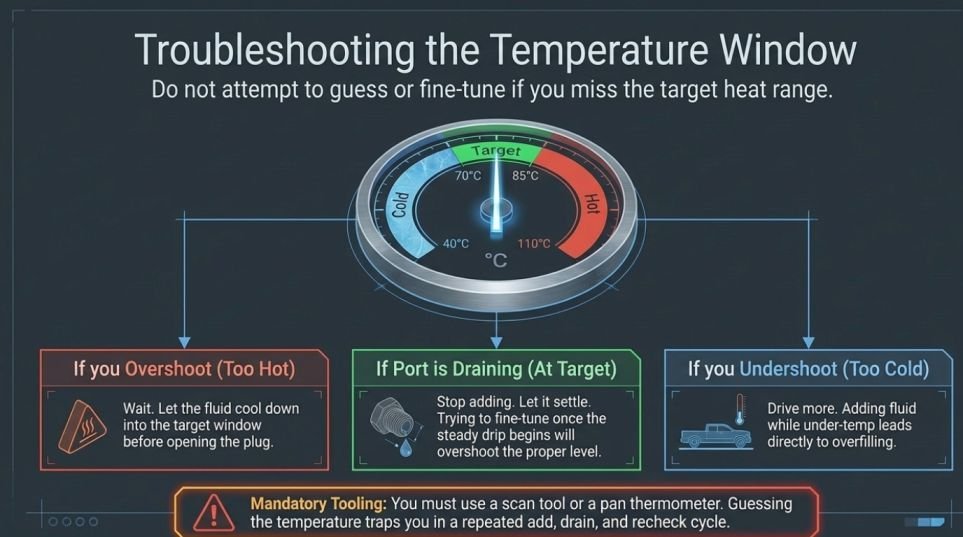
If you overshoot the temperature, wait for the fluid temperature to come back down into the target window before setting the level. If you are under target, drive a little more and recheck, because adding fluid cold usually leads to overfilling hot.
For example, if the check plug shows no fluid at the correct temperature, add only small amounts of the correct specification fluid, then recheck after a short idle period. If fluid drips out steadily at the target temperature, stop adding and let it settle, since trying to “fine-tune” after the port begins draining can overshoot the proper level.
Tip: If you cannot reliably measure transmission temperature, stop and get the right tool or have a shop do the check. Guessing temperature is what turns a simple 6R80 level verification into a repeated add, drain, and recheck cycle.
Quick Summary
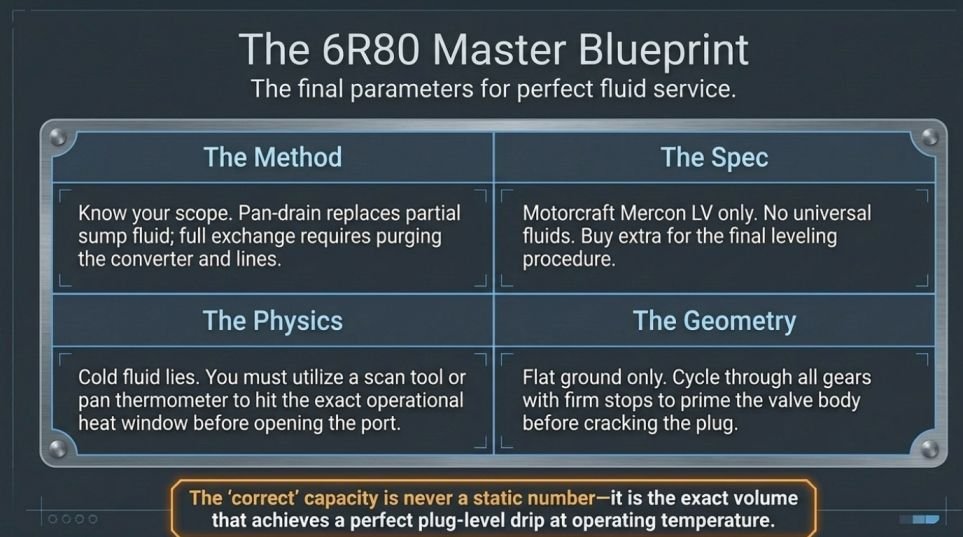
For a 2016 Ford F-150 with the 6R80, transmission oil capacity changes based on how you service it. A pan drain-and-fill replaces mostly the fluid you can reach in the pan, while a full refill or exchange moves more fluid from the torque converter and cooler circuits. The final fluid level is set by the specified check procedure and ATF temperature.
Plan your service approach first, because pan-only service cannot be expected to match the fluid volume needed for a complete circuit refill. Overfilling can aerate the ATF and push fluid out, while underfilling can affect hydraulic operation. Let the truck reach the required temperature, check at the correct point, and adjust only in small increments.
| Service type | What fluid is replaced | Key setup requirement from the article |
|---|---|---|
| Pan drain-and-fill | Mostly pan fluid plus small amounts that come out during servicing | Verify level using the Ford temperature-based procedure and the correct check method |
| Full refill or exchange | Moves more fluid from additional hydraulic circuits, potentially including converter fluid | Check level at the specified ATF temperature to avoid overfilling |
Frequently Asked Questions
What Is The 2016 Ford F-150 6R80 Transmission Oil Capacity?
Ford does not give one universal “capacity” number that fits every 6R80 service method, because capacity changes with drain-only vs fluid exchange and whether the torque converter is drained. For a correct amount on your 2016 F-150, use the specification tied to your exact service procedure and set the level correctly.
How Much 6r80 Fluid Do I Need For A Full Fluid Exchange On A 2016 F-150?
A full exchange typically uses more fluid than a drain-and-refill because it replaces fluid inside the torque converter and cooler circuits. Since exact numbers vary by setup and procedure, follow the manual for your specific procedure and verify the fluid level at operating temperature.
How Long Does It Take To Change 6R80 Transmission Fluid On A 2016 F-150?
A basic drain-and-refill is often a quick job, but you still need time to warm the transmission, verify level, and clean up any mess. Expect roughly a couple of hours if you have ramps and common tools, longer if you are doing a complete exchange or dealing with stuck hardware.
What Happens If I Put Too Much Or Too Little Fluid In A 2016 F-150 6R80?
Overfilling can cause foaming and aeration, which can lead to harsh shifts or abnormal behavior. Underfilling can starve the hydraulic circuits and cooling system, so the best fix is to correct the level using the proper temperature and the correct check method.
Can I Check 2016 F-150 6R80 Fluid Level Without Knowing The Exact Oil Capacity?
Yes, and you generally should, because the correct level is determined by the check procedure and temperature, not by guesswork. If your 6R80 uses a dipstick, follow the warm-level steps; if it uses a fill/check method, set the level by the procedure.
What’s The Most Common Mistake When Adding Fluid To A 2016 F-150 6R80?
The most common mistake is adding fluid when the transmission is not at the required operating temperature or using the wrong method for level checking. Another common one is assuming the “capacity” from a drain-only context applies to a fluid exchange, which can leave you overfilled or underfilled.

- Top 10 Ranking Tire Brand for Minivan: Reviewed 2026 - October 5, 2026
- Model Y Tesla Long Range Automatic Wagon Tyre Fitment And Ratings - October 3, 2026
- What Is The Benefit Of Larger Rear Tyres On A Zero-turn Mower - October 3, 2026