
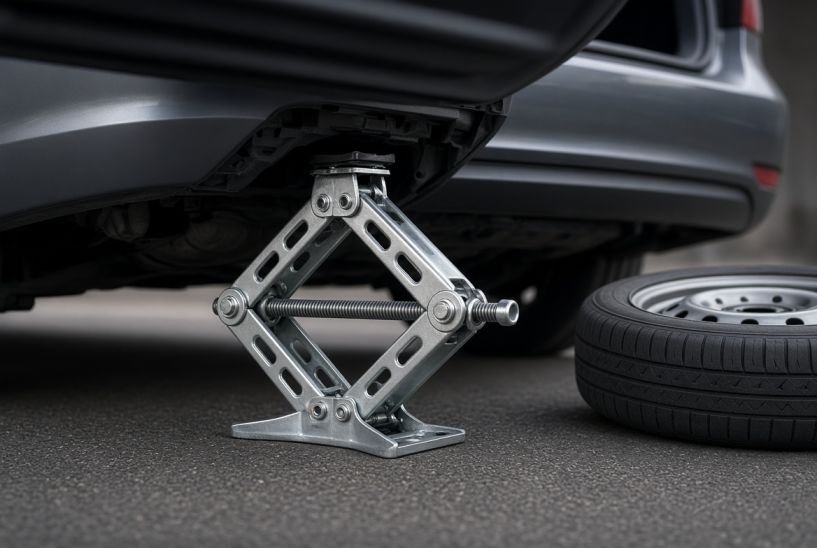
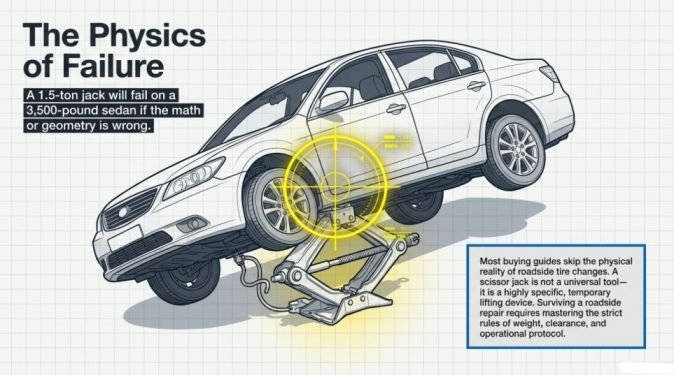
A scissor jack rated for 1.5 tons can still fail you on a 3,500-pound sedan if you park it on a slope or line it up wrong. That’s the part most buying guides skip.
Most scissor jacks lift 1.5 to 3 tons and raise a car 12 to 20 inches, enough clearance for a tire change or a quick brake job. The right one for your car depends on curb weight, ground clearance, and whether you need it for roadside emergencies or regular garage work. Buy a jack rated at least 25% above your vehicle’s actual weight, and always back it up with jack stands before you go underneath.
Key takeaways
- Match capacity to GVWR plus a 25% margin, not curb weight alone.
- A lift range of 12 to 20 inches covers most sedans and SUVs; trucks need the high end of that.
- A scissor jack is for temporary lifting only. Never work under a car supported by one alone.
- Electric and drill-driven models cut lifting effort but still need a manual backup.
- A wide base, 12 inches or more, cuts tipping risk on uneven pavement.
- Grease the threaded rod once a year even if the jack never leaves the trunk.
Scissor jack weight capacity
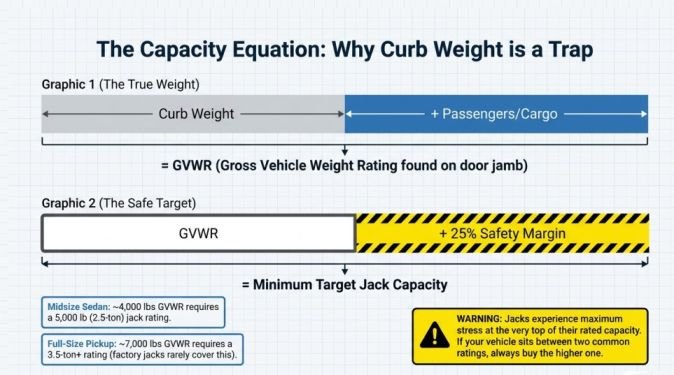
Check your door jamb sticker or owner’s manual for the gross vehicle weight rating, or GVWR. That number includes passengers and cargo, not just the empty car, and it’s the one that matters when you’re deciding on a jack.
Add a 25% safety margin to that figure. A midsize sedan with a GVWR around 4,000 pounds should sit on a jack rated for at least 5,000 pounds, which puts most 2.5-ton (5,000-lb) jacks in range. A full-size pickup with a GVWR near 7,000 pounds needs a 3.5-ton or higher rating, and a lot of factory scissor jacks won’t cover that.
Don’t round down. Jacks under load stress the most right at the top of their rated capacity, and that’s exactly when a weld or thread can give. If your vehicle sits between two common jack ratings, buy the higher one.
One more wrinkle: towing or hauling changes the math. If you regularly drive loaded, size the jack to that loaded weight, not the number on the spec sheet for an empty car.
Lift height and ground clearance
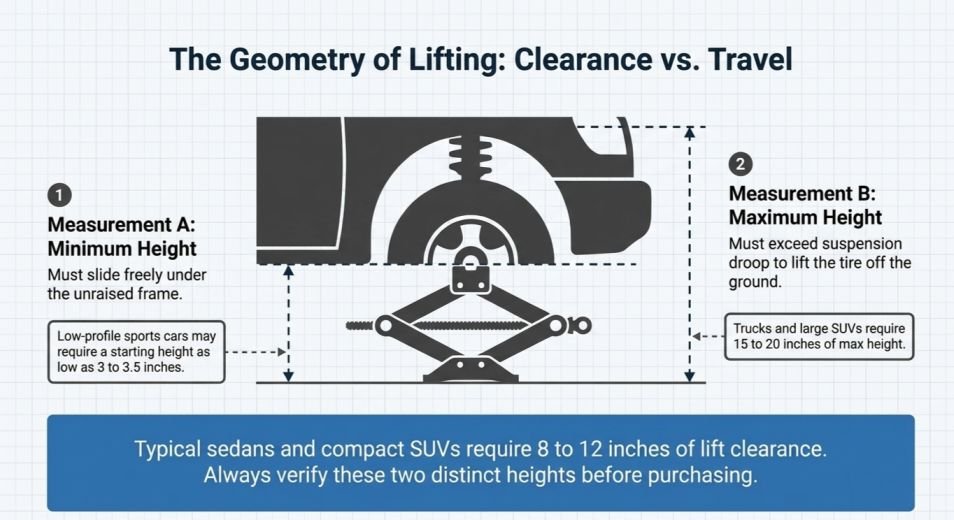
Capacity gets the most attention, but lift height is where people actually get stuck on the side of the road. A jack that tops out at 12 inches won’t get a lifted truck’s tire off the ground, and a jack that starts too tall won’t slide under a lowered sports car in the first place.
Sedans and compact SUVs generally need 8 to 12 inches of lift to clear a flat tire. Larger SUVs and trucks often need the full 15 to 20 inches that higher-end scissor jacks offer. Low-profile sports cars need the opposite problem solved: a jack with a short starting height, sometimes as low as 3 to 3.5 inches, so it can fit under the frame before you start cranking.
Check two numbers before buying: the jack’s minimum height (does it fit under your car with the lift raised?) and maximum height (does it clear your tire or work area?).
Scissor jack vs floor jack vs bottle jack
Each type trades speed and capacity for size and cost. Here’s how they stack up.
| Jack Type | Capacity | Lift Height | Best For | Features | Price | Weight | Maintenance |
|---|---|---|---|---|---|---|---|
| Scissor Jack | 1.5–3T | 12–20 in | Sedans & Compact SUVs | Portable, hand crank | $20–60 | 5–15 lb | Grease yearly |
| Torin Big Red T94581 | 1.5T | 15.1 in | Compact cars | Lightweight | Varies by retailer | ~7 lb | See manual |
| IMAYCC 3T Kit | 3T | 17+ in | Trucks & SUVs | Heavy-duty | Varies by retailer | Varies | See manual |
| Electric Scissor Jack | Varies | Varies | Passenger vehicles | 12V powered | Varies | Varies | See manual |
| Floor Jack | 2–10+T | Varies | Garage use | Fast, heavy-duty | $80–300 | 40–80 lb | See manual |
| Bottle Jack | 2–20T | Varies | Trucks & SUVs | Compact hydraulic | $30–150 | 10–30 lb | See manual |
| Trailer Stabilizing Jacks | ~2.5T each | Varies | Trailers & Campers | 4-jack set | Varies | Varies | See manual |
If you’re choosing one tool to keep in the car, the scissor jack wins on space and weight every time. If you’re setting up a home garage, a floor jack lifts faster and holds more weight, which matters when you’re doing more than a single tire.
Best scissor jacks by vehicle type
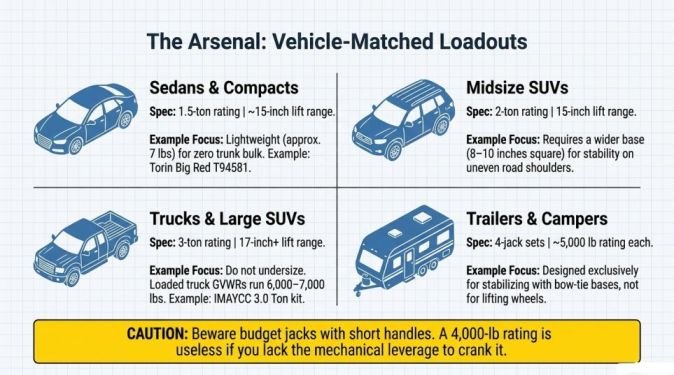
For sedans and compact cars: A 1.5-ton scissor jack with a 15 1/8-inch lift range, like the Torin Big Red T94581, covers most passenger cars with room to spare. It weighs around 7 lbs, so it won’t add real bulk to your trunk.
For midsize SUVs: Look for a 2-ton model with a similar 15-inch range and a wider base, around 8 to 10 inches square, for better stability on uneven shoulders.
For trucks and larger SUVs: A 3-ton jack with a 17-inch-plus lift range, such as the IMAYCC 3.0 Ton kit, handles the added height and weight. Don’t undersize here; a truck’s GVWR often runs 6,000 to 7,000 pounds loaded.
For trailers and campers: Four-jack sets rated around 5,000 lbs each, with a bow-tie base for stability, are built for stabilizing rather than lifting a wheel off the ground.
One honest tradeoff worth naming: some budget jacks with a 4,000-lb rating and a low 15-inch profile, like the TONDA 190104, are genuinely hard to crank because the handle is short. Fine for a lawnmower or a light car, frustrating on anything heavier.
How to use a scissor jack safely
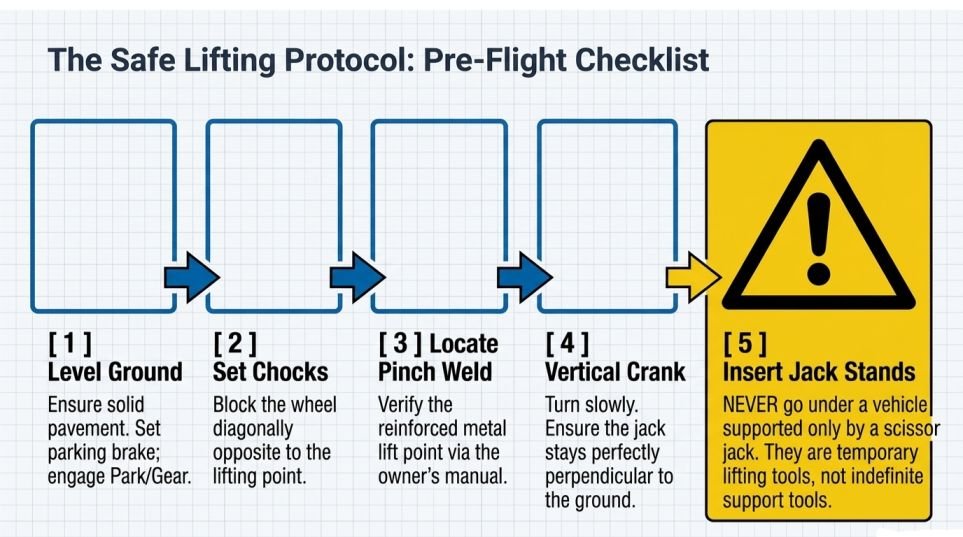
- Park on level, solid ground. Skip gravel, grass, or any slope.
- Set the parking brake and put the transmission in park or in gear.
- Chock the wheels diagonally opposite the one you’re lifting.
- Find the jacking point. Check the owner’s manual for the reinforced pinch weld; plastic trim panels aren’t rated to hold weight.
- Position the saddle squarely under that point before you turn the crank at all.
- Crank slowly, watching that the jack stays vertical and the car doesn’t shift sideways.
- Never go under the car on a scissor jack alone. Use jack stands for anything beyond a quick wheel swap.
- Lower slowly, keeping hands and feet clear of the frame as it drops.
Mistakes that make scissor jacks fail
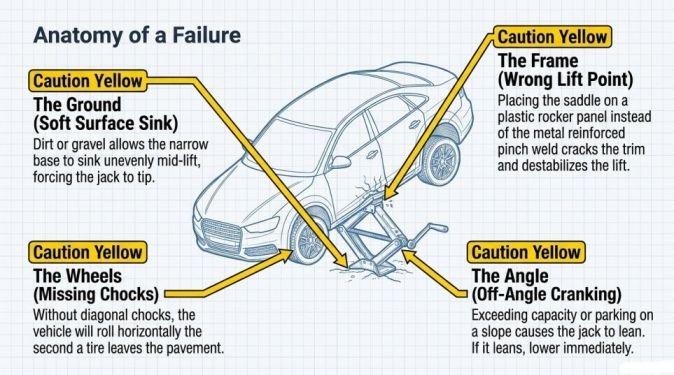
Most scissor jack failures trace back to one of a few repeatable errors, not a bad jack.
- Exceeding the rated capacity. A 1.5-ton jack under a 4,000-lb loaded SUV is already past its margin before you even factor in an uneven surface.
- Lifting on soft ground. Dirt or gravel lets the base sink unevenly mid-lift, which is how jacks tip.
- Wrong lift point. Placing the saddle on a plastic rocker panel instead of the metal pinch weld can crack the panel and destabilize the lift.
- Skipping the chocks. Without them, a car can roll off the jack the moment a wheel leaves the ground.
- Working underneath without stands. A scissor jack is a lifting tool, not a support tool. It’s not rated to hold weight indefinitely.
- Cranking off-angle. If the jack starts to lean, stop, lower it, and reposition rather than continuing to crank.
Manual vs electric vs drill-driven scissor jacks
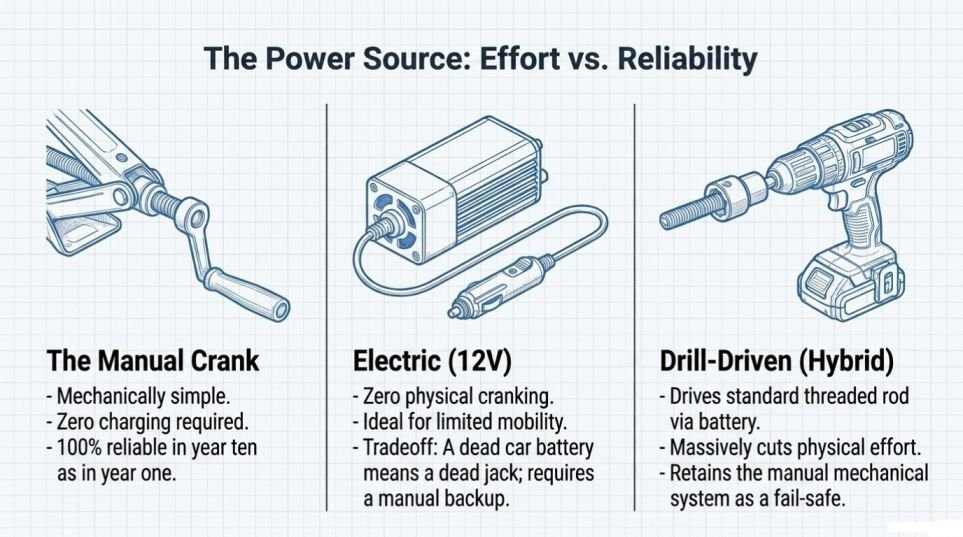
The classic swivel-handle crank is still the most common design, and it’s mechanically simple: fewer parts, nothing to charge, works the same in year one and year ten.
Electric scissor jacks run off a 12V outlet or a car battery and raise the vehicle without any cranking at all, which helps if hand strength or mobility is a concern. The tradeoff is that a dead battery means a dead jack, so a manual backup still belongs in the trunk.
A newer middle option lets you drive the same threaded rod with a cordless impact drill and a socket adapter instead of the hand crank. It’s the same mechanical jack, just powered differently, and it noticeably cuts the physical effort of a full lift.
Keeping a scissor jack ready
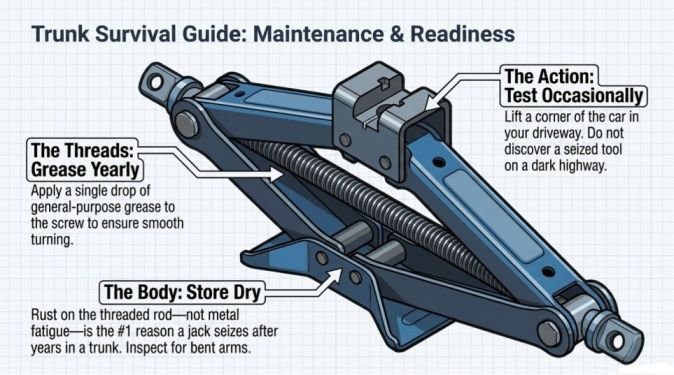
A scissor jack that sits in a trunk for three years needs to work the first time you touch it, not the fifth.
- Store it dry. Rust on the threaded rod is the most common reason a jack seizes.
- Grease the threads once a year, even with light use. A drop of general-purpose grease on the screw keeps it turning smoothly.
- Inspect for bent arms or stripped threads whenever you check your spare tire.
- Test it occasionally. Lift a corner of the car a few inches in the driveway so you’re not discovering a seized jack during an actual roadside emergency.
When a scissor jack isn’t the right tool
Scissor jacks are built for occasional, temporary lifts, not for the jobs that keep you under the car for an hour. A few situations call for something else:
- Heavy trucks or dually pickups with GVWRs past 7,000 pounds often exceed what consumer scissor jacks are rated for.
- Soft or uneven terrain, like a muddy shoulder, where the narrow base can’t stay stable.
- Extended garage work, such as brake jobs or oil changes, where a floor jack plus jack stands gives faster lifts and safer support. [INTERNAL LINK: setting up jack stands correctly]
- Off-road or lifted vehicles with more suspension travel than a standard scissor jack’s range covers.
For these, a hydraulic floor jack or a set of purpose-built stands is the safer call.
Scissor jack buying and safety checklist
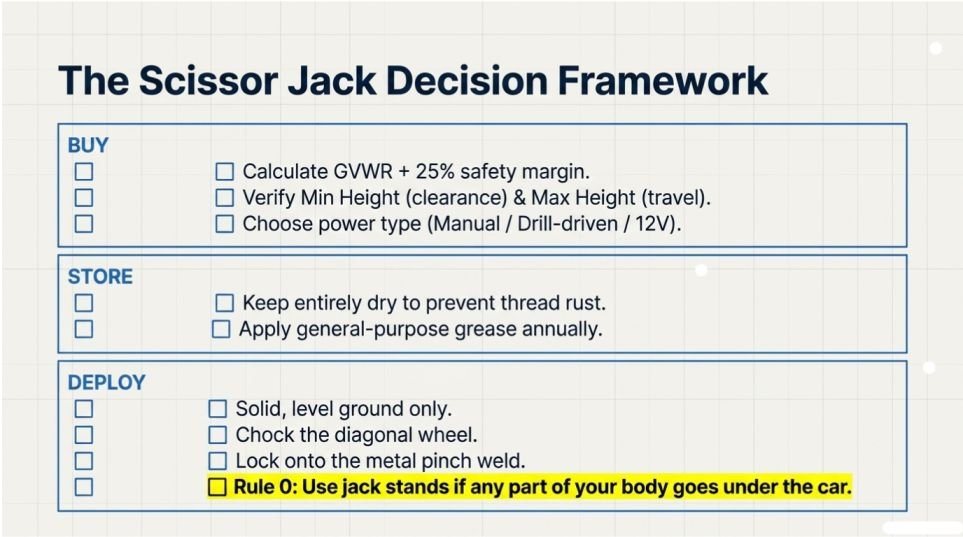
Here’s the decision framework in order: check your vehicle’s GVWR, add a 25% margin, and buy a jack rated above that number. Confirm the lift range covers both your car’s low starting clearance and the height you need for the wheel to clear the ground. Pick manual, electric, or drill-driven based on how often you’ll use it and whether hand strength is a factor.
Once you own it, store it dry, grease it yearly, and test it before you actually need it. And remember what it’s for: getting a wheel off the ground long enough to swap a tire, always backed by chocks on solid, level ground, never as a stand-in for jack stands during real repair work.
FAQ
Can a scissor jack damage my car? Yes, if it’s placed on the wrong point. Lifting from a plastic rocker panel or the floor pan instead of the reinforced pinch weld can crack trim or dent the underbody. Always confirm the jacking point in your owner’s manual first.
How long do scissor jacks last? A steel scissor jack stored dry and greased occasionally can last well over a decade, since there’s no hydraulic fluid to degrade. Rust on the threaded rod, not metal fatigue, is usually what ends a jack’s life early.
Is it safe to sit or work under a car on a scissor jack? No. Scissor jacks are rated for lifting, not sustained support, and a single point of mechanical failure can drop the car. Use jack stands for any work that requires being underneath.
What weight can a scissor jack actually lift? Consumer models typically range from 1.5 to 3 tons, or 3,000 to 6,000 pounds, though trailer-stabilizing sets and heavier-duty kits go higher. Always check the rated capacity against your vehicle’s GVWR plus a safety margin, not just its curb weight.
Can I use a scissor jack on gravel or grass? It’s not recommended. Soft or uneven ground lets the base sink unevenly during the lift, which is one of the more common ways scissor jacks tip over. Move to the nearest solid, level surface, even if that means driving a short distance on a flat tire at low speed.
Do all cars come with a scissor jack? Most do, though some newer EVs and sports cars skip a spare tire and jack entirely in favor of a repair kit or roadside assistance. Check your trunk or owner’s manual to confirm what your car actually includes before you assume you have one.

- 2 Hole Vs 4 Hole Injectors 5.3 Vortec: Swap Rules + Fitment Check - September 12, 2026
- What Oil Does 2012 Honda Civic Use: What Oil Does Honda Civic Use & Spec - September 12, 2026
- 2014 Ram 2500 5.7 Hemi Sparkplugs: Ram 5.7 Hemi Sparkplugs: Oe Vs Fitment, Swap Steps - September 12, 2026