
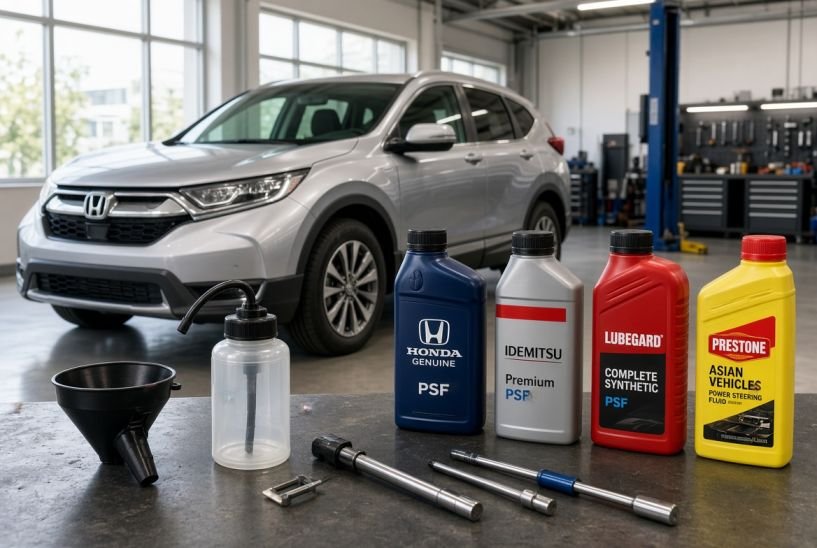
Idemitsu Premium PSF is the closest thing to a drop-in match for genuine Honda fluid because Idemitsu has supplied Honda’s factory fill for years. Lubegard 24242 and Prestone AS269 also work, as long as the bottle says “for Honda/Acura.” Skip anything labeled “universal” and skip ATF.
That’s the short version. The longer version matters more, because Honda changed its own fluid spec partway through the 2000s, and using the wrong viscosity family in the wrong generation is how people end up with a whining pump or a $1,200 rack replacement.
Key takeaways
- Honda’s rotary valve and rack seals run tighter tolerances than GM or Ford systems, so ATF is not a safe substitute.
- Honda has sold this fluid under several names: PSF (08206-9002), PSF-S, and PSF-2 (2007 and newer, thinner viscosity).
- Idemitsu Premium PSF, Lubegard 24242, and Prestone AS269 (Asian Vehicles) are the three equivalents with the strongest track record from long-term owners.
- Mixing an old thick PSF into a 2007+ car built for PSF-2, or the reverse, can cause noise and premature wear.
- Newer Hondas with Electric Power Steering (EPS) have no hydraulic fluid at all, so none of this applies to them.
- Dark brown or burnt-smelling fluid means you need a flush, not a top-off.
Why Honda’s power steering system needs a specific fluid
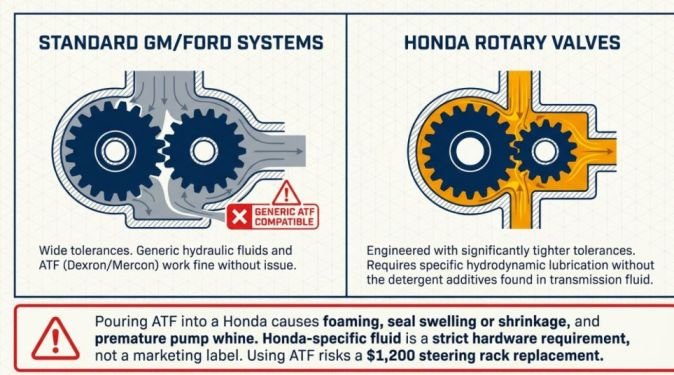
GM, Ford, and Chrysler have historically run their power steering on ATF or a generic hydraulic fluid, and it works fine in those systems. Honda didn’t build its pumps and racks that way. The rotary valve inside a Honda steering gear runs on much tighter clearances, and it needs strong hydrodynamic lubrication without the detergent additives packed into transmission fluid.
Pour ATF into a Honda reservoir, and you’re not looking at instant failure. You’re looking at foaming, seal swelling or shrinkage over months, and a steering pump that starts whining before its time. The tight tolerances that make Honda steering feel precise are the same tolerances that punish the wrong fluid chemistry.
This is also why the “any PSF is fine” advice you’ll see on general automotive forums doesn’t fully apply here. Honda-specific PSF exists because Honda-specific hardware demands it, not because Honda wanted to sell another branded fluid.
If your car is still under warranty, this matters even more. A dealer can and sometimes will point to fluid choice if a steering component fails during a warranty claim.
Decoding Honda’s PSF specs: PSF, PSF-S, PSF-2, and Type V
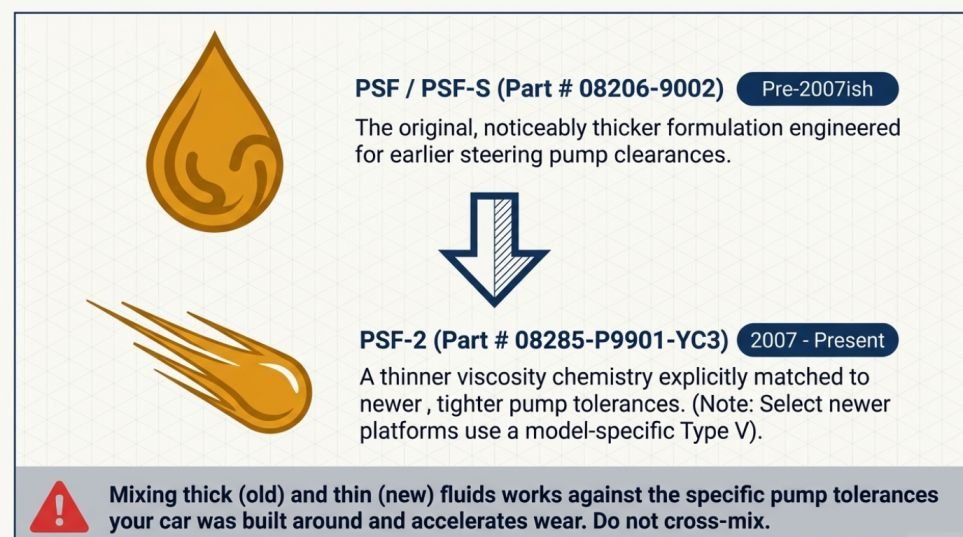
Honda hasn’t used one consistent name for this fluid, and that’s where most of the confusion online comes from.
| Designation | Typical years | Notes |
|---|---|---|
| PSF (08206-9002 / 08206-9002A) | Pre-2007ish | The original, noticeably thicker formulation |
| PSF-S / PSF Type S | Marketed as “universal Honda” | Common current genuine offering at dealers |
| PSF-2 (08285-P9901-YC3) | 2007 and newer | Thinner viscosity, matched to newer pump tolerances |
| PSF Type V | Select newer platforms | Less common, model-specific |
The detail that actually changes your buying decision: older Hondas ran a thicker fluid, and 2007-and-newer models moved to something thinner. A bottle that worked perfectly in a 2003 Accord isn’t automatically right for a 2015 CR-V, and vice versa.
If your cap, dipstick, or owner’s manual specifies a designation by name, match it. If you’re not sure, a dealer parts counter can look up the exact spec by VIN in under a minute, and that’s worth the five-minute stop before you buy three bottles of the wrong thing.
Best Honda power steering fluid equivalents compared
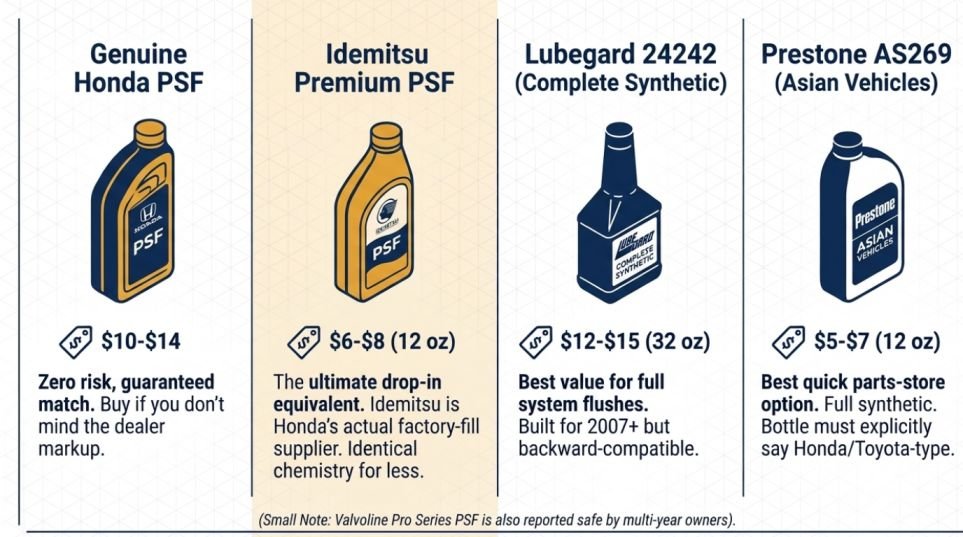
These four show up again and again in long-running owner forum threads as safe, trouble-free substitutes, not just in marketing copy.
| Fluid Name | Year Range | Specification | Recommended Use | Viscosity | Key Features & Benefits | Price Range |
|---|---|---|---|---|---|---|
| Genuine Honda PSF (08206-9002 / 08206-9002A) | Pre-2007 | PSF | Top-off or full flush | Thicker formulation | Original formulation; ensures zero risk and compatibility with tighter tolerances. | $10–14 |
| Genuine Honda PSF-2 (08285-P9901-YC3) | 2007 and newer | PSF-2 | Top-off or full flush | Thinner viscosity | Matched to newer pump tolerances; helps avoid noise and premature wear. | $10–14 |
| Genuine Honda PSF-S / PSF Type S | Current / Universal | PSF-S / PSF Type S | Top-off or full flush | Varies | Marketed as a universal Honda fluid; current genuine offering. | $10–14 |
| Idemitsu Premium PSF | All years | Honda/Acura Equivalent | Top-off or full flush | Varies | Factory-fill supplier; same chemistry for less cost; trouble-free substitute. | $6–8 / 12 oz |
| Lubegard 24242 Complete Synthetic | 2007+ (Backward-compatible) | Honda/Acura Equivalent | Ideal for full flush | Full synthetic | Built for 2007+ models; safe for older systems; 32 oz bottle offers more volume. | $12–15 / 32 oz |
| Prestone AS269 (Asian Vehicles) | All years | Honda/Acura Equivalent | Top-off or flush | Full synthetic | Formulated for Honda-type systems; widely available at parts stores. | $5–7 / 12 oz |
| Valvoline Pro Series PSF | Honda-specific use | Honda/Acura Equivalent | Top-off or flush | Varies | Reported trouble-free by multi-year Honda owners. | $6–9 / 12 oz |
Idemitsu is the one to reach for if you want the closest match to genuine Honda fluid without paying dealer markup. Lubegard’s 32 oz bottle is the better buy if you’re doing a full flush rather than a small top-off, since you’ll use most of a 12 oz bottle just bleeding air out of the system.
One anecdotal flag worth mentioning: a handful of Honda owners on forums report rack problems after using Amsoil PSF, though the car in question was also high-mileage, so it’s not clear causation. It’s not on the list above, and that’s why.
What to avoid: ATF and generic universal PSF
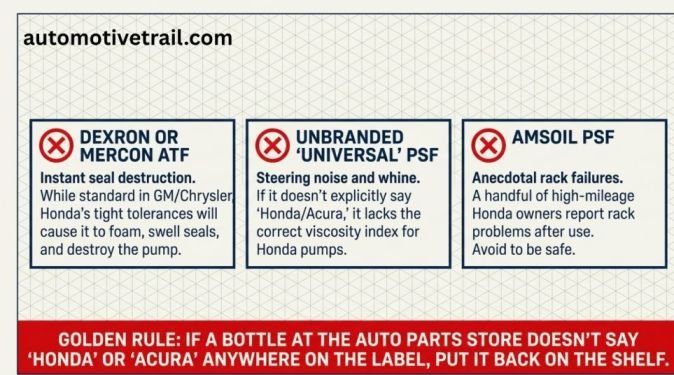
Two categories cause almost all the reported problems.
- Dexron or Mercon ATF. It’s the go-to substitute in GM and Chrysler systems, and some older Honda owners used it decades ago without immediate issue. It’s still not built for Honda’s tolerances, and it’s not something to reach for today, especially in 2007 and newer cars.
- Unbranded “universal” power steering fluid. If the bottle doesn’t specifically call out Honda or Acura compatibility, it likely doesn’t meet the viscosity index Honda’s pumps need. This is the single biggest source of steering noise complaints tied to fluid choice.
A third, smaller risk: mixing an old-spec thick PSF into a car built for the newer thin PSF-2, or the other way around. It won’t destroy your rack overnight, but it works against the pump tolerances your car was engineered around.
If a bottle at the auto parts store doesn’t say “Honda” or “Acura” anywhere on the label, put it back.
How to match the right PSF to your Honda’s year and model
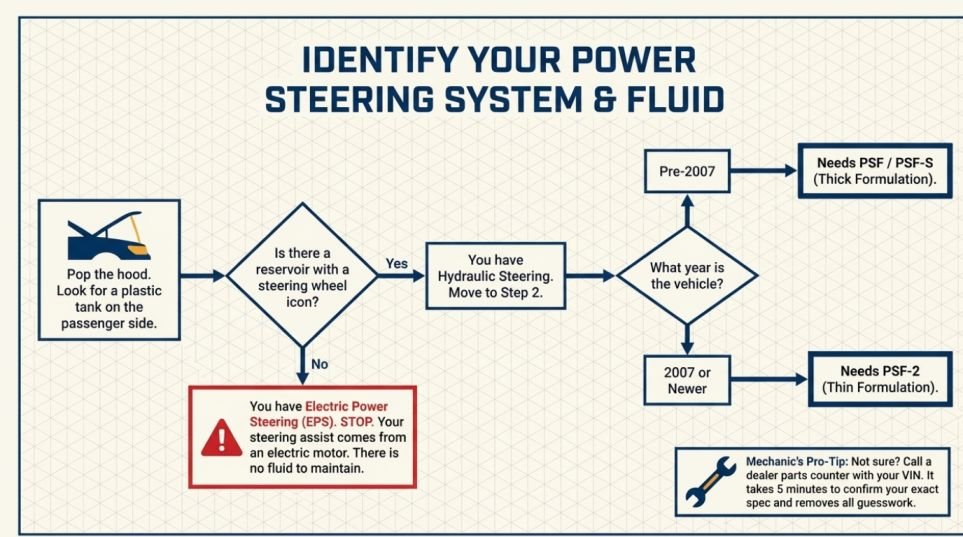
Before you buy anything, confirm which spec your car actually takes. Three ways to check, in order of reliability:
- Look at the reservoir cap or nearby label. Many Hondas print the spec directly on or near the cap.
- Check your owner’s manual. The maintenance section lists the exact PSF designation for your model year.
- Call a Honda parts counter with your VIN. This takes about five minutes and removes all guesswork, especially on a car you didn’t buy new.
If your car predates 2007, lean toward genuine PSF or an equivalent explicitly rated for older Honda systems. If it’s 2007 or newer, look for PSF-2 or a bottle explicitly stating compatibility with post-2007 Honda/Acura vehicles.
How to check and top off Honda power steering fluid
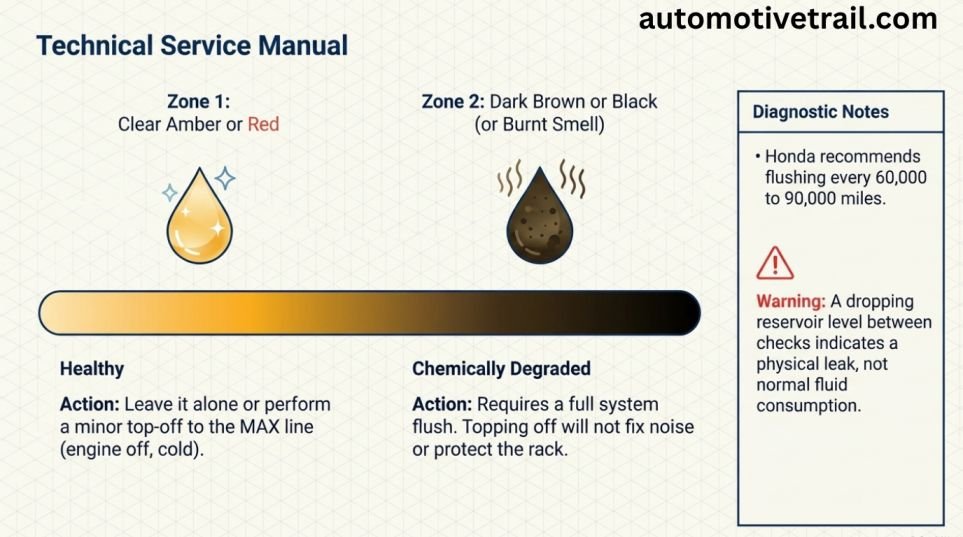
- Find the reservoir. Small plastic tank, usually marked with a steering wheel icon on the cap, typically on the passenger side of the engine bay.
- Check the level cold. Engine off, look at the MIN/MAX or COLD markings. Some older models use a dipstick built into the cap instead.
- Look at the color. Healthy PSF is clear amber or red. Dark brown, black, or burnt-smelling fluid means the system needs a flush, not just more fluid.
- Add fluid slowly. Small amounts at a time, checking the level as you go. Stop at MAX, never past it.
- Bleed the air. Start the engine, put the car in park or neutral, and turn the wheel lock-to-lock several times. Recheck the level once more afterward.
A reservoir that keeps dropping between checks means a leak somewhere in the system, not a fluid problem. Topping off a leaking system just delays a repair.
How to flush Honda power steering fluid at home
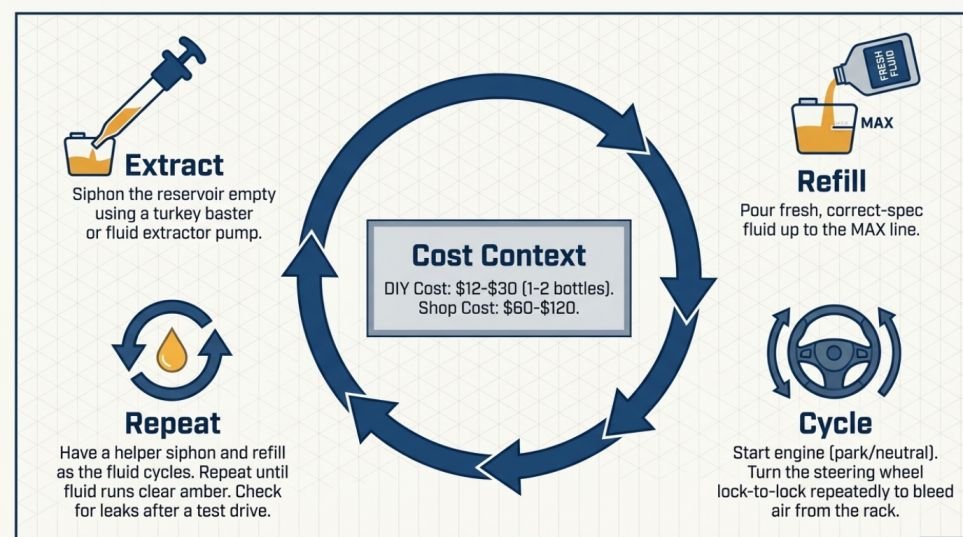
A full flush makes sense once the fluid has gone dark or the car has steering noise that a top-off didn’t fix.
- Siphon the reservoir empty using a turkey baster or a cheap fluid extractor pump.
- Refill with fresh fluid to the MAX line.
- Start the engine and turn the wheel lock-to-lock repeatedly, in park or neutral, while a helper watches the reservoir.
- Have the helper siphon and refill as the fluid cycles, repeating until the fluid coming out runs clear instead of dark.
- Top off to MAX and check for leaks after a short test drive.
This takes 20 to 30 minutes with two people and one to two bottles of fluid, depending on reservoir size. If you don’t want to deal with the mess, a shop can pressure-flush the system in about the same time for $60 to $120, depending on region.
Dealer PSF vs aftermarket equivalents: cost comparison
| Option | Price per top-off (roughly 1 bottle) | Full flush cost (DIY) | Full flush cost (shop) |
|---|---|---|---|
| Genuine Honda PSF (dealer) | $10-14 | $20-30 in fluid | $80-150 |
| Idemitsu / Lubegard / Prestone (parts store) | $6-15 | $12-25 in fluid | $60-120 |
The price gap isn’t huge on a single top-off, but it adds up over a car’s life, especially if you’re doing your own flushes every 60,000 to 90,000 miles as Honda generally recommends. Genuine fluid buys peace of mind and nothing chemically different from Idemitsu’s version, since Idemitsu makes a large share of what ends up in Honda’s own bottle.
Electric power steering: when you don’t need PSF at all
Most current-generation Hondas, including newer Civics, Accords, and CR-Vs, use Electric Power Steering instead of hydraulic. EPS has no reservoir, no fluid, and no hoses to flush. The steering assist comes from an electric motor on the column or rack, not hydraulic pressure.
If you pop the hood and don’t see a PSF reservoir, that’s your answer. Nothing in this guide applies, and there’s no fluid maintenance to schedule for the system at all.
If you’re not sure which system your specific trim uses, the owner’s manual will say, or a quick look under the hood settles it in seconds. No reservoir means no PSF, full stop.
Honda power steering fluid equivalent: summary and decision framework
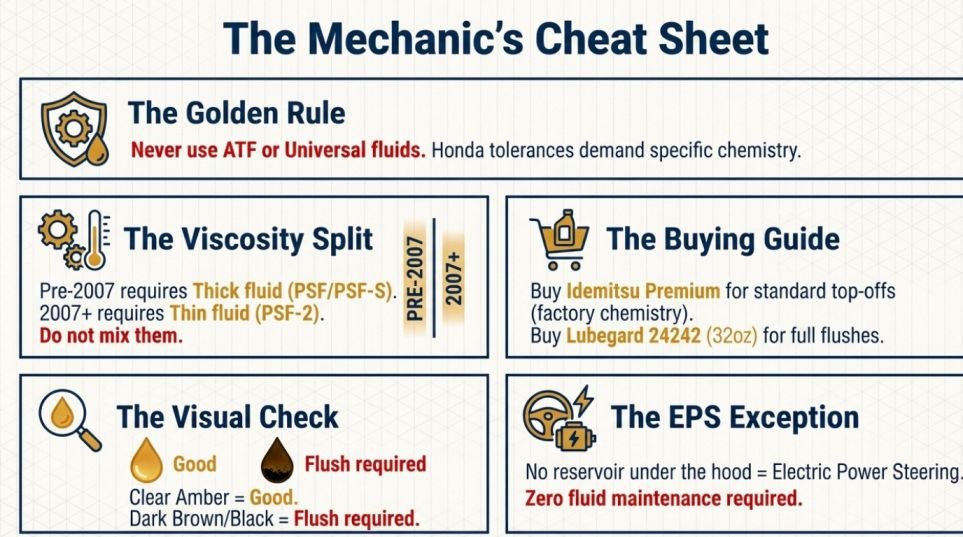
If you want zero risk and don’t mind the price, genuine Honda fluid from the dealer is always correct, as long as you match PSF-S or PSF-2 to your model year. If you want the same chemistry for less, Idemitsu Premium PSF is the strongest equivalent, since it’s the actual factory-fill supplier for much of Honda’s own bottled product.
For a full flush where you’re using a larger volume, Lubegard 24242’s 32 oz bottle is the more practical buy. Prestone AS269 works as a solid parts-store option when you need something fast, and the bottle explicitly says Honda/Acura compatible.
Skip ATF, skip unbranded universal PSF, and don’t cross-mix old thick-spec fluid with a newer PSF-2 system. Check your car’s actual spec before buying, either from the cap, the manual, or a five-minute call to a parts counter. And if you don’t have a PSF reservoir under the hood at all, your car runs Electric Power Steering, and none of this maintenance applies to you.
FAQ
Can I use ATF instead of Honda power steering fluid? Not safely. ATF works in many GM and Chrysler systems, but Honda’s tighter tolerances and seal chemistry weren’t designed around it. It can cause foaming and premature seal wear over time.
Is Idemitsu PSF the same as Honda PSF? It’s widely considered the same formulation, since Idemitsu supplies much of Honda’s own factory-fill fluid. Long-term owner reports back this up as a safe, trouble-free substitute.
What happens if I put the wrong power steering fluid in my Honda? Short-term, often nothing dramatic. Over months, the wrong fluid can cause foaming, pump whine, seal swelling or shrinkage, and in worse cases, accelerated rack wear.
How often should I change Honda power steering fluid? Honda generally recommends a flush somewhere in the 60,000 to 90,000 mile range, though this varies by model. Check your maintenance schedule for the exact interval on your specific car.
Does my Honda even have power steering fluid? If it’s a newer model with Electric Power Steering, no. Pop the hood and look for a small reservoir with a steering wheel icon on the cap. No reservoir means no hydraulic fluid to maintain.
Can I mix different brands of Honda-compatible PSF? Generally, yes, as long as both are rated for your car’s viscosity family, either the older thick PSF or the newer PSF-2. Avoid mixing across those two families when you can.

- 2 Hole Vs 4 Hole Injectors 5.3 Vortec: Swap Rules + Fitment Check - September 12, 2026
- What Oil Does 2012 Honda Civic Use: What Oil Does Honda Civic Use & Spec - September 12, 2026
- 2014 Ram 2500 5.7 Hemi Sparkplugs: Ram 5.7 Hemi Sparkplugs: Oe Vs Fitment, Swap Steps - September 12, 2026