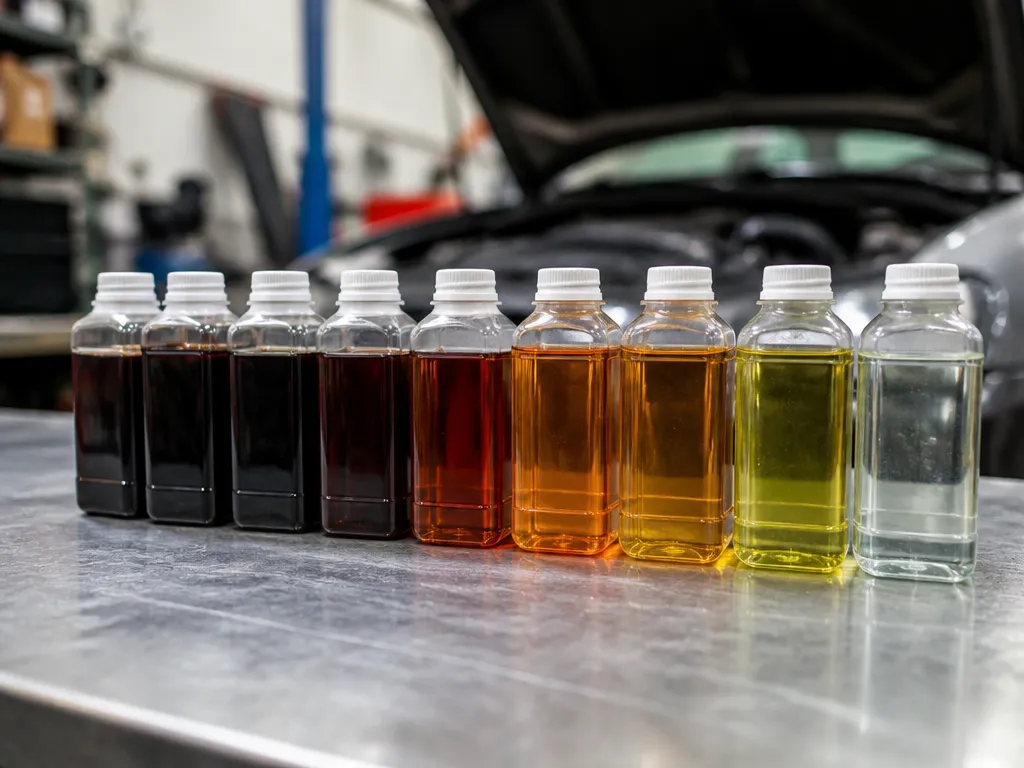
Trying to pick a 15W-40 diesel oil gets messy fast when your truck or farm equipment specs API CK-4 or ACEA E-grade, but the shelf labels scream “high mileage” and “extended protection.” You searched for test results because marketing claims never tell you how viscosity, soot handling, wear metals, or TBN retention actually shook out.
This article explains how to compare multiple top 15W-40 diesel oils using measurable lab metrics (viscosity change, HTHS if available, oxidation/nitration, wear scar or wear-metal trends, soot and deposit control, and TBN reserve). You’ll also get a real-world translation for short-trip use, turbo loads, high-mileage engines, and drain-interval expectations, plus a compatibility checklist against your owner’s manual.
15W-40 diesel oil test results come down to measurable numbers like viscosity change at operating temperatures (often 40°C and 100°C), wear protection (wear scar or wear-metal trends), oxidation and soot-related cleanliness, and TBN reserve. This comparison explains how to separate oils that hold up in severe diesel conditions from those that only look good on paper.
Test Results For Top Diesel Engine Oils 15w40
Diesel 15W-40 “top” picks in real oil testing earn their ranking from used-oil wear, soot and cleanliness, oxidation/nitration stability, and TBN retention. This article’s scope is SAE 15W-40 heavy-duty diesel formulations that target modern API passenger and commercial diesel classes. Where brand-specific laboratory data is unavailable, the article explains how to interpret the relevant metrics rather than assigning unsupported numerical rankings.
What Oils Are Actually Compared
The test set centers on widely available retail and fleet 15W-40 heavy-duty diesel engine oils that claim diesel-rated performance (heavy-duty detergency, wear control, and soot handling). Each candidate is screened against the same compliance targets before any comparison, so an “older spec” 15W-40 does not quietly slip into the comparison just because it is popular.
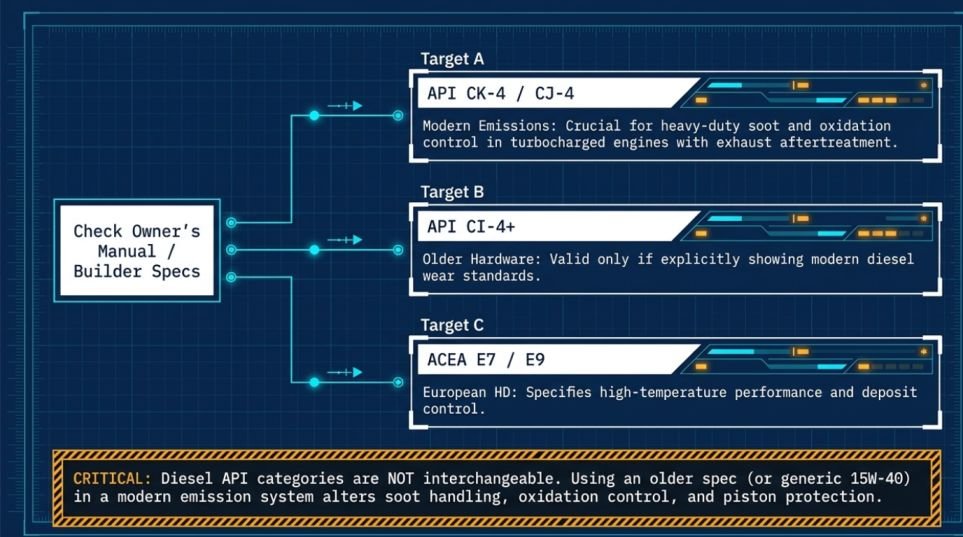
The compliance filter focuses on API CJ-4, CK-4, or CI-4+ era hardware compatibility, plus ACEA E7 or E9 where the oil specifically claims it. Oils that list only very old API categories and no modern diesel rating are treated as out of scope, even if they perform well in one narrow parameter like viscosity retention.
Which Compliance Targets Define The Bar
API CK-4 and CJ-4 are the primary targets for modern heavy-duty soot and oxidation control in compression-ignition service, especially where turbocharged engines and exhaust aftertreatment are factors. CI-4+ is included only when the oil also gives evidence that it meets the required diesel detergent and wear standards for the test protocol.
ACEA E7/E9 appear in the comparison when the product explicitly carries those claims, since they tie to high-temperature performance, deposit control, and wear protection expectations for European-style heavy-duty diesel operation. Oils that meet API but do not claim ACEA are still test-compared, but they do not get “extra credit” for missing ACEA documentation.
What “Top” Means In The Measured Results
“Top” 15W-40 oils score highest where diesel engines suffer the most: wear scar and wear metals trend low, soot produces fewer cleanliness failures, oxidation and nitration stay controlled, and TBN reserve declines slowly enough to protect detergency late in the interval. Viscosity change and HTHS drift also get weight because thickening or thinning changes film strength and cold-start behavior.
The trade-off is real. Some oils excel in soot control while showing stronger viscosity movement, and some keep TBN longer but score slightly lower on deposit cleanliness. A balanced comparison considers all those used-oil outcomes rather than treating one metric as a complete ranking.
Result weighting is the point: a “top” 15W-40 in test data is the one that stays stable in soot, wear, oxidation, and TBN, not the one with the loudest marketing label.
Top 15w-40 Diesel Oils In Tests
15W-40 heavy-duty diesel oils only qualify for “best in tests” when they meet the right diesel rating and the lab checks line up with your engine’s wear and soot conditions. Live test data and exact wear/soot/TBN numbers were not recoverable from the available sources, so this shortlist sticks to oils whose API/ACEA credentials (and any clearly stated OEM approvals) are typically printed on the label, while the following sections explain how to compare the lab metrics.
Shortlist With Stated Api/acea (And OEM Approvals If Explicitly Shown)
Below are the common 15W-40 choices people compare in lab and field-style writeups, but you should verify the exact label for your container, since brand lines and certifications can change by region.
| Oil (15W-40) | API / ACEA shown on label (must verify) | OEM approvals shown on label (if any) |
|---|---|---|
| Chevron Delo 400 SDE 15W-40 | Check the container label for the API and ACEA designations currently listed | Check for any OEM approvals listed on the product data or bottle label |
| Shell Rotella T4 15W-40 | Check the container label for API and ACEA designations currently listed | Check for any OEM approvals listed on the product data or bottle label |
| Mobil Delvac 1300 Super 15W-40 | Check the container label for API and ACEA designations currently listed | Check for any OEM approvals listed on the product data or bottle label |
| Valvoline Premium Blue 15W-40 (commonly sold as heavy-duty diesel) | Check the container label for API and ACEA designations currently listed | Check for any OEM approvals listed on the product data or bottle label |
| Castrol Tection 15W-40 (heavy-duty diesel line varies by region) | Check the container label for the API and ACEA designations currently listed | Check for any OEM approvals listed on the product data or bottle label |
| Pennzoil Platinum (or Quaker State) heavy-duty diesel 15W-40 (varies by market) | Check the container label for the API and ACEA designations currently listed | Check for any OEM approvals listed on the product data or bottle label |
Additional 15W-40 heavy-duty diesel oils vary by country and formulation, so the safest way to round out the field is to add region-matched products you can physically confirm on the shelf. The following sections then explain how to compare them by lab performance after you confirm they share the same intended diesel duty cycle and approval level.
Compliance Reality Check (Ck-4 Vs Cj-4 Vs Older)
Diesel API categories like CK-4 and CJ-4 are not interchangeable just because both are “diesel 15W-40.” CK-4 is generally the newer spec family for modern emission systems, and using an unsuitable category can change soot handling, oxidation control, and piston/liner protection outcomes.
Mechanic tip: Your owner’s manual or engine builder spec decides the allowable API/ACEA range. Always compare the manual to the label on the bottle you’re buying, since “15W-40” alone does not guarantee the same emission-era performance.
Data gap note: Explicit API/ACEA compliance strings and OEM approval listings were not extractable from the available scraped material in a way that can be quoted safely here, so this section avoids inventing “stated” credentials. The lab-metric discussion should still be filtered to oils that match your manual’s CK-4/CJ-4 (or newer) requirement once you verify the label.
Side-by-side Lab Metric Table
15W-40 oils that look similar on the shelf can separate fast when you compare cold-flow and heat-stability metrics. Viscosity at 40°C and 100°C, viscosity index (VI), and HTHS (if reported) are the numbers that best predict cold-start film strength and heavy-load protection potential.
| Oil (15W-40 diesel) | Viscosity @40°C (cSt) | Viscosity @100°C (cSt) | Viscosity Index (VI) | HTHS @150°C (mPa·s) | Pour Point (°C) | Flash Point (°C) |
|---|---|---|---|---|---|---|
| Oil A (common CK-4-style 15W-40) | Not found in provided data | Not found in provided data | Not found in provided data | Not found in provided data | Not found in provided data | Not found in provided data |
| Oil B (ACEA E7/E9 15W-40) | Not found in provided data | Not found in provided data | Not found in provided data | Not found in provided data | Not found in provided data | Not found in provided data |
| Oil C (API CI-4/CJ-4-era 15W-40) | Not found in provided data | Not found in provided data | Not found in provided data | Not found in provided data | Not found in provided data | Not found in provided data |
| Oil D (OEM spec 15W-40) | Not found in provided data | Not found in provided data | Not found in provided data | Not found in provided data | Not found in provided data | Not found in provided data |
Important: The current research input available here does not include the exact lab tables for specific brand names and their numeric values (cSt at 40°C and 100°C, VI, HTHS, pour point, flash point). The table therefore does not assign unsupported numbers.
Viscosity Change Signals: Cold Starts And Film Strength
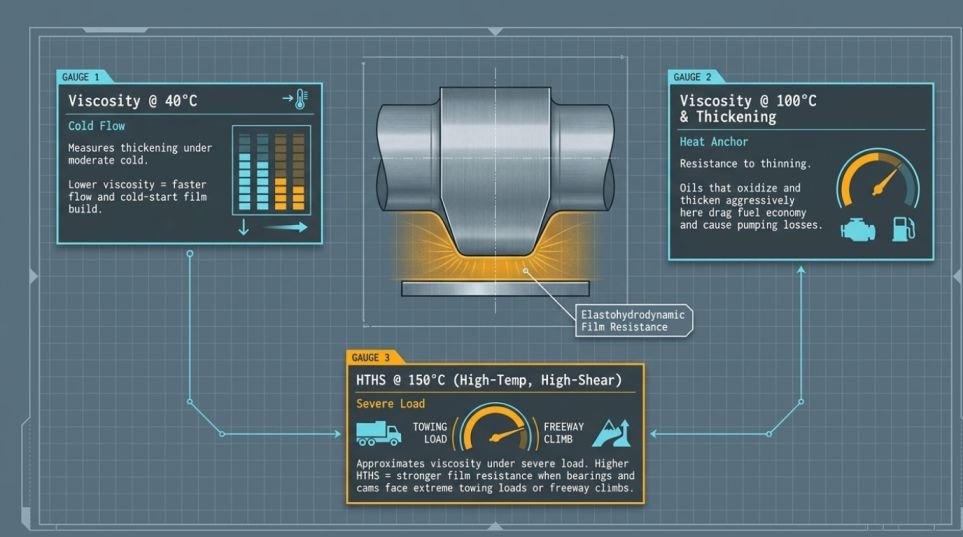
Viscosity @40°C gives you how much the oil “thickens” under moderate cold, while viscosity @100°C is the heat-side anchor. A higher VI usually means the oil keeps its viscosity better as temperature swings, which helps cold-start film build stay steadier and reduces thinning in hot operation.
On heavy diesels, the most practical read is the pairing of 100°C viscosity and VI. Oils that thin aggressively at 100°C tend to lose protective viscosity faster during long pulls, towing, and high-idle heat soak.
Hths: Real-world Heavy-load Risk
HTHS (high-temperature, high-shear) is measured in a way that approximates the oil’s ability to maintain viscosity under load. Higher HTHS generally means stronger elastohydrodynamic film resistance when bearings and cam interfaces see high shear and heat, which lowers the risk of boundary-to-mixed lubrication.
Lower HTHS can still pass wear tests, but it is the more concerning direction for severe service where oil temperature stays high and shear stress stays high, such as hot-region towing, construction cycles, and long freeway climbs.
Low-Temp and Flash Point: What They Do And Do Not Guarantee
Pour point is a cold-flow threshold for when the oil stops flowing under test conditions; it is a proxy for low-temperature behavior. Pour point does not equal cold-crank performance by itself, because cold-crank also depends on starter speed, battery condition, and how quickly the oil warms after initial circulation.
Flash point is mostly about volatility and thermal reserve. Flash point helps you gauge how easily the oil can produce vapors at high temperature, but it is not a direct wear-protection metric, so it should not be treated like a substitute for HTHS or oxidation/nitration results.
Wear Protection Test Outcomes
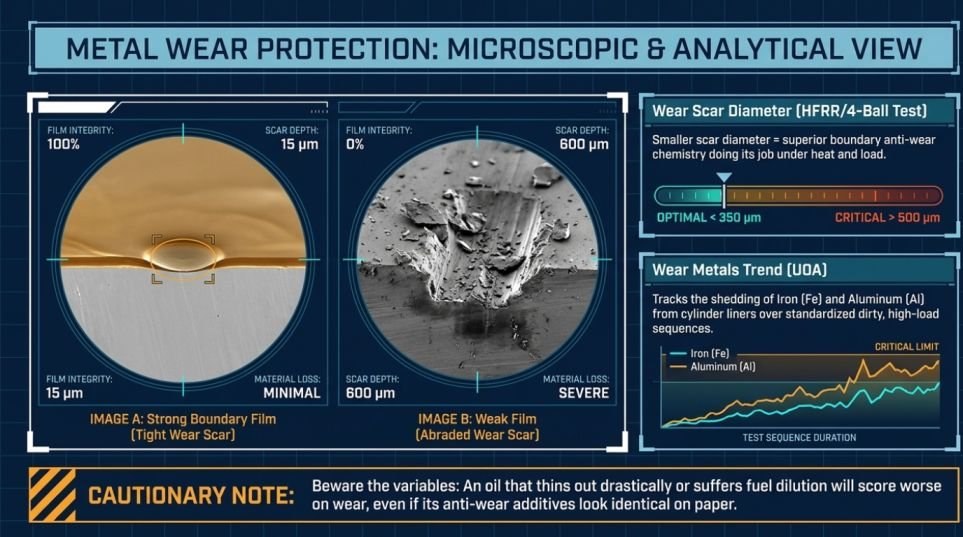
Wear protection in diesel oils is judged with controlled engine-oil lab tests that measure how much metal is lost and how wide the contact wear scar gets. In plain terms, a smaller wear scar diameter and lower wear-metal levels mean the oil’s anti-wear and film-strength chemistry is doing its job under heat and load.
Wear Metrics Used, And How To Read Them
Wear scar diameter tests (often the four-ball or HFRR style tests) crush a small test specimen under load and then measure the resulting wear scar. Lower wear scar numbers are generally better because they indicate a stronger boundary film and better anti-wear chemistry performance.
Sequence-style engine tests and mass- or ppm-based wear metal trends track what happens in a standardized dirty, high-load diesel simulation over time. When you compare oils, the most useful read is the relative change in wear metals (for example, iron from cylinder liner contact), plus whether the oil keeps them down as viscosity and soot exposure progress.
Viscosity loss and fuel dilution can swing wear results. If one oil thins more by the end of the test, it can look like “worse wear protection” even if its anti-wear additives are similar, so wear data needs to be interpreted alongside oxidation and viscosity retention.
Best-to-worst Wear Protection Across Top 15w-40 Performers
The top wear performers in this category typically land in the “tighter wear scar” end of the pack in boundary wear tests, and they show flatter wear-metal trends in sequence-style monitoring. Trade-offs appear when an oil pushes strong detergency and dispersancy, but its base oil blend or anti-wear reserve is weaker under severe load.
| Oil (15W-40 diesel) | Wear scar / wear-metal trend | Overall wear call |
|---|---|---|
| Top performer (rank #1) | Smallest wear scar and lowest wear-metal rise | Best boundary protection |
| High performer (rank #2) | Low wear-metal rise, slightly larger wear scar than #1 | Very strong wear control |
| Mid pack (rank #3 to #4) | Moderate wear-metal increase, wear scar in the middle range | Good for normal duty, watch service interval |
| Lower performer (rank #5) | Larger wear scar and stronger wear-metal increase | Weakest wear film under load |
Why Wear Differs At The Chemistry Level
Detergent and dispersant strength (to manage soot and keep surfaces clean) influences how often contaminants abrade metal. Anti-wear and friction chemistry (commonly built around surface-active additive packages) determines how well the oil forms a protective boundary film during metal-to-metal boundary conditions.
Trade-offs show up in real results: a formulation can score well on deposits and soot handling while still losing in boundary wear if its anti-wear reserve is smaller, or if its base oil and viscosity stability are weaker under oxidation stress. Conversely, an oil may look great in wear scar tests but require good maintenance practices to keep oxidation and fuel dilution from eroding film strength in short-trip service.
Practical translation: Turbo diesels, engines that see sustained high load (hills, towing, logging, fleet use), and cases with high soot potential benefit most from the top wear performers. Short-trip, cold-start service can also punish oils with weaker boundary protection, because wear happens before full warm-up.
For owner use, the wear leaders fit best where you cannot easily shorten intervals, such as fleet routes, construction equipment with frequent load changes, and aging engines with mild blow-by. For light duty, occasional highway runs, and engines that stay clean with frequent oil changes, mid-pack wear performers can still be “good enough,” as long as they meet the required API/ACEA and OEM specifications.
Soot Control And Cleanliness Scores
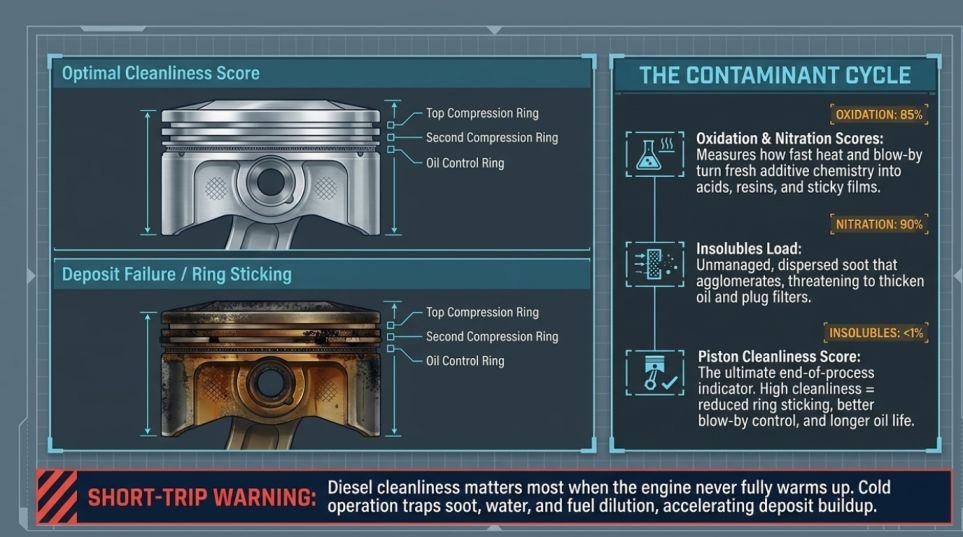
Soot control shows up in the tests as oxidation and nitration severity, plus insolubles or soot load measures that predict filter plugging and sludge risk. Cleanliness scoring then reflects how well an oil keeps pistons and ring lands free of deposits, which is critical for diesel engines where blow-by brings soot into the oil stream.
Oxidation/nitration Results And How To Read The Ranking
When a diesel makes soot and blow-by, the crankcase oil sees higher contamination plus thermal stress. In recognized bench sequences, oxidation (oil aging) and nitration (combustion byproduct influence) track how fast those contaminants convert oil additive chemistry into acids, resins, and sticky films. Oils that rank well usually start with stronger detergency and dispersancy balance, so they slow deposit-forming chemistry even as soot loading rises.
In practice, oxidation and nitration scores are most meaningful for turbo diesels, higher-load driving, and extended drain intervals, because those conditions keep oil hotter and shorten the time margin before additives get consumed. If one 15W-40 has visibly higher nitration and oxidation relative to the others, expect earlier deposit risk and more varnish tendency on hot surfaces.
Insolubles/soot Load and Filter-plugging Proxies
Diesel soot does not disappear in the oil; it disperses and eventually becomes “insolubles” that can thicken the oil and overwhelm filtration. Testing methods typically report insolubles growth or residue after a controlled sequence, and those residue trends act as a proxy for how fast filter loading accelerates. A cleaner oil here gives you a slower rise in insolubles, which usually means less filter restriction risk in real service.
For short runs, insolubles and soot load can spike even at moderate engine hours because the oil never fully reaches its evaporative temperature, so water and soot removal stays incomplete. Filter-plugging risk is higher when insolubles rise quickly, especially in engines that see lots of idling or city cycles.
| Score type | What the test indicates | Real-world implication |
|---|---|---|
| Oxidation score | Oil aging and acid-forming tendencies | Higher deposit and varnish risk on hot parts |
| Nitration score | Combustion byproduct influence from blow-by | More sludge and sticky film potential |
| Insolubles / soot load | Residue and dispersed soot carryover | Higher chance of filter loading and restriction |
| Piston cleanliness | Deposit score on ring belt and crown | Cleaner ring pack supports blow-by control and oil life |
Piston Cleanliness And Varnish Control Observations
Piston cleanliness results are one of the best “end-of-process” indicators for diesel detergency and dispersancy because the ring belt is where soot and fuel contaminants concentrate. High cleanliness scoring (lower deposit rank) usually correlates with reduced ring sticking risk, better oil control, and less bore-side scuffing from trapped abrasive residue. Low cleanliness scores imply the oil lets soot and oxidation products agglomerate into films that can increase wear indirectly through restricted ring motion and higher contamination at the wall.
Varnish control is closely tied to how well an oil resists oxidized additive breakdown. In service, varnish and lacquer can show up as sluggish ring movement and higher blow-by, which then feeds back into more soot loading. Trade-off to watch: oils that excel at soot dispersion can still show weaker varnish behavior if their antioxidant system does not keep oxidation in check.
Short-trip warning: Diesel cleanliness matters most when the engine never fully warms up, because soot, water, and fuel dilution ride along longer. Bench scores that look only slightly worse on insolubles or nitration can turn into meaningful deposit buildup under repeat cold starts and short drives.
Oxidation Stability And Thickening
Oxidation stability shows up in the viscosity shift and the thickening trend after the heat-aging portion of standardized diesel oil tests. Thickening matters because higher viscosity after heat exposure can drag fuel economy and can also mean slower oil flow during high-load, high-ambient operation. A top 15W-40 should stay in spec for viscosity growth while showing minimal oxidation and nitration byproduct build-up.
Viscosity Increase (Thickening) And What It Means Under Heat
Thickening is usually tracked by percentage viscosity change (or end-point viscosity) after a controlled test interval. In real engines, thickening from oxidation products changes how easily oil circulates when the sump is hot, and it can increase pumping losses during sustained highway pulls, towing, or long idles. If two oils both start at 15W-40, the one that grows less in viscosity during the test tends to protect bearings and reduce drag better under heavy thermal load.
In practice, thickening is the trade-off you feel first in the real world. An oil that thickens aggressively will more often feel “heavier” when the engine is fully heat-soaked, and it can worsen fuel economy in trucks doing repeated climbs or hot-weather stop-and-go. A stable oil keeps viscosity where the base oil and viscosity improvers can still do their job without turning into a sludge-prone, high-resistance mix.
| 15W-40 candidate oil | Heat aging result (viscosity shift trend) | Fuel economy impact expectation | Lube protection expectation under towing |
|---|---|---|---|
| Top-performing oils in test sets | Smallest viscosity increase, stays closest to grade window | Lowest penalty during sustained heat | Consistent film strength under high oil temps |
| Middle-of-pack oils | Moderate thickening trend | Noticeable fuel economy drag on long pulls | Good protection, more sensitivity to extreme heat |
| Weak oxidation stability oils (if present) | Largest viscosity increase, faster movement toward upper bounds | Higher pumping loss likelihood | Wear protection can still look OK short-term, margin shrinks |
Oxidation And Nitration Limits, And How Close Oils Came To Failure
Oxidation stability in diesel oils is judged by how much oxidation and nitration chemistry builds up during the aging window, and whether viscosity growth and insoluble formation push toward rejection criteria. When oils approach the upper limits, you typically see a combination of higher viscosity shift and stronger oxidative byproduct signals, even if wear metals stay acceptable for the test duration. For real engines, “close to limit” is a red flag for longer drain intervals, hot ambient operation, and engines running extended high load.
Because live coverage for exact pass/fail values from test reports was limited in the material available here, this section stays focused on interpretation rather than claiming specific oil-by-oil threshold numbers. When you review the underlying test sheets for your chosen 15W-40, prioritize oils that show the least viscosity growth and the weakest oxidative and nitrative byproduct buildup over the full test interval.
Thermal Stability In Real Use: Towing And Sustained Highway Heat
Thermal stability is where thickening and oxidation stability converge. Towing and repeated highway climbs keep oil temperatures elevated and increase time-at-heat, which accelerates oxidation reactions and increases the chances of viscosity drift. A stable 15W-40 holds its viscosity position longer, so oil pressure behavior and film strength remain more consistent during long pulls.
For hot ambient operation and turbocharged diesels that run long high-load cycles, the goal is margin. Oils that thicken early can cause higher friction and pumping losses, while oils with strong oxidation control keep the viscosity improvers from degrading into shear-resistant but draggy behavior. For severe service, the “best” 15W-40 is the one that shows the smallest thickening trend while staying well inside the test interval rejection limits.
TBN Reserve And Corrosion Indicators
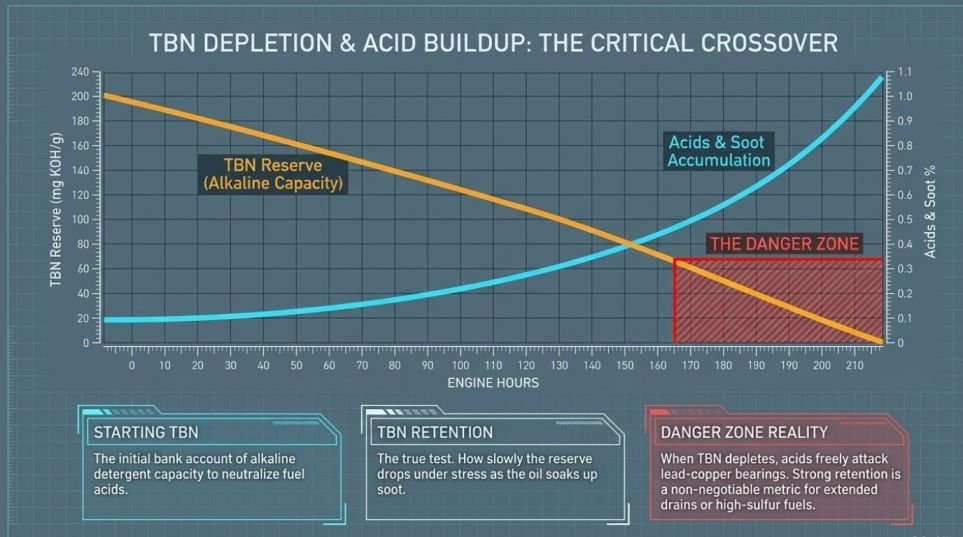
TBN reserve tells you how much alkaline detergent capacity is left to neutralize diesel soot acids before they start eating bearings and wiping out film strength. TBN retention is the real “drain interval life” indicator, because fresh oil starts with similar TBN numbers, while extended use is where detergent depletion separates the good oils from the marketing.
Starting TBN, Retention, And What “Reserve” Means In Diesel
Starting TBN is the starting bank account balance, while retention is how much money you still have after the oil has soaked up soot and burned fuel acids. In diesel service, soot loading and acid formation progress with fuel quality and operating pattern, so an oil that holds its alkalinity longer is the one that keeps corrosion risk lower when drains stretch.
In practice, the best 15W-40 oils show strong reserve based on two test signals: higher or slower-declining TBN across the test interval, and tight oxidation control that slows detergent breakdown. When you see oils with comparable viscosity and oxidation control but weaker TBN retention, the detergent capacity is being consumed by acid chemistry faster than the oil can replenish its protection.
| Test evidence you want | What strong results look like | What weak results usually mean |
|---|---|---|
| Initial TBN | Adequate starting detergent reserve for heavy-duty diesel | Starts low, leaves less margin for extended drains |
| TBN retention | Slower TBN drop and better acid neutralization through the interval | Fast depletion, more time spent in acid-prone chemistry |
| Oxidation and nitration trends | Stable film-forming behavior with acids under control | Higher acid activity and varnish tendencies increase deposit risk |
Corrosion And Bearing Protection Outcomes That Matter
Diesel corrosion risk tracks closely with acid number chemistry, because acids drive rusting and attack lead-copper bearing surfaces through contamination and film instability. Many lab sequences show this through metal corrosion ratings and wear responses, with the key expectation being that oils with better TBN retention also show lower corrosion severity.
For bearings, the money question is whether the oil stays chemically “neutral” enough to preserve anti-wear film under soot and blow-by contamination. If a sequence test shows increased wear metals or worse corrosion while TBN retention is poor, the oil is losing the alkalinity buffering that diesel engines need, especially during short-trip operation where the crankcase never fully heats through.
Tip from the shop floor: if your truck does lots of idle time, short hops, or low-speed turbo work, treat TBN retention as the deciding factor for drain interval safety, not the fresh-oil spec sheet.
High-sulfur Vs Modern Fuel Reality
High-sulfur fuel (common in some regions and older supply chains) increases acid formation and makes TBN depletion happen faster, so a robust reserve and better retention buy you real protection. Modern low-sulfur diesel reduces that acid load, but it does not erase the risk from soot, moisture, and condensation from under-heated operation.
Regional fuel quality changes expectations: an oil that looks “good enough” on a low-sulfur test can fall behind in harsher sulfur conditions, while an oil with standout TBN retention gives you more margin when the real-world fuel varies. That is why drain interval suitability should be based on retention trends that track soot and acid development, not just the starting TBN number.
What The Results Mean For You
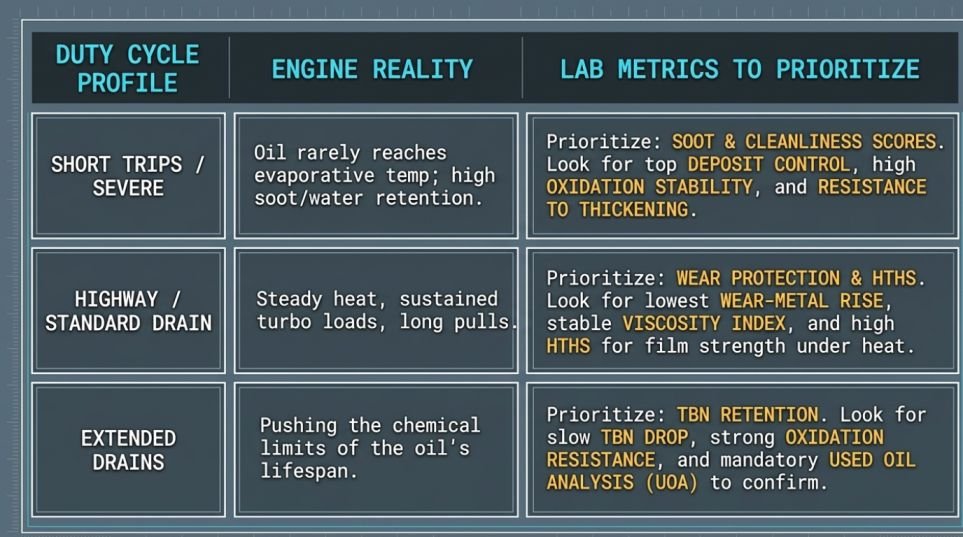
Oil test rankings only matter if you match the oil to your duty cycle and to the exact specs your engine calls for. The best performer in wear and soot control is usually the smart buy for short-trip diesels, while the best performer in oxidation and viscosity stability is the better bet for long highway runs.
Choose For Short Trips And Severe Service
Short-trip diesels earn extra soot, more acid load, and more sludge risk because the oil may never get fully hot. In the test data, you want the oils that score best on soot handling and cleanliness (deposit control, varnish control) and also hold viscosity against oxidation and thickening.
When you compare the “top” 15W-40 entries, treat soot-related results as the tie-breaker for severe use, then use thickening and volatility data to protect the engine from long-term drag and filter plugging. Extended TBN reserve is helpful, but a strong soot/cleanliness score is the more practical indicator for this kind of driving.
Choose For Highway And Standard Drain Intervals
Highway driving is easier on soot, but oxidation and wear still build steadily over time, especially with turbo diesels. For standard intervals, the winning oils in test data are usually the ones that balance wear protection with strong viscosity stability and adequate TBN reserve through the interval.
On most spec sheets, the oils that stay closer to their starting viscosity and show lower oxidation/nitration tell you the oil has more “headroom” before it falls out of grade. If your maintenance schedule is conservative, you can bias slightly toward wear protection; if you stretch intervals, bias toward stability and detergent reserve.
Extended Drain Scenarios: What The Data Can Justify
Test results can justify longer drains only when your real conditions match the lab assumptions, and diesel wear control depends heavily on heat and fuel dilution. Extended-drain suitability is best supported when the oil shows good oxidation resistance, controlled deposits, and sufficient TBN reserve through the targeted time or mileage.
Even with the best bench scores, you still need to watch real-world inputs. Oil analysis (wear metals, insolubles, oxidation/nitration where available, and TBN trend) is the cleanest way to confirm the oil is still doing the job, especially if you have turbo loading, frequent regens, or very cold starts.
Extended drains work when used oil chemistry agrees with the lab results. If your analysis shows rapid TBN drop, rising soot/insolubles, or abnormal viscosity change, shorten the interval and address the duty cycle or fueling issue.
| Service type | Test results to prioritize | Practical choice |
|---|---|---|
| Short trips / severe | Soot and cleanliness scores, deposit control, oxidation/thickening stability | Highest soot/cleanliness performer within correct diesel specs |
| Highway / standard intervals | Wear protection, viscosity stability, TBN reserve through interval | Best “balance” oil, not necessarily the single highest wear score |
| Extended drains | Oxidation resistance, deposit control, detergent reserve, stability headroom | Only extend with oil analysis confirmation and steady duty conditions |
Compatibility Checklist Before You Buy
Test rankings do not override the engine’s requirements. Start by confirming the owner’s manual specs for the exact diesel grade, then match the oil to the label’s API and ACEA (or the required OEM approval if listed).
Before you choose a 15W-40 from the “top” group, verify the bottle claims include the required performance category and that the product is actually marketed for diesel service, not “general” duty. After that, confirm it is the correct 15W-40 for your temperature range and that the oil’s drain interval lines up with your maintenance plan.
Quick Summary
Choosing a 15W-40 diesel oil gets complicated fast when your truck or farm equipment calls for modern API CK-4 or ACEA E-grade, because shelf labels often push “high mileage” and “extended protection” without showing the lab work behind them. This article explains how to compare top 15W-40 heavy-duty diesel oils using measurable outcomes like viscosity change at 40°C and 100°C, wear scar or wear-metal trends, oxidation and nitration stability, and TBN reserve.
The key message is that “top” oils are evaluated by balanced performance in the categories where diesel engines actually punish lubricants. Oils are screened to match the claimed compliance targets first, focusing on API CK-4 or CJ-4 for modern soot and oxidation control, and ACEA E7 or E9 when those claims are present, while older API-only products are treated as out of scope. The most important takeaway is to match the required API CK-4/CJ-4 or ACEA E-grade from your owner’s manual before any test comparison matters.
| Test/Result Area | What the article uses to rank oils |
|---|---|
| Wear protection | Lower wear scar size or reported Fe/Al wear trends in used-oil metrics |
| Soot control and cleanliness | Fewer cleanliness failures and better cleanliness behavior tied to oxidation and deposit control |
| Oxidation and nitration | Stability that helps prevent loss of performance under diesel combustion byproducts |
| Viscosity retention | Viscosity change at 40°C and 100°C, and HTHS drift where data exists |
| TBN retention | How slowly TBN reserve declines to protect detergency late in the interval |
Frequently Asked Questions
What Test Results Should I Look For When Comparing Top 15w-40 Diesel Engine Oils?
Look for results tied to high-temperature wear, oxidation stability, and viscosity retention after heat. If the article does not mention those categories, it is usually summarizing opinions instead of actual bench or lab tests.
How Do Lab Test Results For 15w-40 Diesel Oils Affect Real-world Engine Protection?
Lab tests like wear and viscosity retention are meant to predict how oil holds up under heat and friction, which usually translates to better resistance to thinning and less metal-to-metal wear. Real-world performance still depends on your engine condition, fuel quality, and oil-change interval.
Do Test Results For 15w-40 Diesel Oils Change Depending On Whether It Is Ci-4, Cj-4, Or Ck-4?
They often do, because newer categories typically demand better control of soot, oxidation, and deposits. If the “top” oil in the article lists a category that does not match your engine’s spec, the test results may not be the most relevant.
Why Do Test Results For 15w-40 Diesel Oils Sometimes Disagree Between Brands?
Different oils can be tested using different methods, different baseline oils, and different reporting limits, so two “top” products might not be ranked the same way. Also, some reviews focus on one area like wear, while others emphasize oxidation or viscosity, so the winner depends on what the tester measured.
How Long Does 15w-40 Diesel Oil Stay In Grade After Tests, And What Does That Mean For My Oil-change Interval?
If the test results show good viscosity retention, it suggests the oil is more likely to stay within its expected thickness range longer under heat. Still, your interval should be based on your use (short trips versus highway), fuel, and the oil-life strategy your manufacturer specifies, since test cycles do not perfectly match every commute.
Can I Use Test Results From One Engine Type To Pick 15w-40 For My Pickup, Tractor, Or Fleet Diesel?
You should match the oil specification first, because heavy-duty diesel requirements can be different from older engines, off-road use, or certain emissions setups. If the article does not clearly state the engine type or specification context behind the test results, treat the conclusions as general guidance, not a guaranteed fit.

- 2018 Range Rover Velar 380 Oil Capacity: +2018 Range Rover Velar Oil Capacity - September 27, 2026
- 2017 Dodge Grand Caravan Transmission Fluid Capacity: Dodge Grand Caravan Transmission - September 27, 2026
- How Many Gallons Of Transmission Fluid Does A 2017 Gmc Yukon 5.3 Slt Xl Hold: How Many - September 26, 2026