
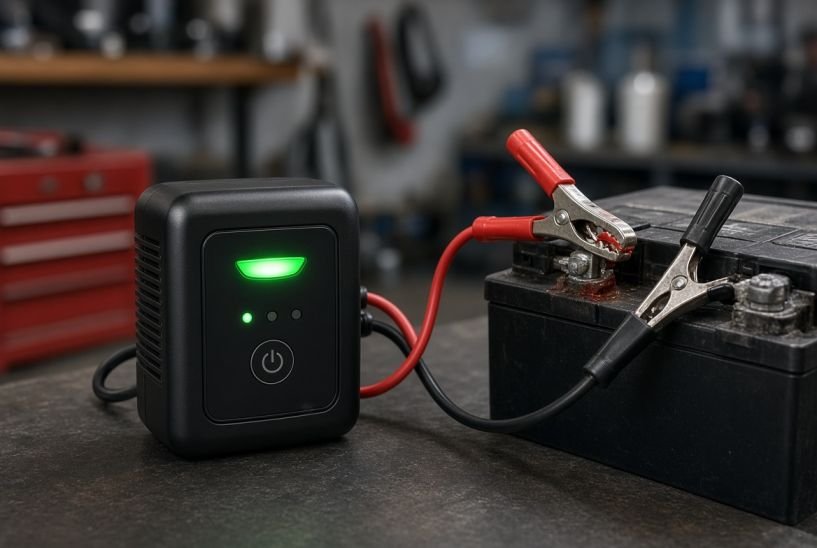
Battery Tender 3 amp reviews and complaints — the short answer
The Battery Tender 3 Amp (model 022-0202-COS, sold as the Power Plus or PowerTender) charges and maintains 6V and 12V batteries between 14Ah and 100Ah. Most owners rate it well for years of storage duty on cars, boats, and larger motorcycles. The complaints that show up again and again aren’t really about charging performance. They’re about a confusing status light, units that quit after five to eight years, and a handful of dead-on-arrival units discovered too late for a return.
Key Takeaways
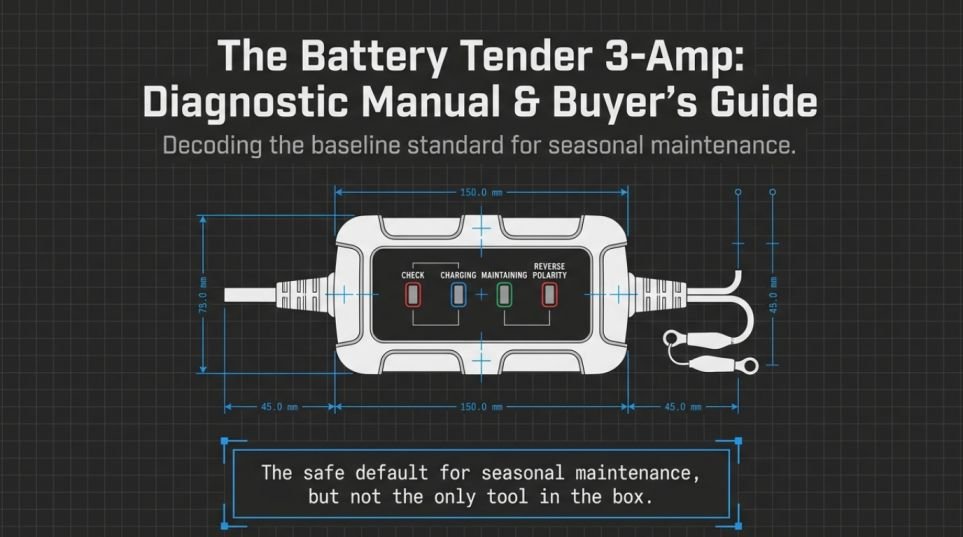
- Rated output is 3 amps at 6V or 12V, selectable, with a stated range of 14Ah to 100Ah batteries.
- Comes with a 5-year warranty and roughly 11 feet of combined cord and lead reach (6 ft AC cord, 5 ft DC lead).
- The most common complaint is a flashing red light that owners mistake for a defect. It usually means a dirty terminal or a battery under 3 volts, not a broken charger.
- A smaller number of owners report units failing outright after several years of daily use, and a few report dead-on-arrival units.
- NOCO’s Genius5 and CTEK’s MXS 5.0 are the two alternatives worth cross-shopping if you want more amperage or a repair mode.
- If your battery is small (motorcycle, ATV, lawn equipment), the 1.25 amp Battery Tender Plus is the better fit than the 3 amp model.
Do you actually need the 3 amp, or is it overkill for your battery
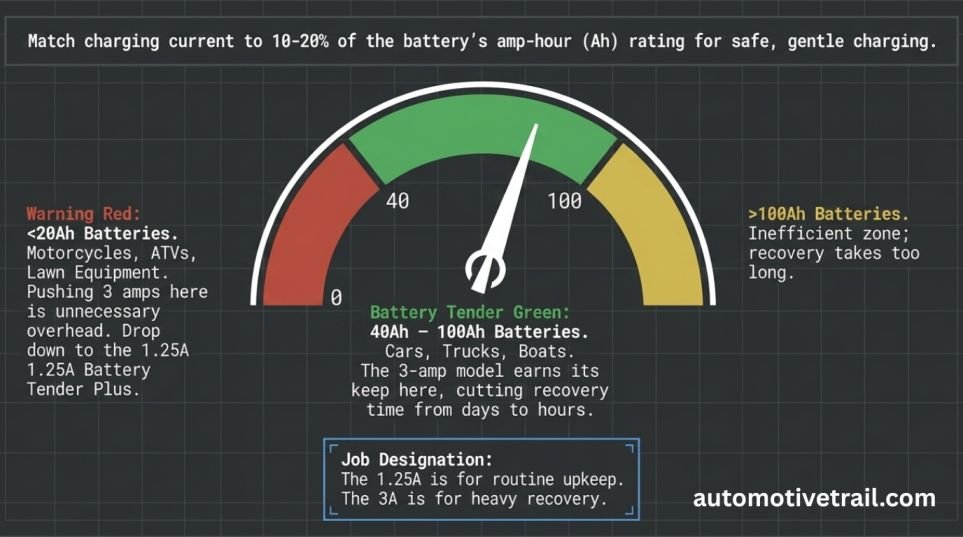
Battery Tender itself splits its lineup by job, not just amperage. The Plus series at 1.25 amps is built for routine maintenance on a battery that already gets charged regularly. The 3-amp PowerTender is built for recovery — a battery that sat all winter with no maintainer, or a larger automotive battery that would take days to come back at 1.25 amps.
That distinction matters more than most buyers realize. A small motorcycle or ATV battery, typically under 20Ah, doesn’t need 3 amps of bulk current. It won’t get damaged thanks to the automatic float switchover, but you’re paying for headroom you won’t use. A car, truck, boat, or larger powersports battery in the 40Ah to 100Ah range is where the 3-amp model earns its keep, cutting recovery time from days to hours.
Rule of thumb: match charging current to roughly 10-20% of the battery’s amp-hour rating for gentle, safe charging. A 20Ah motorcycle battery is happier on a 1.25 amp charger. A 70Ah truck battery benefits from the faster 3 amp bulk charge.
Battery Tender 3 Amp Power Plus (022-0202-COS) review
This is the model most people mean when they search “battery tender 3 amp.” It runs a four-step ISM (Infinite Sequential Monitoring) charge cycle: initialization, bulk charge, absorption, and float. Deltran, the company behind Battery Tender, has used this same core technology since 1965.
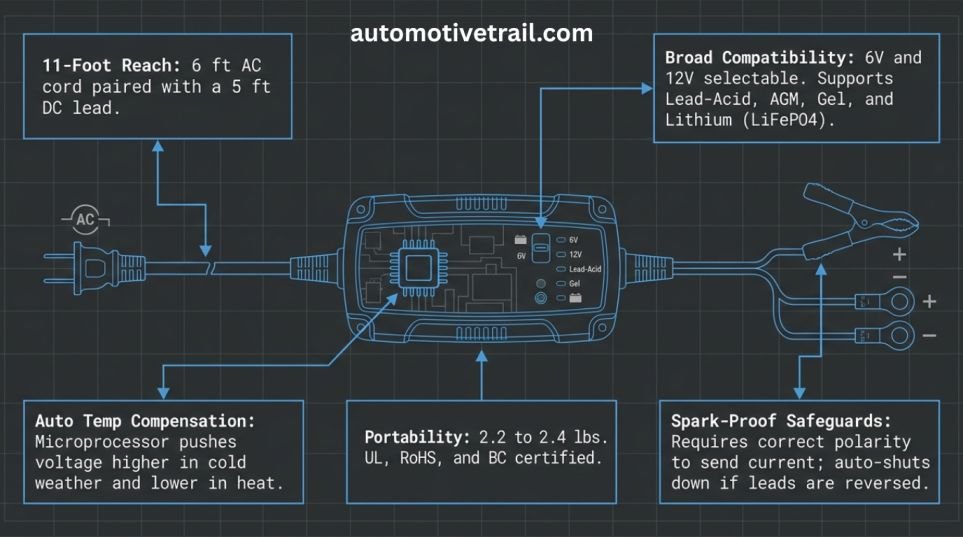
Build quality gets consistent praise. The two-color LED is easy to read from across a garage. The spark-proof connector won’t send current until it confirms correct polarity, and it shuts down automatically if you reverse the leads. Temperature compensation adjusts the charge voltage on its own, pushing it higher in cold weather and lower in heat, so you don’t have to think about seasonal settings.
Real-world owners on forums like SpyderLovers and RiverDavesPlace report years of reliable use on boats, side-by-sides, and daily drivers. One long-term owner running the 3 amp version on a 2025 RAM with heavy electronic load called the output “perfect” for a vehicle that draws parasitic current between drives.
The unit ships with a ring terminal and alligator clip combo cable, works with lead-acid, AGM, gel, and lithium (LiFePO4) chemistries, and carries UL, RoHS, and BC certification. At roughly 2.2 to 2.4 pounds, it’s light enough to toss in a truck bed or boat locker without a second thought. Current retail runs $50 to $75 depending on retailer, with Costco periodically discounting it below that.
The most common battery tender 3-amp complaints, explained
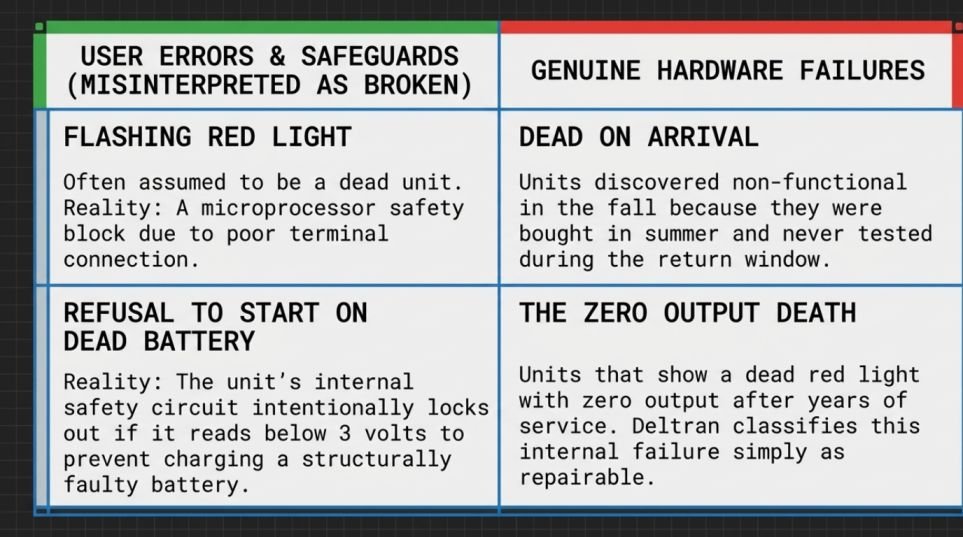
Most negative reviews trace back to one of three causes, and two of them aren’t actually the charger’s fault.
Flashing red light with no charge. This is the number one complaint across Amazon, AutoZone, and owner forums. Per Deltran’s own documentation, a flashing red light means AC power is present, and the microprocessor is running, but the unit isn’t sensing a proper connection. Corroded battery posts or a loose clip cause this more often than a bad charger. Cleaning terminals with a baking soda and water solution resolves a real share of these cases.
Won’t start on a severely dead battery. If the battery reads under roughly 3 volts, the internal safety circuit blocks charging entirely, no lights at all. Owners read this as “the charger is broken” when it’s actually a built-in safeguard against a battery that may be faulty.
Units that die after years of service. This one is a genuine failure mode, not user error. One owner running five units in parallel described them failing one by one around the 7 to 8 year mark, each showing a dead red light with zero output. Deltran’s own repair response on a returned unit was simply “repairable,” without further explanation.
Dead-on-arrival units. A smaller group of buyers discover a non-functioning charger only after the return window closed, often because they bought it in summer and didn’t need it until fall storage season. Testing a new unit on a known-good battery within the first few weeks avoids this problem.
How long these actually last before failing
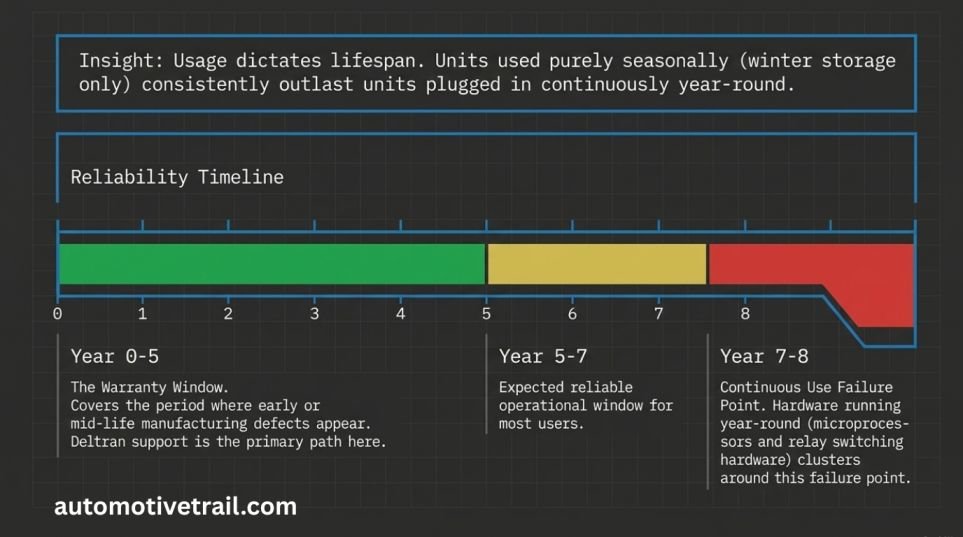
There’s no official mean-time-to-failure number from Deltran, so the honest answer comes from aggregating owner reports. The pattern that shows up most: several years of trouble-free daily or seasonal use, then a die-off that tends to cluster around the 7 to 8 year mark for units run continuously.
That’s not unusual for a device with a microprocessor and relay switching hardware sitting plugged in year-round. Units used seasonally (connected only for winter storage, then unplugged) seem to hold up longer based on forum reports, though nobody’s running a controlled study on this.
The 5-year warranty covers the period where most early or mid-life failures happen. If your unit dies inside that window, Deltran’s customer service line is the path forward rather than assuming you need a new one.
Battery Tender 3 amp vs 1.25 amp Plus — which one to buy
| Spec | Battery Tender Plus (1.25A) | Battery Tender 3 Amp PowerTender |
|---|---|---|
| Output | 1.25 amps | 3 amps |
| Best for | Routine maintenance, small-to-mid batteries | Recovery charging, larger or deeply discharged batteries |
| Battery range | Up to ~40Ah | ~14Ah to 100Ah |
| Recharge speed | Slower, gentler | Roughly 2-3x faster bulk charge |
| Lithium support | Yes | Yes |
| Typical price | $35-45 | $50-75 |
If your battery is already getting charged regularly and just needs upkeep between uses, the 1.25 amp Plus does the job for less money and less current. If you’re recovering a battery that sat dead for weeks, or you’re maintaining something bigger than a standard car battery, the 3-amp model pays for itself in time saved.
Top alternative: NOCO Genius5
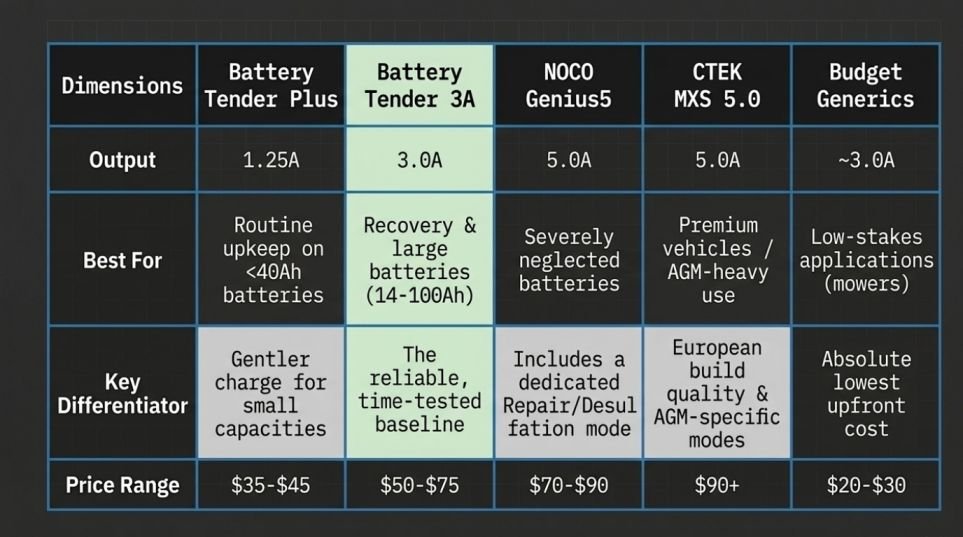
NOCO’s Genius5 charges at up to 5 amps, one step above the Battery Tender 3-amp, and covers a wider range of vehicle types out of the box: automotive, marine, RV, deep-cycle, and lithium. It also includes a repair/desulfation mode aimed at reviving batteries that have sat neglected long enough to develop capacity loss, a feature the Battery Tender line doesn’t offer.
Owners comparing the two brands on forums like GL1800Riders note a real difference in charging behavior, not just spec sheets. The Genius5 tends to step down current more gradually across multiple voltage plateaus during a charge cycle, while the Battery Tender holds a more constant bulk voltage before switching to float. Neither approach is wrong, but the NOCO’s extra steps can mean a longer total charge time on a deeply discharged battery even at higher peak amperage.
Price sits close to the Battery Tender 3 amp, typically $70-90 depending on retailer and sales. If you want one charger to cover multiple vehicle types, including something that occasionally needs real recovery rather than maintenance, the Genius5 is the strongest cross-shop.
Best build quality alternative: CTEK MXS 5.0
CTEK’s MXS 5.0 comes up often in the same breath as Battery Tender and NOCO in long-term owner comparisons, usually praised for construction quality ahead of the other two. It runs at 5 amps and includes an AGM-specific charging mode that some owners trust more for that chemistry specifically, given CTEK’s longer history building chargers for the European AGM-heavy market.
It weighs more than the Battery Tender 3 amp, around 3.6 pounds versus 2.2 to 2.4 pounds, and costs more too. If weight and portability matter, that’s a real tradeoff. If you’re mounting it in a fixed spot in a garage or boat and won’t be moving it often, the extra heft is a non-issue.
Pick this one if AGM batteries specifically are your main concern and you’re willing to pay a premium for a European-built unit with a strong reliability reputation.
Best budget 3 amp maintainer
Generic and store-brand 3 amp maintainers, including Schumacher units and various imports sold through big-box retailers, run well under the branded price, often $20-30 versus $50-75 for the Battery Tender. Forum owners running these on low-stakes applications like a riding mower, generator, or backup vehicle report years of trouble-free service in a fair number of cases.
The tradeoff is consistency. You’re less likely to get the same charge-cycle precision, temperature compensation, or long warranty coverage. For a battery where a slow recovery or an occasional overcharge wouldn’t cost you much, the budget route is a reasonable bet. For anything you actually depend on starting reliably, the extra cost of a name-brand unit with a 5-year warranty is easier to justify.
Troubleshooting a 3-amp battery tender that won’t charge
Check the light pattern before assuming the unit is dead.
| Product | Charging Amperage | Voltage Support | Battery Chemistry | Best Use Case | Warranty | Key Features | Price Range |
|---|---|---|---|---|---|---|---|
| Battery Tender 3 Amp Power Plus (022-0202-COS) | 3A | 6V/12V selectable | Lead-acid, AGM, gel, LiFePO4 | Recovery charging for car, truck, boat, or winter-stored batteries (14–100Ah) | 5 years | 4-step ISM cycle, temperature compensation, spark-proof, reverse-polarity protection, 11-ft reach | $50–$75 |
| NOCO Genius5 | 5A | See manual | Automotive, marine, RV, deep-cycle, lithium | Recovery and maintenance for vehicles with neglected batteries | Varies | Repair/desulfation mode; multiple voltage plateaus for gradual current reduction | $70–$90 |
| CTEK MXS 5.0 | 5A | See manual | AGM-specific mode mentioned | Fixed mounting; suited to build quality and AGM performance | Varies | European-built, heavy construction (3.6 lbs), specialized AGM mode | Premium; typically above $50–$75 |
| Battery Tender Plus | 1.25A | See manual | Lithium support mentioned | Routine maintenance for motorcycles, ATVs, lawn equipment (up to ~40Ah) | Varies | Automatic float switchover; gentle, safe charging for small batteries | $35–$45 |
| Generic / Store-Brand 3A Maintainers | 3A | See manual | See manual | Low-stakes use: riding mowers, generators, backup vehicles | Short / Not specified | Basic maintenance; no precise charge cycles or temperature compensation | $20–$30 |
What to check before buying a 3 amp battery tender
A few checks before you buy save most of the return-window headaches described above.
- Match amperage to battery size. Don’t buy 3 amps for a 15Ah motorcycle battery; step down to a 1.25 amp unit instead.
- Confirm chemistry support. Flooded, AGM, gel, and lithium batteries need different charge profiles. Check the label matches your battery type.
- Check for 6V/12V selectability if you own older vehicles or specialty equipment that needs it.
- Test it within a few weeks of purchase, on a known-good battery, so any DOA unit is still inside the return window.
- Look at warranty length. Five years is now close to the category standard among the major brands; anything shorter is a red flag.
- Confirm it’s rated for your install location. None of these units, including the Battery Tender, are rated for direct outdoor water exposure.
Price and where to buy in 2026
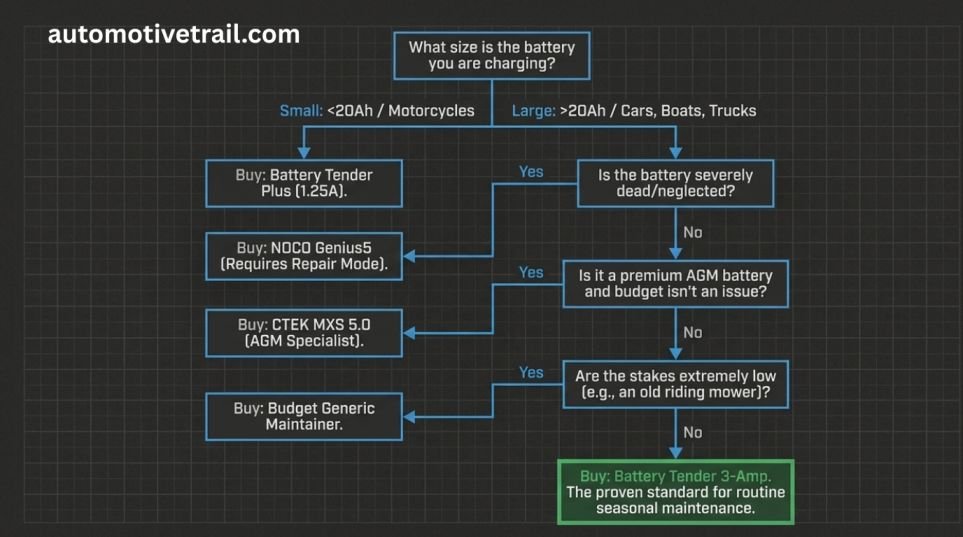
The Battery Tender 3 Amp Power Plus typically runs $50-75 depending on retailer, with Costco and Amazon periodically discounting it $10-20 below list during seasonal sales (fall is common, tied to winter storage demand). AutoZone and O’Reilly carry it in-store for buyers who want to avoid shipping delays before cold weather hits.
Bottom line — which pick fits your situation
For most car, truck, boat, or powersports owners who want dependable seasonal or long-term maintenance, the Battery Tender 3 Amp remains the safe default. It’s well-reviewed, backed by a 5-year warranty, and the complaints that show up most often trace back to a misread status light or a battery too dead to detect, not a flawed product.
If you want faster charging, broader vehicle-type coverage, or a repair mode for a genuinely dead battery, step up to the NOCO Genius5. If AGM performance and build quality are your priority and price is secondary, the CTEK MXS 5.0 is worth the premium. If your battery is small, motorcycle- or ATV-sized, skip the 3 amp model entirely and go with the 1.25 amp Battery Tender Plus instead. And if the stakes are low (a mower, a spare vehicle you rarely use), a budget generic 3 amp maintainer will likely do fine for a fraction of the cost.
FAQ
Is the Battery Tender 3 Amp better than the 1.25 amp Plus? Better depends on the job. The 3 amp model recovers a deeply discharged or larger battery faster, while the 1.25 amp Plus is gentler and sized right for routine maintenance on smaller batteries. Neither is universally better.
Why does my Battery Tender show a flashing red light and never charge? It usually means a bad connection, not a broken unit. Corroded battery posts or a loose clip are the most common causes. Clean the terminals and reconnect before assuming you need a replacement.
Can I leave a Battery Tender 3 Amp connected all winter? Yes. The four-step ISM charging cycle is designed for indefinite float maintenance once the battery reaches full charge, and that’s the primary use case for the product.
How long do Battery Tender chargers typically last? Owner reports suggest several years of reliable service, with some failures clustering around the 7 to 8 year mark for units run continuously. The 5-year warranty covers most of that window.
Is 3 amps too strong for a motorcycle battery? For most small powersports batteries under 20Ah, yes, it’s more current than necessary. The 1.25 amp Battery Tender Plus is the better-sized option for that use case.
What’s a good alternative to the Battery Tender 3 Amp? The NOCO Genius5 offers more amperage and a repair mode for badly neglected batteries, while the CTEK MXS 5.0 is favored for build quality and AGM-specific charging. Both cost roughly the same or slightly more.

- Top 10 Ranking Tire Brand for Minivan: Reviewed 2026 - October 5, 2026
- Model Y Tesla Long Range Automatic Wagon Tyre Fitment And Ratings - October 3, 2026
- What Is The Benefit Of Larger Rear Tyres On A Zero-turn Mower - October 3, 2026