
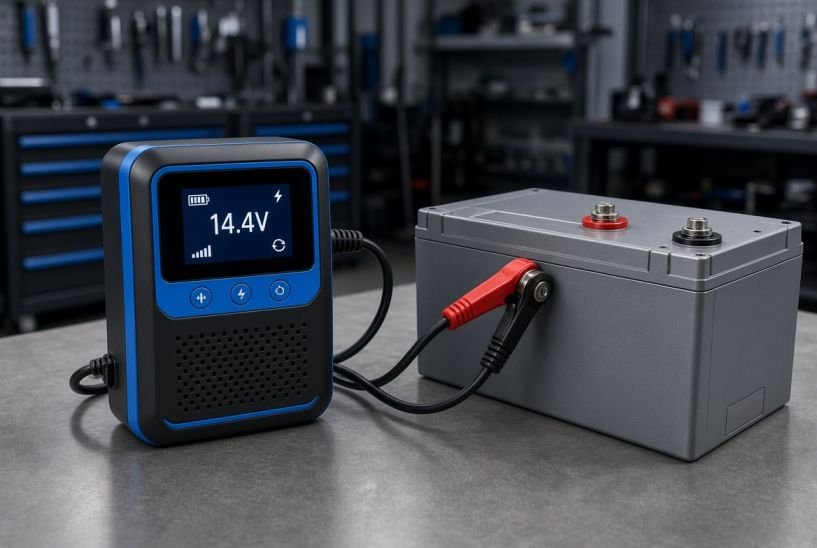
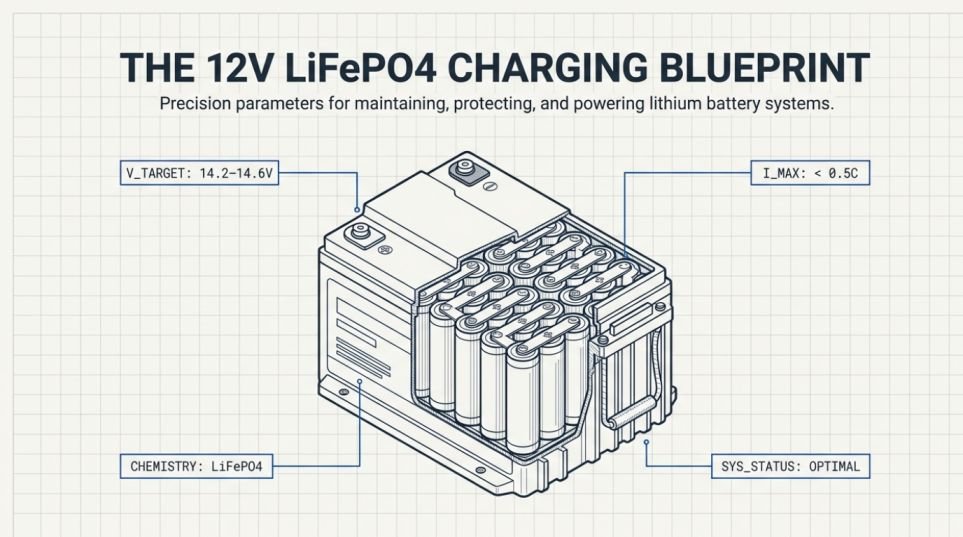
A 12-volt lithium battery charger for LiFePO4 needs to hit 14.2 to 14.6 volts in constant current, then hold that voltage while the current tapers off. Anything else, especially a lead-acid charger’s float stage, will either undercharge your battery or wear it out early.
Short version: match the charger to LiFePO4 chemistry specifically, size the amperage to your battery’s capacity, and skip anything with equalization or desulfation modes built in.
Key takeaways
- Target charge voltage for a 12V LiFePO4 pack is 14.2 to 14.6V, roughly 3.55 to 3.65V per cell.
- A 100Ah battery takes about 5 hours on a 20A charger, or 2.5 hours on a 40A.
- Lead-acid chargers push absorption to 14.7 to 15.0V and add equalization up to 15.8V. Both can trip the BMS or stress lithium cells.
- Charging stops when current tapers to about 0.02C, roughly 2A on a 100Ah battery.
- Most LiFePO4 BMS units block charging below 0°C (32°F).
- Float charging is optional for LiFePO4 and should never exceed 13.6V if used
12-volt lithium battery charger vs. lead-acid charger: why they’re not interchangeable
The plug fits. That’s the problem. A lead-acid charger will physically connect to a LiFePO4 battery and start pushing current, but the voltage curve underneath is built for a different chemistry entirely.
Lead-acid chargers run absorption around 14.7 to 15.0V, then some models add an equalization phase that spikes as high as 15.8V to break up sulfation on the plates. LiFePO4 cells have a hard ceiling near 3.65V each, or about 14.6V across a 12V pack. Cross that line and the battery’s BMS steps in and disconnects the pack to protect the cells. Do it repeatedly and you’re cycling the BMS more than the actual charge cycle, which shortens its working life.
Then there’s float. Lead-acid batteries need a low trickle voltage held indefinitely to fight self-discharge. LiFePO4 barely self-discharges, so a long float stage at lead-acid voltages just keeps the cells sitting at a higher state of charge than they need, which is exactly the condition that accelerates capacity fade over years of storage.
The reverse isn’t automatically true. A dedicated LiFePO4 charger won’t properly charge a lead-acid battery either; the voltage ceiling is too low, and the battery will never reach full charge. These are chemistry-specific tools now, not universal ones, and treating them as interchangeable is the single most common mistake first-time lithium owners make.
How to tell a charger is actually rated for LiFePO4
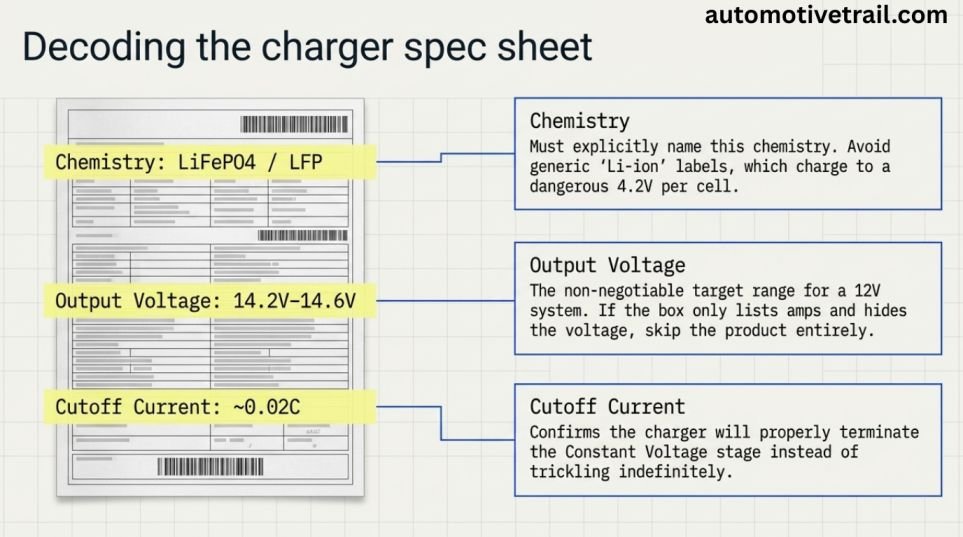
“Lithium compatible” on a box means less than it sounds like. Some multi-chemistry smart chargers list lithium as one mode among six or seven, buried under lead-acid, AGM, gel, and calcium settings, and the lithium mode itself may just be a lead-acid profile with a slightly lower ceiling.
Check for these three things on the spec sheet or manual before buying:
- The charger names LiFePO4 or LFP specifically, not just “lithium” or “Li-ion.” Li-ion cells (like the ones in power tools) charge to 4.2V per cell, nearly a full volt higher per cell than LiFePO4. A charger built around Li-ion voltage will overcharge an LFP pack.
- The output voltage is listed as 14.2 to 14.6V for a 12V system. If the spec sheet only shows amps and no voltage ceiling, that’s a red flag.
- No mention of equalization, desulfation, or pulse reconditioning in the lithium mode’s description. These stages exist to fix lead-acid plate sulfation, a problem LiFePO4 cells don’t have.
If a manufacturer can’t produce a spec sheet with a voltage number on it, skip the product no matter how many reviews it has.
Voltage and current specs to check before buying
These are the numbers that actually determine whether a charger will treat your battery correctly. Compare them against whatever charger you’re considering.
| Parameter | Typical value |
|---|---|
| Nominal voltage | 12.8V (4 cells x 3.2V) |
| Charging (CC/CV) voltage | 14.2–14.6V |
| Per-cell charge voltage | 3.55–3.65V |
| Float voltage, if offered | 13.4–13.6V (skip if not needed) |
| Cutoff current | ~0.02C (2A on a 100Ah battery) |
| Low-voltage BMS cutoff | 10–11V (~2.5V/cell) |
| Minimum charge temperature | 0°C / 32°F |
Your specific battery’s datasheet overrides all of this. Manufacturers set their own BMS thresholds, and a charger that’s technically correct for “LiFePO4 in general” can still exceed what your particular pack’s BMS allows. Five minutes reading the datasheet before you buy a charger saves a returned order later.
What happens during charging: CC/CV in plain terms
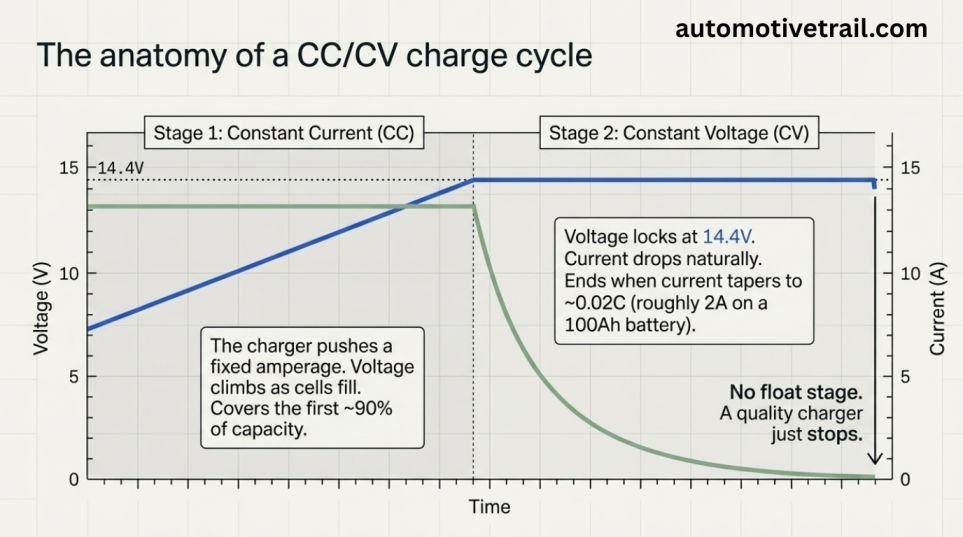
LiFePO4 charges in two stages, not the three or four you’d see on a lead-acid charger. No bulk-absorption-float cycle, no equalization pass.
Stage one is constant current. The charger pushes a fixed amperage into the battery and voltage climbs as the cells fill, similar to pouring water into a container at a steady rate. This stage covers roughly the first 90% of capacity and ends once the pack hits its target voltage, typically 14.4V.
Stage two is constant voltage. The charger locks that voltage in place and lets current drop on its own as the cells approach full. Because voltage is now fixed, current is the variable that signals how close to done you are. Once it falls to around 2% of the battery’s rated capacity, the charger cuts off entirely.
That’s it. No float stage extending the process, no periodic maintenance pulses. A quality LiFePO4 charger just stops, which is part of why lithium setups need less babysitting than lead-acid ones once the charger and battery are matched correctly.
How many amps do you actually need?
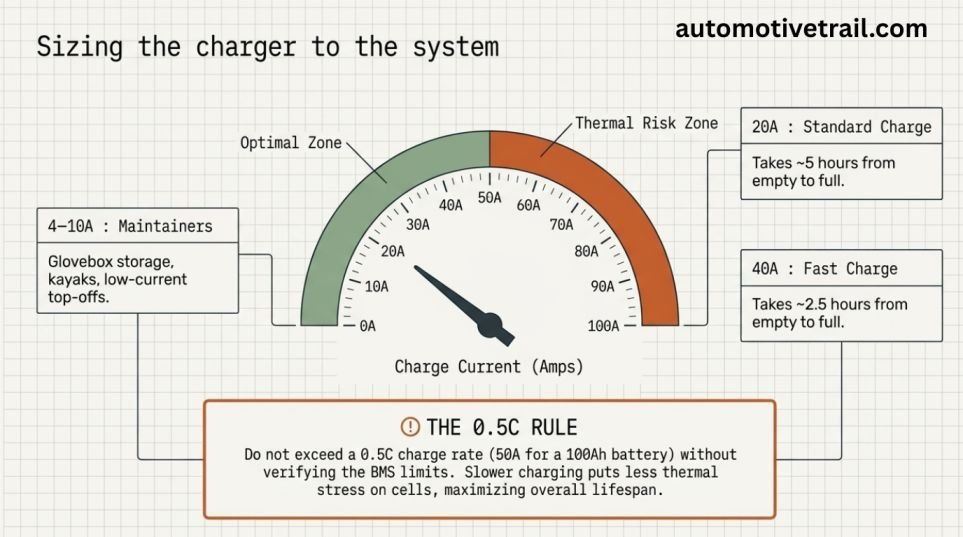
Charging speed comes down to one ratio: charger amperage against battery amp-hours. A common ceiling is 0.5C, meaning a 100Ah battery shouldn’t take more than 50A without checking the BMS’s rated max charge current first. Most home setups run well under that.
Real numbers from current chargers on the market:
- A 20A charger takes a 100Ah battery from empty to full in about 5 hours.
- A 40A charger cuts that to roughly 2.5 hours.
- Compact 4 to 10A maintainers are built for smaller packs, kayak electronics, or trickle maintenance, not daily full-capacity charging on a large bank.
Faster isn’t automatically better. Charging at high current generates more heat, and some BMS units will throttle or disconnect if internal temperature climbs too fast. If you’re charging overnight or have the time, a slower charger putting less thermal stress on the cells is often the safer long-term choice. If you need the battery back in service in an hour or two, size up, but confirm your BMS’s max charge current rating first so you’re not asking for more than the pack can safely accept.
AC charger vs. DC-DC vs. solar (MPPT): picking the right type
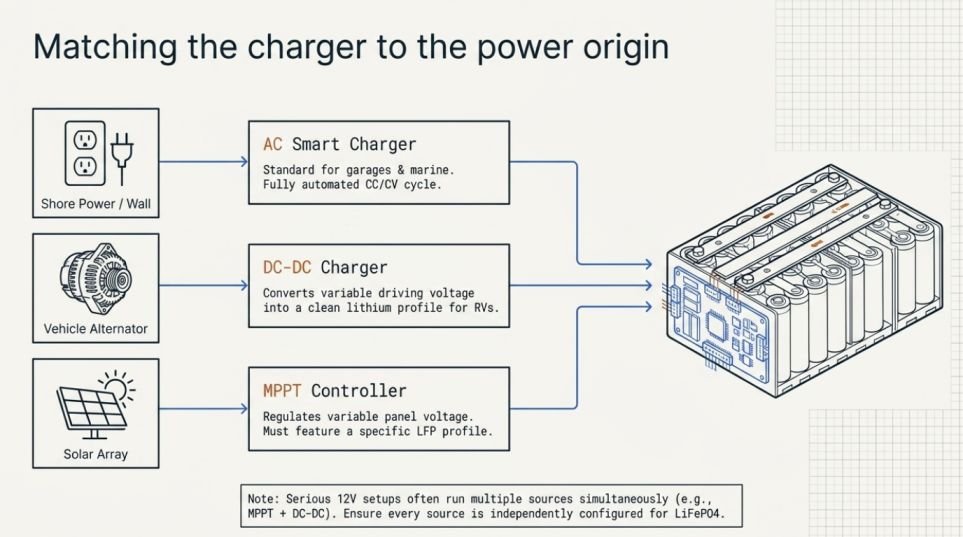
Which charger type you need depends on where the power is coming from, not just what battery you own.
AC smart chargers plug into wall power and are the standard choice for garages, homes, boats at a dock, or anywhere you have shore power. They handle the full CC/CV cycle automatically and are the simplest option if you’re just topping off a battery between uses.
DC-DC chargers sit between a vehicle’s alternator and the lithium battery, converting the alternator’s variable voltage into a clean LiFePO4 charge profile while driving. These are standard in overlanding rigs, camper vans, and RV house-battery setups where the battery charges off the engine.
Solar charge controllers (MPPT) with a built-in LiFePO4 profile let panels charge the battery directly, regulating voltage from the panel array instead of a wall outlet or alternator. Off-grid cabins, boats without shore power, and remote installations lean on this option.
Most serious 12V lithium setups end up running two of these at once, commonly solar plus a DC-DC charger in a van build, so the battery charges whether the vehicle is moving or parked in the sun. Check that each charger source has its own LiFePO4-rated profile; a solar controller charging correctly doesn’t mean your DC-DC unit is configured the same way.
Charger comparison: a few real options by use case
| Charger | Max Current | Voltage | Best Use | Key Features | 100Ah Charge Time |
|---|---|---|---|---|---|
| Redodo 40A LiFePO4 Charger | 40A | 14.6V | Large battery banks; fast turnaround | Fast charging | ~2.5 hours |
| LiTime 12V 20A LiFePO4 Charger | 20A | 14.6V | General AC charging; mid-size banks | 0V reactivation; Anderson connector | ~5 hours |
| ECO-WORTHY 12V 20A LiFePO4 Charger | 20A | 14.6V | Solar-adjacent AC charging | 3-stage profile; cooling fan | ~5 hours |
| Compact 4A LiFePO4 Maintainer | 4A | 14.6V | Small packs; glovebox storage | Auto-detect; low-current top-off | 25 hours |
Pick by amperage first, chemistry mode second. A 40A unit on a 30Ah battery is oversized and unnecessary; a 4A maintainer on a 300Ah bank will take most of a day. Match the charger to the battery, not the other way around.
How to charge a 12V lithium battery step by step
- Confirm your battery’s datasheet for max charge voltage and current before connecting anything.
- Set the charger to its LiFePO4 or LFP mode if it’s a multi-chemistry unit. Don’t leave it on a default AGM or lead-acid setting.
- Connect positive to positive, negative to negative. Reverse polarity protection should stop a wrong connection, but don’t rely on it as a first line of defense.
- Power on the charger and confirm it enters constant current mode, usually shown by a steady LED or current reading on the display.
- Let it run through to constant voltage and cutoff. Don’t disconnect early just because the percentage looks close; the CV stage is doing real work topping off the last 10%.
- Disconnect once the charger indicates complete, or current has dropped to near zero if you’re watching manually.
- If the battery was at 0V and won’t accept a charge, check whether the charger has a low-voltage wake-up or reactivation mode before assuming the pack is dead.
Cold weather charging: what changes below freezing
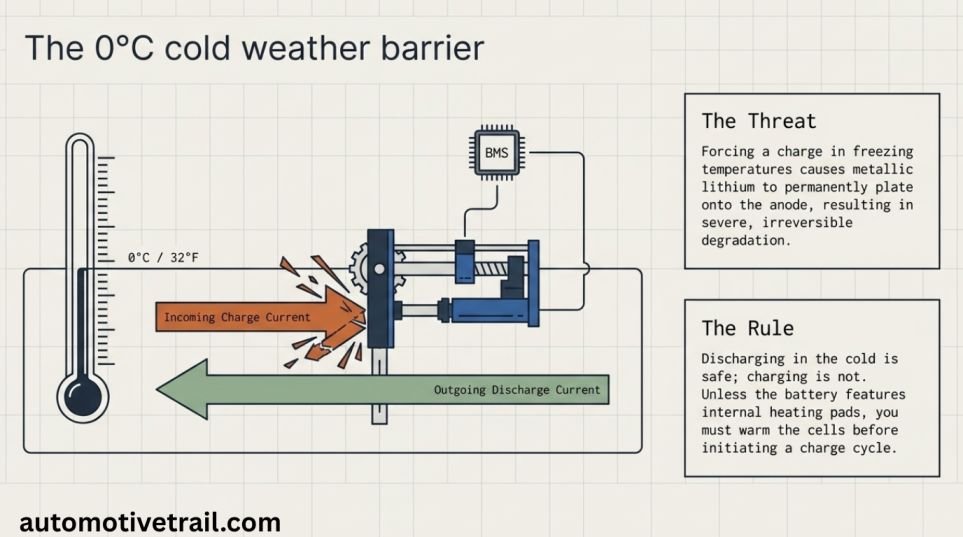
Most LiFePO4 batteries will not charge below 0°C (32°F), and this isn’t the charger’s limitation; it’s the battery’s BMS refusing the current on purpose. Charging lithium cells in freezing temperatures can plate metallic lithium onto the anode, a permanent and sometimes dangerous degradation that discharging at cold temps doesn’t cause.
A handful of batteries now ship with internal heating pads that warm the cells before allowing a charge cycle to start, which is worth paying extra for if you’re in a climate where sub-freezing mornings are routine. Without a built-in heater, options are limited: insulate the battery compartment, bring the battery inside to charge, or wait for ambient temperature to climb.
Discharging (using the battery to run a load) is generally fine in cold weather; it’s specifically the charging direction the BMS is protecting.
Mistakes that shorten battery life
- Leaving a lead-acid charger connected “temporarily” and forgetting about it. The elevated float voltage does damage slowly, which makes it easy to miss until capacity has already dropped.
- Buying based on amperage alone without checking the voltage profile. A high-current charger set to the wrong voltage ceiling is worse than a slow one set correctly.
- Ignoring the BMS’s max charge current rating and assuming any high-amp charger is fine. The battery pack, not the charger, sets the real ceiling.
- Charging in freezing temperatures because the charger didn’t stop you (some cheaper units lack the low-temp cutoff the battery’s BMS should already provide).
- Storing at 100% for months. LiFePO4 stores best around 50 to 70% state of charge for long idle periods, not full.
Summary: how to actually pick one
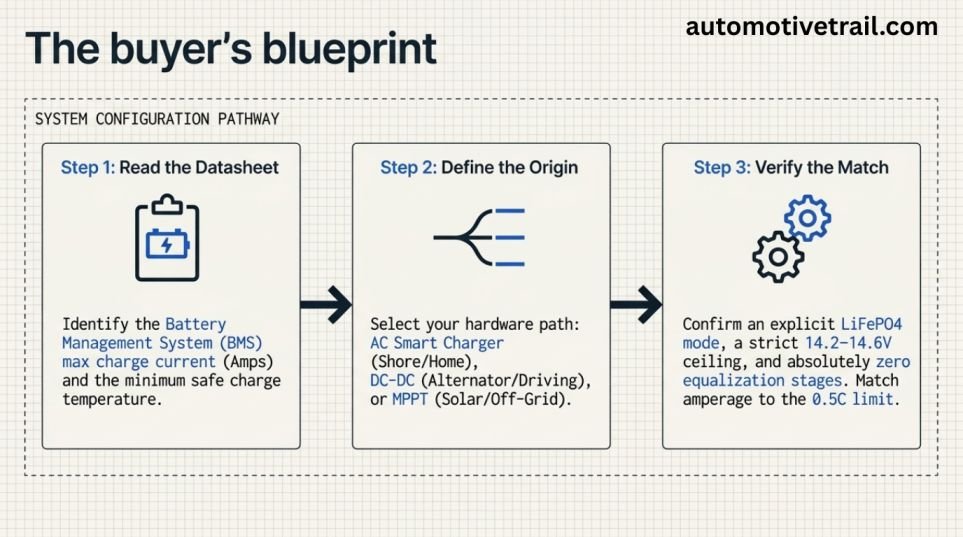
Start with your battery’s datasheet, not the charger aisle. You need the max charge voltage (almost always 14.2 to 14.6V for a 12V pack), the BMS’s rated max charge current, and the minimum charge temperature.
From there, match a charger with an explicit LiFePO4 mode at that voltage, sized to whatever amperage fits your patience and your BMS limit, without any lead-acid-specific stages like equalization along for the ride. A 20A AC charger covers most single-battery home and marine setups. Vehicle owners charging off the alternator want a DC-DC unit; off-grid setups want an MPPT controller with an LFP profile built in.
Everything else- the LED displays, the cooling fans, the connector styles- is convenience on top of that core match. Get the voltage and current right first, and the rest is preference.
FAQ
Can I use a regular battery charger on a lithium battery? Not safely for full charging. It may connect and even push some current, but lead-acid voltage profiles run higher than LiFePO4 cells tolerate, which can trip the BMS repeatedly or degrade cells over time.
What voltage should a 12V lithium battery charger output? 14.2 to 14.6V for the charging stage, which works out to roughly 3.55 to 3.65V per cell across a standard 4-cell 12V pack.
How long does it take to charge a 12V lithium battery? Depends on amperage: about 5 hours for a 100Ah battery on a 20A charger, or 2.5 hours on 40A. Smaller maintainers in the 4 to 10A range take proportionally longer.
Do lithium batteries need float charging? No, not in the way lead-acid does. LiFePO4 self-discharges very slowly, so an indefinite float stage isn’t necessary and can hold cells at a higher charge state than ideal for long-term health.
Can you charge a lithium battery in cold weather? Most BMS units block charging below 0°C (32°F) to prevent lithium plating on the anode. Some batteries include heating pads to work around this; otherwise, warm the battery before charging.
How do I know if my charger is actually LiFePO4 compatible? Check the spec sheet for an explicit LiFePO4 or LFP mode with a voltage ceiling around 14.2 to 14.6V, and confirm it doesn’t include equalization or desulfation stages meant for lead-acid.

- Top 10 Ranking Tire Brand for Minivan: Reviewed 2026 - October 5, 2026
- Model Y Tesla Long Range Automatic Wagon Tyre Fitment And Ratings - October 3, 2026
- What Is The Benefit Of Larger Rear Tyres On A Zero-turn Mower - October 3, 2026