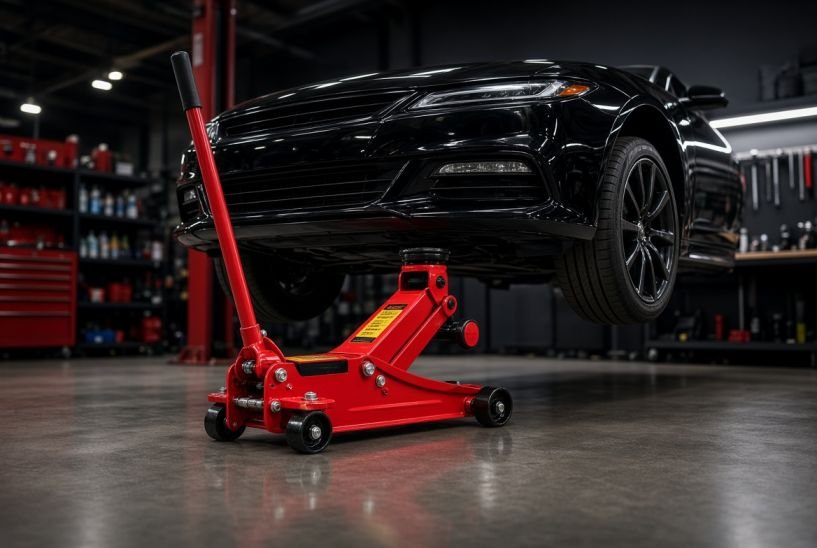
Eighteen floor jacks. That’s the Harbor Freight lineup covered in this guide, running from a $34.99 trolley jack to a $389.99 22-ton air/hydraulic unit. Most people should skip straight to the Pittsburgh 3 Ton Floor Jack with RAPID PUMP at $149.99. It lifts a typical sedan or light truck in about 3.5 pump strokes, which covers nearly every job a home garage sees, from tire swaps to brake work.
If your car sits low, the low-profile version of that same jack runs $169.99. If you’re looking for a Harbor Freight truck jack, jump to the truck section below. If you’re wrenching on a lifted truck or a UTV, none of the standard jacks will clear your frame, so skip ahead to the Badland section.
Prices below are list prices at the time of writing. They change often and can differ between stores and online, so confirm on harborfreight.com before you buy.
Key takeaways
- Harbor Freight floor jacks span 1.5 to 22 tons across three brands: Pittsburgh (value), Daytona (professional), and Badland (off-road).
- Best for most cars and light trucks: Pittsburgh 3 Ton Floor Jack with RAPID PUMP, $149.99.
- Best for changing a tire on the road: the Pittsburgh 2 Ton Compact Trolley Jack, $34.99. Best for tire changes at home: any 3-ton RAPID PUMP jack.
- Best for trucks: the 3-ton jack for half-ton pickups, the Daytona 4 Ton ($269.99) for 3/4- and 1-ton trucks, and Badland for lifted trucks.
- There is only one 2.5-ton model, the Pittsburgh aluminum racing jack at $219.99, and a 3-ton steel jack costs less.
- RAPID PUMP’s dual-piston design cuts pump strokes from 8-10 down to roughly 3.5.
- A jack raises a vehicle. It won’t hold one safely. Pair it with rated jack stands every time.
- Inside Track Club deals cut $30-60 off aluminum racing jacks on a regular basis.
Which Harbor Freight jack should you buy? Quick picks by need
- Everyday car, SUV, or light truck: Pittsburgh 3 Ton Floor Jack with RAPID PUMP, $149.99
- Lowered or sporty car: Pittsburgh 3 Ton Low-Profile with RAPID PUMP, $169.99 (or the Pittsburgh 2 Ton Low-Profile at $139.99 for lighter cars)
- Roadside tire change or trunk spare: Pittsburgh 2 Ton Compact Trolley Jack, $34.99
- Half-ton pickup (F-150, Silverado 1500 class): Pittsburgh 3 Ton Floor Jack with RAPID PUMP, $149.99
- 3/4-ton and 1-ton trucks, vans, heavy SUVs: Daytona 4 Ton with RAPID PUMP, $269.99
- Lifted truck, ATV or UTV: Badland 3 Ton ($379.99) or Badland 1.5 Ton ($279.99)
- Track days and portability: Pittsburgh 1.5, 2.5 or 3 Ton aluminum racing jacks
- Commercial trucks and equipment: Pittsburgh 22 Ton Air/Hydraulic, $389.99
Harbor Freight floor jacks automotive: the full lineup in one place
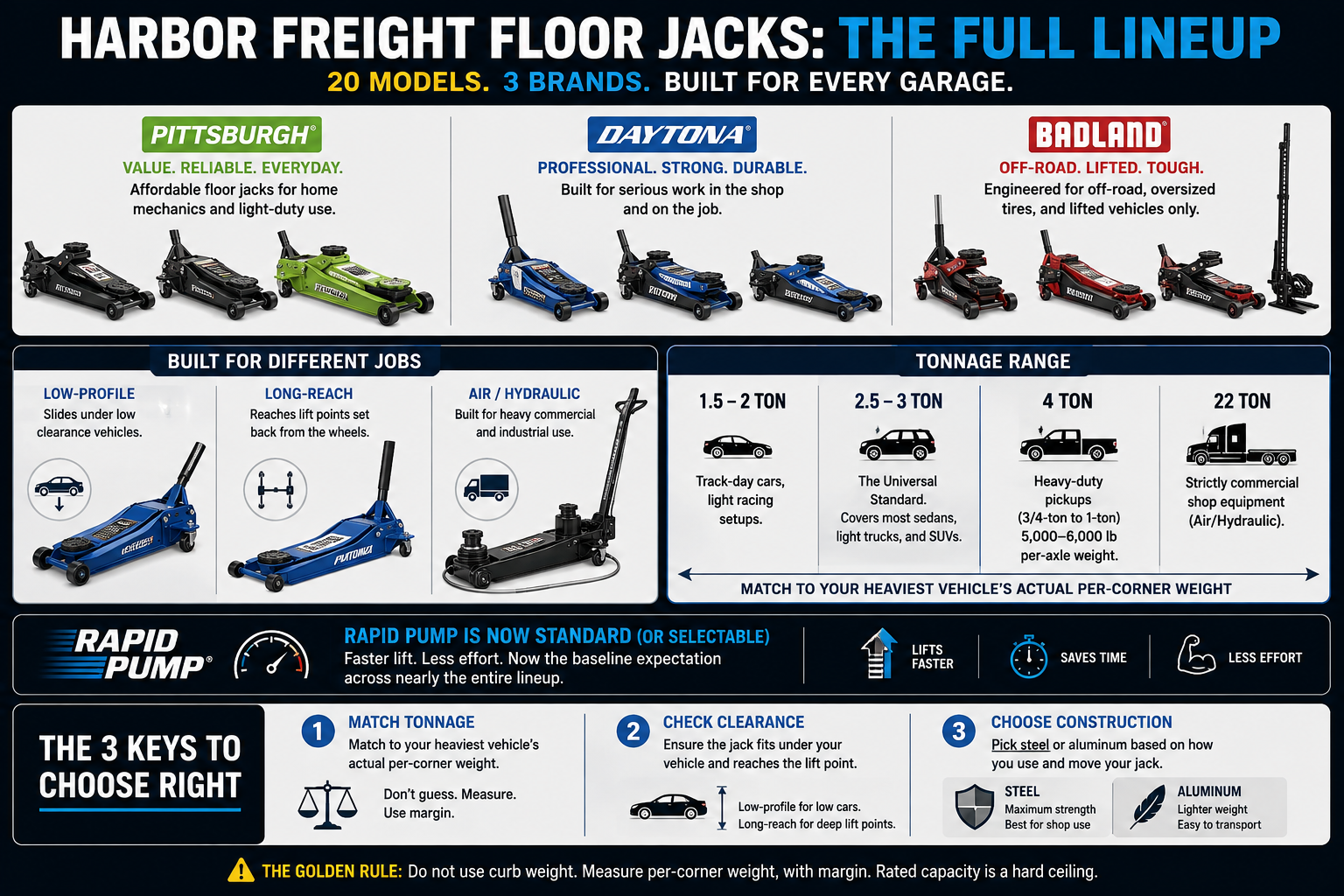
Eighteen models, three brands. Pittsburgh handles the value end. Daytona covers the professional tier. Badland is new and narrow, built strictly for off-road and lifted-vehicle work.
Capacities run 1.5, 2, 2.5, 3, 4, and 22 tons. Inside that range, you’ll find low-profile jacks built to slide under tight clearances, long-reach jacks for lift points set back from where you can position the wheels, and one air/hydraulic unit for heavy commercial use.
RAPID PUMP shows up on nearly every current model now, standard or selectable. It used to be a premium feature. Now it’s closer to the baseline expectation across the whole catalog.
The decision comes down to three things: match tonnage to your heaviest vehicle’s actual per-corner weight, figure out if you need low-profile clearance, and pick steel or aluminum based on how often you’re hauling the jack around versus leaving it parked in one corner of the garage.
Harbor Freight floor jack comparison table: every model, price, and use
Every floor jack covered in this guide, with capacity, material, profile, and best use. Scroll sideways on a phone.
| Brand | Model | Capacity | Material | Profile | Price | Key Features | Best Use |
|---|---|---|---|---|---|---|---|
| Daytona | 3 Ton Low-Profile Superduty Floor Jack | 3 ton | Steel | Low-profile | $289.99 | Heavy-duty; low-profile design | Daily shop use; low-clearance vehicles |
| Daytona | 3 Ton Long-Reach Low-Profile Professional Floor Jack | 3 ton | Steel | Low-profile | $269.99 | Extended reach; deep lift points | Deep lift points; long-wheelbase vehicles |
| Daytona | 4 Ton Professional Floor Jack with RAPID PUMP | 4 ton | Steel | Standard | $269.99 | RAPID PUMP; high capacity | 3/4- or 1-ton pickups; vans; SUVs |
| Badland | 3 Ton Off-Road Jack | 3 ton | Varies | Standard | $379.99 | Sealed ball-bearing axles; high lift | Lifted trucks; SUVs; UTVs; rough terrain |
| Daytona | 1.5 Ton Ultra Low-Profile Lightweight Aluminum Racing Jack | 1.5 ton | Aluminum | Ultra-low | $299.99 | Ultra-low clearance; lightweight | Lowered sports and show cars |
| Pittsburgh | 22 Ton Air/Hydraulic Floor Jack | 22 ton | Steel | Standard | $389.99 | Air-assisted pump; heavy-duty capacity | Commercial trucks; industrial equipment |
| Daytona | 3 Ton Low-Profile Professional Floor Jack | 3 ton | Steel | Low-profile | $199.99 | Professional grade; low clearance | Performance vehicles; daily drivers |
| Daytona | 3 Ton Professional Floor Jack | 3 ton | Steel | Standard | $179.99 | Professional tier; industrial-grade finish | Commercial and shop use |
| Pittsburgh | 3 Ton Low-Profile Floor Jack with RAPID PUMP | 3 ton | Steel | Low-profile | $169.99 | RAPID PUMP; precision-welded steel; universal release | Lowered and show cars |
| Pittsburgh | 3 Ton Floor Jack with RAPID PUMP | 3 ton | Steel | Standard | $149.99 | RAPID PUMP; dual-piston; 3.5 strokes | Sedans; light trucks; SUVs |
| Pittsburgh | 3 Ton Low-Profile Aluminum Racing Jack | 3 ton | Aluminum | Low-profile | $249.99 | Lightweight aluminum; 3-ton capacity | Mobile mechanics; track use |
| Pittsburgh | 2.5 Ton Low-Profile Aluminum Racing Jack | 2.5 ton | Aluminum | Low-profile | $219.99 | Lightweight; mid-range capacity | Portable use; mid-sized sedans |
| Daytona | 2 Ton Professional Racing Series Aluminum Jack | 2 ton | Aluminum | Standard | $229.99 | Professional tier; tight tolerances | Professional use; small to midsize vehicles |
| Pittsburgh | 2 Ton Low-Profile Floor Jack | 2 ton | Steel | Low-profile | $139.99 | Budget-friendly; low clearance | Home garages; standard or lowered sedans |
| Badland | 1.5 Ton Off-Road Jack | 1.5 ton | Varies | Standard | $279.99 | RAPID PUMP; precise descent control | ATVs and UTVs |
| Daytona | 1.5 Ton Professional Racing Series Aluminum Jack | 1.5 ton | Aluminum | Standard | $139.99 | Professional tier; lightweight aluminum | Track-side service; small vehicles |
| Pittsburgh | 1.5 Ton Low-Profile Aluminum Racing Jack | 1.5 ton | Aluminum | Low-profile | $109.99 | Lightweight; racing-oriented | Track days; light cars; portability |
| Pittsburgh | 2 Ton Compact Trolley Jack | 2 ton | Steel | Standard | $34.99 | Low-cost; lightweight | Roadside use; spare-tire changes |
1.5- and 2-ton floor jacks: light cars and racing setups
Seven models fall within this bracket, and most of them lean toward aluminum for weight-conscious, track-day use.
The Daytona Ultra Low-Profile at $299.99 sits at the other end, and the price tells you what it’s for. Extremely low ground clearance, the kind you get on a lowered sports car or a show car, where even a normal low-profile jack won’t slide under the frame. If your car rides at stock height, don’t bother. If it’s slammed, this might be the only jack on the list that fits.
Harbor Freight car jack: which one fits your car
When people search for a Harbor Freight car jack, they usually mean one of two things: a jack to keep at home for brake jobs, oil changes, and seasonal tire swaps, or a small jack to keep in the trunk. The answer is different for each.
- Home garage, stock-height car: the Pittsburgh 3 Ton with RAPID PUMP at $149.99. It has plenty of margin for any sedan, hatchback, or crossover.
- Home garage, lowered or sporty car: the Pittsburgh 3 Ton Low-Profile ($169.99) or the Pittsburgh 2 Ton Low-Profile ($139.99), which is enough for most lighter cars.
- Trunk jack: the Pittsburgh 2 Ton Compact Trolley Jack at $34.99, or a 1.5 ton aluminum racing jack if you want something light but sturdier.
Check your lift point height first. If the jack’s minimum saddle height is taller than your car’s jacking point, it simply won’t go under.
Harbor Freight tire jack: best choices for changing a tire
For a tire change, you don’t need much capacity. You lift one corner of the car, so a 2-ton jack is already enough for most passenger cars. What matters is how easy it is to position and how stable it feels on the ground.
- On the road: the $34.99 Pittsburgh 2 Ton Compact Trolley Jack is the cheap, light option. Use it on flat, hard ground only.
- At home, for seasonal swaps: a 3-ton RAPID PUMP floor jack lifts the corner in about 3.5 strokes, with wide casters that roll under the car cleanly.
- For a quick, repeatable tire rotation: a lightweight 1.5 to 2.5-ton aluminum jack is easier to carry around.
Whatever you use, put the car on jack stands before you take the wheel off and move under or around it. Never rely on the jack alone. Floor jacks are one type of tire jack. Bottle jacks and scissor jacks also exist at Harbor Freight, but this guide covers floor jacks only. If you’re curious how the trunk-style type works, see our guide to scissor jacks. A floor jack is the easiest to roll into place and the most stable of the three for home use.
2.5 and 3-ton floor jacks: the size most people actually buy
Eight models sit here, and this is where the real buying decision happens for most readers.
- Pittsburgh 2.5 Ton Low-Profile Aluminum Racing Jack: $219.99 (often $169.99)
- Pittsburgh 3 Ton Floor Jack with RAPID PUMP: $149.99
- Pittsburgh 3 Ton Low-Profile Floor Jack with RAPID PUMP: $169.99
- Pittsburgh 3 Ton Low-Profile Aluminum Racing Jack: $249.99 (often $199.99, in-store only)
- Daytona 3 Ton Professional Floor Jack: $179.99
- Daytona 3 Ton Low-Profile Professional Floor Jack: $199.99
- Daytona 3 Ton Long-Reach Low-Profile Professional Floor Jack: $269.99
- Daytona 3 Ton Low-Profile Superduty Floor Jack: $289.99
Three tons cover most sedans, light trucks, and SUVs without much thought. The Pittsburgh 3 Ton Low-Profile has an extra-low profile that reaches under most show cars, and the RAPID PUMP system does the lifting in about 3.5 pump strokes. Build quality on this one is worth calling out too: precision-welded steel, industrial-grade finish, extra-wide steel casters, and a universal joint release that lets you control the descent from any handle angle.
Own one car? The plain Pittsburgh 3 Ton at $149.99 covers it. Need low clearance? Add $20 for the low-profile version. Only step up to Daytona if you’re using the jack daily and want tighter tolerances that hold up under that kind of wear.
Harbor Freight 2.5 ton floor jack: what exists and whether it’s worth it
There is one 2.5 ton floor jack in the current lineup: the Pittsburgh 2.5 Ton Low-Profile Aluminum Racing Jack at $219.99, often discounted to around $169.99 with an Inside Track Club deal. It’s light, low, and easy to carry, which makes it a good fit for mid-sized sedans, track days, and mobile work.
The catch is price. A Pittsburgh 3 Ton steel jack with RAPID PUMP costs $149.99 and has more capacity, and the low-profile 3 Ton version is $169.99. So a 2.5-ton buyer is really paying for aluminum weight savings, not extra lifting power. If you don’t need to carry the jack around often, a 3-ton steel jack is the better value. If you want 2.5 tons because your car is light and low, the 2 Ton Low-Profile at $139.99 is also worth a look.
4-ton and 22-ton floor jacks: trucks and heavy-duty work
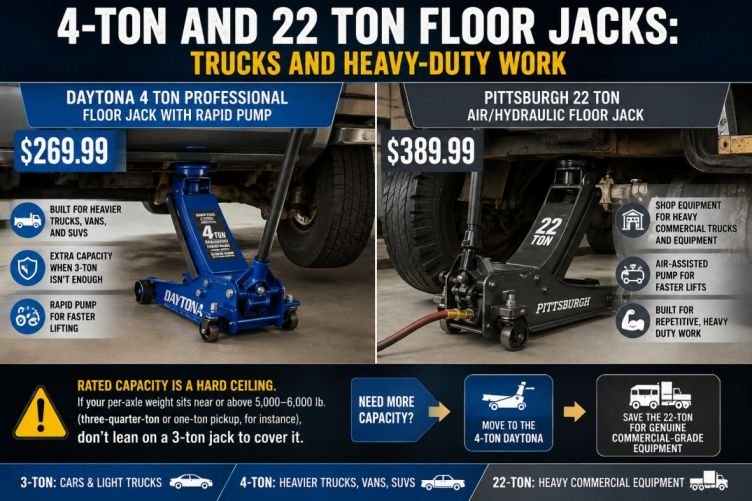
Two models cover the top end. The Daytona 4 Ton Professional Floor Jack with RAPID PUMP runs $269.99, built for heavier trucks, vans, and SUVs where a 3-ton jack starts running out of margin.
Then there’s the jump. The Pittsburgh 22 Ton Air/Hydraulic Floor Jack costs $389.99 and isn’t really a consumer jack anymore. It’s shop equipment for heavy commercial trucks and equipment, where the air-assisted pump speeds up repetitive lifts that would wear out your shoulder on a manual unit. Going from 4 tons to 22 tons isn’t a bigger version of the same tool. It’s a different category of work.
If your per-axle weight sits near or above 5,000-6,000 lb., a three-quarter-ton or one-ton pickup, for instance, don’t lean on a 3-ton jack to cover it. Rated capacity is a hard ceiling. Move to the 4-ton Daytona, and save the 22-ton unit for genuine commercial-grade equipment. Want to see more options beyond Harbor Freight? Read our best 4-ton floor jacks buying guide.
Truck jacks at Harbor Freight: which one for your pickup
Trucks are where people most often buy too small. Weight isn’t the only issue. Ride height and lift points matter too.
- Half-ton pickups (F-150, Silverado 1500, Ram 1500): a 3 Ton jack such as the Pittsburgh 3 Ton with RAPID PUMP ($149.99) is enough for lifting one corner or one end. The standard (non-low-profile) version gives you the most lift height.
- 3/4-ton and 1-ton pickups, vans, heavy SUVs: go to the Daytona 4 Ton with RAPID PUMP ($269.99) for more capacity margin.
- Lifted or leveled trucks: a standard floor jack may not reach the frame or axle at all. The Badland 3 Ton Off-Road Jack ($379.99) is built for the extra height and for uneven ground.
- Commercial trucks and equipment: only the 22 Ton Air/Hydraulic ($389.99) belongs in this category.
Buy a matched pair of jack stands rated for your truck as well. With the higher lift heights trucks need, a jack failure or a tipped vehicle is worse than on a car.
The Badland off-road jacks: lifted trucks and UTVs
Two models exist for one specific problem: standard jacks can’t get under a lifted truck, and even if they could, they’re not built for uneven ground.
The Badland 3 Ton Off-Road Jack, $379.99, lifts trucks, SUVs, ATVs, and UTVs up to 6,000 lb. Sealed ball-bearing axles keep it running smoothly on dirt and gravel instead of a smooth concrete floor. The Badland 1.5 Ton version, with RAPID PUMP and Precise Descent Control at $279.99, is sized for lighter machines like ATVs and UTVs, sold in-store only.
Here’s the thing about lifted trucks specifically: raise the ride height an inch or two and a standard low-profile jack’s base often won’t clear the frame rails anymore. Check that before you assume any regular 3-ton jack in the catalog will do the job. It might not.
Building out an off-road setup? You may also want to read our Harbor Freight winches guide.
Steel vs aluminum: what the price gap buys you
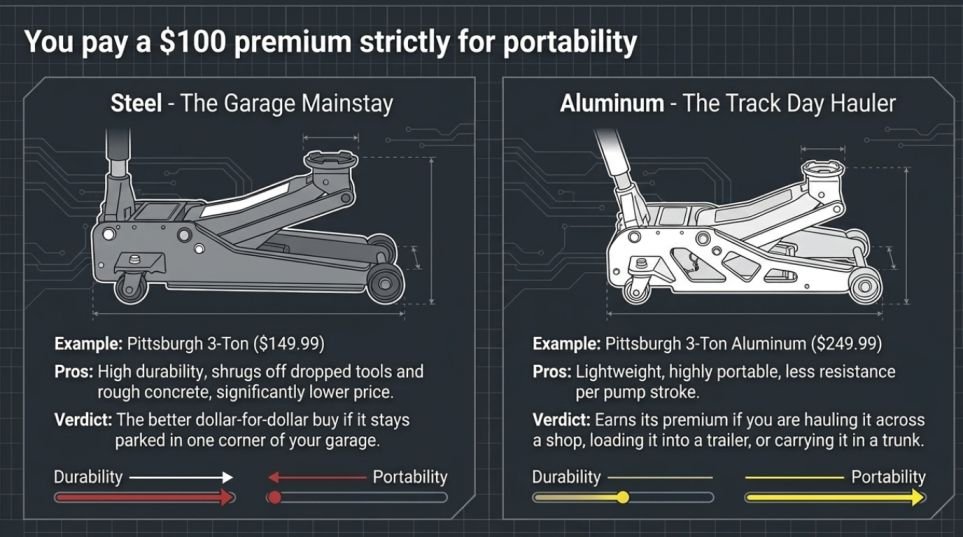
Steel costs less. The Pittsburgh 3 Ton steel jack runs $149.99. The Pittsburgh 3 Ton aluminum racing version, same tonnage rating, runs $249.99. That’s a $100 difference for identical lifting capacity.
What you’re paying for is weight. Aluminum jacks are easier to haul across a shop floor, load into a trailer for track days, or store in a trunk.
Steel wins on durability. It shrugs off dropped tools and rough concrete without much complaint. Aluminum needs a slightly gentler hand and costs noticeably more for the same tonnage.
Parking it in one spot in a home garage? Steel is the better dollar-for-dollar buy. Moving it around constantly or chasing every pound of portable weight? Aluminum earns its premium.
RAPID PUMP, explained with real numbers
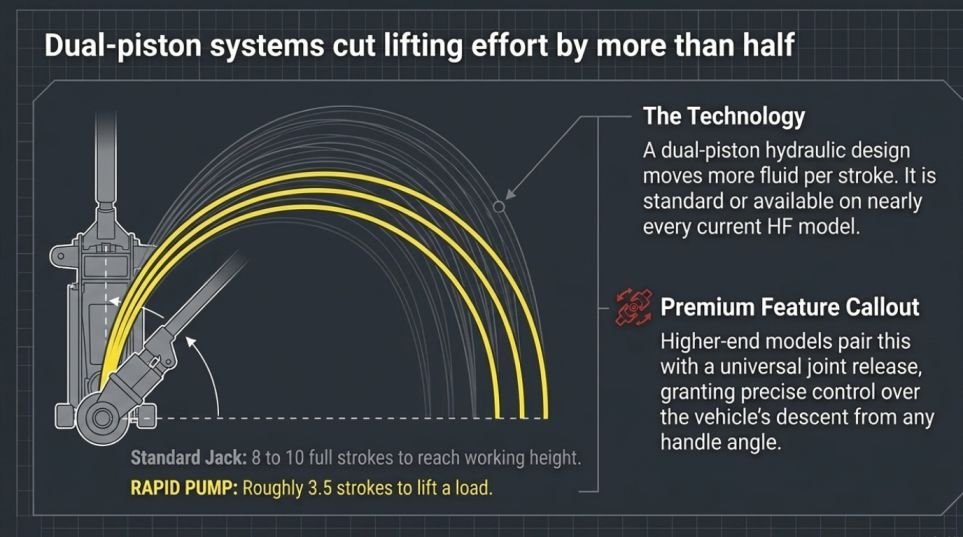
RAPID PUMP is Harbor Freight’s name for a dual-piston hydraulic pump, and it’s now standard or available on nearly every jack they sell across all three brands. The second piston moves more fluid per stroke than a single-piston design, and a representative 3-ton jack under this system lifts most loads in about 3.5 pump strokes.
Compare that to a standard single-piston jack, which typically needs 8-10 full strokes to reach working height. Cutting that number by more than half isn’t a marketing footnote. It’s the difference between raising a car in ten seconds and genuinely working up a sweat doing it.
Higher-end models pair RAPID PUMP with a universal joint release, so you get precise control over the descent no matter what angle the handle sits at. You’re not stuck swinging the handle to one specific spot just to lower the vehicle smoothly.
Low-profile vs long-reach vs standard: reading your lift points
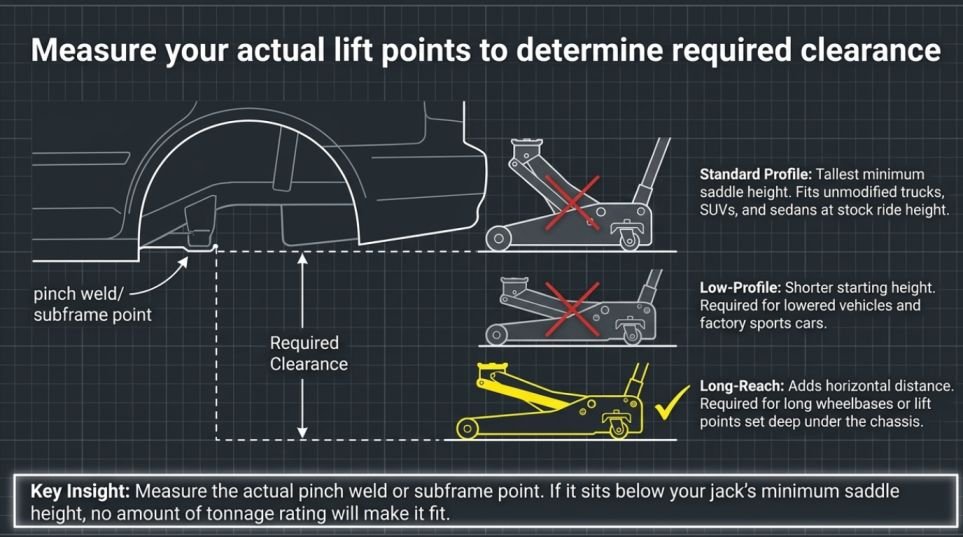
Three profile types solve three different clearance problems, and picking the wrong one means a jack that won’t slide under your car at all.
Standard jacks have the tallest minimum saddle height. Fine for unmodified trucks, SUVs, and most sedans at stock ride height.
Low-profile jacks trade some maximum lift height for a shorter starting height, letting them navigate tight spaces and reach under lowered cars and factory sports cars.
Long-reach jacks, like the Daytona 3 Ton Long-Reach Low-Profile at $269.99, add horizontal distance between the wheels and the saddle. That matters on longer wheelbase vehicles or lift points set well back from where the jack can actually roll.
Before you buy, measure your vehicle’s real lift point height, not the overall ground clearance number. Pinch welds and subframe points often sit lower than the rest of the body. If that measurement lands below your jack’s minimum saddle height, no amount of tonnage rating fixes it. The jack just won’t fit.
Pittsburgh vs Daytona vs Badland: the three brand tiers
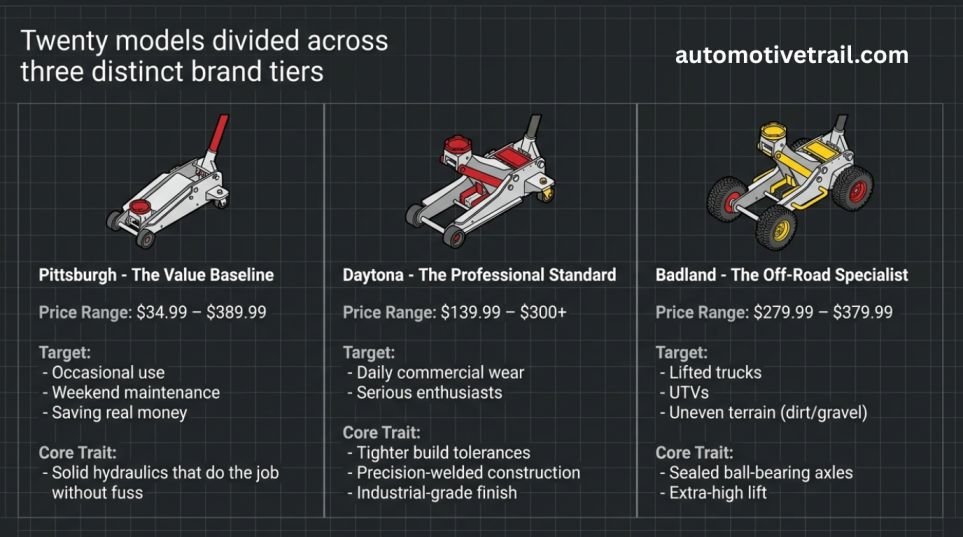
Pittsburgh is the value tier, and it spans the widest price range in the catalog, from the $34.99 trolley jack to the $389.99 22-ton unit. Construction is solid steel or aluminum depending on the model, and the hydraulics do the job without fuss.
Daytona sits above it. Precision-welded construction, industrial-grade finish, built with professional mechanics and serious enthusiasts in mind. A Daytona 3 Ton runs $179.99 to $289.99 depending on profile and reach, a real jump over the equivalent Pittsburgh model. What you’re buying is tighter tolerances and a finish rated for daily commercial wear.
Badland is the newest tier and the narrowest, covering exactly two products. Both exist purely for lifted and off-road applications, and both sit at the top of their tonnage class in price, because nothing else in the catalog does what they do.
Weekend maintenance and occasional tire changes? Pittsburgh saves you real money. Daily commercial use? Daytona’s build quality pays for itself over time. Lifted truck or rough terrain? Badland is the only tier built for it.
Jack stands and cross beams: the gear you buy alongside it
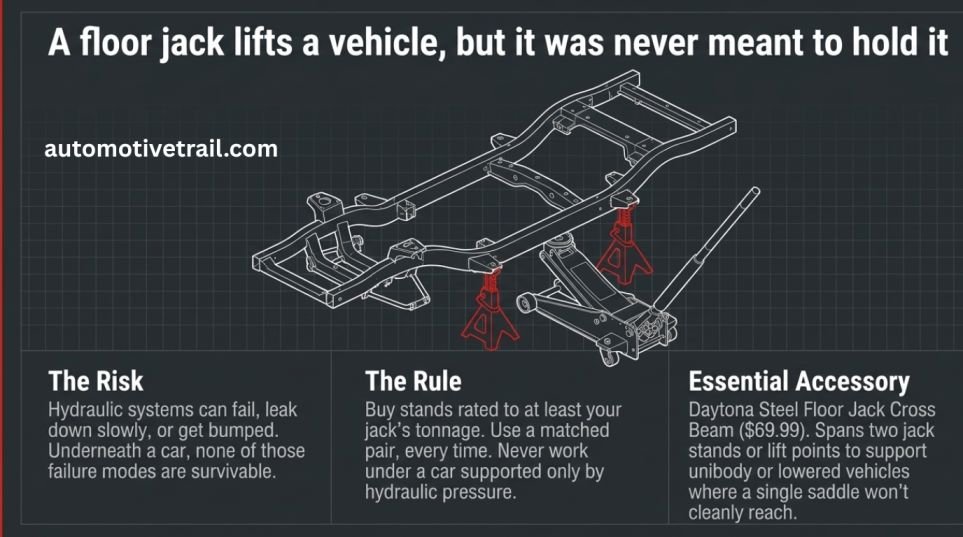
A jack lifts. It doesn’t hold. That distinction matters more than almost anything else in this article, and skipping it is one of the most common ways people get hurt working under a car at home.
A jack stand is a metal, height-adjustable device placed under the lifted vehicle to keep it safely elevated. It’s the backup if the hydraulic system fails, leaks down slowly, or gets bumped. None of those failure modes are survivable if you’re underneath the car with nothing else holding it up.
Harbor Freight also sells the Daytona Steel Floor Jack Cross Beam for $69.99 (often $59.99 on a member deal). It spans two jack stands or lift points, giving you support at locations the jack alone can’t reach cleanly, which comes up more than you’d think on unibody or lowered vehicles.
Buy stands rated to at least your jack’s tonnage. Use a matched pair, always. And don’t work under a car supported only by the jack, no matter how solid it feels or how quick the job looks.
Pricing and Inside Track Club deals
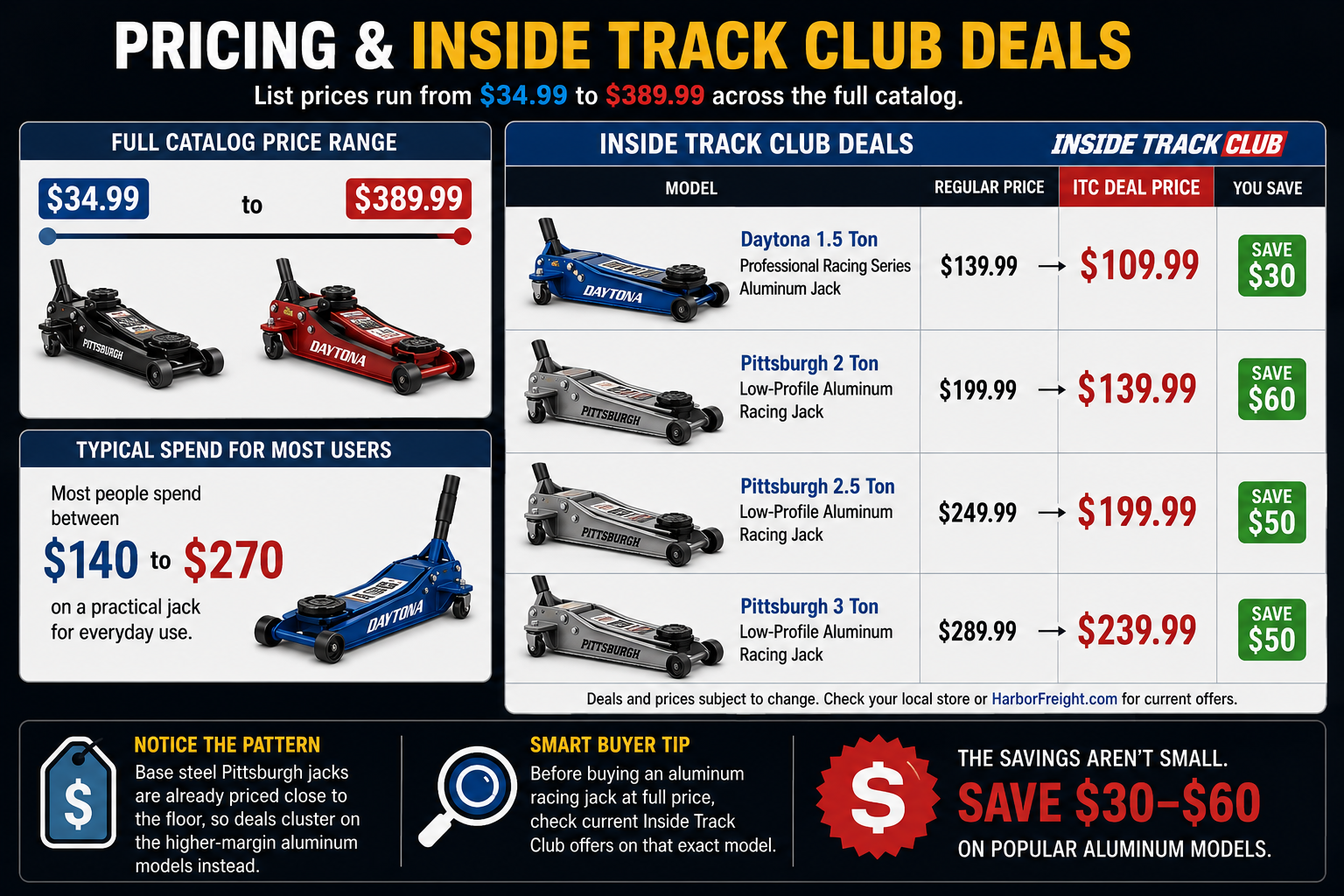
List prices run from $34.99 to $389.99 across the full catalog, but most people end up spending between $140 and $270 on something practical for everyday use.
Inside Track Club deals show up most often on the aluminum racing models. The Daytona 1.5 Ton Professional Racing Series Aluminum Jack drops from $139.99 to $109.99, a $30 cut. The 2.5- and 3-ton Pittsburgh aluminum versions see similar $50 discounts, with the 2.5-ton often around $169.99 and the 3-ton around $199.99. Deals can run up to $60 on some aluminum models.
Notice the pattern. Base steel Pittsburgh jacks are already priced close to the floor, so deals cluster on the higher-margin aluminum models instead. Before buying an aluminum racing jack at full price, check current Inside Track Club offers on that exact model. The savings aren’t small.
What real owners say: reliability and common issues
The Pittsburgh 3-ton RAPID PUMP line gets consistent praise for lift speed, and it’s almost always framed as a comparison. People who replaced an old single-piston jack call out the drop in pump strokes as the thing that actually changed how they use the tool day to day.
Complaints follow a familiar pattern for budget hydraulic jacks generally: some finish wear after heavy use, and occasional reports of a unit needing a bleed or adjustment right out of the box before it holds pressure correctly. Neither issue is specific to Harbor Freight. Both are standard first-use troubleshooting steps for any hydraulic jack, regardless of who made it.
When clearance pricing shows up, and it does periodically at select stores, owner sentiment jumps noticeably. At a deep enough discount, the price-to-performance ratio is hard to beat at any price point, from any brand.
Summary: Which Harbor Freight floor jack to buy
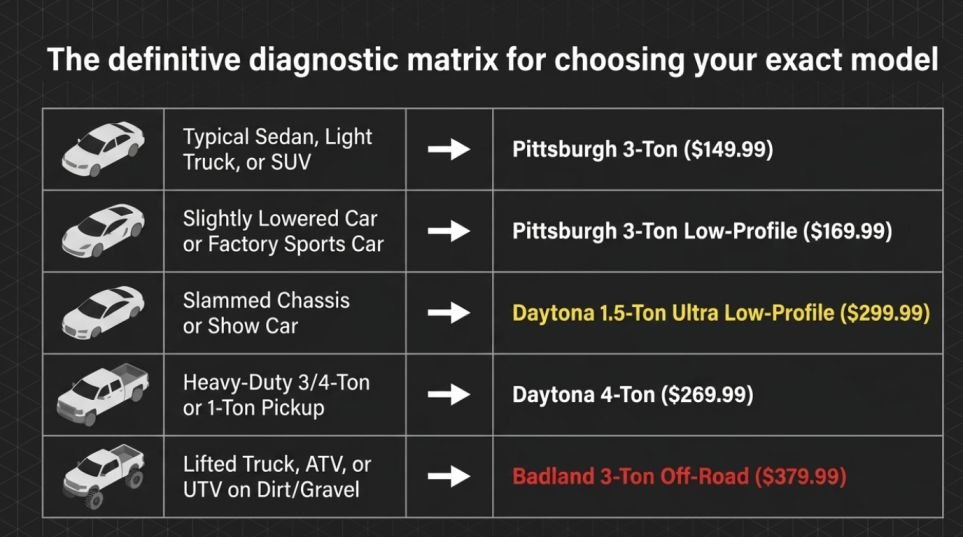
Start with your heaviest vehicle’s actual per-corner weight, not the curb weight on the sticker, and buy a jack rated comfortably above that number. For most sedans and light trucks, that’s the Pittsburgh 3 Ton at $149.99, or the low-profile version at $169.99 if your car sits low.
Just need something for a roadside tire change? The $34.99 Pittsburgh 2 Ton Compact Trolley Jack does that job. Working on something lowered or a genuine show car? Go straight to the Daytona 1.5 Ton Ultra Low-Profile at $299.99, or a Pittsburgh aluminum low-profile model in the 2- to 3-ton range. Lifting a heavier three-quarter-ton or one-ton truck? Skip past the 3-ton class and go with the Daytona 4 Ton at $269.99.
Lifted truck or UTV on rough terrain? Don’t force a standard jack to work. Go to the Badland lineup instead. And whether you land on steel or aluminum, whatever tonnage you pick, budget for a matched pair of rated jack stands in the same order. The jack raises the car. It was never meant to hold it there.
FAQ
What is the best Harbor Freight floor jack?
For most people, the Pittsburgh 3 Ton Floor Jack with RAPID PUMP at $149.99. It handles sedans, SUVs and light trucks, and lifts in about 3.5 pump strokes. Choose the $169.99 low-profile version if your car sits low.
What size floor jack do I need for my car?
Match tonnage to your vehicle’s actual per-corner weight, with margin, not just the curb weight listed on the spec sheet. A 3-ton jack covers most sedans and light trucks. Heavier trucks and SUVs need to move up to 4 tons.
Which Harbor Freight jack is best for changing a tire?
For a trunk jack, the Pittsburgh 2 Ton Compact Trolley Jack at $34.99 is the cheapest option. At home, a 3-ton RAPID PUMP floor jack is faster and more stable. In both cases, put the car on jack stands before working around it.
Does Harbor Freight sell a 2.5-ton floor jack?
Yes, one: the Pittsburgh 2.5 Ton Low-Profile Aluminum Racing Jack at $219.99, often discounted to around $169.99 with an Inside Track Club deal. A Pittsburgh 3 Ton steel jack costs $149.99 and lifts more.
What is the best Harbor Freight jack for a truck?
A 3-ton jack is enough for half-ton pickups. For 3/4-ton and 1-ton trucks, vans and heavy SUVs, use the Daytona 4 Ton at $269.99. For lifted trucks, the Badland 3 Ton Off-Road Jack at $379.99 is the one built for the extra height.
What’s the difference between Pittsburgh and Daytona floor jacks?
Pittsburgh is the budget tier, built for occasional home use at a lower price. Daytona is the professional tier, with tighter build tolerances and an industrial-grade finish for daily commercial use, usually $30 to $50 more per equivalent model.
Is the Badland off-road jack worth it over a regular floor jack?
Only if your vehicle is lifted or you’re working on rough ground. The Badland 3 Ton lifts up to 6,000 lb. and runs sealed ball-bearing axles for uneven terrain, but at $379.99 it costs more than any standard 3 Ton jack in the lineup.
Do I need jack stands with a floor jack?
Yes, every time. A floor jack lifts a vehicle but isn’t rated to support it safely for extended work underneath. Use a matched pair of stands rated to at least the jack’s tonnage before you get under the car.
What does RAPID PUMP mean on a Harbor Freight jack?
It’s Harbor Freight’s dual-piston hydraulic pump system, standard or available on nearly every current model. It lifts a load in around 3.5 pump strokes instead of the 8 to 10 strokes a standard single-piston jack needs.
Does Harbor Freight discount floor jacks regularly?
Yes, mostly on the aluminum racing models. Inside Track Club deals have cut $30 to $60 off specific Pittsburgh and Daytona aluminum jacks. Base steel Pittsburgh models stay closer to list price since they’re already priced low.
Is it Harbor Freight or Harbour Freight?
The store is Harbor Freight Tools, with the American spelling. “Harbour Freight” is a common alternate spelling used in the UK, Canada and elsewhere. It’s the same retailer and the same Pittsburgh, Daytona and Badland jacks.

- Top 10 Ranking Tire Brand for Minivan: Reviewed 2026 - October 5, 2026
- Model Y Tesla Long Range Automatic Wagon Tyre Fitment And Ratings - October 3, 2026
- What Is The Benefit Of Larger Rear Tyres On A Zero-turn Mower - October 3, 2026