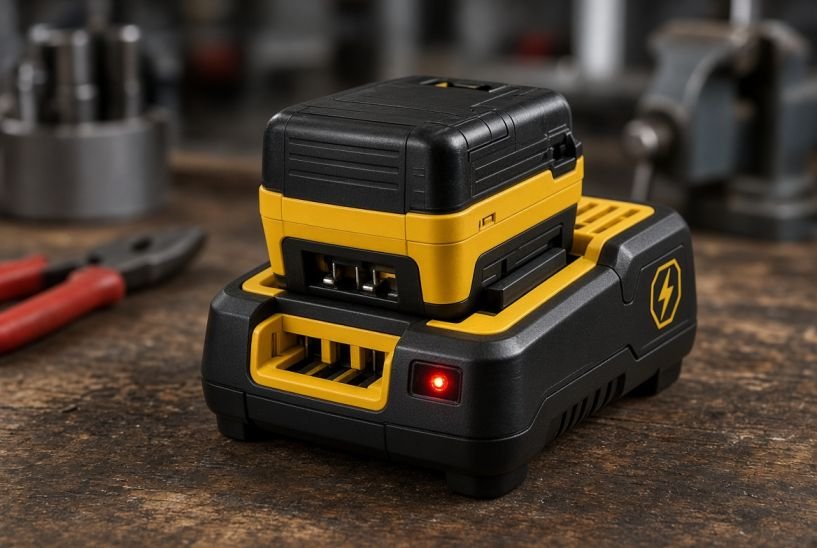
If your charger’s light is flashing red right now, skip to the troubleshooting section below. Otherwise, here’s the short version: the Black & Decker Firestorm 12V battery charger charges NiCd and NiMH slide-style packs like the FS120B, FSB12, and HPB12. It runs on standard 120V household power, outputs up to 2.3A, and charges most packs in under an hour. It does not charge lithium batteries unless the specific unit says so.
Key takeaways
- The 12V Firestorm charger works with NiCd/NiMH slide packs (FS120B, FSB12, HPB12, A12), not lithium, unless the model explicitly lists lithium compatibility
- A rapid blinking red light almost always means a bad battery, not a bad charger, and B&D says it can take up to 30 minutes to confirm this
- Charge in a room between 65-75°F; anything below 40°F or above 105°F can damage the pack
- Original Firestorm chargers are discontinued, so most replacements now are used units or aftermarket multi-volt chargers
- A burnt resistor is the most common internal failure, but at $15-25 for a new charger, repair rarely makes financial sense
- If your whole Firestorm kit is aging out, a bridge charger like the LCS1620B lets you run both 12V and 20V MAX batteries off one unit
Black & Decker Firestorm 12V battery charger: what it actually charges
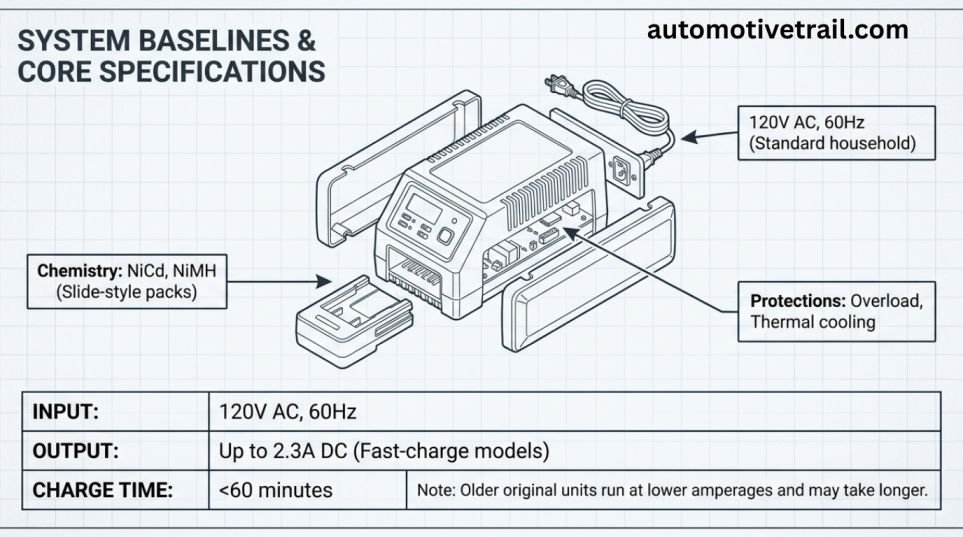
This charger is built for one job: topping up NiCd and NiMH slide-style battery packs in the 12V range. It won’t work with lithium-ion packs unless the specific unit is labeled for it, and mixing chemistries is one of the fastest ways to damage a battery or trip the charger’s safety cutoff.
Multi-volt versions of this charger, sold under names like FSMVC or BDFC240, cover a wider range, typically 9.6V through 24V, so one charger can service several tools in an old Firestorm lineup. If you own more than one Firestorm tool with different voltage batteries, a multi-volt charger saves you from juggling separate units.
Check the label on your battery pack before plugging anything in. It’ll say NiCd, NiMH, or Li-ion right on the case. If it says Li-ion and your charger doesn’t list lithium support, don’t force it.
Original charger and battery model numbers to check
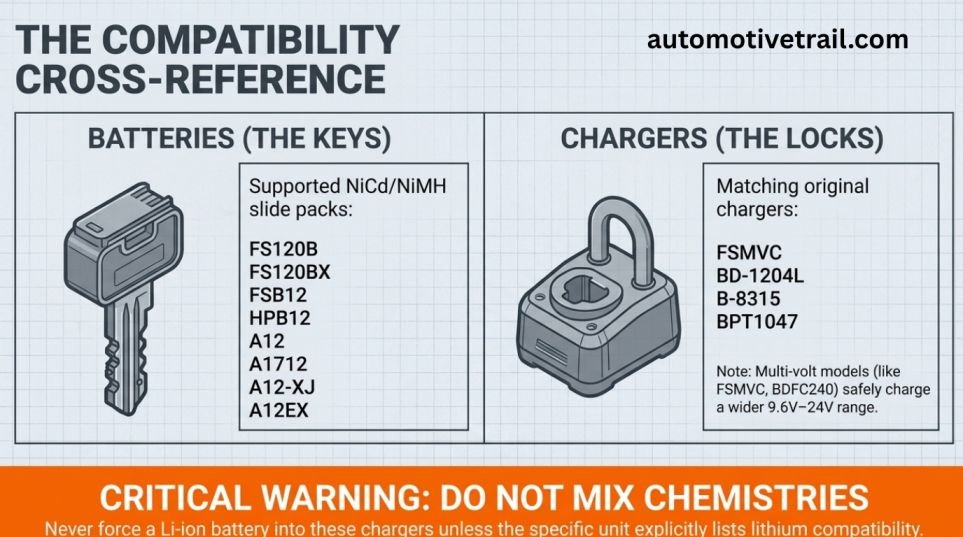
Before you buy a replacement or troubleshoot a fault, match the model number on your unit to what you actually own. Firestorm parts went through a few naming variations over the years, so the numbers below cover most of what you’ll find stamped on the housing.
Battery model numbers: FS120B, FS120BX, FSB12, HPB12, A12, A1712, A12-XJ, A12EX
Charger model numbers: FSMVC, BD-1204L, B-8315, BPT1047
The number is usually printed on a small sticker on the bottom or back of the charger, and on the battery it’s often molded right into the plastic near the contacts. If yours has worn off, a quick photo search of the shape and contact layout will usually get you a match, since B&D reused housings across several model years.
Charger specs: input, output, charge time
Here’s what you’re actually working with, spec for spec.
| Spec | Value |
|---|---|
| Input | 120V AC, 60Hz standard household outlet |
| Output | Up to 2.3A DC (fast-charge models) |
| Charge time | Under 60 minutes for most packs |
| Battery chemistry | NiCd, NiMH |
| Protections | Overload protection, thermal cooling |
| Status display | LED indicator (charging/charged/hot-cold) |
Older original units, the ones that shipped with the tool back when Firestorm was still an active line, tend to run at lower amperage than newer multi-volt aftermarket chargers. If your original charger takes longer than an hour on a full pack, that’s not necessarily a fault. It might just be an older, slower design.
How to charge a Firestorm 12V battery correctly
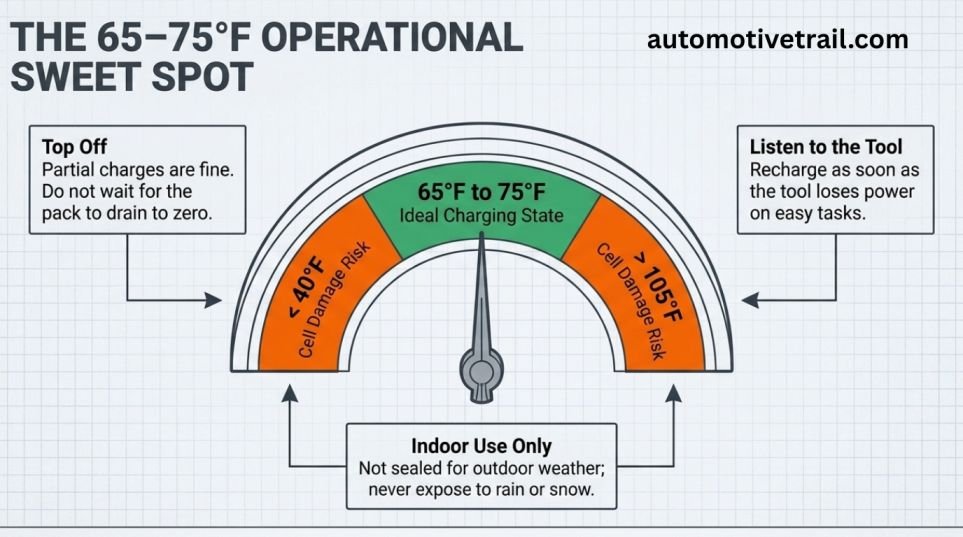
Charging habits matter more than most people think, especially with NiCd and NiMH cells, which degrade faster under bad conditions than lithium does.
Ideal charging temperature
Black & Decker’s own manual puts the sweet spot at 65-75°F (18-24°C). Charging below 40°F or above 105°F can cause real damage to the cells, not just a slower charge. If your garage or shed swings outside that range, bring the battery inside before charging.
A few other habits worth keeping:
- Partial charges are fine. You don’t need to run the pack down to zero before topping it off.
- Recharge once the tool starts losing power on tasks that used to be easy; don’t wait until it dies completely.
- Never expose the charger to rain or snow. It’s not sealed for outdoor use.
- There are no user-serviceable parts inside. Opening the case voids any warranty you might still have.
What the LED light means (normal charging)
During a normal charge cycle, the LED will blink red or green while the battery is actively charging. Once it’s done, the light switches to solid green. That’s it under normal conditions: no flashing, no hot-cold alternation, just a steady color change from active to complete.
If your light behaves exactly like that, your charger is doing its job. The confusion starts when the pattern changes, which is where most support calls and forum posts come from.
Charger flashing red: step-by-step troubleshooting
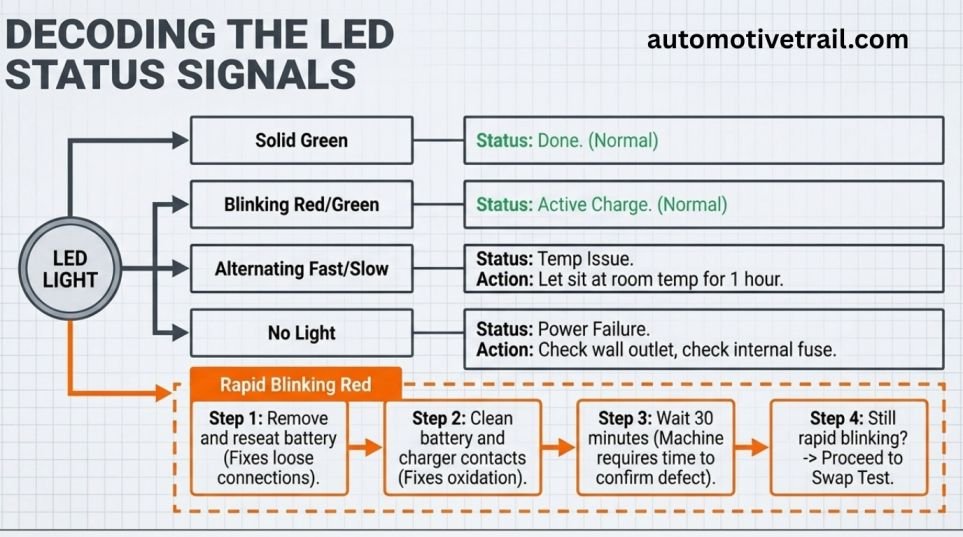
A rapid blinking red light is the single most common complaint with these chargers, and in most cases it points to the battery, not the charger itself.
- Remove and reseat the battery. A loose connection alone can trigger the red flash. This fixes it more often than people expect.
- Clean the contacts. Use a dry cloth or cotton swab on both the battery terminals and the charger contacts. Dirt and oxidation break the connection just as easily as a mechanical fault.
- Give it time. Black & Decker states it can take up to 30 minutes for the charger to confirm a battery is actually defective. Don’t pull the plug after five minutes and assume the worst.
- Watch the blink pattern. A light that alternates between fast and slow blinking usually means the battery is too hot or too cold, not defective. Let it sit at room temperature for an hour and try again.
- Swap in a second battery. If you have access to another Firestorm pack, try it. This is the fastest way to isolate whether the problem is the battery or the charger.
If none of that resolves it, move to the next section to figure out which part actually needs replacing.
Is it the battery or the charger? How to tell
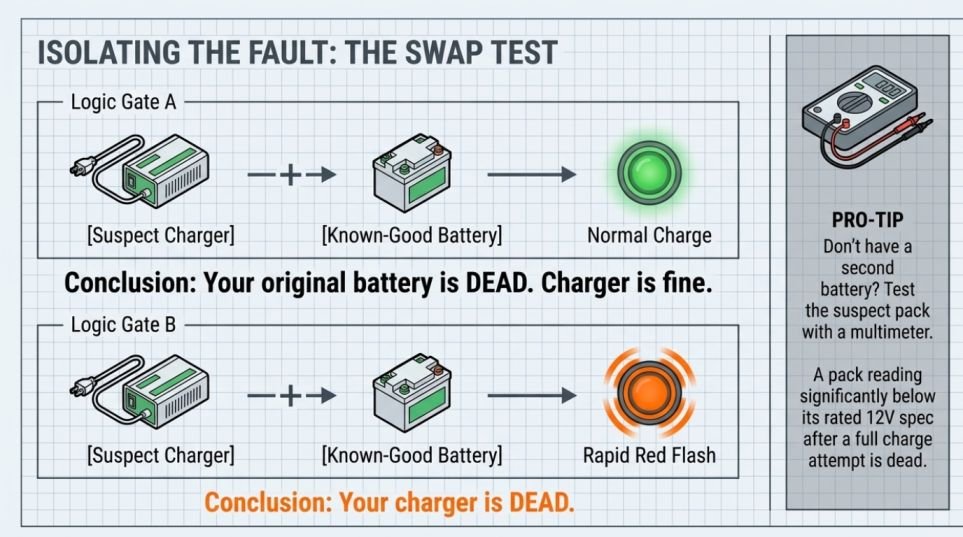
The swap test from step 5 above is the cleanest diagnostic you have, so it’s worth doing properly before you spend money on a replacement.
Put a known-good battery into your charger. If it charges normally, your original battery is dead and needs replacing, not the charger. If the known-good battery also flashes red, the charger is the problem.
Don’t have a second battery on hand? A digital multimeter works too. Check the battery’s voltage against its rated spec. A pack reading significantly below its rated voltage, even after a full charge attempt, is likely bad.
If you’ve isolated the fault to the charger and it’s still under warranty, B&D’s service center list (available on their support site) is the next stop. Outside of warranty, replacement is almost always cheaper than repair, which we’ll get into shortly.
Where to buy a replacement charger
Once you’ve confirmed the charger itself is the problem, or you’re just replacing a unit you no longer have, you’ve got two real paths.
Used or new-old-stock originals show up on eBay fairly regularly, since Firestorm was a long-running line with a lot of units still floating around in garages and estate sales. Pricing varies a lot depending on condition and whether the seller tests before shipping.
Aftermarket multi-volt chargers are the more reliable buy today. These cover 9.6V through 24V in one unit, so they work across your whole Firestorm collection rather than just the 12V pack.]
Combo battery-and-charger bundles are worth a look too, especially if your battery is also on its way out. Buying both together is often cheaper than replacing each part separately.
Original vs aftermarket chargers: which to buy
| Component | Model Numbers | Battery Chemistry | Input/Output | Charging Time | LED Status | Operating Temperature | Troubleshooting Tip |
|---|---|---|---|---|---|---|---|
| Battery Packs | FS120B, FS120BX, FSB12, HPB12, A12, A1712, A12-XJ, A12EX | NiCd, NiMH | 12V | Under 60 min. for most packs | See manual | 65–75°F ideal; 40–105°F safe | Clean contacts with a dry cloth/cotton swab. If capacity is low, check voltage with a digital multimeter. |
| Original/Single-Volt Chargers | BD-1204L, B-8315, BPT1047 | NiCd, NiMH; no lithium unless specified | 120V AC, 60Hz input; up to 2.3A DC output | Under 60 min. fast charge; longer for older units | Blinking red/green: charging; solid green: charged; rapid red: bad battery/fault; fast/slow alternating: hot/cold delay | 65–75°F ideal | Rapid red blinking often means a bad battery. Allow 30 min. to confirm before replacing. |
| Multi-Volt/Aftermarket Chargers | FSMVC, BDFC240 | NiCd, NiMH | 9.6V–24V | Under 60 min. typical | Standard LED status: charging/charged/fault | 65–75°F | Useful for multiple Firestorm tool voltages; replacement often costs less than repair ($15–25). |
| Bridge Charger | LCS1620B | 12V NiCd/NiMH and 20V MAX Lithium | Dual-platform support | Varies | Varies | Varies | Use as a bridge from the discontinued Firestorm platform to the current 20V MAX lithium line. |
The original is worth chasing if you want an exact match and don’t mind used-market uncertainty. For most people, though, an aftermarket multi-volt charger covers more ground for less money and comes with an actual warranty, something you can’t get on a 15-year-old used unit.
Stick to sellers with clear compatibility lists and decent review volume. The category is full of near-identical listings from different brands, and quality does vary even when the specs look the same on paper.
Repairing an old charger vs replacing it
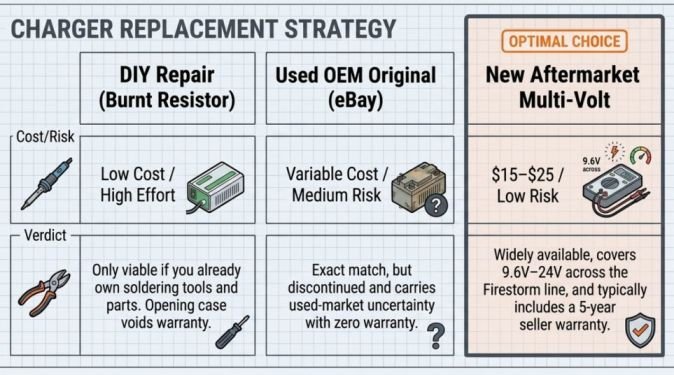
If you’re technically inclined, a dead Firestorm charger is sometimes fixable. A burnt resistor on the internal circuit board is a documented failure point, often triggered by overload or a short. Replacing a blown resistor with the correct value can bring a charger back to life.
That said, weigh the math before you start. A new aftermarket charger runs $15-25. Unless you already have the diagnostic tools and parts on hand, or you’re doing it for the challenge rather than the savings, replacement is usually the faster and cheaper call.
Repair makes more sense if you’re already comfortable with a multimeter and soldering iron, or if you’re trying to keep an original unit running for compatibility reasons rather than cost. For everyone else, buying new is the practical answer.
Should you upgrade to 20V MAX instead?
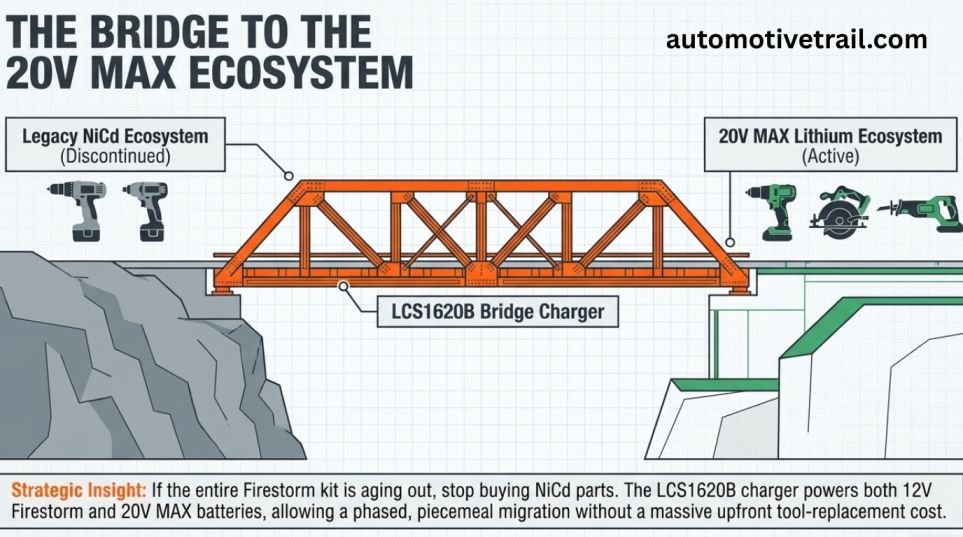
If your entire Firestorm kit, not just the charger, is aging out, it’s worth stepping back and asking whether you’re better off migrating to Black & Decker’s current 20V MAX lithium line instead of keeping the old NiCd platform alive piece by piece.
One option worth knowing about: the LCS1620B charger is compatible with both 12V and 20V MAX batteries, which gives you a bridge if you want to start building a 20V collection without immediately replacing every Firestorm tool you own.
The tradeoff is straightforward. Staying on Firestorm means cheaper individual parts but a shrinking supply of new stock. Moving to 20V MAX means better long-term availability and lithium performance, but a higher upfront cost if you’re replacing tools, not just batteries and chargers.
Summary: how to decide what to do next
Start with the light. A steady blink pattern during charging is normal, and solid green means done. If you’re seeing rapid red blinking, run the swap test before assuming the charger is dead, since a bad battery causes this far more often than a bad charger does.
If the charger is confirmed faulty, replacement beats repair for almost everyone at today’s prices. Aftermarket multi-volt chargers give you the best coverage per dollar, especially if you’re running more than one Firestorm voltage. Original units are worth chasing only if you specifically want OEM parts and don’t mind used-market risk.
And if your whole kit is getting old, it’s a reasonable moment to weigh a slow migration to 20V MAX using a bridge charger, rather than continuing to patch a platform that’s not getting new stock.
FAQ
Can I use a lithium battery in a Firestorm NiCd charger?
No, not unless the specific charger model explicitly lists lithium compatibility. Standard Firestorm chargers are built for NiCd and NiMH chemistry, and using the wrong chemistry can damage the battery or trip the charger’s safety features.
How long does a Firestorm 12V battery take to charge?
Most packs charge in under 60 minutes on a standard fast-charge unit. Older original chargers may take longer, since amperage output varies between older and newer designs.
Why won’t my Firestorm battery hold a charge anymore?
NiCd and NiMH cells naturally lose capacity over years of use, especially with poor charging habits like extreme temperatures. If a fully charged pack drains fast or won’t power the tool at all, it’s likely reached the end of its life and needs replacing.
Is Black & Decker Firestorm discontinued?
Yes. Firestorm has been phased out in favor of the 20V MAX lithium line, though replacement batteries and chargers are still made by third-party manufacturers.
Can I use a Firestorm charger on a different voltage battery?
Only if it’s a multi-volt model like the FSMVC or BDFC240, which are built to handle 9.6V through 24V packs. A single-voltage charger won’t safely charge a battery outside its rated voltage.
What does it mean if the charger light doesn’t come on at all?
Check the outlet first, then the charger’s internal fuse if it’s user-accessible. No light at all, even with a known-good battery, usually points to a dead charger rather than a battery issue

- 2 Hole Vs 4 Hole Injectors 5.3 Vortec: Swap Rules + Fitment Check - September 12, 2026
- What Oil Does 2012 Honda Civic Use: What Oil Does Honda Civic Use & Spec - September 12, 2026
- 2014 Ram 2500 5.7 Hemi Sparkplugs: Ram 5.7 Hemi Sparkplugs: Oe Vs Fitment, Swap Steps - September 12, 2026