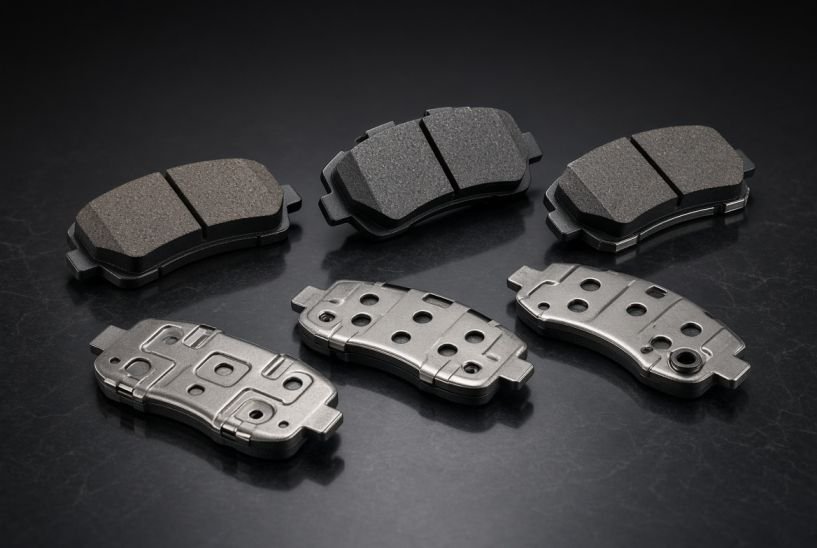
Yes, for most drivers. Ferodo brake pads are solid daily-driver equipment, especially the Premier line, but the performance pads split opinion hard, and noise complaints show up often enough to matter.
Ferodo has made friction material for over 125 years and still supplies OE pads to brands like Land Rover. That history buys real credibility. But “Ferodo” isn’t one product; it’s a whole catalog, and the pad that works great on your neighbor’s SUV might squeal like a smoke detector on your hatchback.
Table of Contents
ToggleKey takeaways
- Ferodo Premier pads get the most consistent praise: strong cold bite, reliable ABS activation, long wear.
- Ferodo DS2500 pads are a genuine toss-up. Some drivers love the bite, others call them a downgrade from stock.
- Noise is the number one complaint across forums, particularly on DS2500 fronts and rears.
- Ferodo is OE on some Land Rover and BMW models, which puts it a notch above generic aftermarket.
- Counterfeit Ferodo pads exist. Check for genuine Priospot labeling before you buy.
- Price sits in the mid-range: expect roughly $35 to $90 per axle set depending on vehicle and line.
Ferodo Premier pads: the everyday driving verdict
Premier is Ferodo’s standard replacement line, and it’s where the brand earns its reputation. One owner ran a set for about 10,000 km and reported they stayed strong enough to trigger ABS during hard stops at 130 to 140 km/h. That’s not marginal performance. That’s a pad doing its job under real panic-stop conditions.
A separate head-to-head test pitted Ferodo Premier against factory Brembo replacement pads on the same car. The tester found the Ferodo pads had noticeably more bite when cold, which matters most in the first few seconds of a morning commute before anything’s warmed up. In a wider three-way comparison against Brembo and Bosch, the same reviewer ranked Premier first, describing it as strong in normal driving and better than expected once things got demanding.
Owners running Premier on heavier vehicles, like SUVs, report similar satisfaction. One Pajero owner called the pads grabby and reliable, with the only real downside being dust buildup on the wheels. That’s a cosmetic complaint, not a performance one.
If you’re replacing pads on a commuter car, crossover, or family sedan and just want something that stops the car predictably for 30,000 to 40,000 miles without drama, Premier is the safe pick. It’s not exciting. It’s just good.
Ferodo DS2500 performance pads: street upgrade or overhyped
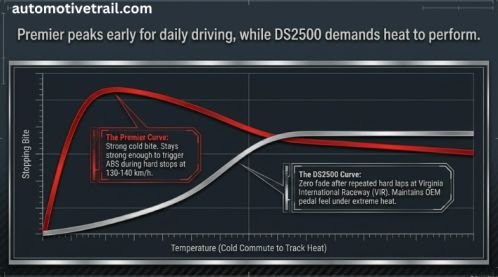
This is where the reviews stop agreeing with each other. DS2500 is marketed as a street-and-track pad, and depending on who you ask, it either delivers or falls flat.
On the positive side, one track day tester compared DS2500 against OEM pads at VIR (Virginia International Raceway). The stock pads showed subtle fade after three or four hard laps. The DS2500 showed none, and pedal feel and modulation felt close to the OEM baseline. His conclusion: not a race pad, but a legitimate step up for occasional track use paired with daily driving.
On the negative side, a BMW 2 Series owner installed DS2500 pads with fresh Zimmermann rotors expecting a mild performance bump. Instead, he called them a downgrade from the stock M Sport pads in almost every way and speculated that a copper-reduction reformulation (driven by EPA rules phasing copper out of friction material) might explain the drop in bite compared to older batches.
Noise shows up repeatedly in DS2500 threads. One Evo owner described gnarly squeal below 10 mph that returned constantly unless the pads stayed properly bedded, which is hard to maintain in stop-and-go traffic. He kept them anyway because the friction performance outweighed the noise for his use case.
Bottom line: DS2500 rewards drivers who track their car occasionally and don’t mind some squeal. It disappoints drivers expecting a quiet daily upgrade.
Ferodo HH sintered pads for motorcycles: worth it
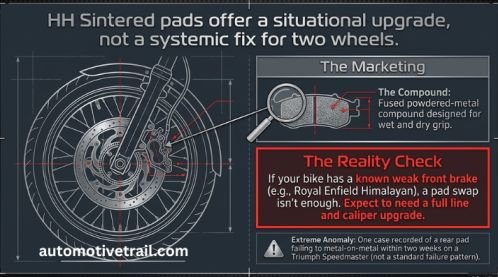
Ferodo markets HH sintered pads as the top of its road-pad range, built for wet and dry grip through a fused powdered-metal compound. Real-world results on two wheels are shakier than the marketing suggests.
One reviewer testing HH pads on a Royal Enfield Himalayan found little to no feel and poor initial bite, needing heavy lever pressure to get real stopping power. To be fair, the Himalayan’s stock front brake was already a known weak point on that bike, so the bar was low. After bedding in, the pads did improve initial bite, but ultimate stopping power felt roughly the same as the factory setup.
A separate report from a repair shop noted one case of a Ferodo sintered pad failing outright on a Triumph Speedmaster. The friction material wore completely away within about two weeks of a rear-pad install, leaving metal-on-metal contact. The shop was clear this was the only issue they’d seen with the brand, so treat it as an outlier rather than a pattern.
For motorcycle riders, Ferodo HH pads are a reasonable choice if your bike’s stock brakes are already decent and you want a small bite improvement. If your bike has a known weak front brake system, don’t expect Ferodo alone to fix it. You may need a full brake line and caliper upgrade alongside the pad swap.
How Ferodo brake pads compare to Brembo, bosch, EBC, and Textar
Here’s how Ferodo stacks up against the brands drivers cross-shop it with most.
| Brand | Cold bite | Noise | Dust | Best for |
|---|---|---|---|---|
| Ferodo Premier | Strong | Low to moderate | Moderate | Daily driving, OE-equivalent feel |
| Brembo (aftermarket) | Weaker initially, improves after bed-in | Low | Low | Budget replacement, quiet ride |
| Bosch | Decent | Low | Low | Mid-range daily use |
| EBC Yellowstuff | Strong | Moderate | Higher | Spirited street driving |
| Textar | Strong | Low | Low | OE-quality replacement, premium price |
In one direct comparison, Ferodo Premier beat aftermarket Brembo pads on cold bite, though the Brembo set eventually caught up around the 200 km mark once fully bedded in. Reviewers who tried EBC Yellowstuff after Ferodo DS2500 found the two comparable: both are street-focused upgrades with some track tolerance, not dedicated race compounds.
Textar tends to come up as the brand people switch to when they’ve had a bad experience with Ferodo noise, since it’s known for staying quiet at OE-level performance. If squeal is your top concern, that’s worth cross-shopping before you commit.
Common Ferodo brake pad complaints (noise, dust, consistency)
Three complaints show up again and again across owner forums, and they’re worth naming directly instead of dancing around them.
Noise. This is the most frequent gripe, concentrated heavily in the DS2500 line but not exclusive to it. Multiple owners describe squeal specifically at low speed, under 10 mph, that returns after the pad loses its bedded-in surface. One owner on a Mercedes forum was advised that inconsistent braking habits, not just the pad, can cause high spots that create the vibration behind the noise.
Dust. Less serious, but common. A Pajero owner running Premier pads called dust the only downside worth mentioning, not enough to change his buying decision.
Inconsistency over time. One longtime user on an oil and car forum said Ferodo quality had slipped compared to a set he installed a decade earlier, describing that batch as noisy on an Alfa 156, and now prefers Zimmermann, Valeo, or Textar instead. In the same thread, other users reported zero issues and called the brand dependable. That split is worth taking seriously. It suggests batch-to-batch or line-to-line variation rather than a universal quality drop.
None of these complaints are dealbreakers on their own. But if you’ve had a bad experience with one Ferodo line, don’t assume it applies to all of them. Premier and DS2500 are different products with different track records.
How to stop Ferodo brake pads from squealing
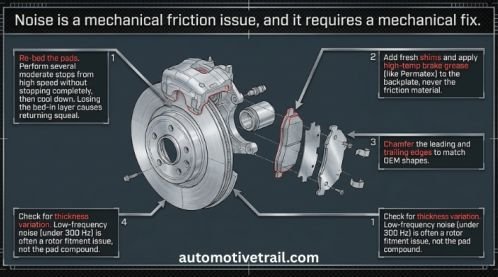
If you’ve already installed Ferodo pads and you’re dealing with squeal, try these fixes in order before giving up and swapping brands.
- Re-bed the pads properly. Do a full bedding cycle: several moderate stops from higher speed without coming to a complete stop, followed by a cool-down period with no braking. Losing the bedded-in layer is the most commonly cited cause of returning squeal.
- Add fresh shims and caliper grease. Multiple DS2500 owners fixed persistent noise by replacing worn shims and applying high-temp brake grease (like Permatex) to the contact points, not the friction surface.
- Chamfer the pad edges. Sanding a slight angle into the leading and trailing edges, matching the shape of most OEM pads, reduced noise significantly for several owners dealing with DS2500 squeal.
- Check the caliper slides and pistons. Ferodo’s own technical guidance points to poor caliper maintenance as a root cause of pull-to-one-side symptoms and squeal, not just the pad compound itself.
- Inspect the rotor surface. Ferodo’s noise diagnostics tie low-frequency noise (under 300 Hz) to poor rotor fitment or thickness variation. If the fixes above don’t help, the rotor might be the real culprit.
Is Ferodo OE-equivalent quality?
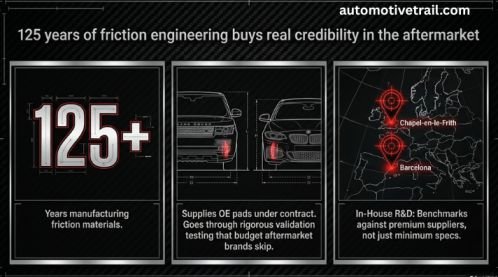
Partly, yes. Ferodo supplies OE pads on some Land Rover models, and a longtime mechanic in one forum thread mentioned occasionally finding genuine BMW-branded pads that were actually manufactured by Ferodo under contract. That’s a meaningful signal. OE suppliers go through validation testing that aftermarket-only brands don’t always face.
Ferodo also runs its own R&D and dynamometer testing at facilities in Chapel-en-le-Frith, UK, and Barcelona, Spain, benchmarking against other premium suppliers rather than just meeting a minimum spec. That’s a step above budget aftermarket brands that skip independent testing entirely.
That said, OE-sourced doesn’t mean every Ferodo line is OE-grade. The pad your BMW dealer installs and the DS2500 you buy online for a track day build are different products from different tiers of the same company. Treat “Ferodo makes OE parts” as a mark of brand credibility, not a guarantee that every product in the catalog performs at that level.
If OE-equivalent quality is your main priority, stick to the Premier line or a pad explicitly listed as an OE-fitment replacement for your specific vehicle, not a performance or track-oriented compound.
How to spot fake Ferodo brake pads
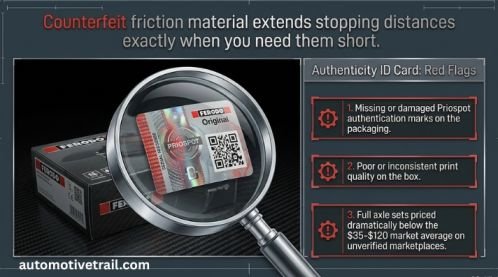
Counterfeit brake pads are a real safety issue, not just a knockoff-handbag inconvenience. A friction material that looks right but performs differently under heat can mean a longer stopping distance exactly when you need a short one.
One experienced reviewer, after two years of independent testing across multiple vehicles, specifically warned buyers to check for damaged or missing Priospot labeling as a red flag for counterfeit Ferodo pads. Genuine packaging carries this authentication mark; poor or inconsistent print quality on it is a warning sign.
Beyond the label, buy from authorized sellers or established parts retailers rather than unverified marketplace listings with prices well below the going rate. If a full axle set is priced dramatically lower than every other listing for the same part number, that’s worth a second look before you buy.
Which Ferodo pad fits your car and driving style
Match the pad to how you actually drive, not how you’d like to drive on a good day.
| Product Line | Application | Cold Bite | Noise | Dust | Key Features | Price/Axle |
|---|---|---|---|---|---|---|
| Ferodo DS2500 | Spirited street; occasional track | Inconsistent; reports range from strong bite to below stock M Sport | High; frequent low-speed squeal | High | Higher heat tolerance; fade resistance; requires proper bedding. | $60–$120 |
| Ferodo Premier | Daily commuting; SUVs; crossovers | Strong; better than factory Brembo replacements | Low–moderate | Moderate on heavier vehicles | OE-equivalent quality; reliable ABS activation; long wear; 125-year brand history. | $35–$75 ≈39–50 EUR |
| Ferodo DS3000 | Occasional track days | Varies | Varies | Varies | Better fade resistance than OEM under repeated hard stops. | Varies |
| Ferodo HH Sintered Motorcycle |
Motorcycles with decent stock brakes | Modest/poor initial bite; improves after bedding | Varies | Varies | Powdered-metal compound; designed for wet/dry grip. | Varies |
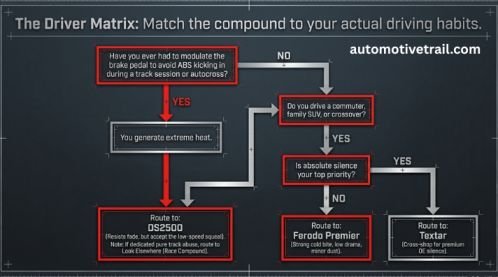
If you’re not sure which category you fall into, ask yourself one question: have you ever had to modulate the brake pedal to avoid ABS kicking in during a track session or autocross? If yes, go DS2500. If no, Premier will serve you better and stay quieter doing it.
Ferodo brake pad prices: what to expect
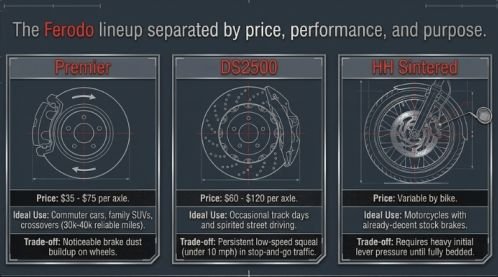
Pricing varies by vehicle and line, but here’s a realistic range based on current listings. A Premier axle set typically runs $35 to $75 depending on the car, with sensor-equipped sets (common on European vehicles) landing near the top of that range. One owner reported paying roughly 50 EUR for front Premier pads and 39 EUR for rears, sensors included, bought through an online marketplace.
DS2500 sets tend to run higher, generally $60 to $120 per axle depending on the vehicle and caliper fitment, since it’s positioned as a performance product rather than a standard replacement.
Compared to Textar or genuine OE pads, Ferodo usually lands slightly cheaper for equivalent coverage, which is part of why it shows up so often as the “step up from cheap, step down from premium” recommendation in forums.
Are Ferodo brake pads worth buying: the real recap
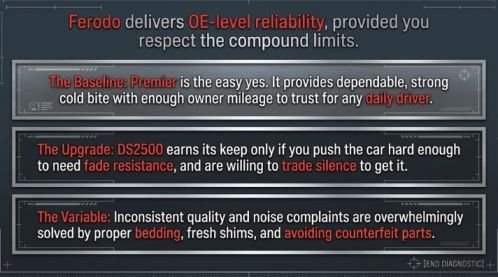
Ferodo brake pads are worth buying if you match the line to your driving. Premier is the easy yes: strong cold bite, OE-level credibility on some platforms, and enough owner mileage behind it to trust for daily use. DS2500 is a conditional yes, good for drivers who track occasionally and will tolerate some squeal in exchange for fade resistance. HH sintered motorcycle pads are a smaller, more situational upgrade that won’t fix a fundamentally weak brake system on its own.
The recurring complaint across every line is noise, and it’s fixable in most cases through proper bedding, fresh shims, grease, and pad chamfering rather than a sign of defective parts. Dust is a minor, mostly cosmetic issue on Premier. The real risk to watch for isn’t performance; it’s counterfeits, so check the Priospot label before you buy.
If you drive normally and want a dependable pad that won’t surprise you, get Premier. If you occasionally push the car hard and don’t mind some pedal noise at low speed, DS2500 earns its keep. For serious track use, look at a dedicated race compound instead.
FAQ
Are Ferodo brake pads better than OEM?
Often yes for cold bite and initial response, based on direct comparisons against factory Brembo pads. But OEM pads sometimes catch up in overall performance once fully bedded in, so the gap narrows with mileage.
Do Ferodo brake pads squeal?
Some lines do, especially DS2500, particularly during low-speed stops after the pad loses its bedded-in surface. Fresh shims, brake grease, and re-bedding solve it in most reported cases.
Is Ferodo a good brand for brake pads?
Yes, with over 125 years in friction materials and OE supply contracts with brands like Land Rover. Quality varies by product line, so match the line to your actual driving needs.
How long do Ferodo brake pads last?
Real-world reports show 10,000 km and counting with no issues on Premier pads under normal driving, though actual lifespan depends heavily on driving style, vehicle weight, and climate.
Are Ferodo DS2500 pads good for daily driving?
They can work, but expect more noise and dust than Premier pads. Several daily drivers found them a downgrade from OEM in normal street use, so they suit occasional spirited driving better than pure commuting.
How do I know if my Ferodo brake pads are genuine?
Check for intact Priospot labeling on the packaging and buy from authorized retailers. Prices well below the market average on marketplace listings are a common red flag for counterfeits.
- 2 Hole Vs 4 Hole Injectors 5.3 Vortec: Swap Rules + Fitment Check - September 12, 2026
- What Oil Does 2012 Honda Civic Use: What Oil Does Honda Civic Use & Spec - September 12, 2026
- 2014 Ram 2500 5.7 Hemi Sparkplugs: Ram 5.7 Hemi Sparkplugs: Oe Vs Fitment, Swap Steps - September 12, 2026