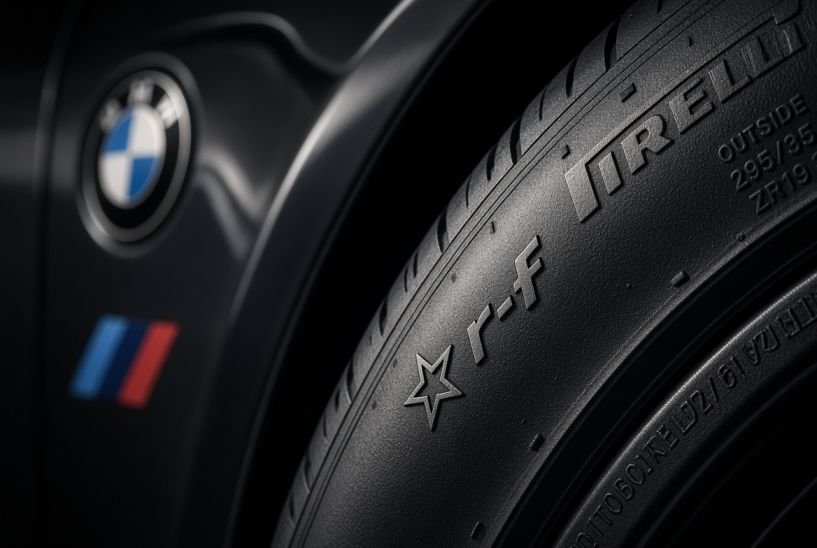
Flip a tire over and look for a small star stamped into the sidewall. That star is the whole reason your BMW’s tire options are narrower and pricier than a Honda’s. Pirelli builds that ★ marking exclusively for BMW, and it means the tire underneath was engineered to BMW’s own spec, not just sized to fit.
Quick answer: Pirelli supplies run-flat tires to BMW across most of the lineup, marked with a ★ (star) on the sidewall alongside “r-f.” They run about 50 miles at 50 mph after a puncture, come in four main families (P Zero, Cinturato P7, Scorpion, Sottozero) depending on the model, and cost roughly $150 to $500+ per tire to replace.
Key takeaways
- The ★ symbol is BMW’s own tire mark; Pirelli’s run-flat identifier is a lowercase “r-f” next to it.
- Run-flats give about 50 miles at 50 mph max after full pressure loss, not unlimited driving.
- P Zero r-f covers M models and performance trims; Cinturato P7 r-f covers comfort trims; Scorpion covers X-model SUVs.
- Pirelli offers a free lifetime road hazard warranty on run-flats, but many dealers don’t mention it.
- Run-flats generally can’t be repaired once driven flat, and most shops won’t try.
- Switching to conventional tires means sourcing a spare, since most BMWs ship with none.
Pirelli run-flats for BMW: what the ★ marking actually means
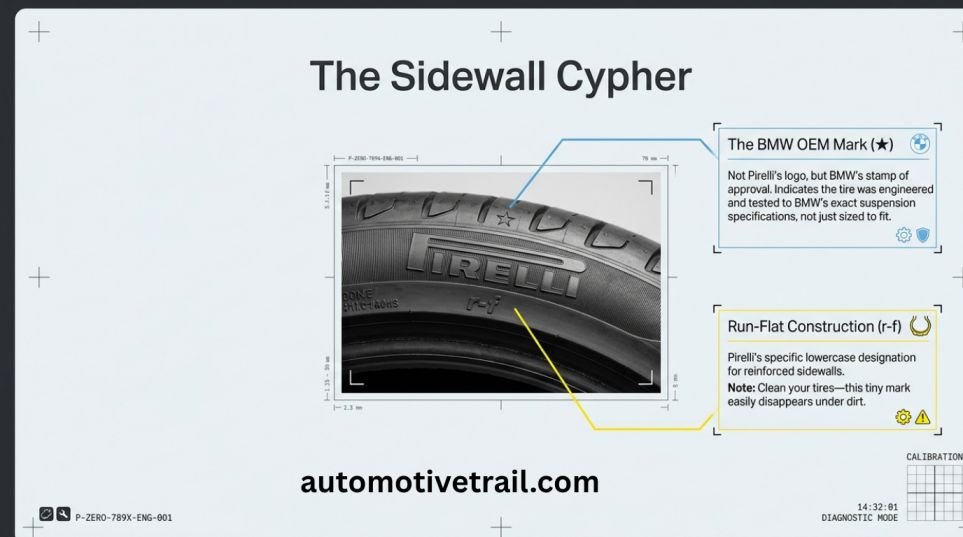
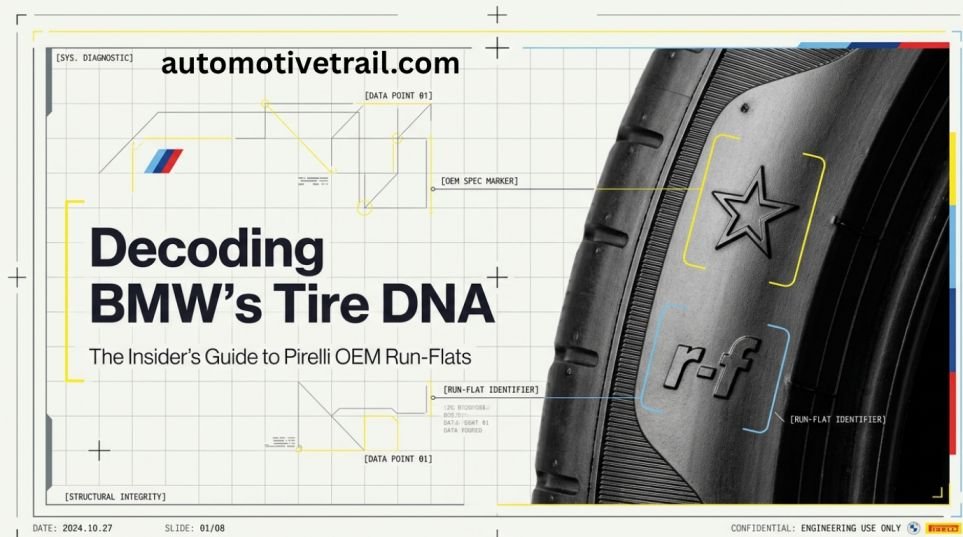
The ★ stamped on a Pirelli sidewall isn’t Pirelli’s logo. It’s BMW’s own original-equipment mark, and Pirelli only applies it to tires built and tested against BMW’s specific requirements for that exact model and trim. A tire without the star wasn’t necessarily rejected by BMW; it just wasn’t developed as a BMW-specific fitment, even if the size matches.
Separately from the star, look for a lowercase “r-f” on the sidewall. That’s Pirelli’s own run-flat designation, and it’s easy to miss. It’s smaller than most competitors’ run-flat markings, Bridgestone’s “RFT” or Continental’s “SSR,” for instance, and on a dirty sidewall it can disappear entirely. Clean the tire before you go looking.
Both marks matter for different reasons. The star tells you it’s a genuine BMW-spec tire. The “r-f” tells you it’s the run-flat construction, meaning reinforced sidewalls that can support the car’s weight for a limited distance after a puncture, without a spare.
You’ll find both markings together on tires across BMW’s mainstream and performance range, from 3 Series sedans to X5 and X7 SUVs. Not every Pirelli that fits your wheel size carries the star. If you’re replacing OEM tires and want to stay spec-matched, check for the star specifically, not just the tire size and speed rating.
How Pirelli run-flat tires work (and their real limits)
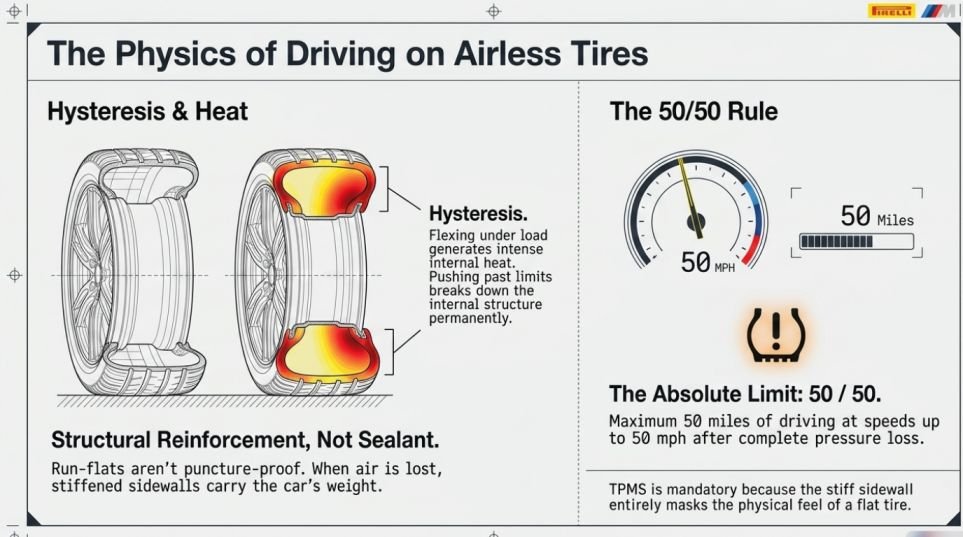
Run-flat construction relies on a reinforced sidewall, not sealant or a foam filler. When the tire loses air, that stiffened sidewall structure keeps the tire’s shape rigid enough to carry the car’s weight and let you keep driving, briefly.
“Briefly” is the operative word. Pirelli’s own guidance, echoed across BMW’s documentation, puts the limit at roughly 50 miles at speeds up to 50 mph after complete pressure loss. Push past that and the tire generates enough internal heat through flexing; engineers call it hysteresis- to break down the structure permanently.
This is why every BMW with run-flat tires also comes with a tire pressure monitoring system (TPMS) as standard. You won’t feel a run-flat go soft the way you would on a conventional tire, since the stiff sidewall masks the loss of pressure. Without TPMS, you could be driving on a fully deflated tire without knowing it.
One detail owners frequently misunderstand: run-flats aren’t puncture-proof, and Seal Inside technology (Pirelli’s separate self-sealing layer, used on some models) is a different feature entirely. Run-flat construction addresses what happens after air is lost. Seal Inside tries to prevent the air loss in the first place by plugging small punctures automatically. Some Pirelli tires carry both features, but they’re not the same thing, and a run-flat tire without Seal Inside will still go flat from a nail; it’ll just let you keep driving afterward.
How to tell if your BMW has Pirelli run-flat tires right now

Three checks, in order of speed:
- Look at the sidewall. Clean it if needed, then check for the ★ symbol and the lowercase “r-f” marking together. If both are present and the brand name reads Pirelli, you’ve got Pirelli run-flat tires.
- Check for a spare tire. Most BMWs built with run-flat tires as standard equipment don’t include a spare, a jack, or a tire repair kit. If your trunk has none of these and factory-sized space savers, that’s a strong secondary signal.
- Check your window sticker or owner’s manual. Original tire fitment is usually documented there by brand and model, even if the physical tires have since been swapped.
If you bought the car used, don’t assume the current tires match the original factory fitment. A previous owner may have switched to conventional tires already, which means no run-flat capability regardless of what the manual originally specified. The sidewall check is the only fully reliable method on a used car.
Pirelli’s run-flat lineup by BMW use case
Pirelli doesn’t sell one run-flat tire for BMW. It builds run-flat versions across four separate product families, each aimed at a different kind of BMW and a different kind of driving.
| Pirelli Family | Best For | Typical BMW Fitment | Price / Tire | Tread Life | Key Characteristics |
|---|---|---|---|---|---|
| P Zero R-F | Performance, M models | M3, M4, M5, sportier 3/5 Series | $250–$450 | 20,000–30,000 miles | Maximum grip and steering response; ultra-high-performance; motorsport-derived compound |
| Cinturato P7 r-f | Daily comfort, quiet ride | 3 Series, 5 Series, X1 | $180–$280 | 30,000–60,000+ miles | Low rolling resistance; quiet ride; fuel efficiency; summer and all-season options |
| Scorpion Verde / Zero R-F | SUVs, crossovers | X3, X5, X6, X7 | $220–$400 | 28,000+ miles | Reinforced for vehicle weight; Verde for comfort, Zero for performance; high siping for traction |
| Sottozero r-f | Winter conditions | Any model in cold climates | $200–$350 | Varies by model | Flexible low-temp compound; ice and snow traction; seasonal tire; accelerated wear in summer |
The split isn’t arbitrary. Pirelli tunes the compound and internal structure differently for a car that needs cornering grip at the limit versus one that needs a quiet, comfortable ride at highway speed, and the run-flat sidewall reinforcement gets tuned right along with it.
Picking the wrong family for your driving isn’t dangerous, but it does mean paying for capability you won’t use, or missing capability you actually need. A daily-driven X3 doesn’t need P Zero-level grip. An M-car owner doing track days wants more than what Cinturato P7 offers.
P Zero R-F: the performance and M-model pick
P Zero is Pirelli’s flagship ultra-high-performance line, and the run-flat version is the one you’ll most often find on M models and the sportier trims of BMW’s mainstream lineup. It first appeared in 1987 as Pirelli’s original UHP tire, and the current fourth-generation compound draws directly on the company’s motorsport programs.
The tradeoff with P Zero r-f is the one you’d expect: maximum grip and steering response in exchange for a firmer ride and a shorter tread life than the comfort-focused options. Owners report tread wear in the 20,000 to 30,000 mile range under normal driving, faster if you’re pushing the car hard.
Sizes commonly seen on BMWs run from around 245/40R19 up through 275/45R20 XL, depending on the model and whether it’s a front or staggered rear fitment. M models frequently run different front and rear sizes, so check both axles separately before ordering.
If your BMW is a genuine M model or a performance-package trim, P Zero R-F is very likely what came on it from the factory, and matching it keeps handling characteristics consistent with how the suspension was tuned.
Cinturato P7 R-F: the comfort and daily-driver pick
Cinturato P7 R-F is Pirelli’s “Green Performance” line, built around low rolling resistance and a quieter ride rather than outright grip. It’s the tire you’ll most commonly find on mainstream 3 Series, 5 Series, and X1 trims that aren’t chasing a performance badge.
The compromise runs the other direction from P Zero: less outright cornering grip, but noticeably better fuel economy and cabin noise, plus generally longer tread life. Real-world reports from owners put wear anywhere from 30,000 to over 60,000 miles, though several owners note run-flat sidewalls sometimes develop bubbles well before the tread wears out, an issue tied to the stiffened construction rather than tread compound.
Cinturato P7 comes in both summer and all-season run-flat variants, with the all-season version adding wet and light-snow performance at a small cost to dry grip.
If your BMW is a standard trim used mostly for commuting and highway driving, this is almost certainly the family it left the factory wearing, and it’s a reasonable default to stick with unless you specifically want more grip or better winter capability.
Scorpion Verde/Zero R-F: the SUV and X-model pick
Scorpion is Pirelli’s SUV and crossover line, and the run-flat version covers BMW’s X-model range from the X3 up through the X7. Verde leans toward comfort and efficiency; Zero leans toward performance, particularly on X5 M and X6 M variants.
SUV run-flats carry extra engineering burden compared to sedan tires, since they’re supporting more vehicle weight on the same reinforced sidewall structure. That’s part of why Scorpion Zero All Season packs over 30 meters of siping, nearly double an earlier Scorpion Zero Asimmetrico, specifically to keep traction reasonable on snow-covered roads without sacrificing the tire’s structural role.
Reported tread life varies more here than with sedan tires. Some owners report as little as 28,000 miles on Scorpion Zero All Season before replacement; others report noise developing well before the tread wears down, particularly on X5 and X6 models running the larger 20-inch and 21-inch sizes.
If you drive an X-model BMW, Scorpion is almost certainly your OEM fitment, and the Verde versus Zero choice comes down to whether you prioritize daily comfort or want to retain more of the performance character on higher-output X models.
Sottozero: the winter run-flat option
Sottozero is Pirelli’s dedicated winter tire family, and BMW offers a run-flat version for owners in genuinely cold climates who want winter-specific grip without giving up the run-flat safety margin.
The tread compound stays flexible at low temperatures where summer and all-season compounds harden and lose grip, and the tread pattern is built around ice and snow traction rather than dry-road cornering. Sottozero 3 is the current generation most commonly fitted to BMW sedans and coupes.
The catch with any winter run-flat is the same catch that applies to winter tires generally: they’re a seasonal tire, not a year-round one. Running them through summer accelerates wear significantly and gives up dry-weather grip you’d get from a summer or all-season option.
If you already run a dedicated summer or all-season set and swap seasonally, Sottozero run-flat is worth pricing out specifically for winter months. If you’re looking for one tire to handle everything including occasional snow, the all-season Cinturato P7 or Scorpion variants are a more practical single choice.
Can you mix Pirelli run-flats with regular tires?
Don’t. Mixing run-flat and conventional tires on the same axle, or even across the car, creates a real handling mismatch, not just a cosmetic inconsistency.
Run-flat sidewalls are significantly stiffer than conventional tire sidewalls by design. That stiffness changes how the tire flexes under cornering load, which means a car with run-flats on one axle and conventional tires on the other will handle unpredictably differently side to side, particularly under hard braking or in a sudden lane change.
There’s a second, more immediate problem: BMWs built around run-flats typically ship without a spare tire, a jack, or a repair kit, on the assumption you’ll always be running the reinforced tire. Put a single conventional tire on as a temporary fix, and you’ve got no backup plan if that tire fails too.
If you’re planning to move away from run-flats entirely, the right approach is replacing all four tires in the same change, along with sourcing a spare tire solution, not mixing types as a stopgap.
What it costs to replace Pirelli run-flats on a BMW
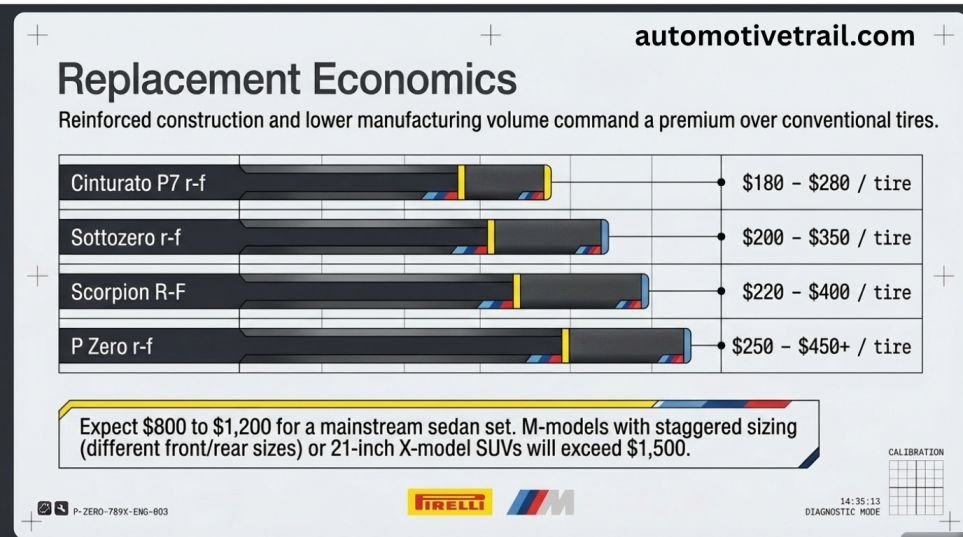
Expect to pay more than you would for a comparable conventional tire, largely because of the reinforced construction and the smaller manufacturing volume relative to standard tires.
| Tire family | Typical price per tire |
|---|---|
| Cinturato P7 r-f | $180–$280 |
| P Zero r-f | $250–$450 |
| Scorpion (Verde/Zero) R-F | $220–$400 |
| Sottozero r-f | $200–$350 |
Across the run-flat category generally, per-tire pricing runs roughly $150 to $500 or more depending on size, model, and whether it’s a staggered fitment requiring different front and rear sizes.
A full set replacement on a mainstream sedan running Cinturato P7 R-F often lands somewhere around $800 to $1,200 installed. An M model on P Zero R-F, especially with staggered sizing, can run well past $1,500 for a full set.
Larger SUV sizes, common on X5 and X6 models in 20-inch and 21-inch fitments, tend to sit at the higher end of these ranges since bigger diameters cost more to manufacture regardless of brand or run-flat status.
Pirelli’s run-flat road hazard warranty: what’s covered
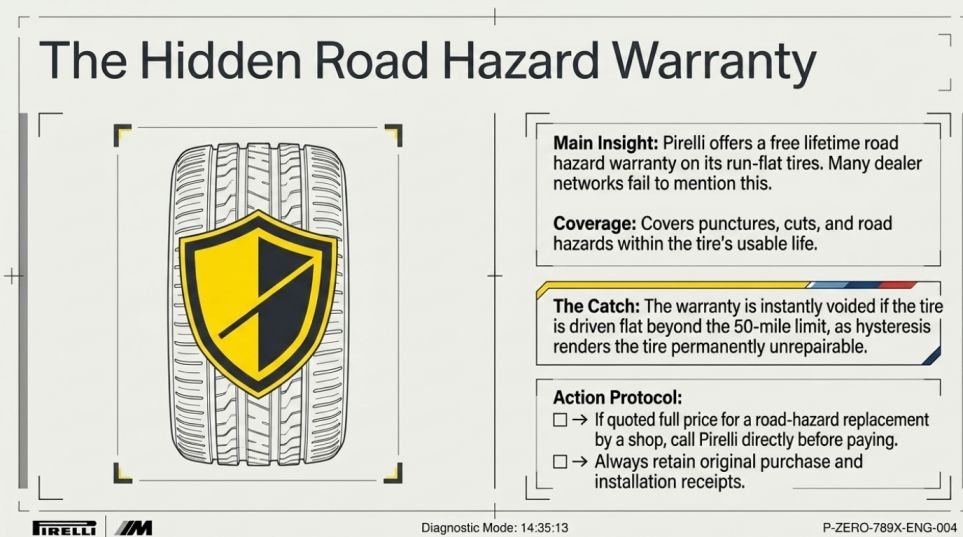
Pirelli offers a free lifetime road hazard warranty on its run-flat tires, and it’s a detail many BMW dealers either don’t mention or aren’t fully aware of themselves. One owner reported being quoted $330 for a single replacement tire at a dealer with under 100 miles on it, only to learn after calling Pirelli directly that the tire should have been covered under this warranty at no cost.
The warranty generally covers tires damaged by road hazards, punctures, cuts, and similar events, within the tire’s usable life, though the specific terms and documentation requirements vary. If a dealer or shop quotes you full price for a road-hazard-related replacement on a Pirelli run-flat, it’s worth calling Pirelli directly before paying, since the coverage doesn’t always get communicated down through the dealer network.
Keep in mind this warranty doesn’t cover damage from driving on a fully deflated tire past the 50-mile limit. Once a run-flat has been driven flat beyond its rated distance, most shops, and the warranty itself, treat it as unrepairable and ineligible regardless of the original cause of the puncture.
Documentation matters here. Keep your purchase receipt and any service records, since a warranty claim without proof of purchase or installation date is much harder to process.
Switching away from run-flats: what changes
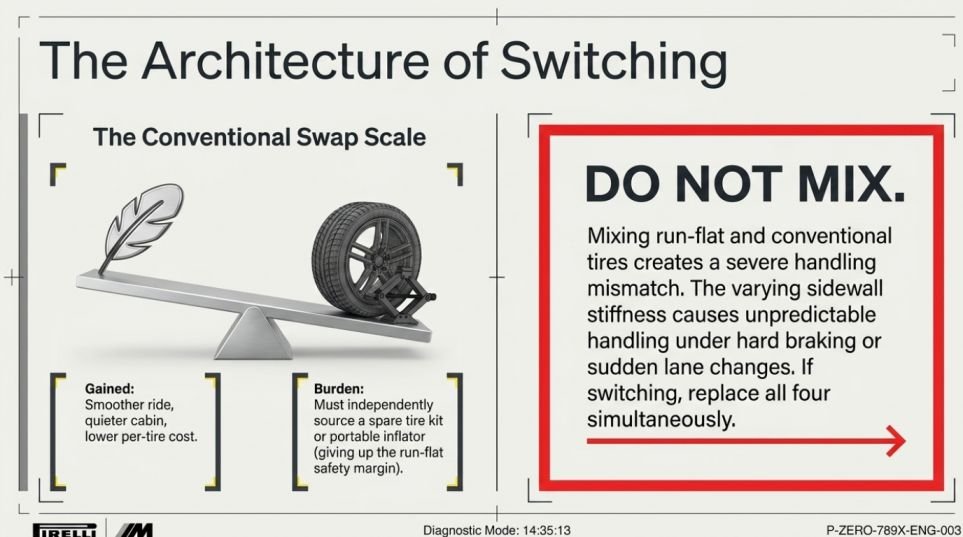
You can replace run-flat tires with conventional ones on a BMW, but it’s not a drop-in swap without consequences.
BMW’s suspension tuning on run-flat-equipped models accounts for the sidewall stiffness of the run-flat construction. Switching to a conventional tire, particularly a softer sidewall aimed at comfort, changes how the car rides and handles, sometimes for the better in terms of comfort, sometimes worse in terms of steering precision, depending on which tire you choose.
The bigger practical issue is the missing spare. Since most run-flat-equipped BMWs ship without a spare tire, jack, or repair kit, switching to conventional tires means you’re giving up the run-flat safety margin without gaining a backup plan, unless you source a spare and the tools to change it yourself, or carry a portable inflator and plug kit.
Conventional tires generally offer a smoother ride, quieter cabin, and often better tread life for the same price point, since run-flat sidewall reinforcement adds cost without adding tread rubber. Some owners find this trade well worth it, especially on comfort-focused trims where the run-flat’s performance advantage barely applies anyway.
If you do switch, replace all four tires together rather than mixing, for the handling consistency reasons covered earlier in this guide.
Summary: choosing the right Pirelli run-flat for your BMW
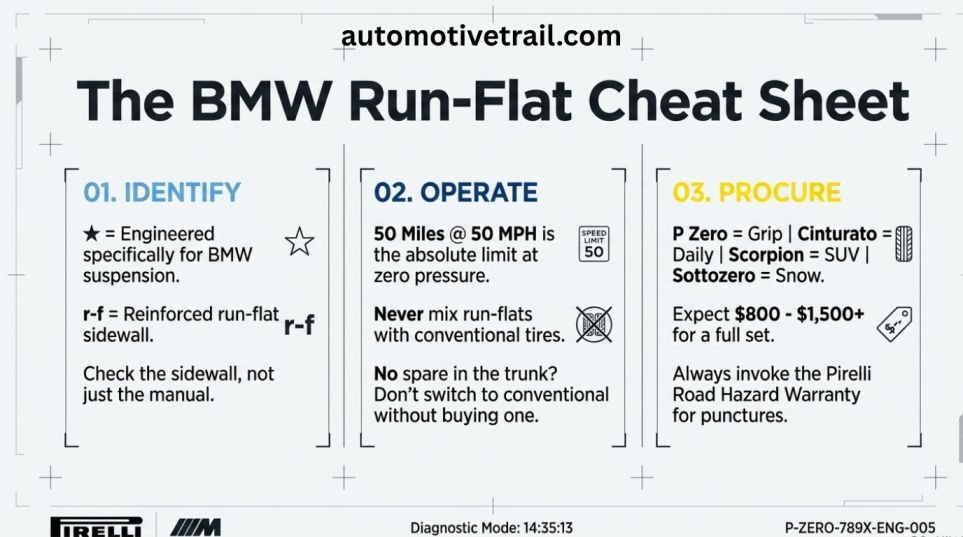
Start by confirming what you actually have. Check the sidewall for the ★ and “r-f” marks before assuming anything based on trim level or model year alone, especially on a used car.
From there, match the Pirelli family to how the car is actually driven, not how it’s badged. P Zero R-F for genuine performance and M-model use, Cinturato P7 R-F for daily comfort-focused driving, Scorpion for X-model SUVs, Sottozero for dedicated winter use. Most owners are best served sticking close to their original factory fitment unless they have a specific reason to prioritize grip, comfort, or winter capability differently.
Budget realistically. A full set replacement runs anywhere from around $800 on a mainstream sedan to well over $1,500 on a performance model with staggered sizing, and don’t skip checking Pirelli’s road hazard warranty before paying a shop’s quoted price out of pocket.
And if you’re considering a switch away from run flats entirely, go in knowing you’re also solving the spare tire question, not just picking a different tire brand.
FAQ
Are all Pirelli tires on BMW run flats? No. Pirelli sells both conventional and run-flat versions of most of its tire families. Only tires marked with the lowercase “r-f” alongside the ★ symbol are the run-flat construction; the star alone confirms BMW original-equipment spec, not run-flat capability.
Can Pirelli run-flat tires be repaired after a puncture? Usually not, especially if the tire was driven any distance while flat. Most shops decline to repair run-flats because they can’t verify how far or how fast the tire was driven without air, and internal damage from that driving often isn’t visible from the outside.
Do I need a special TPMS to use Pirelli run flats on my BMW? No special TPMS is needed beyond what BMW already includes as standard equipment on run-flat-equipped models. TPMS comes standard specifically because run-flat sidewalls mask the feel of low pressure that you’d normally notice on a conventional tire.
How long do Pirelli run flats last on a BMW? It varies by family and driving style, but reported ranges run from about 20,000 miles on performance-focused P Zero r-f under hard driving up to 50,000-plus miles on comfort-focused Cinturato P7 r-f under normal commuting use.
Can I put a regular spare tire in my BMW if I switch away from run-flats? Yes, but most run-flat-equipped BMWs weren’t built with space or mounting hardware for a spare, so you’ll likely need an aftermarket spare tire kit or a portable inflator and plug kit as a backup solution.
Is Pirelli or Bridgestone better for BMW run-flats? Both are legitimate BMW original-equipment suppliers, and the better choice depends on the specific model and priority. Pirelli is generally BMW’s primary performance run-flat supplier for M models and sportier trims, while Bridgestone and Continental are often noted for a more comfort-focused run-flat feel on mainstream trims.

- 2 Hole Vs 4 Hole Injectors 5.3 Vortec: Swap Rules + Fitment Check - September 12, 2026
- What Oil Does 2012 Honda Civic Use: What Oil Does Honda Civic Use & Spec - September 12, 2026
- 2014 Ram 2500 5.7 Hemi Sparkplugs: Ram 5.7 Hemi Sparkplugs: Oe Vs Fitment, Swap Steps - September 12, 2026