
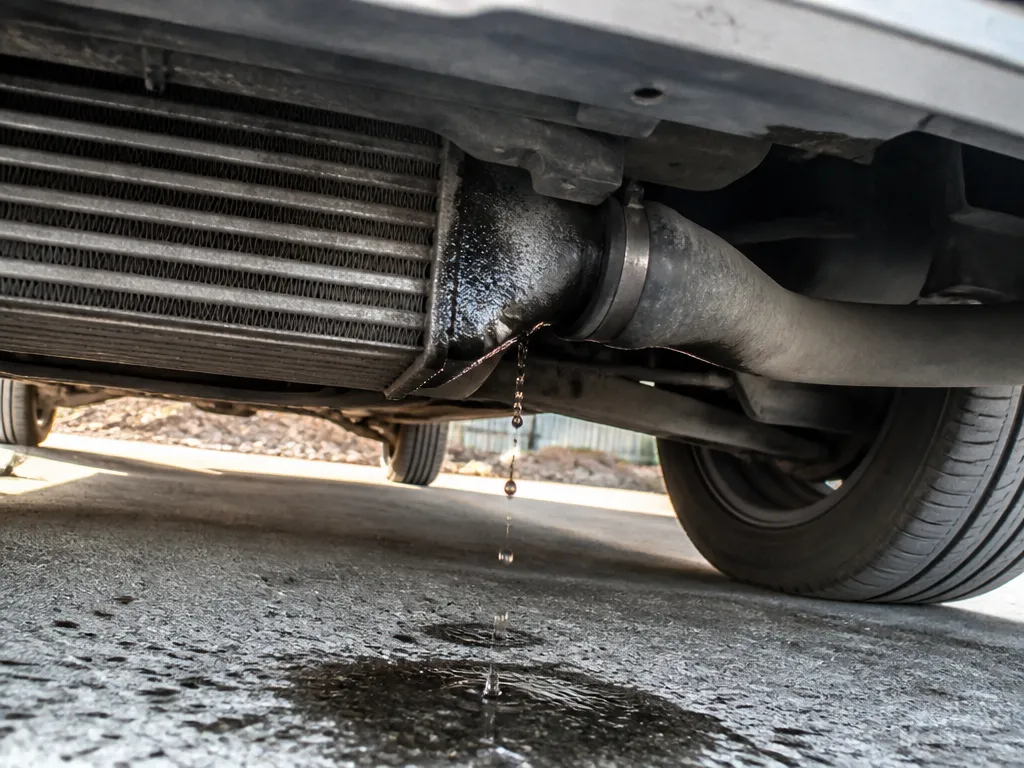
Your Renault Trafic’s intercooler seems to be leaking, and you’re seeing wet oil residue around the end tanks, hearing a hiss under boost, or getting reduced power. That could be a simple hose or clamp issue, or it could be a split intercooler end tank. This troubleshooting walks you through telling air/boost leaks from coolant leaks, then finding the exact spot and deciding what to replace.
Renault Trafic leaking intercooler usually comes from a split rubber charge hose, a loose or damaged clamp, or cracked plastic intercooler end tanks that wet the area with oil film. Fast checks include looking for oily soot at hose joints and end seals, then pressure-testing the charge air circuit with soap bubbles for 5-10 minutes.
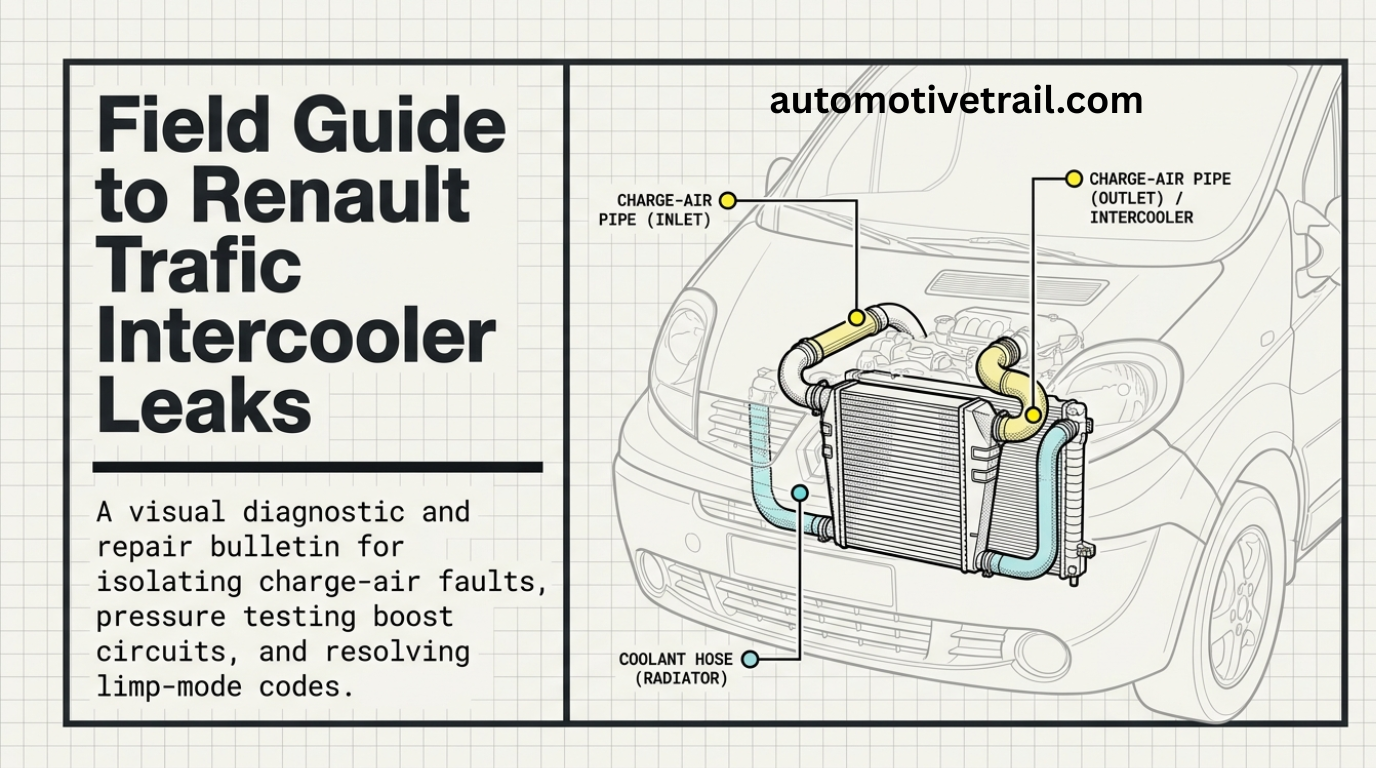
Renault Trafic Leaking Intercooler: Quick Diagnosis Flow
Start by sorting the leak by fluid type: charge-air leaks are air and oil mist; coolant leaks are sweet-smelling liquid and clean steam. A fast decision path saves you from replacing an intercooler when the real problem is a cracked boost pipe or a failed clamp.
| What you see | Most likely leak type | Where it usually starts |
|---|---|---|
| Oily film, oily dirt buildup, hissing after boost | Charge-air (air/boost) leak | Intercooler end tank seams, hose ends, clamp contact points |
| Sweet odor, colorful wet liquid, steam while hot | Coolant leak | Coolant hoses, liquid connections near the heat exchange plumbing |
Expert tip: Wipe the area lightly with a clean paper towel, then drive and re-check. The new wetness spot tells you the active leak location, even if residue from an earlier leak is still on the parts.
Air/boost Leak Vs Coolant Leak Cues
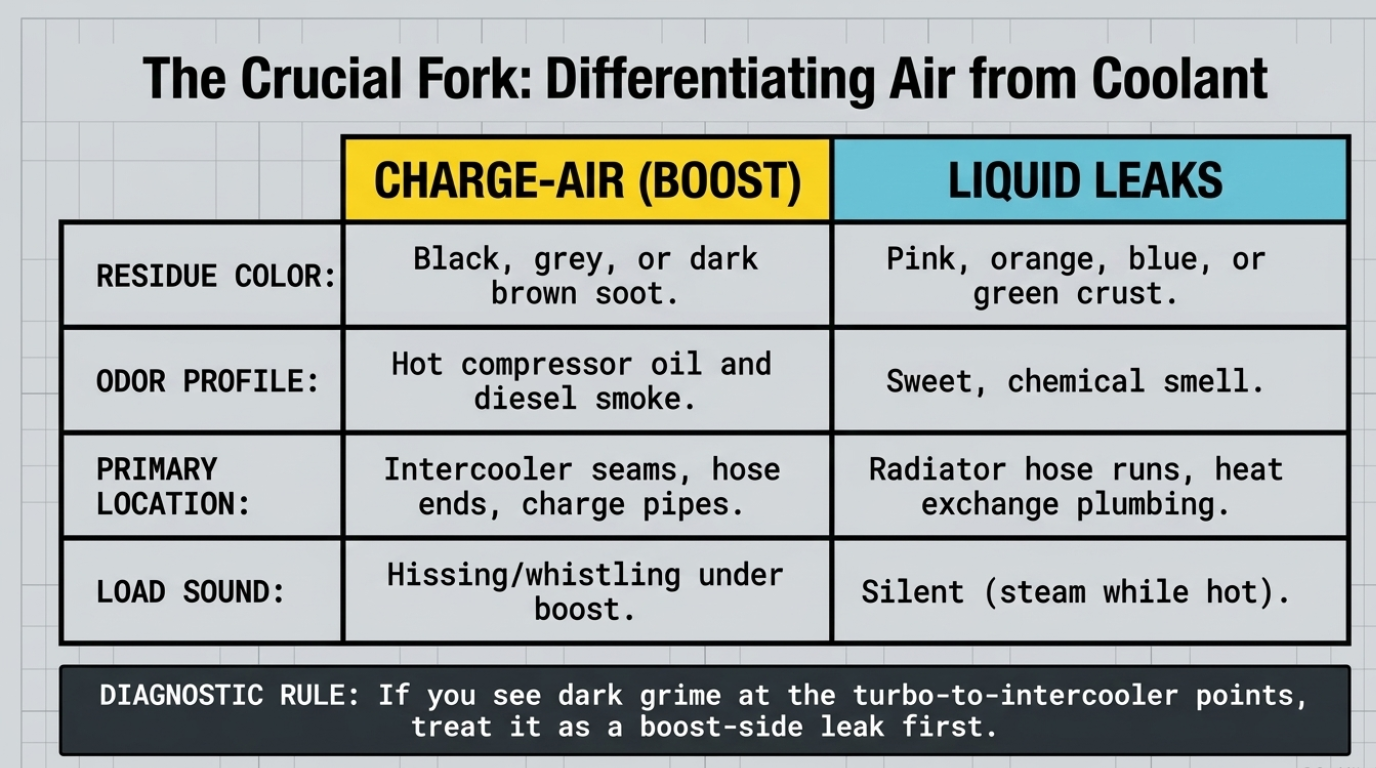
Charge-air (air/boost) leaks usually leave dry oily soot or black grime streaks around the intercooler and charge pipes. Coolant leaks leave a sweet smell and a wet pink or blue-green film with crusty deposits around hose connections.
Air/boost Leak Cues (What Oily Boost Residue Looks Like)
Air leaks in the Renault Trafic intercooler system tend to carry compressor oil mist and diesel soot, so you often see dry black or dark brown grime at the seam, clamp area, or end tanks. Common tells are damp-looking residue that dries tacky, and a clear pattern where air jets out during boost.
For example, a split intercooler end tank or a hose crease near the clamp band can produce a hissing sound under load and a soot halo around the leak path. Because the leak happens when boost rises, you may only notice it during a short acceleration run or from under-hood airflow when the engine is working hard.
Coolant Leak Cues (What Real Coolant Looks And Smells Like)
Coolant leaks usually smell sweet, and the residue looks bright and wet at first, then crusts as it dries. Coolant film is often pink, orange, blue, or green depending on what the Trafic has in it, and it commonly appears near coolant hoses, the intercooler coolant circuit, or the small radiator hose run.
For instance, a pinhole at a hose connection can leave a crusty ring and streaks that track down the same path every time you park. If the leak drips onto hot exhaust or turbo parts, you may see a thin haze when heat soaks.
How Charge-air Oil Mist Mimics Coolant, And How To Tell The Difference
Charge-air leaks can look “wet” because turbo systems carry oil mist, but it typically leaves black, gray, or dark oily grime and soot speckling around boost components. Coolant is visually cleaner (color-based film) and has a sweet smell, while oily boost residue usually smells like hot oil or diesel smoke.
In practice, rub the residue between clean white paper or a shop rag and check what comes off. Oil-boost residue smears dark and leaves a greasy film, while coolant dries to a colored crust and can wipe off with a more watery, less sooty feel.
| Clue | Air/boost leak | Coolant leak |
|---|---|---|
| Residue color | Black/gray/dark brown | Pink, orange, blue, or green film |
| Smell | Hot oil, diesel-like | Sweet, chemical |
| Where it shows up | Intercooler seams, hose clamps, charge pipes | Coolant hose runs, connectors, cooler water passages |
| Sound at load | Hissing or whistle under boost | Not typical from boost hoses |
Pro tip: If you only see dark grime at turbo outlet to intercooler points, treat it as a boost-side leak first. If you see colored coolant film plus sweet odor near coolant plumbing, treat it as coolant-side until proven otherwise.
Trafic Charge Pipes And Intercooler Check Points
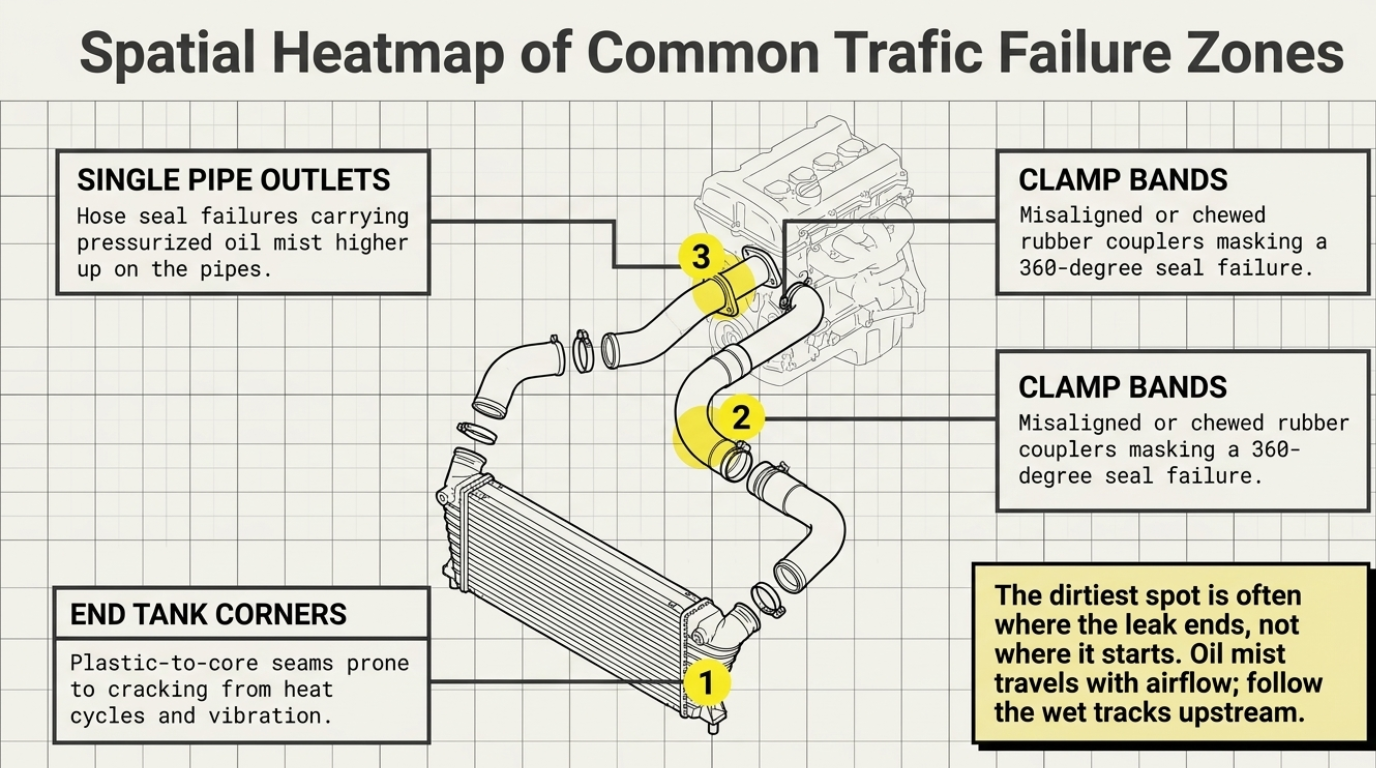
Renault Trafic charge-air leaks usually leave oil-wet residue right where boost pressure exits. The quickest way to confirm the leak area is to visually map wet tracks around the intercooler end tanks, hose-to-intercooler clamps, and rubber couplers on the boost pipes.
For example, residue that wraps around the entire circumference right at one clamp band usually points to a clamp seating issue or a worn coupler mouth. Residue that starts at an end tank seam and spreads outward is more likely an intercooler end tank crack than a loose hose.
| Where you see wet/oily marks | Most likely cause | What to inspect next |
|---|---|---|
| At end tank corners/seams | Cracked end tank or seam leak | Both corners and full seam length around outlet |
| At one clamp band, both sides of band | Clamp not sealing or coupler mouth damage | 360-degree clamp contact and coupler split/crease |
| On only one outlet after the intercooler | Hose/connection seal failure at that leg | Coupler condition and clamp orientation |
| Higher up on pipes, above drip points | Air/boost leak carrying oil mist | Follow residue trail to the exact seam or junction |
Quick reality check: If the residue is fresh-looking and oily, treat it as active leak evidence. If the residue is dry, crusty, and spreads everywhere with no pattern to seams or clamps, keep inspecting because it may be leftover oil mist from prior service.
Renault Trafic charge-air plumbing is sensitive to clamp quality and coupler age. Reused clamps or couplers that have been “adjusted” by tightening can distort and keep leaking even after they feel snug.
Intercooler Leak Test With Pressure
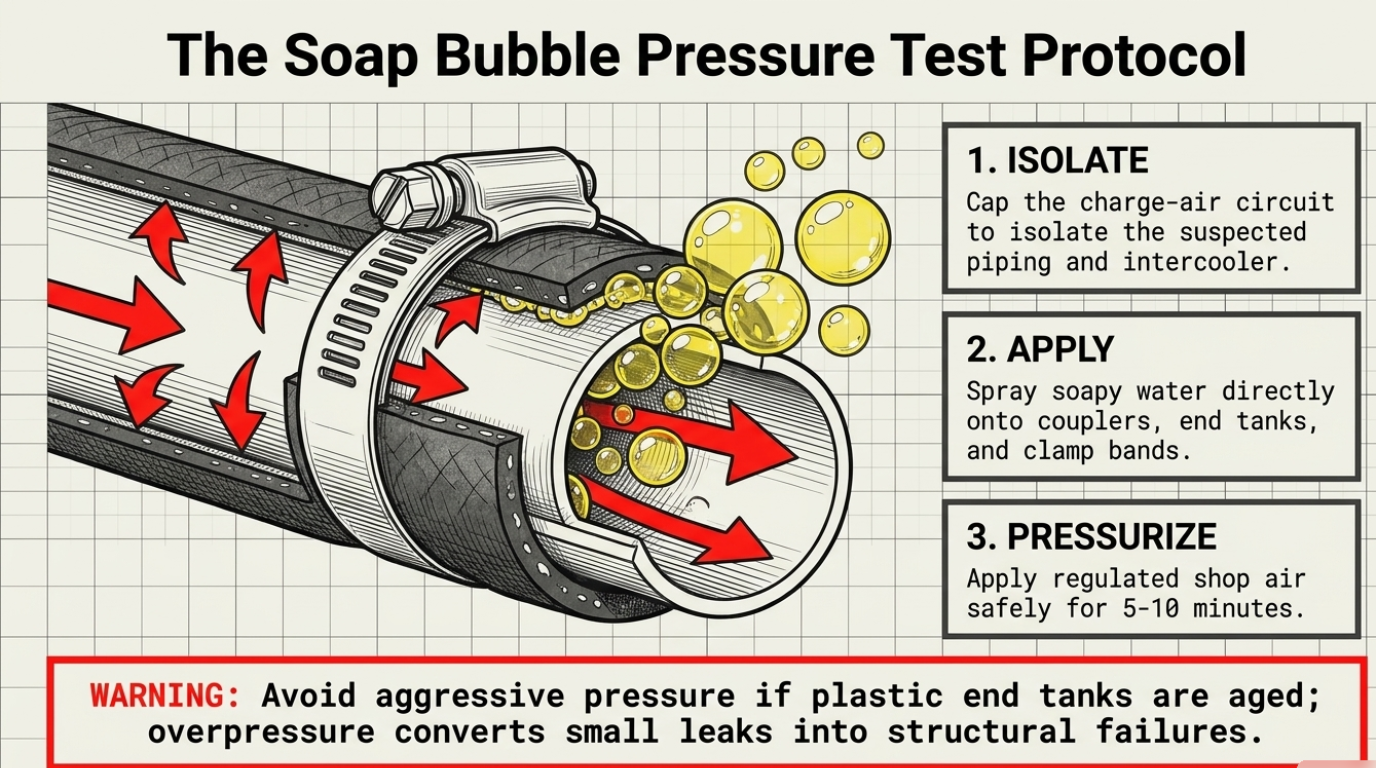
Charge-air systems leak under boost pressure, so a controlled pressure test is the most reliable way to confirm an intercooler or hose leak on a Renault Trafic. Soap-and-water then pinpoints the exact spot where air escapes. Hissing and oily residue usually point you in the right direction first, but pressure testing proves it.
What You Need For A Safe, Controlled Boost/charge-air Test
A pressure test needs regulated shop air, a way to cap the system openings, and a gauge if possible so you can keep the pressure consistent. For a Renault Trafic, you are working on the charge-air pipes between the turbo, intercooler, and intake manifold, so treat the hoses and clamps like you will later need them again.
Set Up The Charge-air Pressure Test Correctly
Charge-air testing works best when you isolate the circuit so you can pressurize the section you suspect. Start with the intercooler and the hoses on either side, then expand if pressure holds and the fault still exists.
Where To Apply Soapy Water And What Bubbles Mean
Soapy water should be applied where charge-air turbulence and joints concentrate leaks: couplers, end tanks, clamp bands, and any seams in plastic intercoolers. Expect leaks to show at the edge of a seal, under a clamp, or at a hose that looks “fine” until pressure loads it.
For example, if bubbles appear at only one end tank, you have a localized intercooler failure.
For instance, bubbles at both hose coupler seams with a clean gauge reading that still drops suggests either multiple weak clamps or a hose that is leaking at more than one seating point under load.
Interpreting Results On The Traffic
Pressure tests can show two common patterns: a single obvious leak or multiple small leaks that add up. A strong hold on the gauge plus no bubbles at the intercooler points to a leak outside your test boundaries, such as another section of charge piping.
| Test outcome | What it usually means | Where to look next |
|---|---|---|
| Gauge drops quickly, bubbles at one spot | Split hose, cracked end tank, or loose connection | That exact seam or joint first, then recheck clamps |
| Gauge drops slowly, small bubbles over multiple areas | Hairline hose crack, worn O-ring, or multiple clamp issues | All coupler seats, then inspect hose texture for collapse lines |
| Gauge holds, no bubbles on intercooler area | Leak is outside the isolated section | Extend test to the next pipe segment and check other joints |
Pro tip: Mark the wet-looking oil residue areas you see first, then confirm them with bubbles. Oil carryover can make a connection look guilty, but soap bubbles tell you which joint is actually leaking under pressure.
When To Avoid Home Pressure Testing
Avoid DIY pressure testing if you cannot cap the openings securely or if the charge pipes are already damaged and likely to split under clamp load. Avoid pressurizing too aggressively, especially if the intercooler has plastic end tanks or aged seals, since overpressure can turn a small leak into a bigger failure.
Seek a professional when the leak location is unclear after a proper isolate-and-test attempt. Professional shops can test the whole charge system, confirm whether any wetness is from coolant contamination versus air leaks, and keep pressure within safe limits for the specific Trafic charge layout.
Symptoms To Likely Causes Map
Low boost and a hissing sound during acceleration point to a charge-air (boost) leak somewhere between the turbo outlet and the intake manifold. Oil-wet or crusty residue plus reduced power usually narrows it to a split hose, a failed intercooler seal, or a cracked intercooler end tank.
Quick “Air Leak Vs Coolant Leak” Clues
Air leaks in the charge system usually show oily mist or dry residue at clamp joints, couplers, and intercooler end tanks. Air leaks also trigger hissing/whistling that tracks with throttle changes.
Coolant leaks tend to smell sweet or sour, look glossy and wet in one route, and can pull grime into a clean streak pattern. Coolant contamination can also cloud nearby areas, so expect wetness even when there is no strong turbo whistle.
| What you see/hear | Most likely leak source | What it typically looks like |
|---|---|---|
| Hissing under load, weak power | Charge-air hose split or intercooler connection | Greasy film, dust trails at a joint |
| Whistle at a coupler band | Loose clamp, slipped hose, damaged O-ring/seal | Dust ring around the band |
| Grease at one intercooler end | Cracked end tank or failed end seal | Oily residue pooling at one side |
| Grease at several pipe sections | Multiple clamp slip points or downstream splits | Oily mist across multiple joints |
| Coolant smell or wetness near cooling components | Coolant leak route (not an air-only boost leak) | Consistent wet streak toward the radiator area |
Shop tip: If the leak only happens when you accelerate hard, chase the turbo-to-intercooler and intercooler-to-intake joints first. If the area stays wet even at idle or after shutdown, suspect coolant intrusion earlier.
Repair Decision Tree: Replace Vs Renew
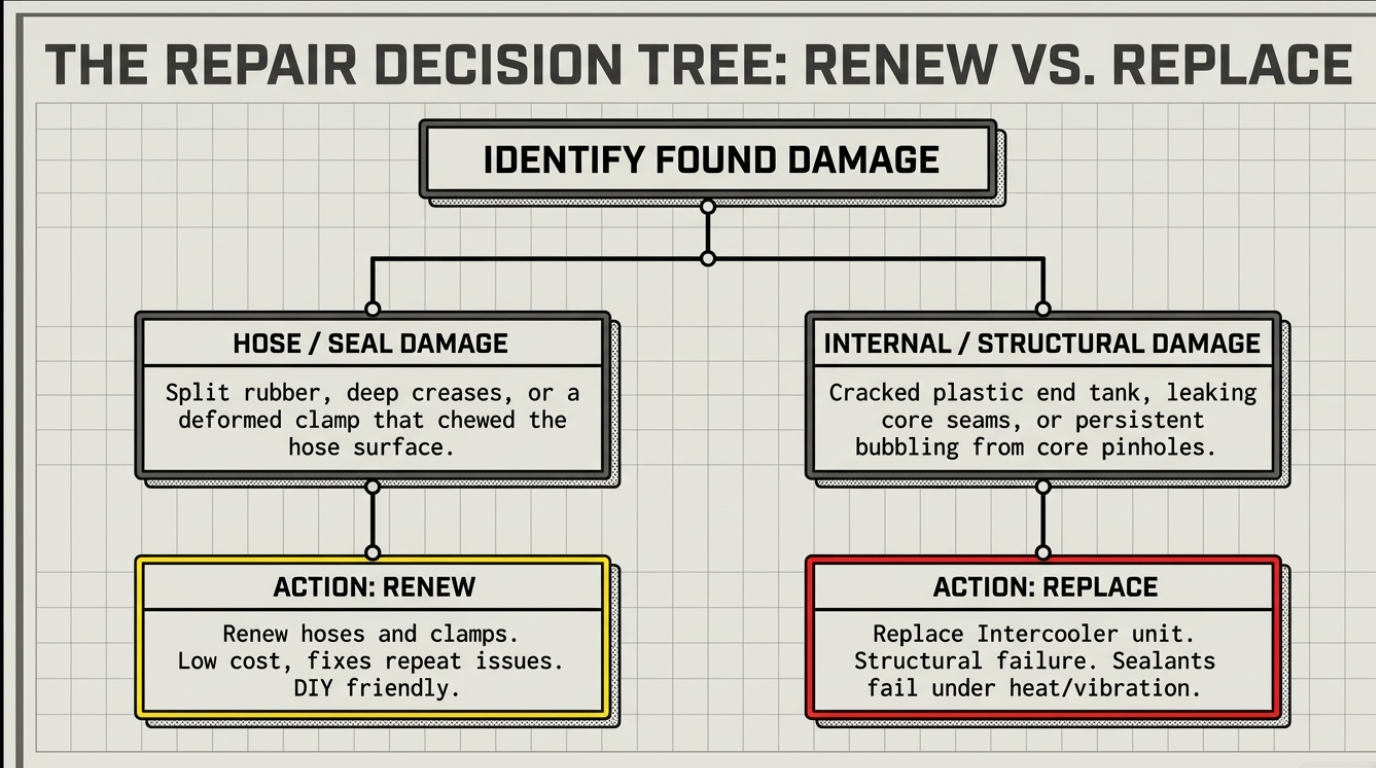
Charge-air leaks on a Renault Trafic usually come from a split rubber hose or failed clamp, while the intercooler itself is the culprit when you find a cracked end tank or a leaking seam. Match the replacement to the damage location, because swapping parts “close to the leak” leads to repeat repairs.
| What you found | Replace this | Why it keeps leaking | Renew cost reality |
|---|---|---|---|
| Hose split, deep crease, hardened rubber, torn coupler | Charge-air hose/coupler | Cracked rubber loses seal pressure under boost pulses | Usually the cheapest fix; parts are common |
| Clamp has chewed the hose surface or is visibly deformed | Clamp and affected hose section | Damaged hose cannot seal even with a new clamp | Often small parts cost; add hose if needed |
| Clamp loose fit, improper seating after prior work | Clamp/fasteners (and re-seal mating surfaces) | Leak path forms at the joint during boost | Low parts cost; time depends on access |
| Band clamp damaged, mismatched clamp size, or missing support | Clamp/fasteners | Incorrect clamping force or uneven contact | Low cost, fixes repeat issues quickly |
| Intercooler end tank cracked (plastic or metal) | Intercooler | Crack propagates, and gasket or sealant work fails | Higher cost, usually the real repair |
| Intercooler seam leaking or visible seepage at seam line | Intercooler | Seam is a structural joint; sealant typically fails under vibration and heat | Higher cost, safest long-term outcome |
| Core shows perforation, or persistent bubbling during pressure check | Intercooler | Pinholes open under boost flow and heat soak | Higher cost; repair attempts risk re-leak |
| Joint leak after cleaning, correct positioning, and clamp update attempts | Seals and O-rings (replace as required) | O-ring compression set or joint faces not sealing evenly | Moderate cost if seals are available |
Replace The Right “Seal Parts” First (Hoses, Couplers, Clamps)
Replace rubber hose and couplers immediately when you see a split, a sharp crease, hard surface cracking, or an insert that is torn. Replace the clamp at the same time if the band chewed the hose, the band is deformed, or the clamp will not tighten to a firm, even seat.
Replace clamps and fasteners when the fit is loose, the clamp size is wrong, or the joint looks like it was assembled with the hose not fully bottomed. For any Renault Trafic that previously had work done, assume you must correct improper seating before you chase the leak deeper into the system.
Replace The Intercooler When The Failure Is Inside The Tank Or Core
Replace the intercooler when an end tank is cracked or leaking, because the pressure pulses keep widening the damage. Replace the intercooler for a seam leak (wetness along the tank seam line) since sealants and patches usually fail with heat cycles and vibration.
Replace the intercooler if pressure testing shows core perforation, or if bubbling keeps returning at the same spot after you dry the unit and re-test.
In practice, this is where a “renew” attempt turns into repeat labor, especially when the leak is in the core where airflow paths are dense.
Replace Seals And O-rings Only When The Joint Is The Problem
Replace seals and O-rings when leakage occurs at the joints after the hose is correctly seated and the mating faces are clean. Sealing rings can take a set during a past leak, so a fresh hose and a new clamp still leak if the seal has flattened or nicked.
Re-test after every change; confirm the leak is actually gone before you road test. Skipping this step makes it easy to blame the wrong part, and boost leaks can create poor power and repeat warning lights.
Trade-off: Renewing hoses and clamps is quick and cheap, but renewing only around a cracked end tank or a leaking seam is a waste of time. The damage location decides the parts, not the symptom.
Service difficulty stays reasonable for hose and clamp renewals, usually a DIY job with basic tools and patience for access. Intercooler replacement is still straightforward for most experienced DIYers, but persistent tank/core leaks warrant professional help if you cannot pressure-test confidently.
Common Renault Trafic Failure Points
Oil mist and boost pressure escape on the Renault Trafic charge-air path usually comes from a few repeat offenders: cracked intercooler end tanks, failed hose seals, and loose or stretched clamp bands. The leak often hides behind oily residue until you follow the airflow from the turbo outlet to the intake manifold.
Intercooler And End-tank Cracks
Intercooler end tanks crack or seep along the seam where the plastic tank meets the core, especially if the unit has seen heat cycles and road vibration. A small end-tank leak is easy to misread because it can start as a damp spot and grow into hissing under boost.
Intercooler core damage is less common than end-tank issues, but it still happens from debris impact or corrosion at seams. When you find fresh grime in the corner of an end tank, that area is usually where the pressurized air is escaping.
Hose Couplers, Seals, And Compromised Sealing Surfaces
Failed intercooler-to-pipe end seals and rubber O-rings cause leaks that look like “weeping” around the joint. The most common signs are oily residue at the coupler lip and a clamp that does not tighten the joint because the mating surface is damaged or uneven.
Worn or misaligned boost pipes also create a seal failure, especially if the pipe twists after removal or a clamp was reinstalled in a slightly shifted orientation. The joint can seal at low pressure and leak once boost rises, which matches typical symptom patterns like reduced power or charge-air whistle.
| Failure point | What you see | What it does |
|---|---|---|
| Split end seal / O-ring | Wet ring around the coupler | Boost loss and soot growth at the seam |
| Cracked boost pipe outlet | Fine oil tracks on the pipe | Leak only under load |
| Deformed sealing surface | Clamp bites but joint still “spits” | Repeat leaks after quick re-tightening |
Clamps And Boost Pipe Alignment
Loose, stretched, or damaged clamp bands are a classic Trafic failure point because the charge-air system sees vibration and heat every drive. Even with a new coupler, an old or bent clamp can keep uneven pressure, so the leak returns quickly.
For example, a misaligned rubber coupler can seat halfway and “look fine” until the first pull under boost. A quick visual check should show even coupler overlap and no gap at the pipe ends.
Oil-soot Contamination That Hides The True Leak Start
Oil-soot contamination is the reason you can chase the wrong part for hours. Charge air leaks carry oily vapor from the crankcase breathing system and turbo area, so the dust “attracts” to the first wet spot, then spreads downstream, making the far side look like the culprit.
For instance, you may see the heaviest grime near the intake side but find the leak begins at an intercooler end-tank seam where the airflow first enters the airstream. Fresh tracks that look darker and recently wet usually mark the start of the leak, while older residue looks duller and feathered.
Shop tip: Follow the airflow path and check every joint where the pipe meets the intercooler and where clamps sit directly on rubber lips. The “dirtiest” spot is often where the leak ends, not where it starts.
Difficulty to confirm: Intermediate. If the leak only appears under boost, you may need a pressure test and careful observation to avoid random part swapping.
Best Practices To Stop Repeat Leaks
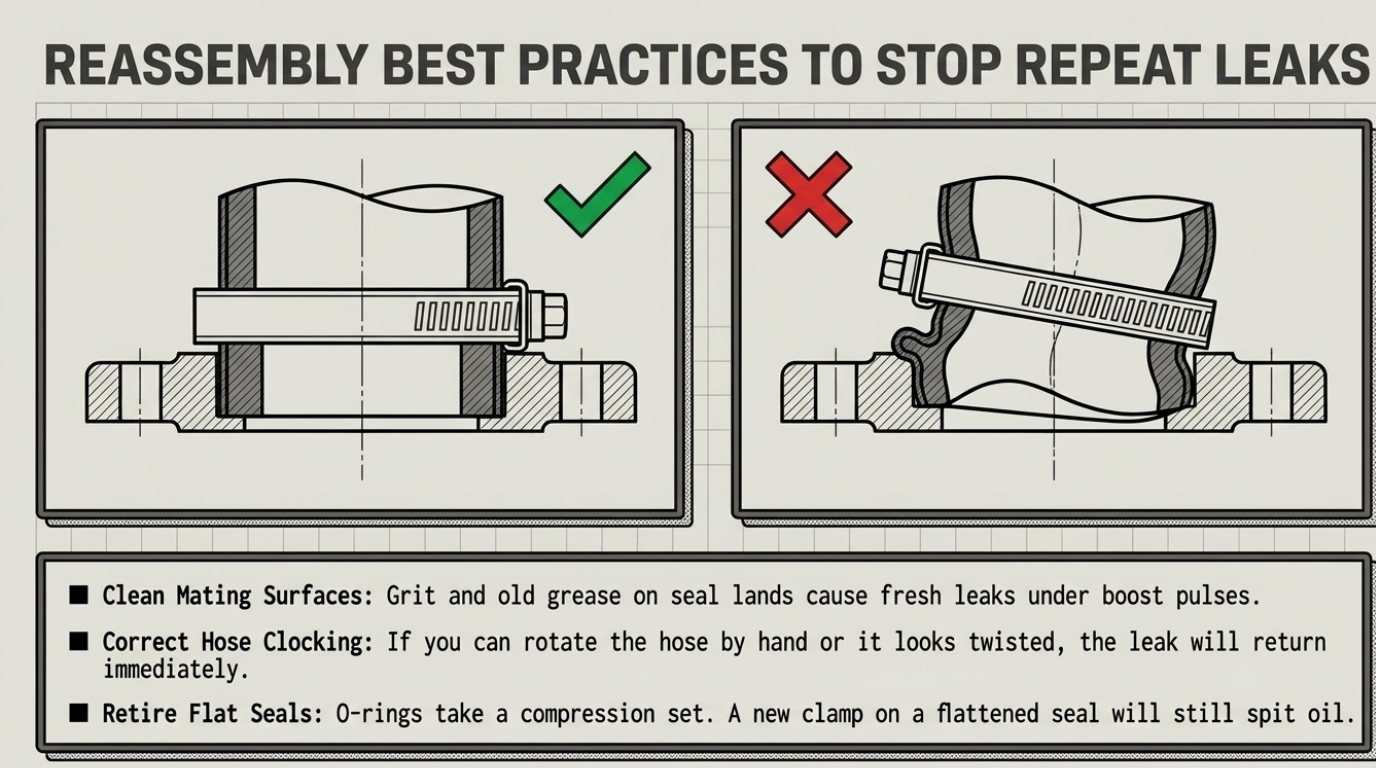
Repeat leaks on a Renault Trafic almost always come from poor prep, wrong clamp setup, or reusing seals that already took a set. Clean, dry mating surfaces and correct hose seating prevent the charge-air pipe from stressing the intercooler end tank seals under boost.
For example, a common repeat failure is an intercooler end tank that’s intact but has a seal land contaminated with grease and grit. The joint looks fine when dry, then starts growing wet residue once you run boost, which is why cleaning and seal replacement matter as much as the part swap.
| What you see after repair | Most likely cause | Fix |
|---|---|---|
| Fresh wet oil on the same joint after a short drive | Seal surface contaminated or seal reused | Disassemble, clean mating surfaces, replace seal, re-seat hose depth |
| Residue at the hose crease near a clamp | Hose twist, wrong clocking, or clamp mismatch | Realign hose routing, confirm full seating depth, correct clamp type/size |
| New seep around a cracked pipe section | Plastic housing damaged during clamp install | Replace the cracked charge-air pipe or housing section |
Insider tip: After tightening, check hose alignment by sight and feel. If you can rotate the hose by hand at the joint or it looks twisted when installed, the leak will come back.
Difficulty: Moderate (about 2 to 4 hours) for experienced DIYers, longer if you need to remove stuck charge-air pipes or access brackets. See a pro if the test equipment indicates a leak you cannot pinpoint, or if you find cracked charge-air components that need replacement rather than resealing.
Drivability and Fault Codes After Fixing
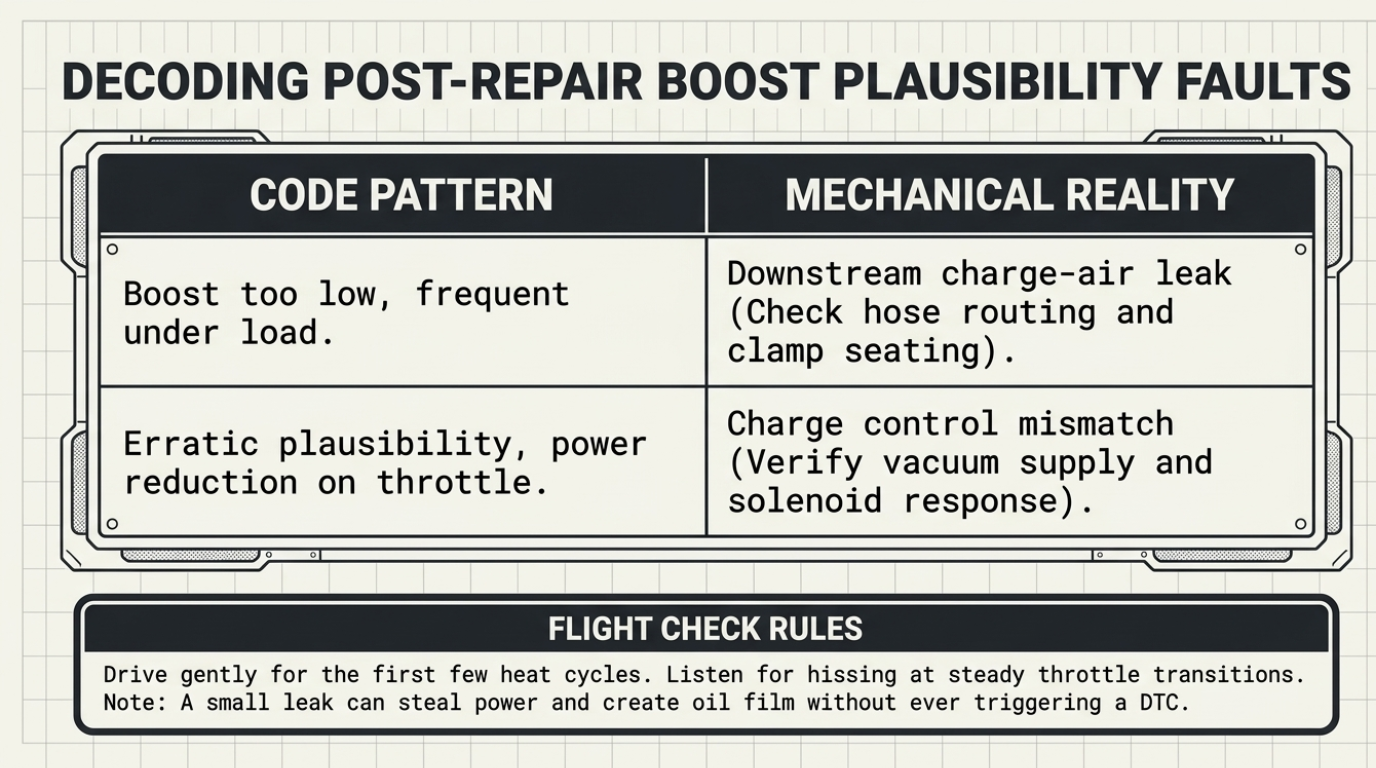
Boost leaks on a Renault Trafic can still cause drivability trouble for a while even after the intercooler hose or intercooler is repaired. Correct repairs should bring back normal throttle response and eliminate hissing, oily residue growth, and new wet spots. If boost pressure plausibility codes appear, treat them like a clue about remaining air leaks or charge-air control faults.
How Long You Can Drive After A Boost Leak Repair
After repairs, drive gently for the first few heat cycles. Hard acceleration can load the charge-air system and expose a clamp or seal that looks “good” when cool but leaks once pressure and temperature rise.
Limp mode risk is the big concern if the ECU sees boost that is too low or too erratic. Low-boost behavior feels like weak acceleration, while over-boost behavior can feel harsh or may trigger power reduction immediately. If the warning lamp stays on, or power is limited under normal driving, stop pushing it and get it scanned.
What To Monitor Right After The Fix
Monitor boost response first. A healthy repair gives a steady pull with no delayed “catch up” feel, and boost should rise normally when you roll into the throttle.
Watch the leak indicators you saw before the repair. The right outcome is no more audible hissing at steady throttle transitions, and no new oily wetness around the intercooler end tanks, hose couplers, or the clamp locations.
How To Interpret Boost Plausibility Fault Codes (And What To Re-check)
If OBD-II/vehicle codes are present, boost plausibility patterns matter. “Boost too low” often points to a leak downstream of the turbo outlet, an intercooler hose connection that is not sealed, or a clamp that slipped slightly.
“Boost control/plausibility” codes that happen in specific load ranges can also mean the turbo charge-air control is not tracking what the ECU commands. Re-check vacuum routing, boost solenoid operation, and the integrity of vacuum/pressure hoses before you assume the intercooler job failed.
| Observed code pattern | More likely cause | Next diagnostic step |
|---|---|---|
| Boost too low, frequent under load | Remaining charge-air leak (hose, cracked pipe, end tank seam) | Repeat pressure test and inspect both intercooler end tanks and all couplers |
| Erratic plausibility, power reduction on throttle changes | Charge control mismatch (vacuum/boost control hoses, solenoid sticking) | Verify vacuum supply and control response; inspect hose routing for splits |
| Codes return immediately after reset | Leak is still present, or control is misbehaving | Scan live data for requested versus actual boost, then leak-test again |
What To Do If There Are No Fault Codes
No codes does not automatically mean the job is perfect. A small boost leak can stay below the threshold for a stored DTC while still costing power and creating a light oil film over time.
Proceed based on symptoms and test results. Confirm with a proper charge-air pressure test, then verify the symptom match on a road drive (no hissing, restored pull, and no new wetness). If you still feel low power or the residue keeps expanding, treat it as an unresolved leak or a damaged adjacent component, like a cracked boost pipe hidden behind the intercooler area.
ASE-style tip: If you repaired a charge-air connection and the leak “returns,” inspect the mating surfaces for corrosion tracks or rubber that was nicked during removal. A clamp alone will not fix a torn hose or a cut rubber bead.
Quick Summary
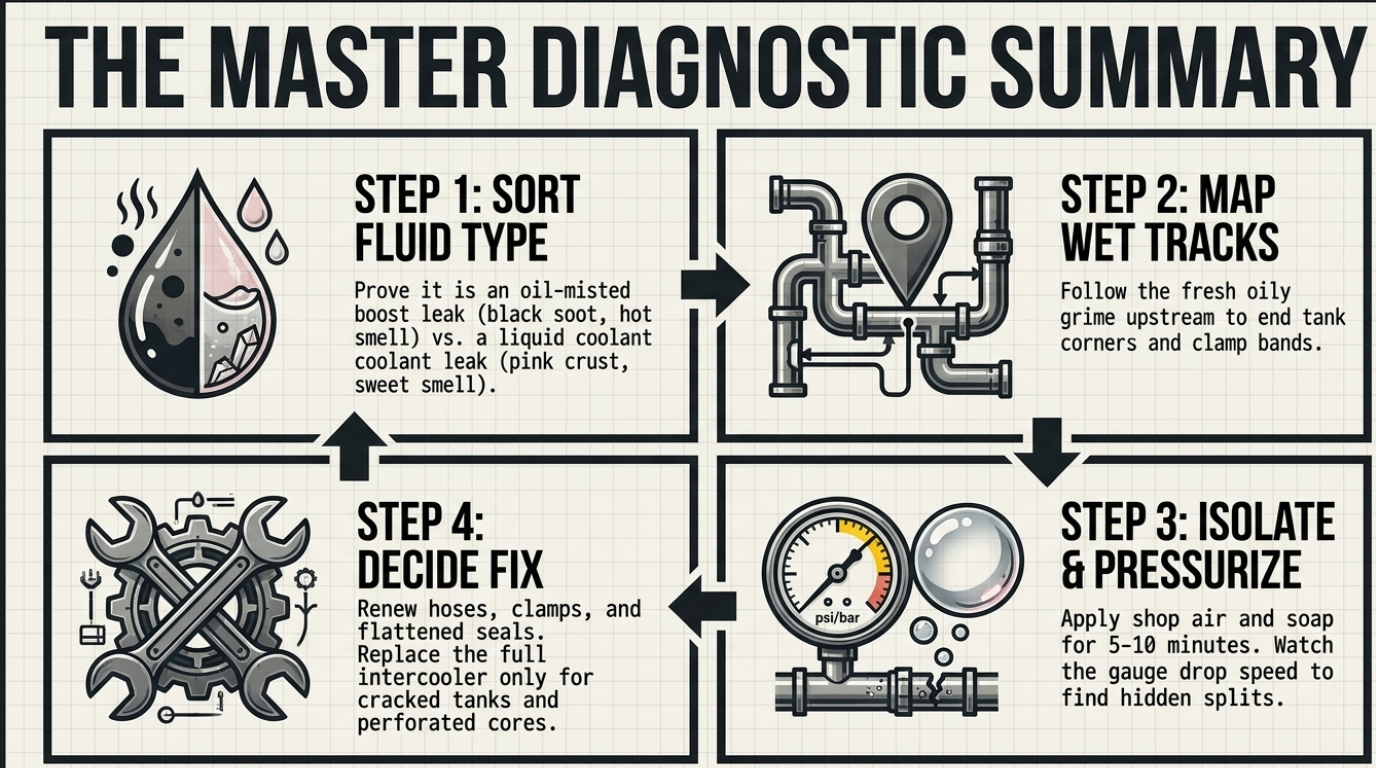
When a Renault Trafic intercooler is leaking, you typically notice oily residue around the end tanks, a hiss under boost, or reduced power. The article points to charge-air leaks caused by a split rubber charge hose, a loose or damaged clamp, or cracked plastic intercooler end tank seams that wet the area with an oil film. It also stresses fast checks, like looking for oily soot at hose joints and end seals, before you decide the intercooler core is bad.
To confirm what you are actually dealing with, pressure-test the charge-air circuit and watch for soap bubbles at every joint for 5-10 minutes. Follow the wetness origin from the highest damp spot down to the leaking connection, then repair hoses, clamps, or pipes, and replace the intercooler when an end tank leaks.
| Most likely leak type | Where it usually starts | Quick clue |
|---|---|---|
| Charge-air (air/boost) leak | Intercooler end tank seams, hose ends, clamp contact points | Oily film or oily dirt buildup, hissing after boost |
| Coolant leak | Coolant hoses and liquid connections near heat exchanger plumbing | Sweet odor, colorful wet liquid, steam while hot |
Frequently Asked Questions
How Do I Confirm My Renault Trafic Intercooler Is Leaking Instead Of Something Else?
Start by checking for coolant or charge-air residue around the intercooler end tanks, hose clamps, and pipe joints. Then pressure-test the charge-air system (boost side) rather than just looking for wet spots, because diesel soot and road spray can mimic a leak.
What Are The Common Signs Of A Renault Trafic Intercooler Leak?
You’ll usually notice oil mist or wetness near intercooler hose connections, a hissing sound on boost, or loss of power under load. In some cases, the leak can cause boost pressure instability, so the truck feels flat or inconsistent when accelerating.
Can An Intercooler Leak Cause My Renault Trafic To Run Poorly Or Trigger A Fault Code?
Yes. A boost leak can make the engine see less charge pressure than expected, which often leads to performance complaints and may trigger related boost or air intake plausibility codes. If you have codes, focus testing on pipes, clamps, and the intercooler seams before replacing sensors.
How Much Does It Usually Cost To Repair A Renault Trafic Leaking Intercooler?
The cost depends on whether it’s a hose/clamp joint or the intercooler itself, but expect more for a full intercooler replacement. Treat online figures as rough estimates and get a proper quote after diagnosis.
Is It Safe To Drive A Renault Trafic With A Leaking Intercooler?
It’s generally best to avoid prolonged driving if the leak is large, because boost loss can push the engine to run differently and can contribute to overheating under load. If you must get home, drive gently and watch for symptoms like strong power loss or abnormal noises, then fix it promptly.
What’s The Most Common Mistake When Fixing A Renault Trafic Intercooler Leak?
The big one is replacing parts before confirming the leak source, like assuming the intercooler is bad when it’s actually a loose clamp, cracked rubber elbow, or failed hose bead. Another common miss is not pressure-testing after the repair, so the same leak still shows up quickly.

- Top 10 Ranking Tire Brand for Minivan: Reviewed 2026 - October 5, 2026
- Model Y Tesla Long Range Automatic Wagon Tyre Fitment And Ratings - October 3, 2026
- What Is The Benefit Of Larger Rear Tyres On A Zero-turn Mower - October 3, 2026