You searched “group 4 synthetic oil brands” because your owner’s manual calls for a specific SAE grade (like 0W-20 or 5W-30) and you want the best base oil, not marketing fluff. Group 4 means PAO, which can help with cold-start performance and oil stability. This article lays out what’s real, what’s mislabeled, and which branded oils to trust for your engine.
Group 4 synthetic oil brands are usually PAO-based products, often sold with common viscosities like 0W-20, 5W-30, and 0W-40. To pick the right one, match SAE viscosity to your manual, then verify Group 4 using a PDS/TDS base-oil disclosure. You will also learn how to spot “Group 3+” or GTL being marketed as Group 4.
1. Group 4 Synthetic Oil Brands: Verify Claims
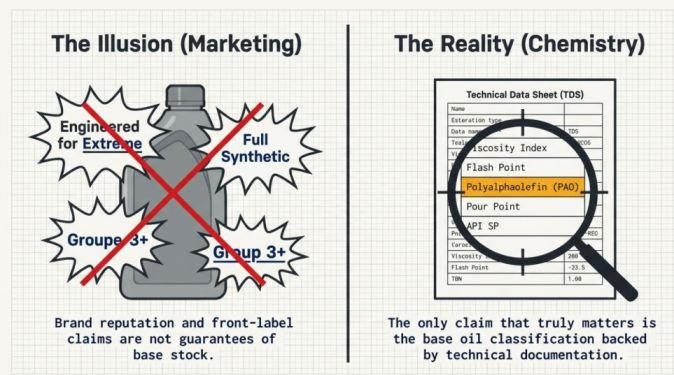
Group 4 “synthetic” is often used in oil marketing, but the only claim that truly matters is the base oil classification backed by documentation. This item belongs in a list because brand labels can be inconsistent, and a quick verification process helps you avoid paying for “synthetic” wording that may not match your requirements. A practical way to protect your engine and warranty is to confirm what is actually in the bottle before you buy.
Start by checking the brand’s published technical data sheet (TDS) or product bulletin for base oil composition, since Group IV typically refers to polyalphaolefin (PAO).
In practice, reputable brands list the viscosity grade (like 0W-20, 5W-30, or 10W-40) and often include performance standards (API, ILSAC, ACEA) on the same document.
For example, if a product claims Group 4 but the TDS only lists “synthetic” with no base oil detail, treat it as a marketing statement and keep shopping. If you’re matching a specific OEM spec, confirm the oil is licensed or meets that exact approval rather than relying on base oil alone.
What To Ask For When A Label Sounds Vague
When a bottle or website says Group 4 without showing base oil breakdown, ask the seller or manufacturer for the TDS that states the base oil type and classification. Many retailers can provide a spec sheet quickly, and you can compare it across brands in minutes. Pay special attention to whether the product is a full Group IV formulation or a mix, since “synthetic” can still include other base oils and add pack changes that affect cold flow, volatility, and oxidation performance. If the documentation is slow to arrive or the wording stays generic, that is a strong signal the claim is not clearly supported.
Reader takeaway: buy Group 4 synthetic oils only when the TDS or official spec sheet clearly supports the base oil classification, and then confirm the viscosity grade and OEM-relevant performance approvals match your vehicle’s manual.
2. How To Confirm Group 4 PAO
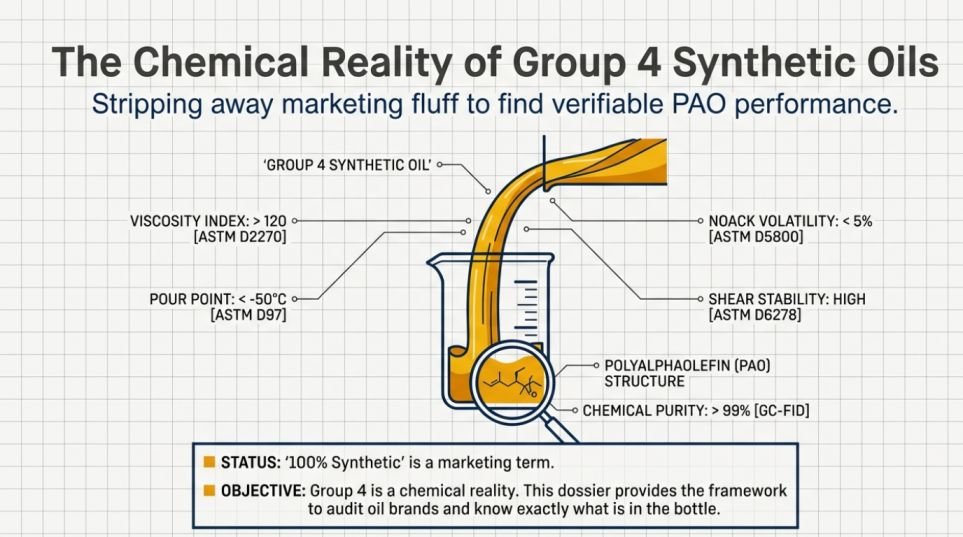
“Group 4” on a lube label identifies a PAO-based formulation. PAO (polyalphaolefin) is associated with low-temperature flow and thermal stability, but the finished oil’s performance also depends on its blend and additive package. Since public web coverage for exact “Group 4 PAO” listings is inconsistent, official technical data and approved cross-reference information remain the most useful sources.
For example, look for language such as “PAO base stock,” “polyalphaolefin,” or a base oil blend that explicitly includes PAO in the TDS, plus an API and/or OEM performance statement that matches your engine.
In practice, the PAO indicator is usually paired with key specs like viscosity grade (10W-30, 5W-30, 0W-40) and measured properties such as pour point and NOACK volatility. If the bottle says “Group IV” but the TDS never mentions PAO, treat it as a weak or promotional claim and move on.
What To Look For On The Paperwork
On the manufacturer’s TDS, the base oil section is usually short but decisive: it may list “PAO” directly, or it may provide a base oil blend description that clearly includes PAO. Then cross-check the performance side, since a true PAO-based product typically aligns with the advertised cold-flow targets through a consistent pour point and volatility range. If you are comparing two oils labeled “Group 4,” the TDS is also where you’ll see whether one is a PAO-heavy blend while the other is mostly Group III with only partial PAO wording. Keep in mind that “Group 4” can be used loosely in some listings online, so the only hard verification is the brand’s own technical documentation or their official distributor cross-reference.
3. Likely Group 4 PAO Brands List
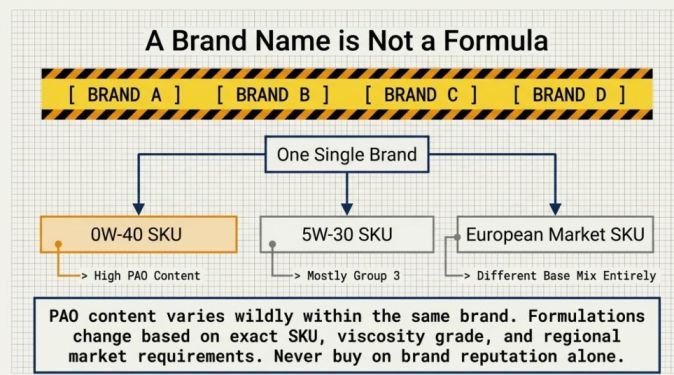
Group 4 base oil is the PAO (polyalphaolefin) portion of synthetic lubricant, and it is commonly used when an oil aims for strong low-temperature flow and stable high-temperature performance.
In practice, brand lineups that explicitly list PAO in their data sheet, or clearly market “PAO synthetic” as the base stock, are the most likely candidates to align with Group 4 chemistry. Since public labeling is inconsistent, this list is best treated as “most likely based on how the products are marketed,” not a guarantee for every viscosity or package run.
For example, Mobil 1 has long marketed its synthetics as PAO-based in many markets and product families, and the brand is widely sold in multiple viscosity grades for passenger cars and light trucks. Castrol often sells products described as synthetic with PAO involvement (with the exact base mix sometimes varying by formula and region), so matching the exact product name to its product data is important. Shell Rotella and Motul also sell “full synthetic” grades that may use PAO, but you should confirm the specific SKU’s base oil statement in the manufacturer literature because additives and blending can change.
In practice, look for an oil that explicitly mentions “PAO” or “polyalphaolefin” on the bottle, the technical data sheet, or the product page for the exact viscosity you plan to buy (for example, 0W-20 vs 5W-30). If a listing only says “100% synthetic” without base oil disclosure, treat it as uncertain for Group 4.
How To Confirm PAO (Group 4) On The Exact Bottle
PAO content can vary even within the same brand, because different viscosities or market-specific versions may blend different base oils (PAO, Group 3, and sometimes others) to hit pour point and volatility targets. The most reliable check is the manufacturer’s technical data sheet for the exact product name and viscosity, since it is where base oil composition and test results like low-temperature flow are usually tied to the formulation. If the brand only provides marketing copy like “synthetic” or “engineered for extreme temperatures,” it may still include PAO, but it is not something you can verify without the data sheet. For anyone choosing oil for tight climates, turbo engines, or long drain intervals, spending two minutes confirming PAO language for your specific SKU saves you from guessing.
4. Group 4 Vs Other Synthetics
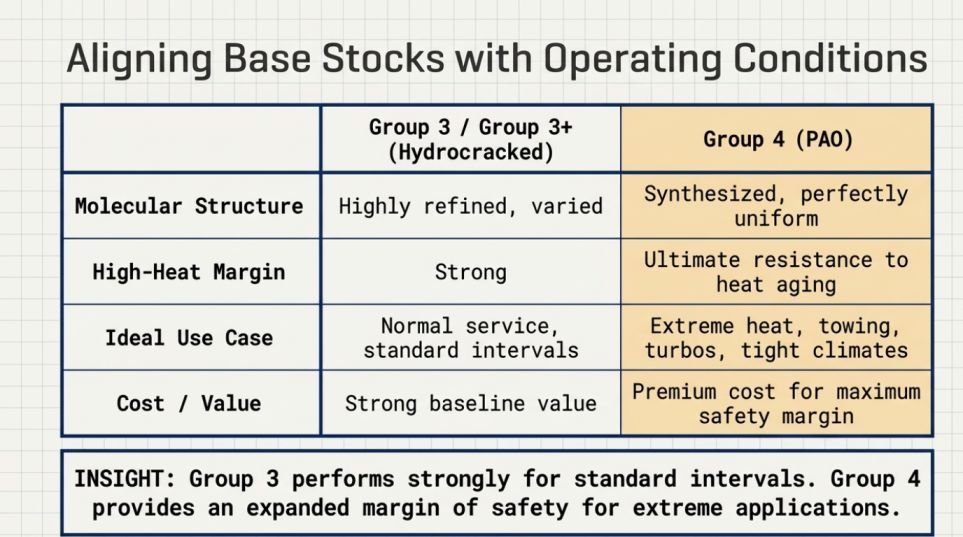
Group 4 synthetic oils (true PAO base stocks) are on the “more uniform” end of the synthetic spectrum because PAO has a well-defined molecular structure that holds up well to oxidation and high-heat breakdown. That makes this category worth including when comparing real-world stability versus Group 3 hydrocracked oils and blends. In practical terms, the Group 4 choice often comes down to cold-start flow, long-drain potential (when the engine and interval call for it), and how much margin you want against heat aging.
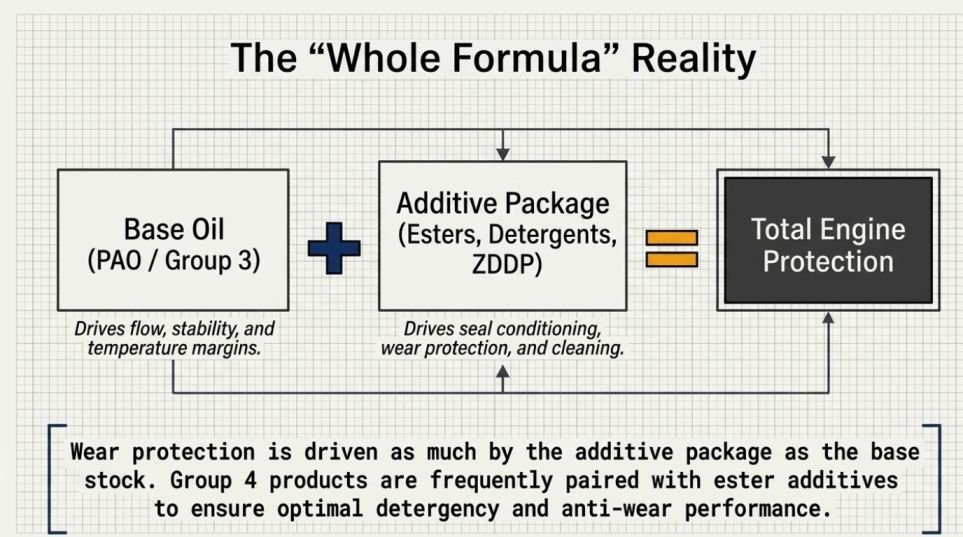
For example, Group 4 products are commonly sold as full synthetics and are frequently paired with ester additives for detergency, seal conditioning, and anti-wear performance. Most “Group 3” oils still perform strongly on paper, but they can be more sensitive to formulation and oxidation control since the base stock is made differently. When switching categories, the key is to match the engine’s required API/ILSAC or ACEA approval and the viscosity grade, not just “Group 4” on the label.
Tradeoffs With Group 3 And Blended Synthetics
Group 4 is usually chosen for drivers who want strong high-heat oxidation resistance and consistent performance over longer service intervals, but it is not a license to ignore the manufacturer’s oil-change guidance. A well-formulated Group 3 or Group 3 plus additive package can be a better fit if your engine is under a standard short interval, uses a common viscosity, and the oil meets the exact approval requirements. The “best” option is the one that meets spec for your engine and operating conditions, because wear protection is driven by the additive package as much as the base stock. If you track oil condition or want maximum margin in extreme heat or towing, PAO-forward formulations can make sense, but keep expectations grounded: the brand matters less than the approvals, viscosity, and that your drain interval is appropriate.
Quick Summary
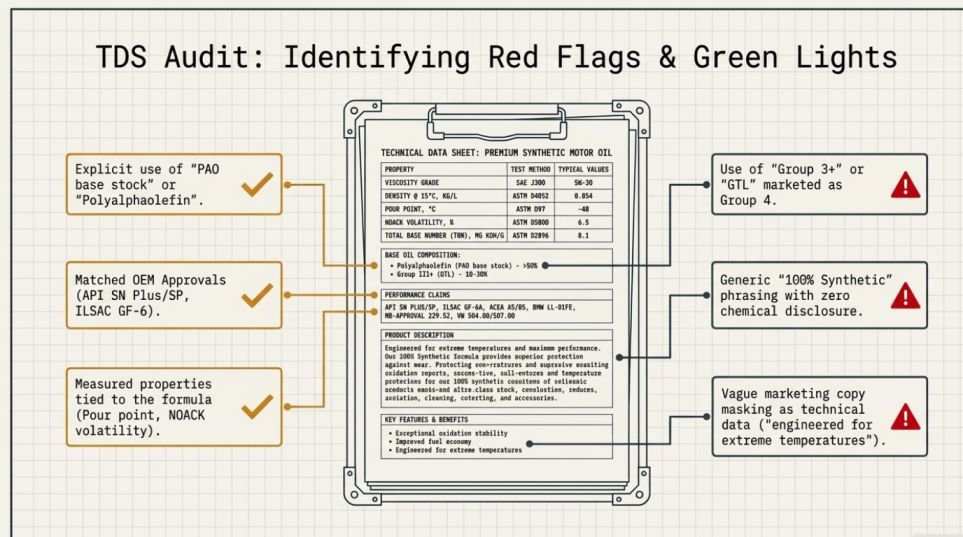
Group 4 synthetic oil brands are typically PAO-based products, meaning polyalphaolefin base oil, which can help with cold-start performance and oil stability. Common grades include 0W-20, 5W-30, and 0W-40, while the exact formulation can vary by product family, viscosity, and market. Group 3+, GTL, and other synthetic technologies should not be assumed to be Group 4 solely because of similar marketing language.
For everyday use, PAO is a base-stock choice rather than a substitute for the vehicle maker’s requirements. Group 3 oils can be a strong value for normal service, while PAO-forward formulations may offer useful margin in cold starts, high heat, towing, or extended service conditions. The appropriate drain interval remains the one supported by the vehicle and oil specifications.
| What to check | What the article says to look for |
|---|---|
| Base oil classification | Explicit PAO or polyalphaolefin in the PDS/TDS, not just “synthetic” or vague Group IV wording |
| Viscosity grade | Match your manual, with examples cited including 0W-20, 5W-30, and 0W-40 |
| Approvals and specs | Verify API SN Plus or SP and ILSAC GF-6 against the requirements for your vehicle |
| Mislabeling red flags | Watch for “Group 3+” or GTL being marketed as Group 4 |
Frequently Asked Questions
What Does “Group 4 Synthetic Oil” Mean, And Which Brands Actually Use Group 4 Base Stocks?
Group 4 refers to oils made from PAO, or polyalphaolefins. Brands such as Mobil 1, Castrol, Shell Rotella, and Motul have product families or market versions associated with PAO, but the exact base blend can vary by SKU, viscosity, and region. A brand name alone is therefore not a guarantee of Group 4 content.
How Can I Tell If A Group 4 Synthetic Oil Brand Is Really PAO, Not A Group 3 “Synthetic”?
A product data sheet is more useful than a general safety data sheet for this question because it may identify the base stock and formulation. Marketing terms such as “full synthetic” describe the product category but do not by themselves identify PAO.
Are Group 4 Synthetic Oil Brands More Expensive, And What’s A Realistic Price Expectation?
In general, Group 4 PAO oils often cost more than common Group 3 synthetics, because PAO is typically priced higher. Since pricing changes a lot by retailer and viscosity, treat any “typical” number you see online as a rough estimate, and compare per-quart cost for the same spec like API/SP and the same SAE grade.
Can I Use A Group 4 Synthetic Oil Brand For Extended Drain Intervals, Or Should I Stick To The OEM Schedule?
You can follow longer intervals only if the oil meets your car’s required specs and you keep an eye on use conditions (short trips, extreme heat, heavy towing). Even with strong base stocks, the safe move is to stick to the OEM interval unless your oil brand clearly states an approved extended-drain method for your application.
Will Switching To A Group 4 Synthetic Oil Brand Cause Leaks Or Damage If I’m Coming From Conventional Or Group 3?
Most modern seals handle synthetics well, but the risk of leaks is usually tied to old, shrunken seals or prior contamination. If you are already leaking, don’t assume the oil is the cause, and avoid aggressive flushing additives that can loosen sludge and make leaks worse.
What’s The Biggest Mistake People Make When Shopping For Group 4 Synthetic Oil Brands?
The most common mistake is treating a brand reputation or the word “synthetic” as proof of a particular base stock. Product formulas can change, so the exact SKU and its intended service application matter when comparing oils for a vehicle.

- 2017 Dodge Grand Caravan Transmission Fluid Capacity: Dodge Grand Caravan Transmission - September 27, 2026
- How Many Gallons Of Transmission Fluid Does A 2017 Gmc Yukon 5.3 Slt Xl Hold: How Many - September 26, 2026
- 17 Gmc Yukon Transmission Fluid Capacity V8 (8l90) Quarts/liters - September 26, 2026