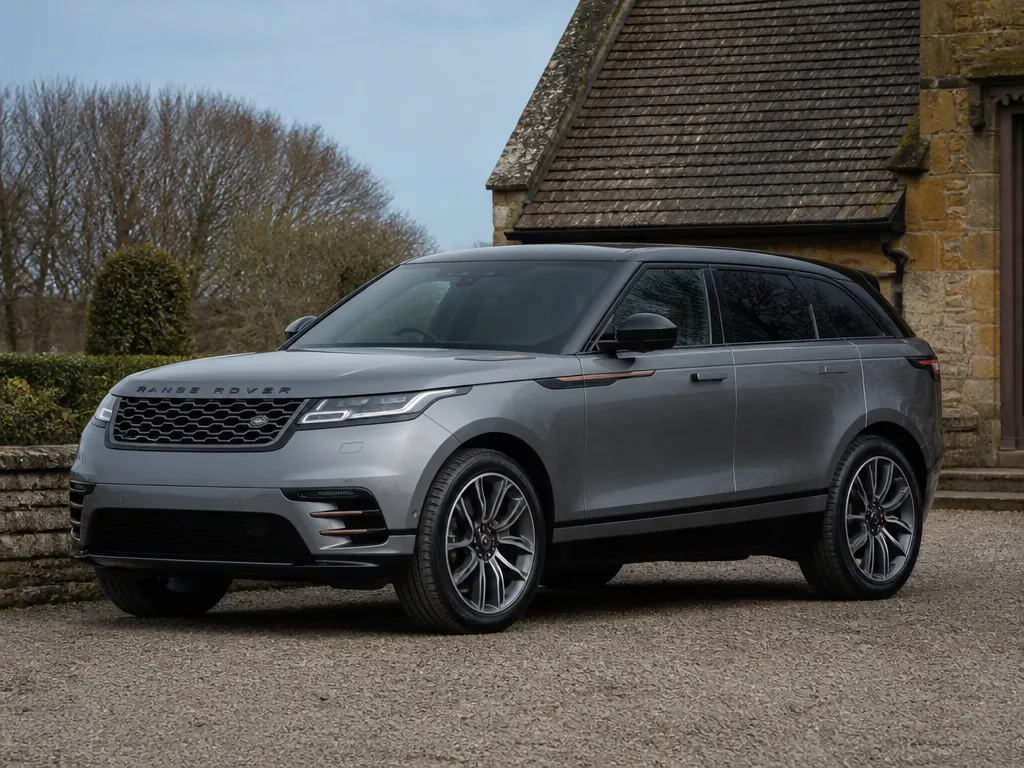
Standing in the auto parts aisle with a Velar and a handful of oil jugs is a high-stakes moment. Using the wrong viscosity or a non-spec oil can lead to serious issues with your Ingenium engine or clogged DPF systems. You need the exact manufacturer specifications to keep your warranty intact and your engine running smoothly.
Range Rover Velar engine oil type is typically 0W-20 full synthetic for the 2.0L 4-cylinder models. This specific viscosity requires meeting the STJLR.01.A.2020 specification to ensure proper lubrication and component protection. Most 2.0L engines require approximately 4.2 quarts of oil during a standard service.
Range Rover Velar Oil Type And Specifications
Land Rover specifies a single oil grade for every Velar equipped with an Ingenium powerplant: 0W‑20 full‑synthetic that meets the STJLR‑01‑A‑2020 (or later) specification. The same grade applies to the 2.0 L four‑cylinder, the 3.0 L V6, and the 5.0 L V8 models built from 2018 onward. Deviating from this formula can lead to reduced oil film strength, accelerated wear, and warranty‑coverage issues.
JLR-approved Oil Is Non‑negotiable
JLR’s engineering teams develop the Ingenium block around a precise oil film thickness that only the approved formulation can sustain. The STJLR standard guarantees the right additive package, high‑temperature stability, and low‑temperature flow characteristics required for the variable‑geometry turbochargers and the integrated exhaust‑after‑treatment system.
Viscosity Requirements Per Engine
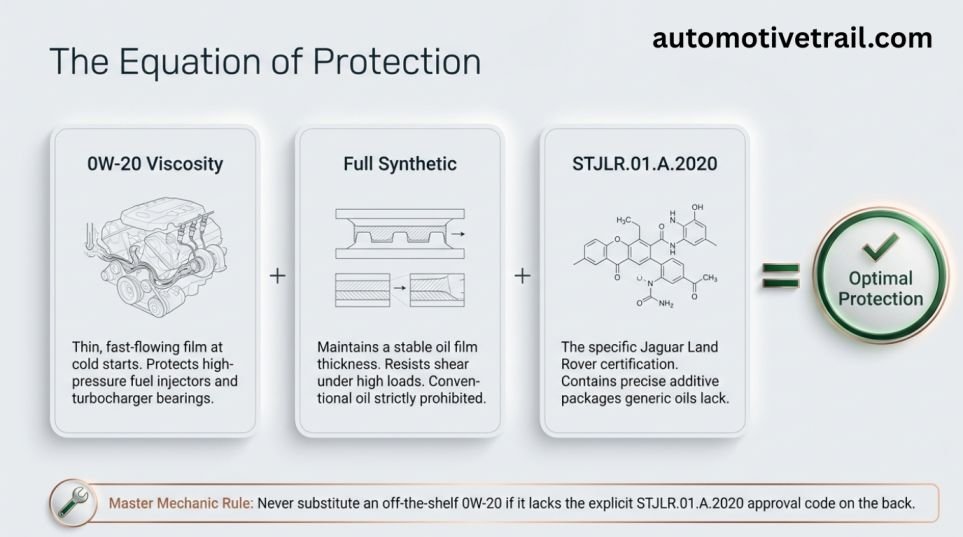
The 0W‑20 grade provides a thin, fast‑flowing film at cold start, protecting the high‑pressure fuel‑injector rails and turbocharger bearings. At operating temperature, the oil’s 20‑weight maintains a stable film thickness that resists shear under high load.
Even though the displacement changes, the internal clearances and bearing designs are tuned for the same viscosity range. Therefore, owners of the 3.0 L V6 or 5.0 L V8 do not need a thicker oil.
| Engine | Recommended Oil | Capacity (qt) | STJLR Spec |
|---|---|---|---|
| 2.0 L 4‑cyl | 0W‑20 full synthetic | 4.2 | STJLR‑01‑A‑2020 |
| 3.0 L V6 | 0W‑20 full synthetic | 5.0 | STJLR‑01‑A‑2020 |
| 5.0 L V8 | 0W‑20 full synthetic | 5.5 | STJLR‑01‑A‑2020 |
Master‑mechanic tip: When topping off between services, pour only a few milliliters of the approved oil and re‑check the dipstick after the engine warms. Over‑filling a 0W‑20 system can raise crankcase pressure and force oil past the seals.
Required Oil Standards And Viscosity Grades
The Ingenium engine family inside your Velar requires precise lubricant specifications to maintain the variable valve timing and high-pressure fuel systems. You must use an oil that carries the specific STJLR (Jaguar Land Rover) certification code found in your owner’s manual, as generic oils lack the necessary additive packages for these specific internal tolerances.
Viscosity And Specification Requirements
Most modern Ingenium 2.0L four-cylinder engines demand 0W-20 oil, specifically formulated to meet the STJLR.01.A.2020 standard. This low-viscosity synthetic oil is engineered to reduce internal friction and improve fuel economy in the tight clearances of the Ingenium block.
Mechanic’s Note: Never substitute a standard off-the-shelf 0W-20 oil if it does not explicitly list the STJLR.01.A.2020 approval on the back of the bottle. These engines use specific chemistry to prevent timing chain wear and carbon buildup on the intake valves, which are common failure points if the wrong oil is used.
Engine Configuration Variations
Different engine outputs may call for slight variations in oil requirements, though the 0W-20 grade remains the most common across the North American market. Always check the emissions label under your hood, as Land Rover occasionally updates these requirements based on mid-cycle engine revisions or climate-specific operating conditions.
| Engine Type | Standard Requirement | Viscosity Grade |
|---|---|---|
| 2.0L Ingenium I4 | STJLR.01.A.2020 | 0W-20 |
| 3.0L V6 / V8 | STJLR.01.A.2020 | 0W-20 |
Always verify the physical oil filler cap under the hood, as it often displays the correct viscosity grade for your exact engine build.
Engine Oil Capacity By Configuration
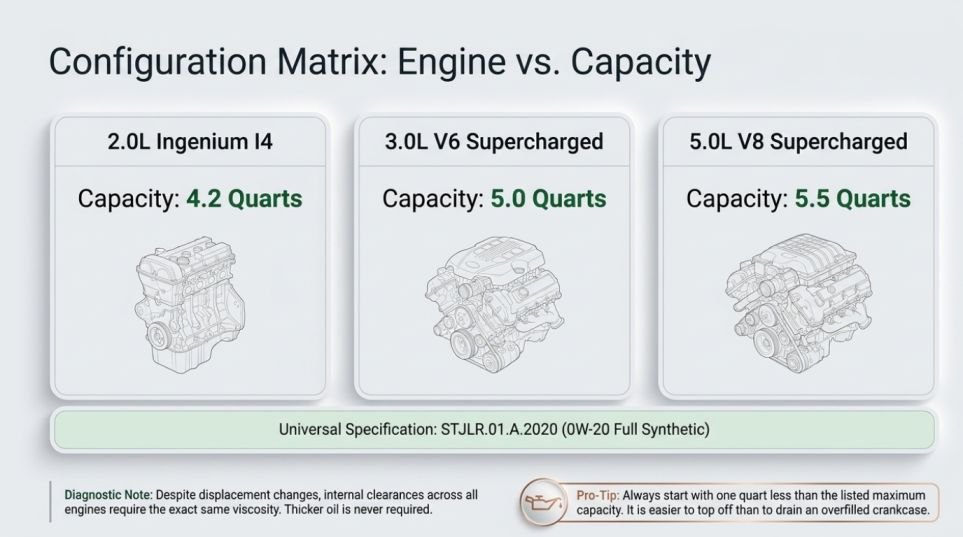
The Ingenium 2.0L 4-cylinder engine requires approximately 4.2 quarts of oil for a standard change. Larger 3.0L V6 and 5.0L V8 configurations typically demand between 5.0 and 5.5 quarts.
Capacity And Variance
Engine oil levels in modern Land Rover vehicles rely on precise electronic monitoring rather than traditional dipsticks. You must verify the exact level through the vehicle’s infotainment system after the engine reaches operating temperature and sits on level ground.
| Engine Configuration | Approximate Capacity |
|---|---|
| 2.0L Ingenium I4 | 4.2 Quarts |
| 3.0L V6 Supercharged | 5.0 Quarts |
| 5.0L V8 Supercharged | 5.5 Quarts |
Mechanic Tip: Always start with one quart less than the listed maximum capacity. It is significantly easier to add oil to reach the full mark than it is to drain excess fluid if you overfill the crankcase.
Verification Procedures
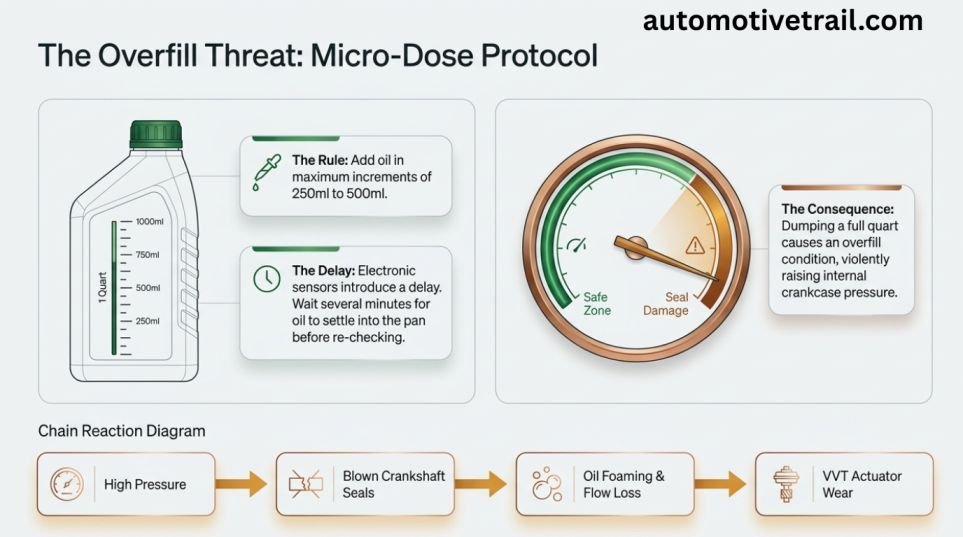
Overfilling the crankcase causes high internal pressure, which can damage crankshaft seals or cause the oil to foam. Foam reduces the lubricating properties of the oil and leads to premature wear on sensitive components like variable valve timing actuators.
Risks Of Using Non-approved Engine Oil
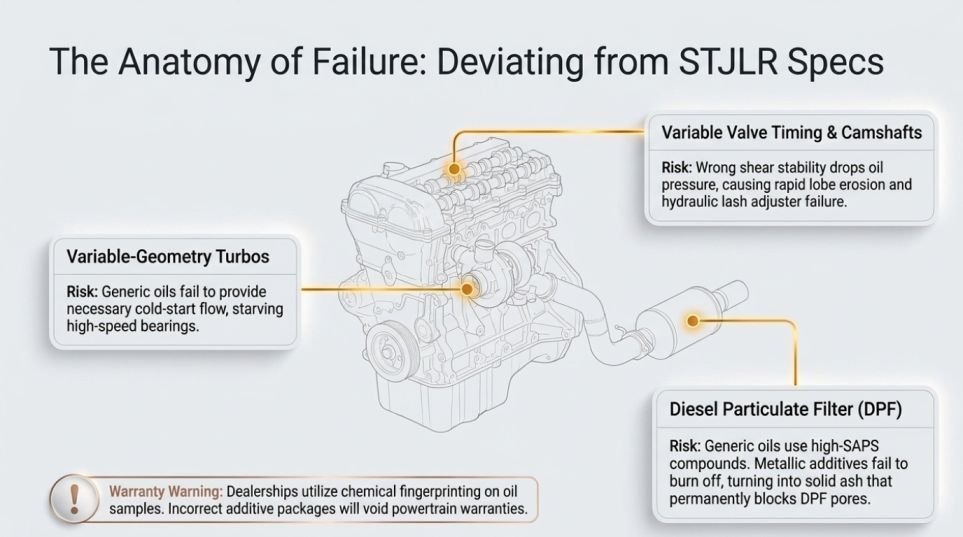
Using motor oil that lacks the specific STJLR manufacturer approval creates immediate risks for the Diesel Particulate Filter (DPF) and the engine’s internal components. These proprietary specifications ensure the oil contains the correct chemical balance to prevent ash buildup and premature clogging of the emission control systems.
Diesel Particulate Filter (DPF) Damage
The DPF in your Velar relies on specific low-SAPS (Sulfated Ash, Phosphorus, and Sulfur) oil formulations to function correctly. When you use an oil that does not meet the required STJLR standard, the additive package often contains higher levels of metallic compounds. These compounds do not burn off during the regeneration cycle and instead turn into solid ash that permanently blocks the DPF pores.
Warranty And Mechanical Consequences
Jaguar Land Rover explicitly ties warranty coverage to the use of oil meeting their internal STJLR specifications. If an engine failure occurs, the dealership service department will pull an oil sample for chemical analysis. Finding an oil that fails to match the required chemical fingerprint is a common reason for denied warranty claims on powertrain components.
Mechanic’s Note: Never assume that a “Full Synthetic” label on a bottle is sufficient. The STJLR approval is a specific performance standard that goes far beyond generic viscosity ratings like 0W-20. Always check the bottle for the explicit manufacturer approval number before pouring.
In practice, the long-term cost of choosing the wrong oil far outweighs any savings at the parts store. The Ingenium engine architecture relies on precise oil flow for variable valve timing and hydraulic lash adjusters. Using oil with the wrong shear stability or detergent levels can lead to oil pressure drops and accelerated wear on the camshafts and turbocharger bearings.
Checking Oil Levels Via Infotainment
Range Rover Velar models rely entirely on an electronic sensor system to monitor engine oil levels, as the engine bay lacks a traditional physical dipstick. Accessing this data requires navigating the Pivi Pro or Touch Pro Duo infotainment interface while the vehicle meets specific thermal and orientation requirements.
Accessing The Monitor
Mechanic Tip: If the system displays a “Measurement Not Available” message, the oil is likely too cold or the engine has not been shut down long enough after a drive. Wait at least ten minutes after a warm drive to ensure the sensor stabilizes before attempting to pull a reading again.
Electronic sensors provide convenience, but they also introduce a delay between adding oil and seeing the updated level on the screen. If you find yourself topping off the engine, add oil in small increments of 250 to 500 milliliters. Wait several minutes for the oil to settle into the pan before checking the monitor again to avoid an overfill condition.
Modern Land Rover diagnostic systems require the hood to be closed for the oil level sensor to function correctly. If you have just finished adding oil and the system refuses to register the change, verify that the hood latch is fully engaged. A sensor that remains erratic or shows a “Service Required” warning often indicates a fault in the level sensor itself rather than an actual oil level issue.
Oil Change Maintenance Intervals
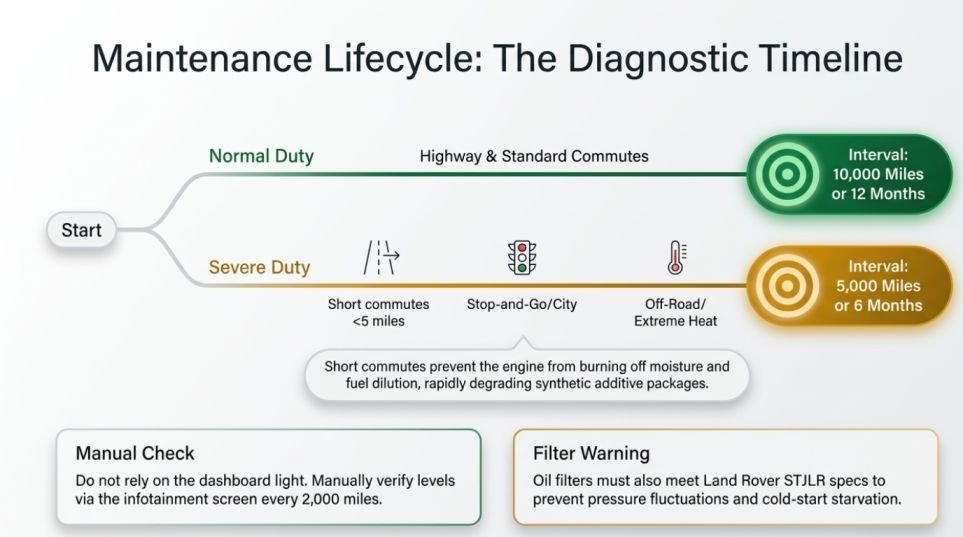
Standard service intervals for the Range Rover Velar are set at 10,000 miles or every 12 months, whichever comes first. Adhering to this schedule is critical for the long-term health of the Ingenium engine family and its complex variable valve timing components.
Conditions Requiring Shortened Intervals
Severe duty cycles force the oil to break down faster than the standard 10,000-mile interval allows. You should consider cutting your service interval in half to 5,000 miles if your driving habits include any of the following conditions.
For example, if you use your Velar primarily for short commutes under five miles, the engine oil will accumulate moisture and fuel dilution significantly faster than a vehicle used for highway travel. These contaminants degrade the additive package in your synthetic oil and accelerate internal wear.
Mechanic Tip: Do not rely solely on the dashboard service light if you drive aggressively or in extreme heat. Check your oil level manually at least once every 2,000 miles to ensure you are not running low between scheduled changes, as these engines are sensitive to oil volume.
Service Interval Comparison
| Usage Type | Recommended Interval |
|---|---|
| Normal Highway/Commute | 10,000 miles / 12 Months |
| Stop-and-Go/City Driving | 5,000 miles / 6 Months |
| Off-Road/Towing/Extreme Heat | 5,000 miles / 6 Months |
Always use a high-quality filter that meets the Land Rover STJLR specification when performing your own maintenance. Using an incorrect or low-grade filter can cause oil pressure fluctuations that trigger warning lights or, in extreme cases, lead to oil starvation during cold starts.
Quick Summary
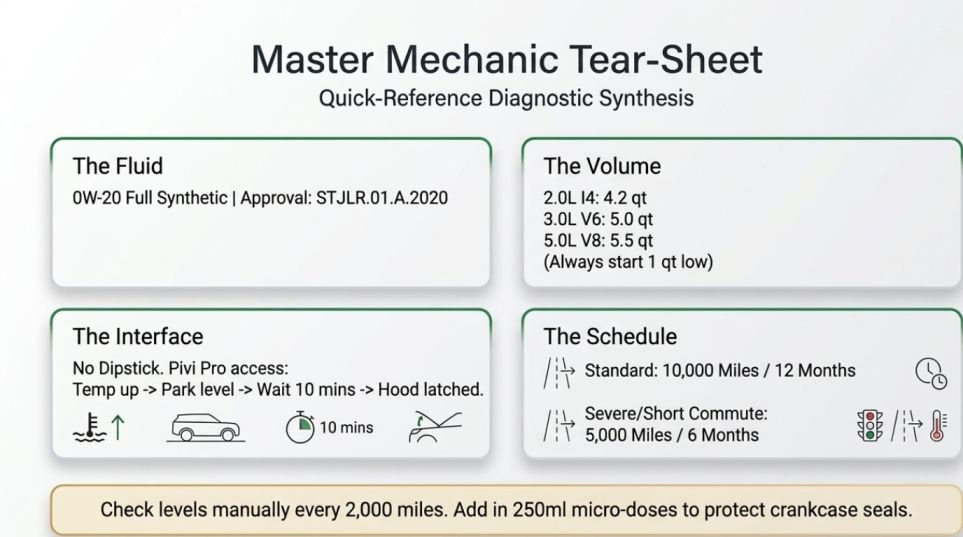
Maintaining a Range Rover Velar requires strict adherence to manufacturer specifications to protect the complex Ingenium engine architecture. Every Velar model produced from 2018 onward necessitates 0W-20 full synthetic oil that carries the specific STJLR-01-A-2020 certification. Using generic oil alternatives can cause significant damage, including premature camshaft lobe erosion, oil pump wear, and potential voiding of your factory warranty. These engines rely on precise oil film thickness to support high-pressure fuel systems and variable-geometry turbochargers, making the correct chemical additive package essential for long-term reliability and proper emissions system functionality.
Engine oil capacities vary by powerplant, with the 2.0L 4-cylinder requiring 4.2 quarts, the 3.0L V6 needing 5.0 quarts, and the 5.0L V8 requiring 5.5 quarts. You should perform oil changes every 10,000 miles or every 12 months, whichever occurs first, and monitor your levels using the digital readout on the infotainment screen. When adding oil, avoid overfilling to prevent increased crankcase pressure that can force oil past critical seals. The most important takeaway is to verify the STJLR approval code on the bottle before purchase to ensure total engine compatibility.
| Engine | Oil Grade | Capacity | JLR Spec |
|---|---|---|---|
| 2.0L 4-Cyl | 0W-20 | 4.2 qt | STJLR-01-A-2020 |
| 3.0L V6 | 0W-20 | 5.0 qt | STJLR-01-A-2020 |
| 5.0L V8 | 0W-20 | 5.5 qt | STJLR-01-A-2020 |
Frequently Asked Questions
What Is The Correct Oil Type For A Range Rover Velar?
For most modern models, the manufacturer recommends using 0W-20 full synthetic engine oil to ensure proper lubrication and engine performance. Always check your specific owner’s manual or the sticker under your hood, as requirements can shift based on your exact engine configuration.
How Often Should I Change The Oil In My Range Rover Velar?
You should stick to a service interval of 10,000 miles or every 12 months, whichever comes first. If you frequently drive in harsh conditions, such as extreme heat or heavy stop-and-go traffic, you might consider shortening that window to protect your engine’s longevity.
How Many Quarts Of Oil Does A Range Rover Velar Typically Need?
While capacity varies by engine type and model year, most Velar models require approximately 4.2 to 5.5 quarts of oil for a standard change. Always verify the exact amount by checking the digital oil level monitor in your vehicle’s infotainment system after refilling.
Can I Use Conventional Oil Instead Of Full Synthetic In My Velar?
No, you should never use conventional oil in these engines because they require the high-performance protection of full synthetic oil to handle tight tolerances and operating temperatures. Using the wrong oil type can lead to premature wear and may void your factory warranty.
Is It Safe To Top Off My Oil If The Low Oil Light Comes On?
You can top off the oil, but you must use the exact same viscosity and specification as what is currently in your engine. If your Velar is consuming oil rapidly, visit a mechanic to rule out leaks or internal issues, as these engines are designed to maintain their levels between scheduled service intervals.

- 2017 Dodge Grand Caravan Transmission Fluid Capacity: Dodge Grand Caravan Transmission - September 27, 2026
- How Many Gallons Of Transmission Fluid Does A 2017 Gmc Yukon 5.3 Slt Xl Hold: How Many - September 26, 2026
- 17 Gmc Yukon Transmission Fluid Capacity V8 (8l90) Quarts/liters - September 26, 2026