Direct injection (GDI) engines are known for carbon buildup on the intake valves, and every parts shelf has a bottle that promises to stop it. Will an oil additive actually prevent it? Short answer: no. What does help is understanding where the deposits come from.
An oil additive will not clean existing carbon and cannot reliably prevent new carbon. In a GDI engine no fuel washes the back of the intake valves, so oil vapor from the crankcase ventilation (PCV) system and exhaust gas (EGR) bake onto them. You reduce that with the right low-volatility oil (API SP / ILSAC GF-6), on-time oil changes, a healthy PCV system, and, when symptoms appear, a physical cleaning such as walnut blasting.
Oil Additive For Direct Injection: Do They Work?
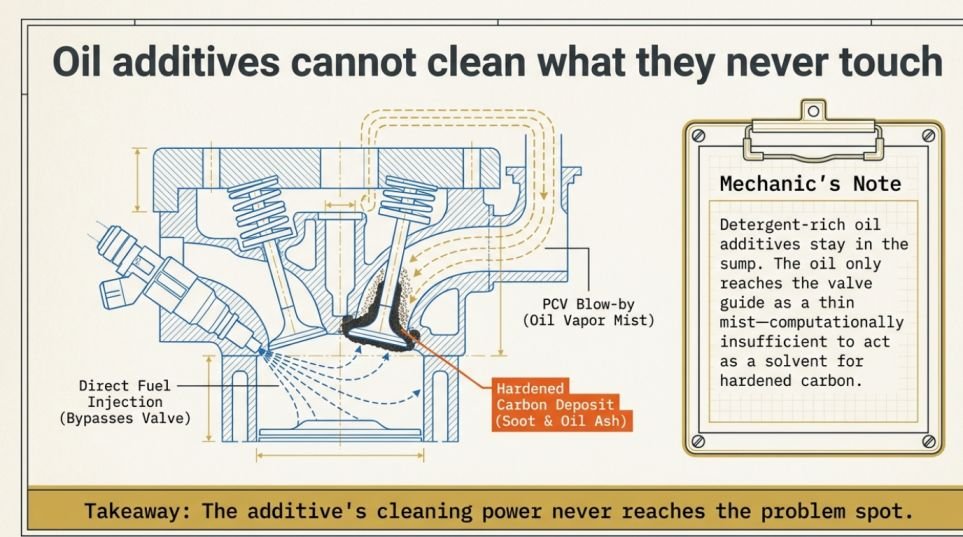
In a port-injected engine, gasoline sprays over the back of the intake valve, and its detergents keep that area clean. A GDI engine sprays fuel straight into the cylinder, so that cleaning stops. The valves then collect whatever is in the intake air: oil mist from the PCV system and soot from the EGR system. Deposits build gradually and can cause rough idle, hesitation, misfires, and power loss.
An oil additive can’t solve this for two reasons. It circulates in the crankcase and lubrication system, not in the intake port, so it never washes the valve face. And the deposits are partly made of oil that reaches the intake through the PCV system, so adding more additive chemistry to that oil does not remove the source.
What Oil Additives Actually Do
Aftermarket oil additives typically add friction modifiers, anti-wear compounds, or viscosity boosters. Any benefit is to the engine’s internal lubrication, not to intake-valve cleanliness. Fuel-side cleaners don’t fix this either: in a pure direct-injection engine, the fuel never passes over the valves, so a fuel additive doesn’t reach them.
What Actually Removes Valve Carbon
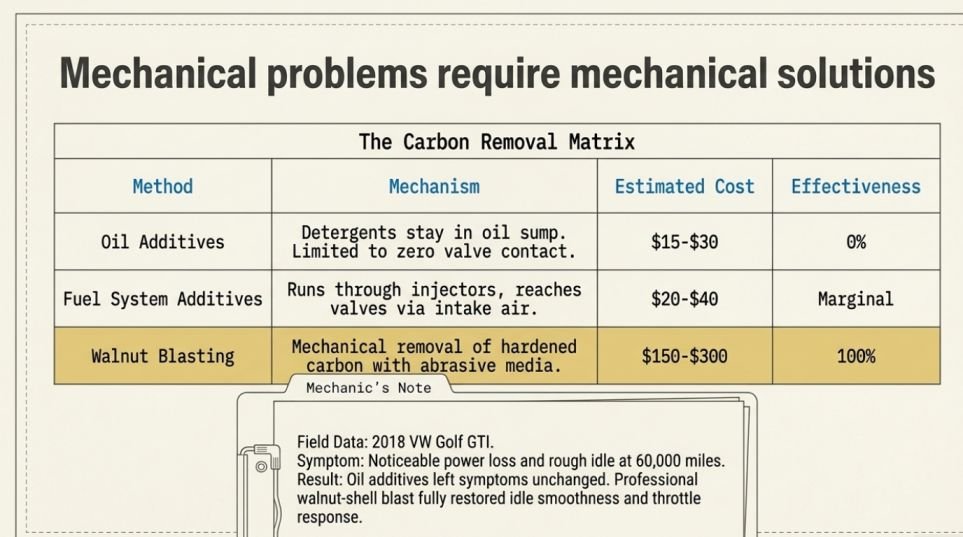
| Method | What it does | Typical cost (varies a lot) |
|---|---|---|
| Oil additive | No meaningful effect on intake-valve deposits | $15–$30 per bottle |
| Intake-spray (induction) cleaner | Sprayed into the intake to soften light deposits; limited on heavy buildup | Roughly $20–$150 (DIY to shop) |
| Walnut-shell blasting | Physically removes hardened carbon; the most reliable fix for heavy buildup | Often several hundred dollars; some shops quote about $1,000 when the manifold is hard to remove |
If your car has noticeable power loss or rough running and a mechanic confirms heavy carbon with a borescope, cleaning the valves physically is the fix. An oil additive would leave the symptoms unchanged.
Mechanic’s tip: Don’t clean on a calendar. Clean when there are symptoms (rough idle, misfire codes, loss of power). Many shops suggest checking somewhere in the 40,000 to 80,000 mile range, but engines differ widely.
GDI Blow-by And Oil Contamination Explained
Blow-by is combustion gas and unburned fuel that slip past the piston rings into the crankcase. It mixes with oil and forms a fine mist. The PCV system pulls that vapor out of the crankcase and feeds it into the intake so it gets burned. That is good for emissions but is the main route for oil to reach the intake valves.
The PCV System And Intake Deposits
In a port-injected engine, fuel spray washes that oil mist off the valve. In a GDI engine, nothing does. The oil vapor lands on the hot valve and intake port, then bakes into hard carbon, especially when mixed with soot from the EGR system. Fuel that dilutes the oil adds to the vapor.
Mechanic Tip: An oil catch can intercepts some PCV oil vapor before it reaches the intake, which can slow buildup. The evidence is mixed, it may not stop it, and a poorly designed can can cause problems such as freezing in cold weather or being a legal issue in some regions. Treat it as an optional helper, not a cure.
Why Oil Additives Struggle With Deposits
The oil itself matters more than any bottle you add to it. Fuel dilution thins the oil, which hurts turbo bearings and timing-chain tensioners. A more volatile oil gives off more vapor into the PCV system. That is why mechanics point to low-volatility, quality synthetic oil and on-time changes as the real lever, rather than an additive that cannot reverse deposits already on the valves.
If you drive a turbocharged BMW, see our BMW 5W-30 engine oil guide and the petrol BMW X1 oil guide for how oil specs apply to these engines. For low-volatility oils in general, our Group 4 synthetic oil brands page covers PAO-based options.
Preventing LSPI with the Right Motor Oil
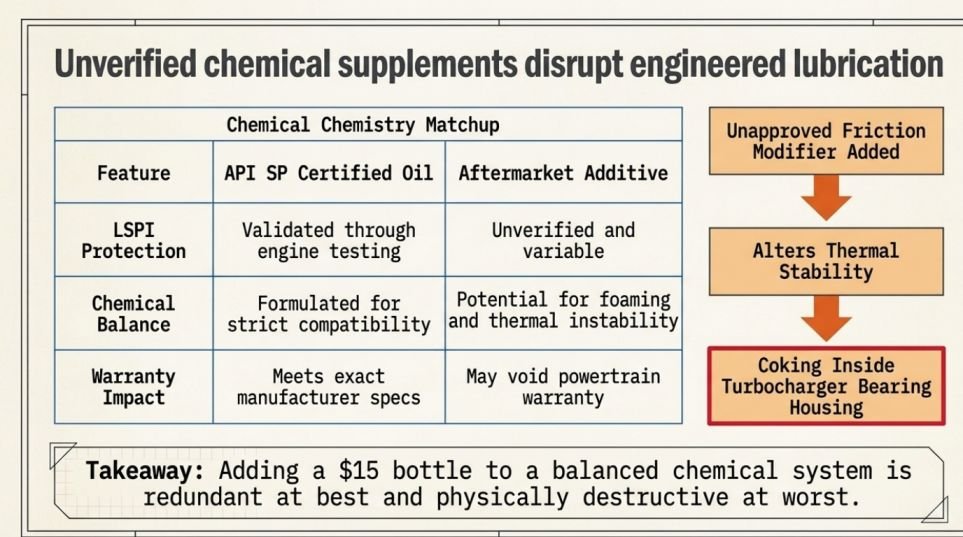
Low-Speed Pre-Ignition (LSPI) is a separate problem from valve carbon. It happens in small turbocharged GDI engines under high load at low rpm, when the fuel-air mixture ignites before the spark. The resulting pressure spike can damage pistons and rods. It is not caused by valve deposits, and an oil additive is not the answer to it either.
Research links LSPI to oil chemistry, especially calcium-based detergents, which can form lower-octane compounds that auto-ignite. The industry response was oil specifications that include an LSPI engine test.
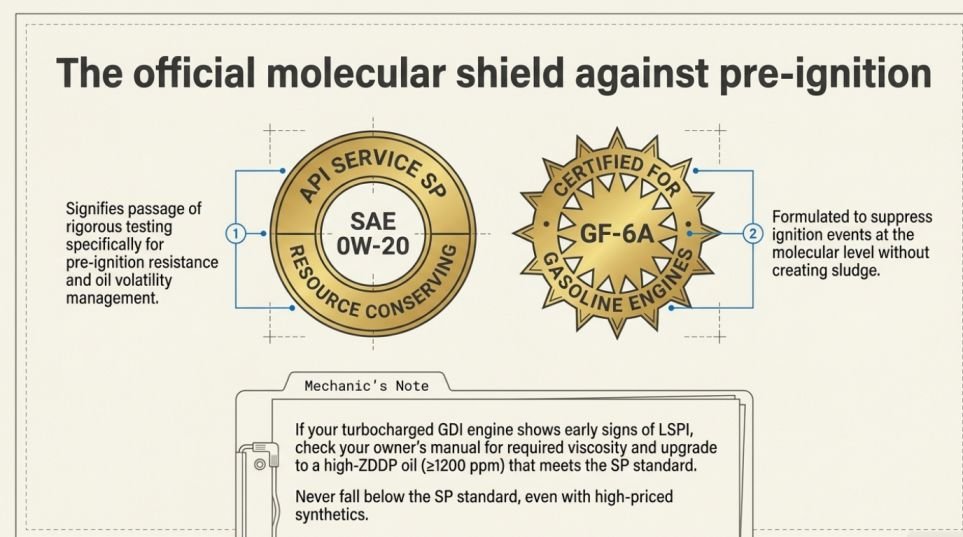
API SP And ILSAC GF-6A Standards
API SN Plus (2018) was a stopgap. API SP and ILSAC GF-6 (2020) made LSPI testing permanent. If you drive a turbo GDI car, look for the API SP donut or ILSAC GF-6A starburst, and use the viscosity in your owner’s manual.
Mechanic’s Tip: Don’t chase high ZDDP to fight LSPI. ZDDP does suppress LSPI in lab tests, but extra zinc and phosphorus also raise ash and can shorten catalytic converter life. Use an oil that already passed the SP LSPI test instead.
Why Oil Chemistry Beats Aftermarket Additives
Motor oil is a balanced formula of detergents, dispersants, and anti-wear agents. Adding a supplement changes that balance in ways the maker never tested. Certified oil has actually been engine-tested for LSPI. A bottle of additive generally hasn’t.
| Feature | API SP Certified Oil | Aftermarket Oil Additive |
|---|---|---|
| LSPI protection | Validated by an engine test | Generally untested |
| Chemical balance | Formulated as a system | Can upset the balance |
| Valve-carbon effect | Low-volatility oils help limit vapor | No meaningful effect |
Risks Of Using Aftermarket Oil Additives
Most additives add cost without a documented benefit for GDI engines, and some carry real risk. They can disturb the oil’s carefully tuned chemistry, and some friction modifiers or thickeners can affect the oil’s behavior in a turbo engine.
Chemical Interference And Performance
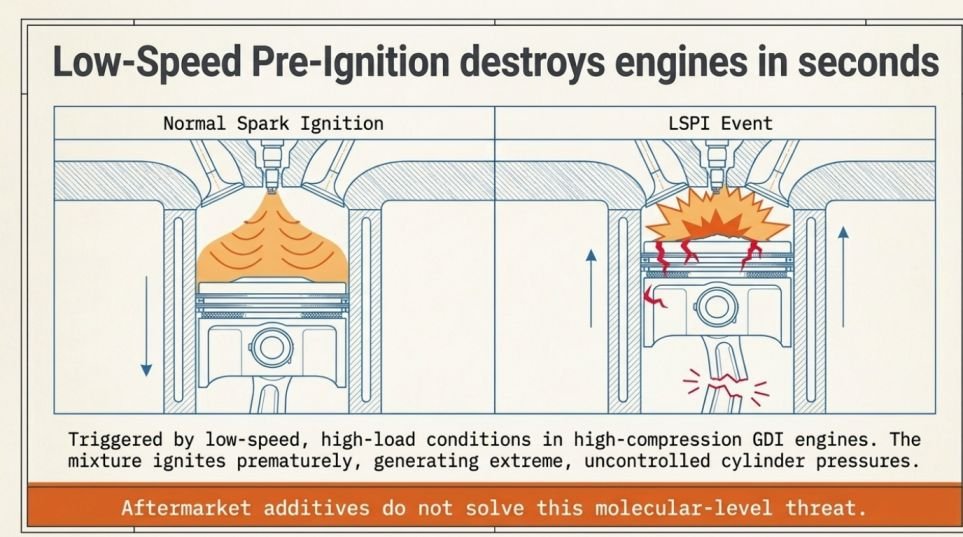
Changing the concentration of detergents, dispersants, and friction modifiers can cause foaming or reduce thermal stability. A turbo’s bearing housing runs very hot, so an oil that breaks down early is the main concern, and it can lead to coking there.
Pro Tip: A good full synthetic that meets your manufacturer’s approval already contains the additive package your engine needs.
Warranty Implications
Using an additive doesn’t automatically void a warranty. But if a failure occurs and the manufacturer can point to a non-approved product as the cause, it can contest the claim. The safest practice is to follow the oil specification and viscosity in your owner’s manual and keep your service records.
| Risk Factor | Potential Impact |
|---|---|
| Chemical imbalance | Shorter oil life, foaming, reduced thermal stability |
| Warranty dispute | Possible denied claim if the additive is blamed |
| Turbo or chain wear | Oil that degrades early starves hot, tight parts |
Effective Strategies For GDI Engine Health
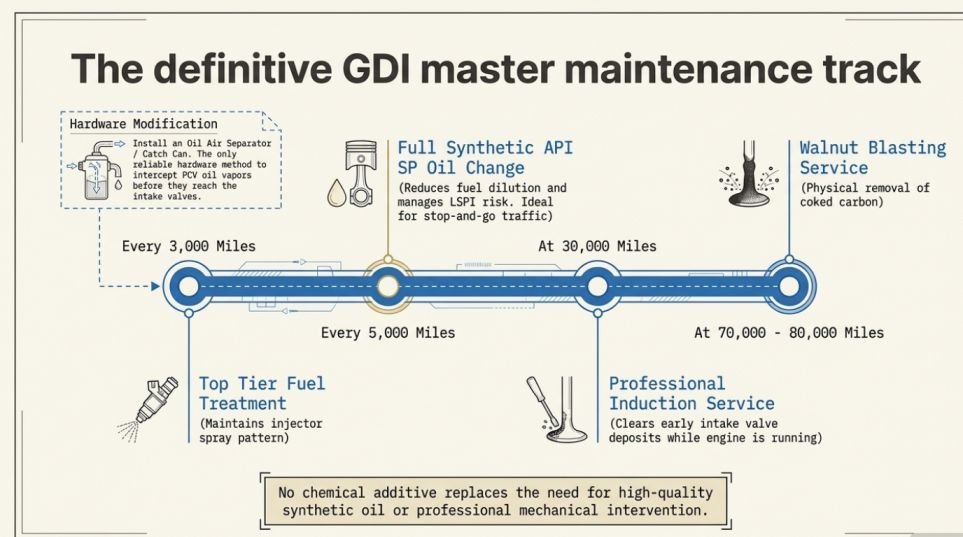
You can’t fully stop carbon in a direct-injection-only engine, but you can slow it down. These habits do more than any additive:
- Use the right oil. API SP / ILSAC GF-6 with your manual’s viscosity, and prefer a low-volatility synthetic.
- Change oil on time, or earlier for short trips. Stop-and-go driving and cold starts add fuel dilution and vapor.
- Keep the PCV system healthy. A failing PCV valve or separator sends more oil into the intake.
- Drive it properly. Regular highway runs get the engine fully hot.
- Use quality fuel. It helps injectors and combustion chambers, even though it won’t wash the valves.
- Consider an oil catch can if you intend to keep the car long term, understanding its limits.
Some Engines Avoid The Problem
Not every direct-injection engine has the same issue. Dual-injection systems add port injectors, so some fuel still sprays across the valves. Toyota’s D-4S system is a well-known example, and some Ford engines use dual injection too. If you own a Toyota, see our 0W-20 full synthetic oil for Toyota guide. Whether your engine is direct-only or dual-injection tells you how likely carbon buildup is.
Mechanic’s Note: Short trips are the enemy. If you mostly do stop-and-go driving, your engine runs cooler and builds more deposits and fuel dilution, so shorten your oil change interval within your manual’s severe-service guidance.
Signs Of Carbon Buildup And When To Clean
Heavy intake-valve carbon tends to show up as a rough idle (especially on a cold start), hesitation, misfire codes, and reduced power. Have a mechanic confirm with a borescope before paying for a cleaning, since the same symptoms can come from spark plugs, coils, or injectors. If it’s confirmed, walnut blasting is the standard fix.
Quick Summary
Oil additives do not prevent or remove carbon on GDI intake valves. The deposits come from PCV oil vapor and EGR soot that no fuel washes away. To reduce buildup, use a quality low-volatility oil that meets API SP / ILSAC GF-6, change it on time, keep the PCV system healthy, and clean the valves physically if symptoms appear. LSPI is a separate issue handled by choosing an SP-certified oil, not by additives.
| Goal | What works | What doesn’t |
|---|---|---|
| Slow carbon buildup | Low-volatility SP oil, on-time changes, healthy PCV, catch can (helps some) | Oil additives |
| Remove existing carbon | Walnut blasting; intake sprays for light buildup | Oil or fuel additives |
| Avoid LSPI | API SP / ILSAC GF-6A oil in the right viscosity | Adding extra ZDDP or random supplements |
Best Direct Injection Oil: What To Look For
The best direct injection oil is not a special additive. It is a quality full synthetic that meets your car’s spec and carries API SP / ILSAC GF-6 (or a carmaker approval such as dexos1 Gen 3 or VW 508/504). These oils include tests for low-speed pre-ignition (LSPI), which is common in turbocharged GDI engines. Low-volatility oils also send less vapor through the PCV system, so less of it bakes onto the intake valves.
Frequently Asked Questions
Can An Oil Additive Prevent Carbon Buildup In Direct Injection Engines?
No. Valve deposits come from oil vapor and exhaust soot that no fuel washes off. A quality low-volatility oil, on-time changes, and a healthy PCV system slow the buildup. Additives don’t.
Will Adding An Oil Supplement Void My Warranty?
Not automatically, but if a failure occurs and the additive is blamed, the manufacturer may contest the claim. Check your owner’s manual for fluid requirements and keep service records.
Are There Oil Additives That Help With Fuel Dilution?
Not reliably. Fuel dilution comes from fuel getting past the rings during cold starts and short trips. Shorter oil change intervals within your manual’s severe-service guidance, and occasional long drives, are the practical fixes.
Do High Detergent Oil Additives Clean Direct Injection Intake Ports?
No. Oil doesn’t wash the intake ports. To clean valves, you need a physical method such as walnut blasting, or an intake-spray service for light deposits.
Is It Safe To Use A Friction Modifier Additive In A Turbocharged Direct Injection Engine?
It’s generally not worth the risk. Turbos depend on an oil that stays stable under extreme heat, and a non-approved friction modifier can change that, with no verified benefit for your engine.
Does Every Direct Injection Engine Get Carbon Buildup?
No. Direct-injection-only engines are most prone. Dual-injection engines, such as Toyota’s D-4S, spray some fuel over the valves and are much less affected.

- “Does Higher Tire Pressure Improve Fuel Economy? Recommended PSI Explained” - November 25, 2026
- Best Tires for Minivans 2026: 10 Best Minivan Tires Reviewed - October 5, 2026
- Best Tires For Tesla Model Y Long Range (2026) - October 3, 2026