Planning a transmission service on a 2019 Toyota Highlander? The answer depends on which engine you have, because that decides which transmission is in your car. In short: the 3.5L V6 (8-speed) holds a little over 8 quarts in total and takes about 3 quarts for a drain-and-fill, while the 2.7L four-cylinder (6-speed) holds about 6.9 quarts in total. Both use Toyota ATF WS.
2019 Toyota Highlander transmission fluid capacity varies by engine and transmission, and by whether you do a drain-and-fill or a full exchange. Below you’ll find the quart numbers for each setup, the right fluid, how to check the level (there is no dipstick), and when a service makes sense.
2019 Toyota Highlander Transmission Fluid Capacity Quick Reference
Find your engine in the table, then read across. Capacities are approximate: they vary slightly with service method and fluid temperature, so always finish by setting the level with the Toyota procedure rather than by counting quarts.
| 2019 Highlander engine | Transmission | Total fluid capacity | Typical drain-and-fill | Fluid |
|---|---|---|---|---|
| 2.7L 4-cylinder (L/LE, FWD) | 6-speed automatic | About 6.9 qt (6.5 L) | Roughly 3 to 4 qt; buy 4 to be safe | Toyota ATF WS |
| 3.5L V6, FWD | 8-speed automatic (UA80E) | A little over 8 qt | A little over 3 qt; buy 4 | Toyota ATF WS |
| 3.5L V6, AWD | 8-speed automatic (UA80F) | A little over 8 qt | A little over 3 qt; buy 4 | Toyota ATF WS |
| Hybrid (3.5L V6 + electric motors) | Hybrid transaxle | Different unit with its own fluid procedure. The figures above do not apply; use Toyota service information. | ||
Drain-and-fill quantities are what comes out when you pull the drain or overflow plug, which is far less than the total because the torque converter, valve body, and cooler circuit keep most of the fluid. That is why a single drain-and-fill only refreshes part of the fluid.
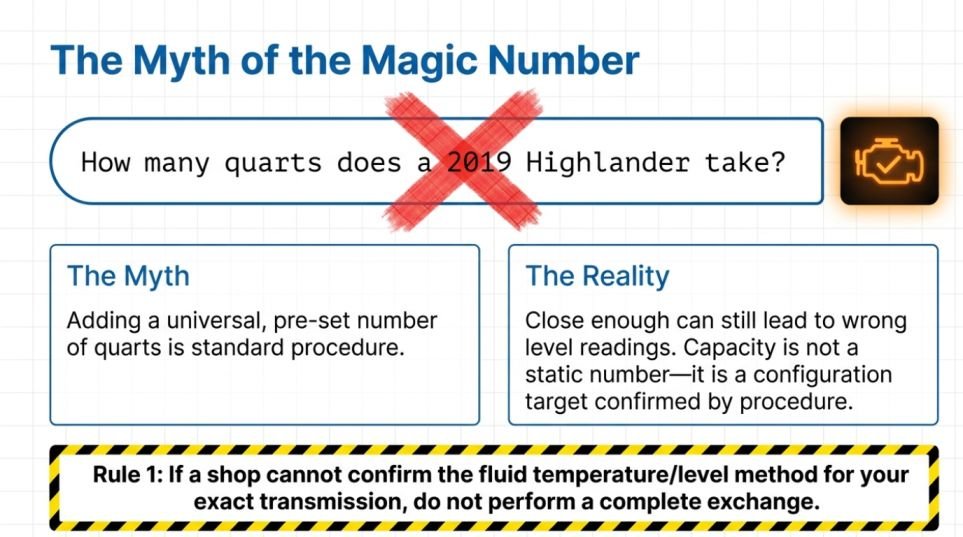
Pro tip: Quarts are a shopping guide, not a fill spec. On these transmissions the correct level is set at the overflow (level) plug with the fluid at the right temperature. Overfilling or underfilling can cause shift problems, so verify by procedure.
How To Tell Which Transmission Your 2019 Highlander Has
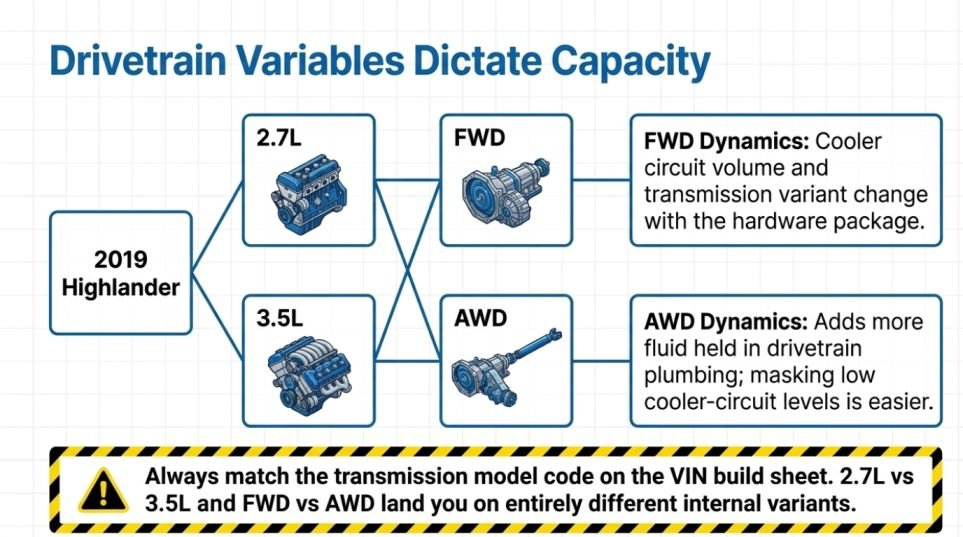
2019 Toyota Highlander transmission fluid capacity depends mainly on the engine, because each engine is paired with its own transmission. You can tell which one you have in seconds:
- 2.7L four-cylinder: base trims (L and LE) with front-wheel drive, paired with the 6-speed automatic.
- 3.5L V6: LE, XLE, SE, Limited, and Platinum trims in FWD or AWD, paired with the 8-speed automatic. The FWD version is the UA80E and the AWD version is the UA80F.
- Hybrid: badged Hybrid on the tailgate and uses a hybrid transaxle, not either of the transmissions above.
Not sure? Check the engine under the hood or the engine code in your VIN, or ask a Toyota parts counter to look it up. If you own an XLE, remember XLE is a trim level, not a different transmission: it will have the 3.5L and the 8-speed.
Pan Capacity Versus Total System Fill

Total capacity is the amount in a completely dry transmission. A drain-and-fill only returns what drains out, which is roughly 3 to 4 quarts. If you want most of the old fluid gone, repeat the drain-and-fill after a few hundred miles instead of using a pressure flush.
Transmission Fluid Type: Toyota ATF WS
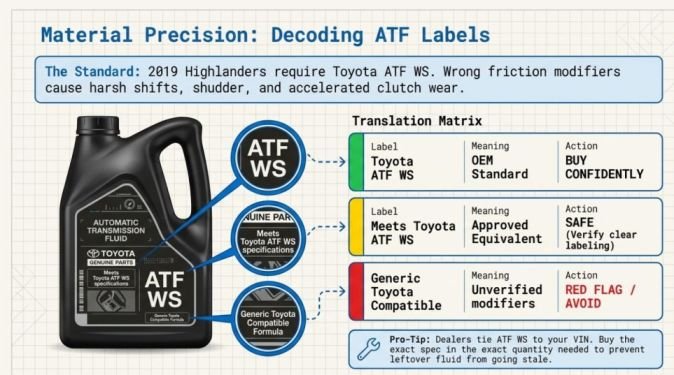
For the 2019 Toyota Highlander, the correct transmission fluid specification is Toyota ATF WS (World Standard), a low-viscosity fluid. This applies to the 6-speed and the 8-speed. Toyota warns that using another ATF can cause poor shift quality and vibration, so do not substitute Dexron, Mercon, or a “universal” fluid.
What To Look For On The Label
Buy Toyota Genuine ATF WS, or an aftermarket fluid whose label clearly says it meets the Toyota WS specification. “Compatible with Toyota automatics” is not enough.
| Fluid label claim | How to treat it |
|---|---|
| Toyota Genuine ATF WS | Buy confidently |
| “Meets Toyota WS” stated clearly on the bottle | Generally acceptable from a reputable brand |
| Vague “Toyota compatible” or “WS-type” | Do not assume; look for the written WS requirement |
| Other Toyota ATF (Type IV, T-IV) or universal ATF | Avoid for this application |
Dealers match WS to your VIN, which removes guesswork. Buy 4 quarts for a drain-and-fill and about 9 quarts if you plan a full exchange on the 3.5L, and keep the unopened extra for the next top-up. Older Toyota models can call for a different ATF, so always check the spec for your exact vehicle, for example, in this 2005 Toyota Avalon transmission fluid capacity guide.
Is There A Transmission Dipstick On A 2019 Highlander?

No. The 2019 Highlander’s automatic transmissions are sealed units with no dipstick, and the 8-speed has no serviceable pan filter. The level is set through a fill plug on the side of the case and an overflow (level) plug on the underside. You cannot check it with the engine off and a rag.
On the 8-speed, the fill plug sits high on the driver’s side, and the correct level is when fluid just dribbles from the overflow opening once the fluid is within Toyota’s temperature window. Because temperature changes the level, a scan tool or reliable fluid temperature reading is needed to do it right. Many owners hand this step to a shop for that reason.
| Situation | What to do | Why it matters |
|---|---|---|
| Nothing dribbles from the overflow plug | Add small amounts through the fill plug and recheck in the temperature window | Underfill can cause aeration and poor lubrication |
| Fluid keeps flowing out of the overflow | Let it settle to a dribble, then close up | Overfill can cause foaming and overheating |
| Dark, burnt-smelling fluid | Get a diagnosis before repeating services | Dark fluid can be normal; burnt fluid can indicate clutch wear |
Drain-and-fill Procedure Overview
This is a general outline, so you know what the job involves. Follow Toyota’s service information for your exact transmission, including torque specs and the temperature window.
- Park on level ground, set the parking brake, chock the wheels, and support the vehicle on jack stands if you need to go under it.
- Open the fill plug first, so you know you can refill before you drain anything.
- Remove the drain/overflow plug and let the fluid drain. Expect roughly 3 to 4 quarts, and measure it.
- Reinstall the plug (and the internal level tube where equipped) with the correct torque.
- Pump in the same amount of new Toyota ATF WS through the fill plug.
- Run the engine, cycle through the gears, bring the fluid into Toyota’s temperature range, then open the overflow plug and confirm a dribble. Add or release fluid as needed.
- Close everything up, check for leaks, and dispose of the used fluid at a recycling center.
Set aside about 1 to 3 hours depending on tools, access, and warm-up time. You need a fluid pump with a hose, since the fill port is hard to reach for pouring.
Drain-and-fill Vs Flush
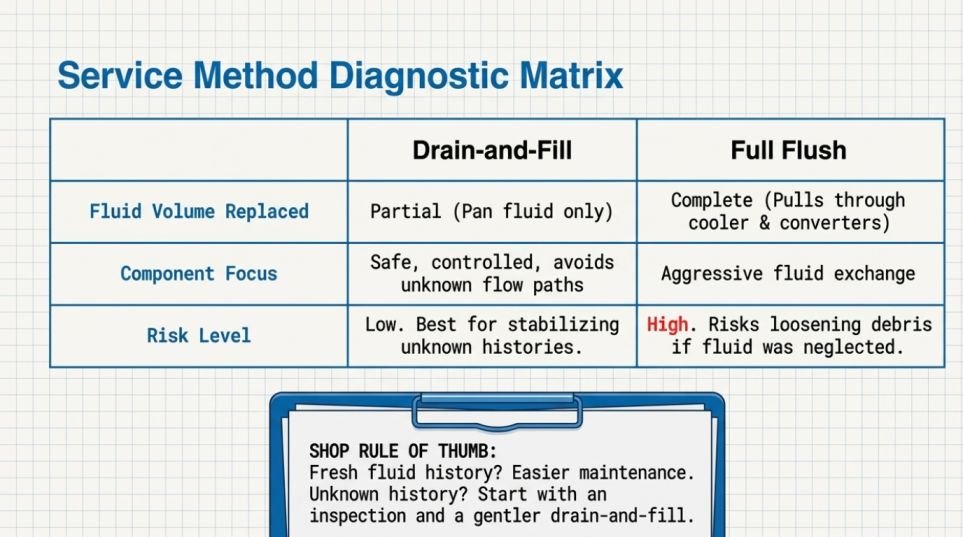
A drain-and-fill is the controlled, lower-risk choice. A machine flush pushes more fluid through the system and can disturb sediment, which is a concern if the fluid is old or the history is unknown. For a fresh-ish fluid change, stick with drain-and-fill; if you want a higher percentage of new fluid, do two or three drain-and-fills a few hundred miles apart.
How Often Should You Change The Transmission Fluid?

Toyota does not list routine transmission fluid replacement as a normal-use item on many of these vehicles, and the fluid is often described as “lifetime.” In practice, heat is what ages ATF, so many independent shops recommend a drain-and-fill at around 60,000 miles, sooner for hard use. Check your Warranty and Maintenance Guide for the severe-duty schedule that applies to you.
| Driving duty cycle | Suggested approach |
|---|---|
| Mostly highway, light use | Drain-and-fill around 60,000 miles, or when the fluid looks or smells worn |
| Stop-and-go city driving | Earlier, roughly every 30,000 to 60,000 miles |
| Towing or hot climate | Earlier again; heat is the main enemy of ATF |
| Unknown history or high mileage | Inspect first, then a gentle drain-and-fill; avoid a flush |
Signs it is time for a service: harsh or delayed shifts, flaring between gears, shudder at light throttle, or fluid that is dark and smells burnt.
Looking For Engine Oil Capacity Instead?
Transmission fluid and engine oil are different systems. For reference, the 2019 Highlander 2.7L takes about 4.6 quarts of 0W-20 oil with a filter change, and the 3.5L V6 takes roughly 5.6 quarts without a filter change (a little more with a new filter). Confirm the exact figure in your owner’s manual. Both engines call for low-viscosity synthetic oil, and you can read more in this guide to 0W-20 full synthetic oil for Toyota engines.
Quick Summary
| Topic | 2019 Highlander answer |
|---|---|
| Fluid type | Toyota ATF WS |
| 3.5L V6 (8-speed), FWD or AWD | A little over 8 qt total; a little over 3 qt for a drain-and-fill |
| 2.7L (6-speed) | About 6.9 qt total; roughly 3 to 4 qt for a drain-and-fill |
| Dipstick | None; level is set at the overflow plug within a temperature window |
| Best service method | Drain-and-fill; avoid pressure flushes on older or unknown-history units |
Frequently Asked Questions
How Many Quarts Of Transmission Fluid Does A 2019 Toyota Highlander Take?
The 3.5L V6 with the 8-speed holds a little over 8 quarts in total and takes a little over 3 quarts for a drain-and-fill. The 2.7L with the 6-speed holds about 6.9 quarts in total. Both use Toyota ATF WS.
What Type Of Transmission Fluid Does A 2019 Highlander Use?
Toyota Genuine ATF WS, or a fluid that explicitly states it meets the Toyota WS specification. The XLE, LE, SE, Limited, and Platinum all use the same fluid.
Does The 2019 Highlander XLE Take A Different Amount Than Other Trims?
No. Trim level does not change the capacity; the engine and transmission do. An XLE has the 3.5L V6 and 8-speed, so use the 3.5L figures.
Is The Capacity The Same For FWD And AWD?
On the 3.5L, the FWD (UA80E) and AWD (UA80F) transmissions have essentially the same capacity. AWD models also have a separate rear differential and transfer case with their own fluids, which are not part of the transmission figure.
What’s The Difference Between A Drain And Fill And A Full Fluid Change?
A drain-and-fill replaces only what drains out, about 3 to 4 quarts, so part of the old fluid stays in the converter and cooler. A full exchange moves much more fluid, close to the total capacity, but it needs specialized equipment and carries more risk on high-mileage or neglected transmissions.
Can I Check The Transmission Fluid Level Myself?
There is no dipstick. The level is checked at the overflow plug with the fluid at a specified temperature, which usually requires a scan tool. If you are not set up for that, have a shop do the level check.
Can The Wrong Amount Of Fluid Cause Shifting Problems?
Yes. Too little or too much fluid can cause improper hydraulic pressure, harsh or delayed shifts, and overheating. If you suspect a wrong level, have it corrected using the proper procedure.
How Long Does A Transmission Fluid Change Take?
Usually about 1 to 3 hours. Capacity does not change labor time much; the warm-up and level verification steps are what add time.

- Top 10 Ranking Tire Brand for Minivan: Reviewed 2026 - October 5, 2026
- Model Y Tesla Long Range Automatic Wagon Tyre Fitment And Ratings - October 3, 2026
- What Is The Benefit Of Larger Rear Tyres On A Zero-turn Mower - October 3, 2026