
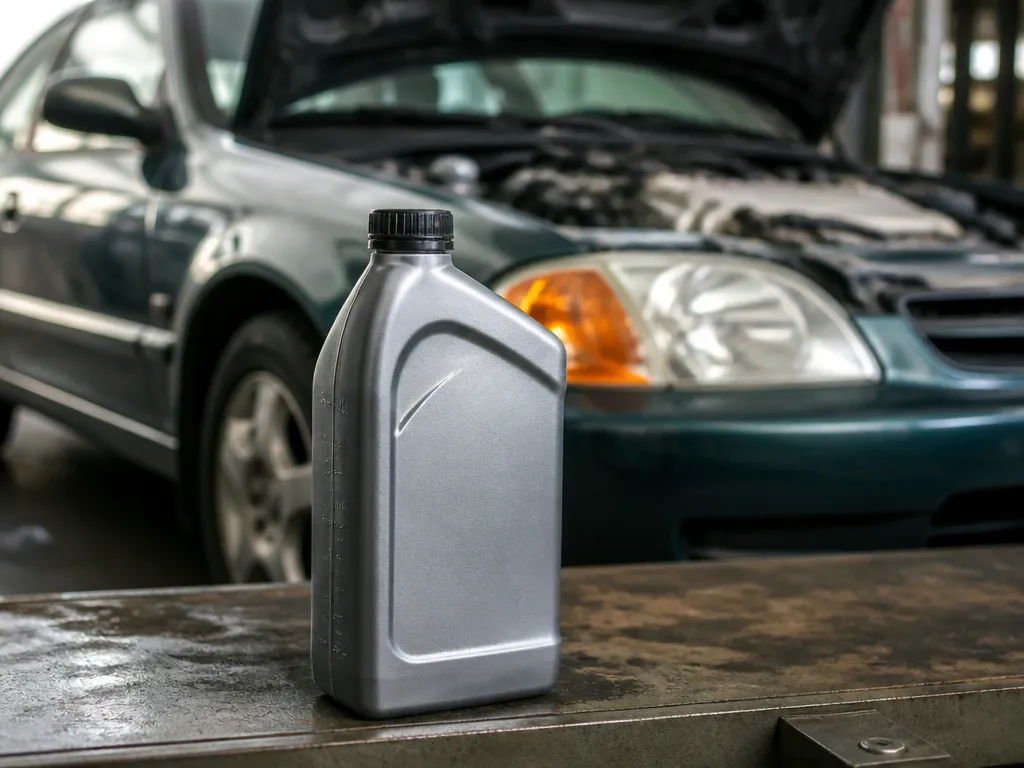
You searched “oil for 1998 Honda Civic” because your dipstick reading looks off or you’re due for a change and want the exact stuff in the bottle. That’s the right move, because the Civic’s oil choice is all about matching viscosity to your temps and matching the oil’s API or ILSAC rating to the engine’s needs.
For a typical 1998 Civic, start with 5W-30 for most climates, switch to 10W-30 for warmer weather, and choose an oil with at least an API “SL” era rating or better (and an ILSAC GF-3 level if listed). Next, confirm your engine family, then match the oil filter and refill to the dipstick’s “between marks” level.
Oil for 1998 Honda Civic: use 5W-30 as the main viscosity, or 10W-30 if you live where winters stay mild. Pick an oil with an API SL rating (or newer) and, if shown, ILSAC GF-3. Plan on a correct oil filter match and topping to the dipstick marks.
Oil For 1998 Honda Civic Quick Buy
For a 1998 Honda Civic, the go-to choice is SAE 5W-30 for most driving and climates. Use an oil that meets API/ILSAC GF-3 or newer labeling on the bottle.
Primary Viscosity And Quick Climate Alternatives
The safest “buy it today and move on” pick for a stock 1998 Civic is 5W-30. If you live somewhere hot or cold, adjust the first number to match your temperature swing so the engine gets oil fast at startup.
| Buying target | What to look for on the label | Why it matters |
|---|---|---|
| Viscosity grade | 5W-30 (primary) | Good cold-start flow and stable protection in typical temps |
| Performance rating | API/ILSAC GF-3 (or newer) | Correct formulation for the engine’s needs and emissions-era requirements |
| Construction | Either conventional or synthetic | Synthetic helps with cold starts, repeated heat cycles, and long service intervals |
How Much Oil And What To Verify
A 1998 Civic typically holds about 3.5 quarts during an oil change with a filter. Expect to check the level carefully, because leftover oil in the engine and whether the filter is new can shift the final amount a bit.
After draining and installing a new oil filter, pour in roughly 3.0 to 3.5 quarts first, then top off to the MIN and MAX marks on the dipstick. Start the engine for 30 seconds, shut it off, wait a couple of minutes, and re-check the level for leaks.
Match your exact engine needs: If you have an engine swap, unusual trim, or the maintenance sticker in the glove box specifies something different, follow that over the “generic” Civic recommendation.
Synthetic Vs Conventional Choice
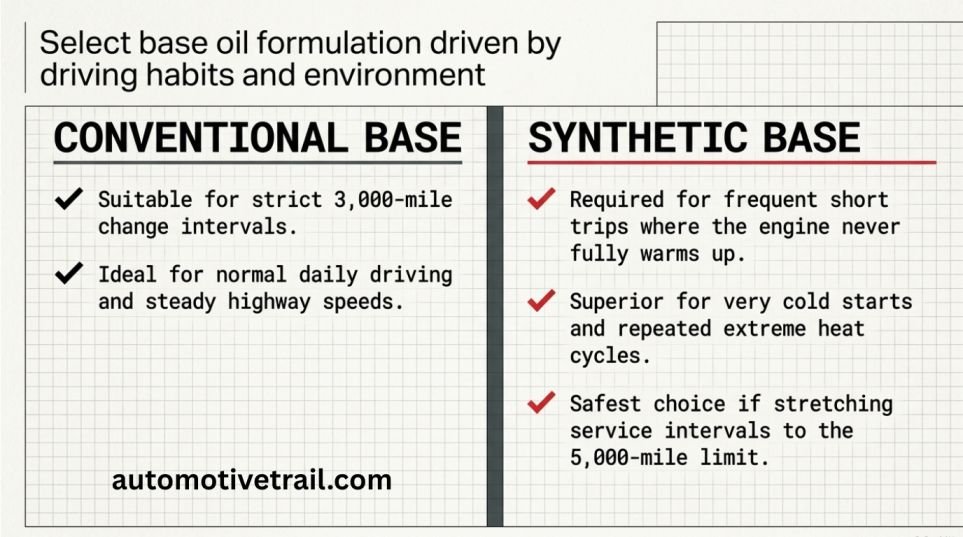
Conventional oil is usually fine for normal driving schedules and shorter intervals. Synthetic oil is the better pick if you face frequent short trips, very cold starts, or you stretch intervals while staying within the oil’s service guidance.
Correct Oil Viscosity Grades
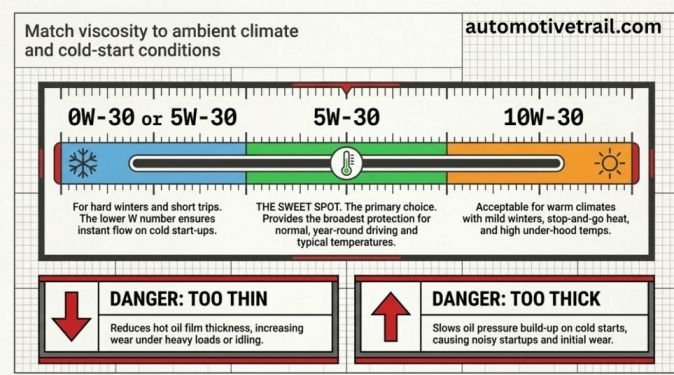
For a 1998 Honda Civic, the most broadly safe viscosity choice for year-round driving is SAE 5W-30. In colder climates where winter starts are hard, 0W-30 or 5W-30 can provide easier cranking and faster oil circulation. In warmer climates where winters are mild, 10W-30 can be acceptable. Follow the engine-specific recommendation if it differs.
Best Overall Choice By Climate
SAE viscosity grades tell you two things at once: the first number with the W controls cold start flow, and the second number controls oil thickness at operating temperature. For most drivers, 5W-30 is the sweet spot because it flows well enough in winter and stays within the normal thickness band when the engine is fully warmed up.
| Climate / Use | Recommended viscosity | Why it fits |
|---|---|---|
| Most climates, normal driving | 5W-30 | Good winter start flow and stable protection when hot |
| Cold winters, short trips, hard starts | 0W-30 or 5W-30 | Lower “W” number helps oil move sooner on start-up |
| Hot summers, stop-and-go heat, high under-hood temps | 10W-30 | Suitable for warmer conditions when winters are mild |
Cold Vs Hot: What To Avoid
Going too thin can reduce the oil film thickness when the engine is hot, which increases wear risk, especially if you tow, idle a lot, or run hard in summer. Going too thick can make the engine slow to build oil pressure until the oil warms up, which can mean noisier cold starts and extra wear during those first minutes.
Mixing Viscosities: What’s Okay Vs Not
Mixing different viscosities in the crankcase is only “okay” in the short term when you add a top-off due to a mistake or an emergency. The mixture becomes an average blend, but oil additives are engineered to work within a specific performance range, so repeated mixing is where you get into trouble.
Pro tip: If your Civic is burning oil or you regularly see low oil level on the dipstick, viscosity choice won’t fix the root issue. Keep the level correct, then address what is causing consumption.
Required Api/ilsac Oil Quality
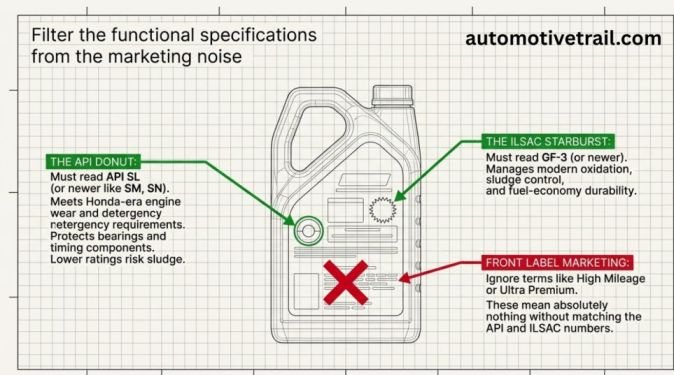
1998 Honda Civic owners should use engine oil that meets the correct API engine service category and, when listed, the ILSAC performance rating on the bottle. Matching the label matters because newer oils can protect better, while oils with too-low ratings can fail to meet the chemical and wear-control needs Honda specified for that era.
Api Service Category and ILSAC Rating To Look For
For the 1990s, the bottle should carry an API “service category” mark (it will look like “API SN,” “API SL,” etc.). Many 1998 Civics ran when API SL was current, so that is the benchmark category you want to see or exceed.
When the bottle also lists ILSAC, the usual format is ILSAC GF-3, GF-4, or GF-5 (depending on the oil’s generation). For a late-1990s Civic, you generally want GF-3 or better so the oil meets modern oxidation, sludge control, and fuel-economy-related durability targets.
| What to find on the bottle | What it means for your 1998 Civic |
|---|---|
| API service category (ex: SL, SM, SN) | Confirms the oil meets Honda-era engine wear and detergency requirements for your generation. Aim to match SL or higher. |
| ILSAC GF rating (ex: GF-3, GF-4, GF-5) | Confirms the oil meets ILSAC durability and performance tests. Aim for GF-3 or higher when shown. |
How To Read The Label (And What Marketing Won’t Tell You)
The only numbers that really matter are the API category and ILSAC GF rating printed on the back label or near the “donut” performance icons. Brand names like “High Mileage” or “Ultra Premium” are marketing terms and do not replace the API/ILSAC numbers.
Pro tip: If the back label lists API “SL” and no ILSAC, that is still valid for quality matching. If the label lists ILSAC but no API category, keep looking for a full specification line.
What Happens If The Rating Is Lower
A lower API/ILSAC category means the oil may not provide the same detergency, anti-wear performance, and oxidation resistance that protect the bearings and timing components over long intervals.
In practice, that can show up as faster oil darkening, increased sludge risk, and higher wear, especially in stop-and-go driving.
For a 1998 Civic, the risk is mainly accelerated engine wear and deposits. Using an oil with a clearly lower rating than what the bottle should list for your benchmark category is a bad trade, even if the viscosity looks correct.
Match Oil To Civic Engine
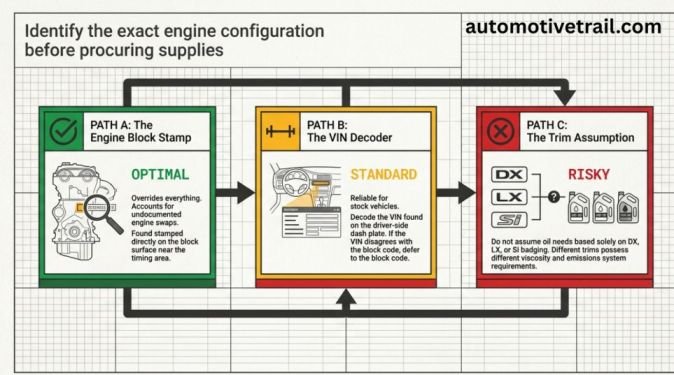
Civic oil spec can change with the engine family and trim, so the safest move is to identify the exact engine before you buy oil and a filter. A 1998 Civic can be more than one engine, and that difference affects which viscosity you should run and whether the oil needs to meet a specific performance category.
Confirm Which Engine You Have (VIN and Engine Code)
Pull the vehicle identification number from the driver-side dash plate (visible through the windshield) or the door jamb sticker. Use that VIN to decode the engine family in reliable VIN lookup tools, then compare the result to what is on your car.
For a more direct check, look for an engine code stamped on the engine block (location varies, but it is typically on the block surface near the code boss or timing area). Write down the code and the transmission type, then match them to your engine listing when selecting oil and filter.
Si Vs Dx/lx And Other Trim Differences
1998 Civic trims like Si can be paired with different engine calibration and sometimes different recommended oil viscosity windows than base models. Commonly, the “right” oil is the one that matches your engine’s required viscosity grade and performance category, not just the year and model name.
For example, a base DX or an LX might align with one viscosity grade range and an oil that meets the required performance specs for typical fuel economy and emissions equipment. An SI may call for the same general performance category, but the exact viscosity recommendation can differ enough that you should not treat all 1998 Civics as identical.
If You Are Unsure, What To Do
When engine identification is unclear, the safest approach is to choose oil by the engine code or VIN-decoded engine, not by “1998 Civic” alone. The wrong viscosity can change cold-start lubrication and hot oil film strength, and the wrong performance category can leave out the protection your engine expects for emissions system durability.
Trade-off: Choosing a “closest guess” oil risks poor fit to the required specification, especially if your car has been modified. Spending a few minutes confirming VIN and engine code is cheaper than redoing an oil change because the bottle does not match what the engine needs.
Insider tip: If the engine was replaced, the VIN may still reflect the original configuration. The engine code stamped on the block is the tie-breaker when selecting oil.
| What you found | What you should match on the oil bottle |
|---|---|
| VIN-decoded engine family matches your block code | Viscosity grade and performance category listed for that engine family |
| VIN decoder disagrees with engine code | Match the oil and filter to the engine code, since that is the engine you are actually running |
| Only trim (Si vs DX/LX) is known | Do not buy yet; confirm engine family first to avoid a mismatched viscosity recommendation |
1998 Civic Oil Capacity Numbers
1998 Honda Civic engines use about 3.5 quarts of oil when you drain the crankcase and install a new oil filter. Topping off (adding oil without a full drain) is typically only a small top-up of about 0.25 to 0.5 quarts since the level should be near the “between MIN and MAX” marks on the dipstick.
| Oil change situation | How much to add initially | Expected total after settling |
|---|---|---|
| Dry fill reference (new engine, for context) | About 3.7 to 3.9 qts | About 3.7 to 3.9 qts |
| Oil change with new filter | 3.2 qts to start | ~3.5 qts to reach the upper-safe dipstick range |
| Topping off only (no drain, no new filter) | 0.25 qt, then check | 0.25 to 0.5 qt typical |
1998 Civic oil capacity is often quoted around 3.5 quarts, which is why the common shop method is “start a little under, then top to the dipstick.” Filter replacement adds oil because the new filter is empty at install, so you end up adding closer to the full figure.
Refill Target Method (Dipstick-first)
Refill accuracy beats guessing. Oil level changes with temperature, how long the engine sits, and how much oil drains back from the filter and galleries.
Tip: Overfilling can foam oil and hurt lubrication, while underfilling risks low oil pressure. The dipstick reading is what you want to trust, even when you know the spec.
Oil Filter Type And Replacement
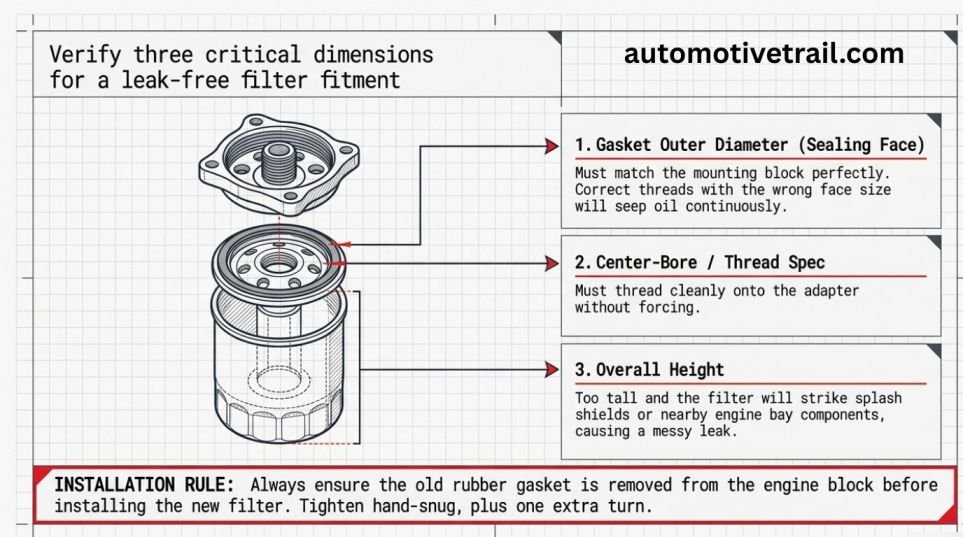
1998 Civic oil changes require an engine oil filter that matches the exact filter housing style and gasket type used on your engine, because the baseplate and seal diameter are what prevent leaks. When you order, confirm the thread size, whether the filter is a cartridge or spin-on style, and the overall height so the filter clears the engine bay parts.
What Filter Type To Buy For The 1998 Civic
Most 1998 Honda Civics use a spin-on filter, but a wrong listing usually happens when the vendor groups multiple years or trims together. Spin-on filters screw onto a threaded adapter, so the critical fitment details are the gasket outer diameter (or sealing face size), the center-bore/thread spec, and the filter height. Cartridge systems (less common on this vintage Civic) require a different housing and a specific cartridge element.
For a reliable match, use the VIN on the parts website or parts catalog, then cross-check the filter’s sealing style. A filter that “fits” by thread but has a different sealing face size can seep. A filter with the correct seal but incorrect height can hit a splash shield or nearby components, which turns into a messy leak.
Replacing The Filter, Gasket Prep, And Refill-level Tie-in
Oil filter choice affects how fast the engine’s oil level stabilizes right after the service. A brand with stronger anti-drainback behavior can keep oil from draining out of the filter media, so the level rise and pressure stabilization feel more consistent during the first minute after start-up.
In practice, you still set the final level at the dipstick after the engine idles and you shut it off.
Dipstick Check And Refill Steps
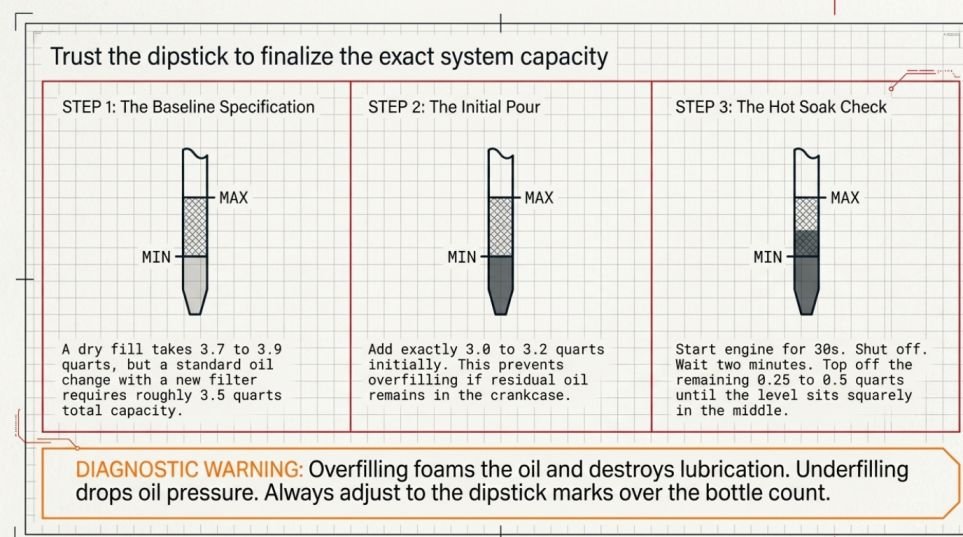
After an oil change or any top-off, the goal is to read the level on flat ground with the correct “hot” soak time. A quick check while the engine is cold or after driving long distances leads to overfill or underfill mistakes.
After you dial the level in, record the service details in a quick checklist so you can spot problems later. Record the oil brand and exact viscosity, the API/ILSAC category shown on the bottle, the filter part used, and the total oil added to reach the correct dipstick level.
Change Interval And Driving Severity
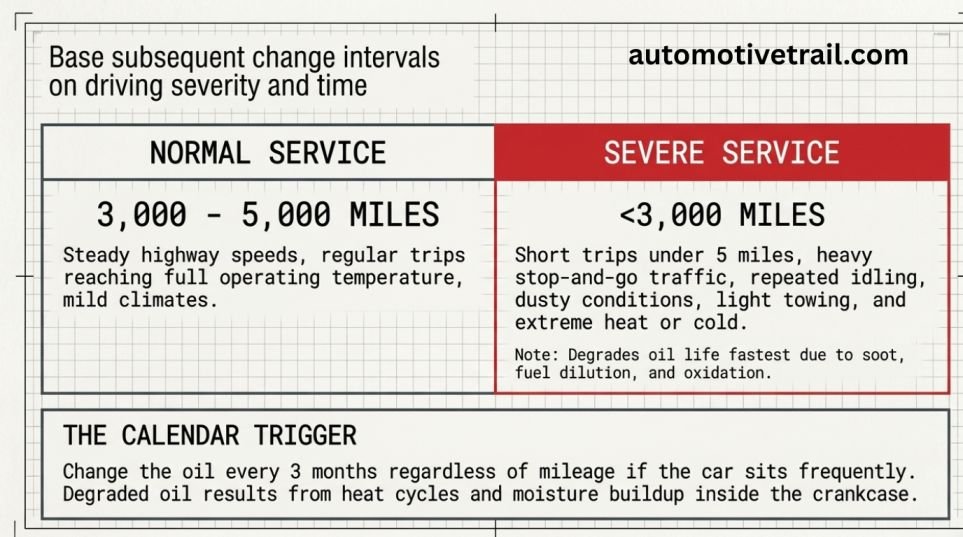
A 1998 Honda Civic generally needs an oil change every 3,000 miles or about 3 months under typical mixed driving. If you regularly drive gently and keep engine oil clean and topped off, you can stretch the interval, but you should do it by checking oil condition, not by hope.
Normal Driving Interval Guidance
Normal driving usually means mostly steady highway speeds, regular trip lengths that let the engine reach full operating temperature, and no towing or frequent lugging. In that situation, a 3,000 to 5,000-mile interval is common for many owner-kept schedules, with the shorter end if your climate is hot or your commute is short.
Time-based changes matter too. If you rack up fewer miles than expected, change by the calendar, because oil degrades from heat cycles and moisture contamination even when the odometer barely moves.
Severe Driving Interval Guidance
Severe service is what kills oil life fastest. Severe driving usually means lots of short trips where the engine never fully warms up, stop-and-go traffic, extreme heat, frequent cold starts, rough roads that keep you at high engine load, or any towing-like load (even light towing can do it depending on how often).
Severe service also includes driving habits and environments that spike temperatures. Examples include repeated idling, driving in dusty conditions, and climbing hills with a heavy car load, because that increases soot and fuel dilution and pushes oxidation faster.
Practical warning: Don’t stretch intervals just because the oil “looks fine” on the dipstick. Used oil can still be working hard, and the oil filter can only do so much before flow and particle capacity limit performance.
Signs You Should Change Early
Early change triggers are based on evidence you can measure or observe. If you notice any of the following, cut the interval short and change the oil and filter.
In practice, a cheap oil analysis can settle the debate when you want to run longer intervals. If you do not want to test, assume severe service and stay conservative.
Storage Or Unused Vehicle Oil Considerations
Vehicles that sit spend more time exposed to condensation inside the crankcase. If a Civic sits for weeks to months with minimal driving, plan on changing the oil based on time, especially if the car sees short starts that never fully warm it up.
When you bring a stored Civic back into service, change the oil and filter first, then drive normally until you reach full operating temperature. Fresh oil after storage reduces the chance of moisture and contaminants lingering in the system.
Quick Summary
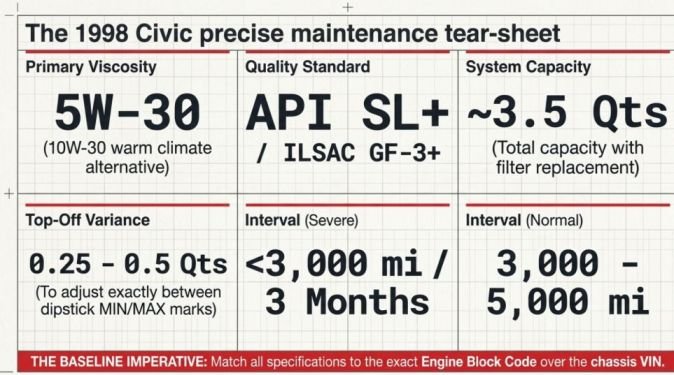
Confirm your exact Civic engine family before buying oil and a filter, then install the correct filter and fill to the dipstick “between marks” level. A typical change holds about 3.5 quarts, so plan to pour in roughly 3.0 to 3.5 quarts first, then top off after rechecking. After starting for 30 seconds, shut down, wait a couple of minutes, and recheck.
| Item | Article recommendation |
|---|---|
| Primary viscosity | 5W-30 |
| Warm climate option | 10W-30 if winters are mild |
| Oil quality rating | API “SL” or newer, and ILSAC GF-3 if listed |
| Typical capacity (with filter) | About 3.5 quarts; adjust to dipstick between marks |
Frequently Asked Questions
What Oil Viscosity Should I Use For A 1998 Honda Civic?
Use the viscosity specified for your exact engine and temperature range. For most 1998 Civics, 5W-30 is the primary choice, while 10W-30 can suit warmer climates with mild winters.
Can I Use Synthetic Oil In A 1998 Honda Civic?
In most cases, you can switch to synthetic for a 1998 Civic, as long as you still use the correct viscosity grade and meet the same oil level and filter requirements. If you have heavy leaks or you are unsure, do a cautious switch and watch for seepage after the change.
How Often Should I Change Oil On A 1998 Honda Civic?
A practical baseline is about every 3,000 to 5,000 miles depending on driving conditions, with shorter intervals if you do lots of short trips, idling, or dusty driving. If your car runs on conventional oil, leaning closer to 3,000 miles is usually the safer bet.
How Much Oil Does A 1998 Honda Civic Take For An Oil Change?
A typical 1998 Civic takes about 3.5 quarts with a filter, but capacities vary by engine. Start slightly below that amount, fill to the cross-hatch zone, then adjust after the level stabilizes.
What Oil Filter Should I Use For A 1998 Honda Civic?
Use the filter number matched to your engine and body style, because filters can differ even within the same model year. When installing, make sure the old gasket comes off, and tighten the new filter by hand until snug, then an extra turn per the filter instructions.
Is It Safe To Top Off Low Oil On A 1998 Honda Civic With A Different Brand?
Topping off is usually fine if the viscosity grade matches, but avoid mixing different viscosity grades. Still, plan to do a proper change soon, because topping off doesn’t remove contaminants as worn oil does.

- 2017 Dodge Grand Caravan Transmission Fluid Capacity: Dodge Grand Caravan Transmission - September 27, 2026
- How Many Gallons Of Transmission Fluid Does A 2017 Gmc Yukon 5.3 Slt Xl Hold: How Many - September 26, 2026
- 17 Gmc Yukon Transmission Fluid Capacity V8 (8l90) Quarts/liters - September 26, 2026