You cracked the question because the dipstick readings or a fresh drain-and-fill never line up with what you bought. A 2005 Dodge Durango can take very different amounts depending on the automatic transmission and 2WD versus 4WD setup. Get the quarts you should start with, plus how to confirm the correct level after adding fluid.
2005 Dodge Durango transmission fluid capacity varies by transmission. Reference figures range from about 8.1 quarts (5-speed automatic) up to about 14.8 to 16.9 quarts (6-speed 65RFE, especially on 4WD). For a service, expect the amount to be less than total capacity unless you do a full exchange.
How Many Quarts Of Transmission Fluid Go In A 2005 Dodge Durango
2005 Dodge Durango fluid capacity depends on the transmission and drivetrain layout, so the “correct” quarts number changes from one setup to the next. Reference charts for Durango applications include totals around 8.8 to 9.7 quarts for some 8-speed units, while other transmission variants list much higher or lower totals. Use the VIN and confirm the transmission code before buying fluid.
Why The Capacity Varies On A 2005 Durango

Transmission design and axle setup change how much fluid the pan and internal passages hold, and even the same general model year can come with different automatic units. Durango also used multiple engines across trims, and those engines were paired to different transmissions, so “engine size” alone is not enough to guarantee the right quart count.
In practice, you will also see differences between a drain-and-fill (fluid level reset) and a complete exchange (more fluid moves through the system). A partial service usually adds only a portion of the total capacity, since much of the fluid remains in the torque converter and cooler lines.
| Transmission variant (examples found online) | Total fill (quarts) | Typical fluid type label (as listed) |
|---|---|---|
| 8HP50 (3.6L) | 9.5 qt | SL076 |
| 8HP70 (5.7L, 6.4L) | 8.8 qt | SL076 |
| 8HP95 (6.2L) | 9.7 qt | SL076 |
| W5A580 (5-speed) | 8.1 qt | AP4 |
Online numbers like these can help you estimate how many quarts to buy, but they still may not match your specific 2005 Durango build. The safest approach is verifying your transmission type from the VIN or the vehicle build plate.
Insider tip: “Total fill” is what a fully emptied and refilled transmission takes, “added after a drain-and-fill” is a smaller number. Your level check after service is what ultimately matters.
The transmission references below show why the exact unit must be identified before using a specific quart total or drain-and-fill estimate.
Durango Transmission Options By Year
Durango transmission references vary by engine and drive layout, and that is why quarts needed can vary a lot. The clean way to confirm the correct fluid amount is to match your truck’s transmission code. The examples below include units and capacities found in Durango application references; they should not be treated as universal 2005 factory specifications.
Common 2005 Durango Automatic Transmissions
Reference materials associate Durango applications with several automatic transmission families, including 5-speed and 6-speed units. Some broader Durango application charts also include 8-speed units, so the transmission code – not the model year or engine label alone – must control the capacity choice.
Because exact fits depend on engine, axle ratio, and whether the truck is RWD or 4WD, treating any one number as universal is a mistake. Use the transmission identification plate or the VIN-based spec at the fill point to avoid overfilling or underfilling.
| Transmission (commonly referenced) | Typical quarts (total fill) | Notes on drive layout |
|---|---|---|
| W5A580 (5-speed automatic) | About 8.1 quarts | Often seen on earlier builds |
| 65RFE (6-speed automatic) | About 16.9 quarts for 4WD | 4WD total fill is much higher than RWD |
| 65RFE (6-speed automatic) | About 14.8 quarts for RWD | RWD total fill is lower than 4WD |
2wd Vs 4wd Capacity Differences

Drive layout affects fluid capacity because 4WD systems add components and fluid volumes. For the 65RFE 6-speed example, 4WD total fill is listed around 16.9 quarts, while RWD is listed around 14.8 quarts, a difference of about 2.1 quarts.
Capacity also changes if you are doing a partial drain-and-fill versus a more complete exchange, even when the transmission is the same. For service planning, expect a drain-and-fill to require fewer quarts than the full total fill.
Service tip: The amount you pour back depends on what the shop does (drain-and-fill vs cooler line exchange). Always recheck level at the correct temperature and with the correct method specified for your transmission.
Identify Your Durango Transmission Variant

The transmission and drivetrain are what change the fluid capacity. Fluid fill charts for Durango applications commonly list several variants, including 8HP family units with totals like 8.8 to 9.7 quarts and 65RFE units with larger totals like 14.8 to 16.9 quarts. These chart entries are reference examples, so confirm that the listed unit matches the vehicle.
Before you buy fluid, confirm your transmission by matching your VIN to the drivetrain build, then verify the transmission code on the vehicle or from dealer paperwork. A mismatch by even one transmission family can send you home with the wrong number of quarts.
For example, some online capacity charts list:
| Transmission variant | Total fill (quarts) | Common fluid spec (reference) |
|---|---|---|
| 65RFE 4WD 6-speed | 16.9 | AP4 |
| 65RFE RWD 6-speed | 14.8 | AP4 |
| W5A580 5-speed | 8.1 | AP4 |
Quick tip: If you can only confirm one thing, confirm the transmission tag code. Engine type helps, but drivetrain and transmission variant are what lock the correct quart count.
Write down the exact transmission designation from the VIN lookup and the tag, then carry both into the next step for choosing the correct fill amount. If the two sources disagree, use the transmission tag on the unit.
ATF Type And Spec For 2005 Durango

ATF for a 2005 Dodge Durango must match the exact transmission spec, because mixing can cause harsh shifts or torque converter shudder. Reference charts list labels such as AP4 and SL076 for different transmission variants, so confirm the transmission and use the fluid specification listed for that unit rather than assuming every Durango uses the same product.
Fluid Spec Basics You Should Match
Dodge uses transmission fluid specs that are more specific than “a generic ATF.” The label on the bottle matters, since each approved specification is tied to a particular additive package and performance standard, and the wrong spec can mess with shift timing and clutch behavior.
In practice, you confirm the spec by matching the transmission model to the fluid type listed for that unit. If you cannot verify the transmission ID, do not guess based on engine size alone, because multiple transmissions were used across Durango configurations.
When To Use ATF+4
ATF+4 is the correct choice only for setups whose transmission requirements call for it. Other reference listings identify fluids by labels such as AP4 or SL076; those labels should be matched to the exact transmission rather than treated as interchangeable descriptions.
| Transmission variant (examples) | Fluid type listed | What you should do |
|---|---|---|
| 3.6L 8-speed (ex: 8HP50/850RE in listings) | SL076 (ATF+4 compatible requirement) | Buy fluid labeled to meet the correct Dodge spec |
| 5.7L/6.4L 8-speed (ex: 8HP70 in listings) | SL076 (ATF+4 compatible requirement) | Verify transmission before filling |
| 6-speed 65RFE (in listings) | AP4 | Use the listed AP4 requirement, not generic ATF+4 |
| 5-speed W5A580 (in listings) | AP4 | Use AP4-labeled fluid for that unit |
Trade-off: Using the right ATF spec is cheaper than correcting transmission shift complaints later. Swapping bottles after a fill mix can get expensive because you may still need a drain-and-correct procedure.
Avoid Wrong-fluid Fill
Wrong-spec fluid is one of those silent problems that can show up as delayed engagement, flare between shifts, or shudder under load. If you already added fluid and you are unsure it matches the spec, plan on correcting it, because “close enough” does not apply to transmission fluid additive packages.
Drain-and-fill Quantities By Variant

2005 Durango quarts per service depends on which transmission is in your truck, with reference capacities landing around 8.1 quarts for the W5A580 5-speed automatic and about 16 to 17 quarts total for the 65RFE 6-speed. Drain-and-fill usually takes less than the total fill because you are removing fluid from the pan while fluid remains in the torque converter and other passages.
41te/42re Style Pans (Pan Drain-and-fill)
2005 Durango references more commonly discuss later 6-speed or 5-speed automatics, so 41TE/42RE-style fill numbers may not match every configuration. If your truck does use a 41TE/42RE-type pan, a pan drain-and-fill typically pulls roughly 60 to 70% of the total system capacity, so plan on topping off in the low-to-mid single digits of quarts after you drain the pan.
For practical shopping, treat this as a “buy for a measured top-off” situation. You drain, then refill to the correct level (engine running, correct temp, level check method), and you add small amounts until it reads right.
W5A580 5-speed Style Pans (Pan Drain-and-fill)
The W5A580 5-speed automatic is listed in some Durango application references at about 8.1 quarts total. A pan drain-and-fill usually requires less than a total fill since only the pan fluid is replaced, so a refill in the neighborhood of 5 to 7 quarts may be needed, depending on how much fluid remains in the pan after draining.
For a clean comparison while you’re planning fluid purchase, use the table below as a realistic “buy and top off” guide. Your final amount can swing a quart or two due to pan volume differences and drain effectiveness.
| Transmission variant (2005 Durango) | Approx. total system fill | Typical drain-and-fill refill amount |
|---|---|---|
| W5A580 5-speed (pan service) | 8.1 quarts | 5 to 7 quarts |
Drain-and-fill assumes a pan drain only, correct fluid level procedure, and normal residual in passages.
45RFE-style Drain-and-fill (If Applicable)
The 45RFE is not as commonly associated with Durango references as the 5-speed or later 6-speed, so verify the exact transmission code before buying fluid. When the 45RFE is present, the same principle applies: pan drain-and-fill replaces only a portion of the total fill, and the level procedure determines the final quarts you add.
For a safe parts-counter purchase, stock enough fluid to complete a measured top-off. A reasonable target for a pan drain-and-fill on a 45RFE-style setup is usually 6 to 10 quarts on hand so you can finish the level accurately without running short.
Complete Refill Quantities And Flow

A 2005 Dodge Durango uses several possible automatic transmissions, and the complete refill quantity depends on which one you have. Reported total fill ranges for Durango automatics are about 8.8 to 9.7 quarts for some 8-speed units, while some 6-speed setups list much higher totals around 14.8 to 16.9 quarts. Flow also changes with the method, since a drain-and-fill only replaces part of the old fluid.
Typical “Complete Fill” Amounts By Transmission
For a true capacity number, confirm your transmission model because Durango configurations vary by engine and drivetrain. The table below shows published total-fill figures that are consistent with the application references used in this article.
| Transmission (typical Durango setups) | Reported total fluid capacity | Notes on fill |
|---|---|---|
| 8HP50 (3.6L 8-speed) | ~9.5 quarts | Total fill listed around 9.5 qt |
| 8HP70 (5.7L/6.4L 8-speed) | ~8.8 quarts | Total fill listed around 8.8 qt |
| 8HP95 (6.2L 8-speed) | ~9.7 quarts | Total fill listed around 9.7 qt |
| 65RFE 4WD 6-speed | ~16.9 quarts total | Initial fill listed separately around 6.6 qt |
| 65RFE RWD 6-speed | ~14.8 quarts total | Initial fill listed separately around 5.5 qt |
| W5A580 5-speed | ~8.1 quarts | Total fill listed around 8.1 qt |
Notes On Full-flush Expectations
A “complete fluid exchange” usually ends up using more fluid than the transmission’s static sump capacity, because fluid is also stored in the torque converter, cooler lines, and internal passages. That is why flush-style services can add something closer to the “system total” rather than just the pan drain number.
Rule of thumb: drain-and-fill typically replaces a portion of the total, while a true exchange targets replacement of fluid throughout the circuit. Buying for a drain-and-fill alone can run short if you later decide to complete the exchange.
The correct transmission model and level-check procedure matter more than relying on a generic quart number. Use the vehicle’s VIN data and transmission identification to select the applicable capacity before starting.
Level Check And Fill Procedure
Warm the Durango’s transmission and set the fluid level with the engine running at idle, then add fluid in small amounts until the dipstick or level plug shows the correct level. The exact quarts you need can vary by transmission family and whether you did a drain-and-fill or a deeper service, so level verification is the only step that guarantees you are truly full.
Warm-engine Verification
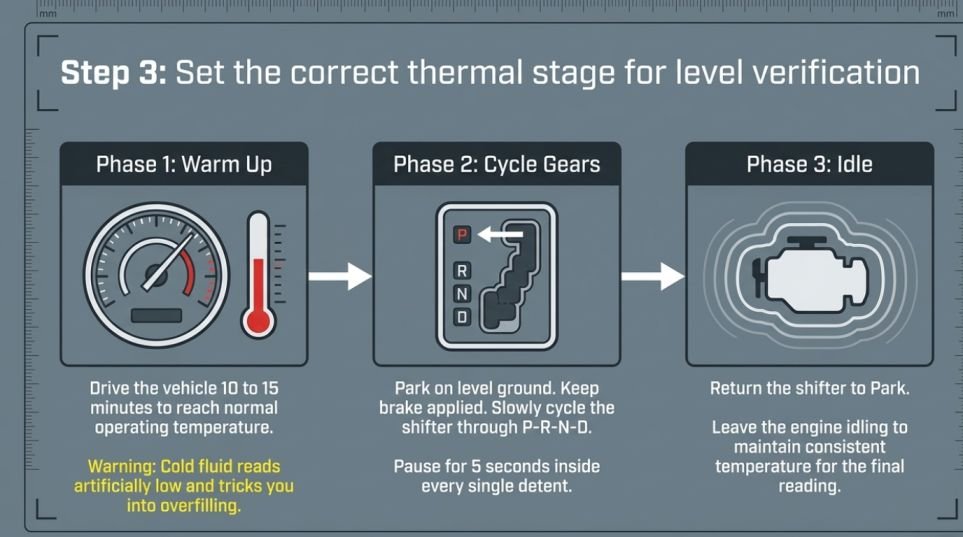
Drive the Durango 10 to 15 minutes so the transmission reaches normal operating temperature, then park on level ground. Keep the brake pedal applied and cycle the shifter through each gear range (P-R-N-D and any additional positions) for about 5 seconds per position, pausing fully in each detent.
Leave the shifter in Park and let the engine idle. The goal is a consistent temperature and an accurate reading, because a cold transmission will read low and trick you into overfilling.
Dipstick Vs Level Plug Method

Many automatic transmissions use either a dipstick or a threaded level plug, and the reading method changes how you confirm “full.” The most common mistake is adding by “total quarts” without confirming the level tool you actually have on that specific transmission.
For dipstick-equipped units, wipe clean, reinsert fully, and read the crosshatch range with the engine idling. For level plug-equipped units, remove the plug first on level ground, then add fluid through the fill until it just starts to run out of the opening (or reaches the specified edge on the plug, if your unit is designed that way).
| Check method | How to confirm correct level | Common mistake |
|---|---|---|
| Dipstick | Fluid at correct range with engine idling in Park, after warm-up | Reading with cold fluid or not reinserting dipstick fully |
| Level plug | Fluid behavior at the opening on a level surface with warm, idling operation | Overfilling because you added too fast and never re-checked |
Pro tip: Add 0.25 to 0.5 quart at a time, re-check, and stop as soon as the level tool says you are correct. That approach keeps you closer to the right capacity even if your drain-and-fill vs partial exchange changed the “total quarts” required.
Quick Summary

For a 2005 Dodge Durango, the transmission fluid quart amount is not one fixed number, because it varies by automatic transmission type and whether the truck is 2WD or 4WD. The article notes reference total fill figures ranging from about 8.1 quarts for a 5-speed automatic up to about 14.8 or 16.9 quarts for 65RFE applications. It also warns that a service usually takes less than the total capacity.
After draining, expect a drain-and-fill to add only part of the system since the torque converter, cooler lines, and other passages still hold fluid, while a “complete exchange” moves much more toward total capacity. The article lists different initial-fill amounts for the 65RFE, about 6.6 quarts for 4WD and 5.5 quarts for RWD. Match the applicable fluid specification, then verify level with the engine running at the specified temperature.
| Transmission (as referenced) | Typical total fill (quarts) | Notes from article |
|---|---|---|
| W5A580 (5-speed automatic) | About 8.1 | Often cited lower end of the range |
| 65RFE (6-speed automatic) RWD | About 14.8 | Total fill is higher than drain-and-fill |
| 65RFE (6-speed automatic) 4WD | About 16.9 | Total fill is much higher than RWD |
Frequently Asked Questions
How Many Quarts Of Transmission Fluid Does A 2005 Dodge Durango Take?
It depends on the transmission. Reference charts list around 8.8 quarts for the 8HP70 8-speed, around 9.5 to 9.7 quarts for other 8-speed variants, and about 14.8 or 16.9 quarts total for 65RFE applications depending on RWD versus 4WD.
What Is The Transmission Fluid Capacity For A 2005 Dodge Durango 4WD vs RWD?
For the 65RFE 6-speed automatic, one reference lists 16.9 quarts total for 4WD and 14.8 quarts total for RWD, with different initial-fill amounts also listed. If your Durango has a different transmission, the numbers can change.
How Many Quarts Do I Need For A Drain And Fill On A 2005 Durango Transmission?
A “drain and fill” usually does not use the full total capacity. One reference lists 5.5 quarts for an initial fill for a 65RFE RWD and 6.6 quarts for an initial fill for a 65RFE 4WD. Add fluid gradually, then top off to the correct level after running the transmission.
How Many Quarts Of Transmission Fluid Are Needed If I Flush A 2005 Dodge Durango?
For a flush, you generally plan for near the total fill capacity rather than the initial fill amount. Depending on the transmission, that can be roughly 8.8 quarts for the 8HP70 8-speed, up to about 14.8 to 16.9 quarts for 65RFE applications, but the exact amount can vary by torque converter and procedure.
What’s The Most Common Mistake When Figuring Out How Many Quarts A 2005 Durango Needs?
The biggest mistake is using the wrong capacity for your specific transmission. Reference tables show very different amounts, such as 8.8 quarts for an 8HP70 setup versus 14.8 to 16.9 quarts for a 65RFE, so the transmission code should be confirmed before ordering fluid.
Do I Need To Check The Level After Adding Quarts Of Transmission Fluid On A 2005 Durango?
Yes. Even if you buy the right number of quarts for the fill, you still need to check the level and top off correctly using the dipstick or level procedure for your transmission, because fluid ends up distributed through the torque converter and cooler circuits.

- Top 10 Ranking Tire Brand for Minivan: Reviewed 2026 - October 5, 2026
- Model Y Tesla Long Range Automatic Wagon Tyre Fitment And Ratings - October 3, 2026
- What Is The Benefit Of Larger Rear Tyres On A Zero-turn Mower - October 3, 2026